India Natural Fibre Reinforced Plywood Market Set for Strong Growth as Sustainable Construction Reshapes the Industry Outlook Through 2034
The India Natural Fibre Reinforced Plywood Market is gaining significant momentum as rising demand for eco-friendly and sustainable construction materials transforms how the nation builds. A comprehensive new market report covering the 2026-2034 forecast period highlights robust growth drivers, emerging technologies, and expanding investment opportunities across the natural fibre reinforced plywood industry.
India's construction and manufacturing sectors are undergoing a fundamental shift. Builders, architects, and procurement managers are increasingly prioritizing green building materials over conventional alternatives and natural fibre reinforced plywood is emerging as a preferred solution at the intersection of performance, cost efficiency, and environmental responsibility.
Market Overview: A Billion-Rupee Growth Story
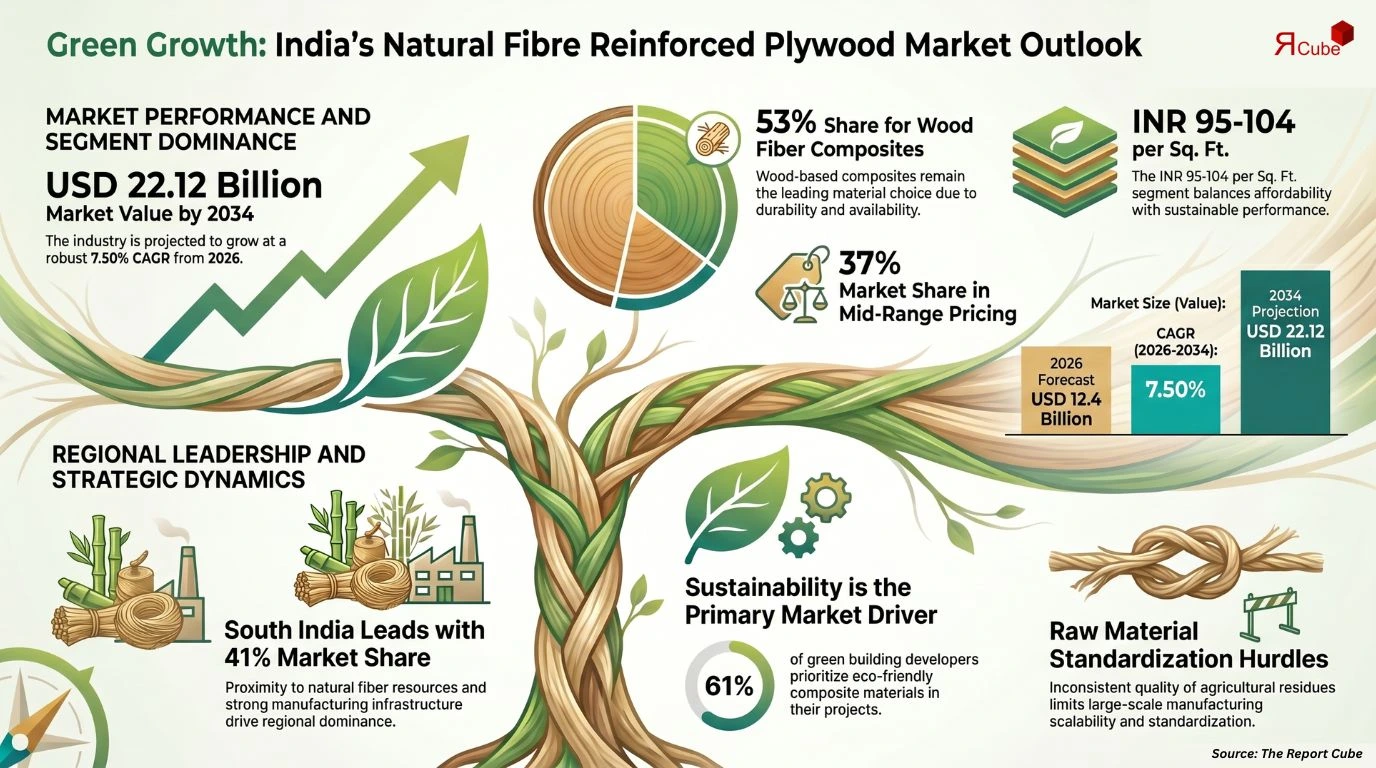
The India Natural Fibre Reinforced Plywood Market is anticipated to register a 7.50% CAGR during 2026-2034. The market size was valued at USD 12.4 billion in 2026 and is projected to reach USD 22.12 billion by 2034. This trajectory underscores growing confidence among investors and manufacturers in the long-term viability of the renewable fibre plywood market. As India accelerates its urban infrastructure development, demand for durable, lightweight, and biodegradable panel solutions continues to rise across residential, commercial, and industrial construction segments.
Key Market Drivers and Construction Plywood Trends in India
Several converging forces are propelling the expansion of the eco-friendly plywood market in India. Government policies promoting green infrastructure, increasing awareness of carbon footprints in construction, and tightening regulations around deforestation are together pushing buyers toward bio-based plywood solutions reinforced with natural fibres such as jute, coir, sisal, and bamboo.
The rapid growth of India's real estate sector particularly affordable housing under flagship government schemes is generating sustained demand for cost-effective yet high-performance panel materials. Simultaneously, the export-oriented furniture and interior design industries are seeking compliant, sustainable materials that meet global environmental standards.
Construction plywood trends in India also reflect a notable shift toward lightweight structural panels that reduce transportation costs and labour requirements at building sites, making natural fibre composites increasingly attractive to project developers.
Need Specific Data, Let’s Customize the Report for You
Request CustomizationTechnological Advancements and Sustainability Impact
Innovation within advanced plywood manufacturing in India is playing a defining role in accelerating market adoption. Manufacturers are investing in improved resin bonding techniques, natural fibre pre-treatment processes, and hybrid composite configurations that significantly enhance the structural performance and moisture resistance of natural fibre panels.
The integration of bio-based plywood solutions into modular construction, green-certified commercial buildings, and prefabricated housing is expanding the addressable market beyond traditional woodworking applications. These developments are aligning the natural fibre reinforced plywood industry with India's broader sustainability agenda, including the national commitment to achieve net-zero carbon emissions.
Industry Challenges and Emerging Opportunities
Despite its strong trajectory, the sustainable construction materials India segment faces certain challenges. Inconsistent raw material quality, limited large-scale fibre processing infrastructure, and lower awareness among tier-2 and tier-3 market buyers remain areas requiring strategic attention. Price sensitivity in certain buyer segments also continues to present friction in faster market penetration.
However, these challenges open equally significant opportunities. Investments in fibre processing supply chains, government-backed industry development initiatives, and growing appetite from institutional buyers committed to ESG (Environmental, Social, and Governance) compliance are expected to bridge existing gaps. The green building materials market in India is poised to be a major beneficiary as new sustainability certification frameworks gain traction across commercial real estate.
Competitive Landscape Overview
The India Natural Fibre Reinforced Plywood Market features a mix of established plywood manufacturers diversifying into natural fibre composites and newer, innovation-driven entrants focused exclusively on sustainable panel solutions. Key competitive strategies include product differentiation through fibre blend customization, regional distribution partnerships, and certification alignment with international green building standards. Companies investing early in scalable bio-based plywood manufacturing infrastructure are positioning themselves to capture a disproportionate share of the growing demand pipeline.
A Forward-Looking Market Anchored in Sustainability
The outlook for the India Natural Fibre Reinforced Plywood Market through 2034 is compelling. As India continues to urbanize at scale, the intersection of affordable construction costs, environmental accountability, and performance-driven material engineering will keep natural fibre reinforced plywood at the forefront of industry conversations.
For investors, manufacturers, distributors, and construction stakeholders, the next eight years represent a critical window to establish leadership in this high-growth, future-oriented market. The renewable fibre plywood market is not just responding to a trend it is becoming a structural pillar of how India builds sustainably for generations to come.
About the Report This press release is based on market intelligence and forecast data from an industry report on the India Natural Fibre Reinforced Plywood Market (2026-2034), providing comprehensive analysis of market size, growth drivers, competitive dynamics, and regional demand patterns. For report inquiries, contact your regional research partner.