Japan Smart Agriculture Market to See Promising Growth: CAGR of 13.20% & USD 4.09 Billion by 2034
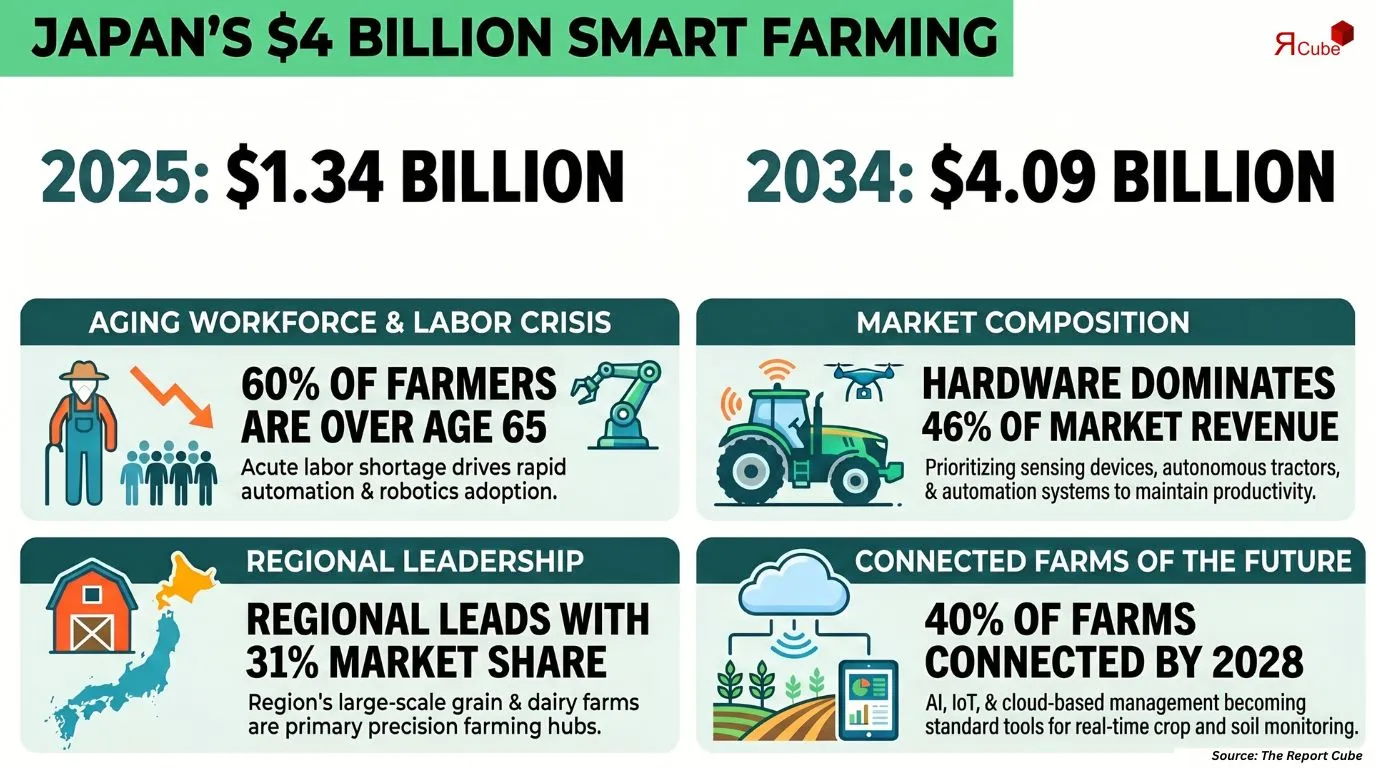
According to recent research studies by The Report Cube, the Japan Smart Agriculture Market Research Report highlights that the market is poised for significant growth from 2026 to 2034, driven by the rapid digitalization of farming practices, labor shortages in rural areas, and the increasing adoption of precision agriculture technologies. The industry is predicted to register a CAGR of about 13.20% (2026–2034), further valued at around USD 1.34 billion in 2025, and predicted to reach nearly USD 4.09 billion by 2034.
The country’s agricultural sector is undergoing a structural transformation as farmers increasingly integrate AI-powered analytics, autonomous equipment, IoT-enabled machinery, and data-driven farm management systems to enhance productivity, reduce operational costs, and address labor shortages. Also, strong government support for smart farming initiatives, together with increasing investments in agri-tech innovation, further augments market growth.
Key Dynamics Affecting the Japan Smart Agriculture Market
- The aging agricultural workforce & lack of labor in Japan are instigating the adoption of automation, robots, and autonomous farming equipment.
- The deployment of IoT sensors, GPS-enabled machinery, and precision farming solutions enhances crop monitoring, soil analysis, and yield optimization.
- Higher initial investment costs & inadequate digital literacy among small-scale farmers obstruct uptake, specifically in remote rural areas.
- Government programs supporting smart farming, digital agricultural subsidies, and sustainable food production upscale technology adoption.
- Data-driven fertilization, irrigation, and pest management systems are in great demand as climate-resilient agriculture & resource optimization become more crucial.
- Incorporation of AI, big data analytics, and cloud-based farm management platforms surges predictive decision-making, operational efficacy, and sustainable agriculture practices.
Need Specific Data, Let’s Customize the Report for You
Contact UsWhich of the Segments, under Offering Classification, Influences the Market Share?
Across the Offering, the Japan Smart Agriculture Industry is segmented as:
- Hardware
- Software
- Services
- Others
Of them all, Hardware solutions sustain a leading market share, as farmers progressively invest in autonomous harvesters, drones, GPS-enabled equipment, smart tractors, and IoT-based sensors. These technologies form the foundation of smart agriculture by enabling real-time data collection, automated field operations, and precision input application.
In addition, the scalability, durability, and compatibility of advanced agricultural hardware make it essential for revolutionizing Japan’s farming ecosystem, specifically in large-scale commercial farms & cooperative farming models.
Regional Coverage: Japan Smart Agriculture Market
- Hokkaido
- Kanto
- Chubu
- Kyushu
- Others
Geographically, Hokkaido governs the Japan Smart Agriculture Market, compelled by its wide-ranging farmland, large-scale crop production, and early acceptance of mechanized & precision farming technologies. Also, the region’s robust emphasis on dairy farming, grain cultivation, and smart machinery utilization strengthens its guidance position within the national market demographic.
Company Profile: Leading Japan Smart Agriculture Market Players
The major market players support Japan’s smart agriculture ecosystem via progressive farm machinery, autonomous solutions, AI-powered analytics, and integrated digital farming platforms, fueling efficacy & sustainability across the agricultural value chain. Some of the key market companies include: Kubota Corporation, Yanmar Holdings, Iseki & Co., Topcon Corporation, Sagri Co., AGRIROBO (Kubota Brand), Mitsubishi Corporation Life Sciences, Eco-Pork Co., AGRIST Inc., Notas Inc., and Others.
Kubota Corporation stands out as a potential leader in the Japan Smart Agriculture Market, leveraging autonomous agricultural machinery, data-driven farm management systems, and precision farming technologies. The firm’s constant innovation in AI-enabled equipment, robotics, and smart farming platforms substantially improves operational efficacy, sustainability, and output across Japan’s agricultural industry.
Questions Answered in the Japan Smart Agriculture Market Research Report
- What is the current market size & future growth forecast underlined in the Japan Smart Agriculture Market research report?
- Which major factors are driving the rapid expansion of the Japan Smart Agriculture Industry across major regions?
- What emerging trends are restructuring the competitive landscape according to the latest market insights?
- How is consumer / end-user demand evolving, and what impact does it have on the Japan Smart Agriculture Market growth?
- Which leading companies are dominating the Japan Smart Agriculture Industry, and what strategies are they adopting?
- What technological advancements are influencing product adoption & market penetration?
- How does the report evaluate regional performance & identify high-growth market opportunities?
- What challenges & risks could potentially affect market stability, according to the research findings by the analysts?