Philippines Breakfast Cereals Market Set to Reach USD 3.04 Billion by 2034, Driven by Health Awareness and Convenience Food Demand
New market research report covers the breakfast cereals industry in the Philippines across the 2026-2034 forecast period, highlighting steady growth, emerging consumer trends, and competitive dynamics.
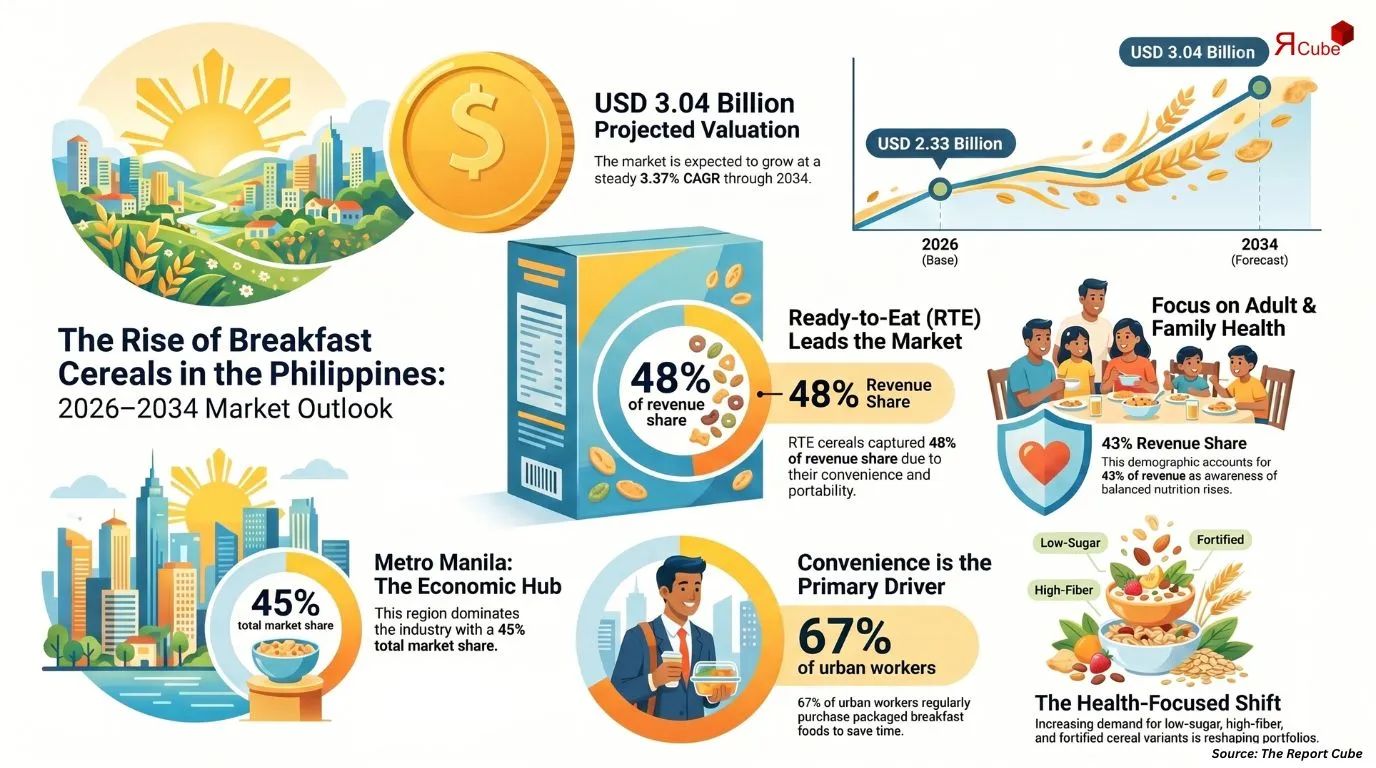
The Report Cubes has published a detailed analysis of the Philippines Breakfast Cereals Market, offering a comprehensive view of current market conditions and long-term growth prospects. According to the report, the Philippines Breakfast Cereals Market is anticipated to register a 3.37% CAGR during 2026-2034. The market size was valued at USD 2.33 billion in 2026 and is projected to reach USD 3.04 billion by 2034. This upward trajectory reflects a convergence of demographic shifts, evolving dietary habits, and a measurable increase in demand for convenient, nutritious breakfast options across urban and semi-urban regions.
Market Overview
The Philippines packaged food market has undergone notable structural changes over the past decade, and the breakfast food industry is no exception. Rapid urbanization, coupled with longer commute times and dual-income households, has pushed Filipino consumers toward ready-to-eat and easy-to-prepare meal formats. Breakfast cereals fit squarely within this shift, offering a low-preparation, shelf-stable alternative to traditional morning meals.
Health awareness is also reshaping purchasing decisions. Consumers are increasingly scrutinizing nutritional labels and gravitating toward products with added vitamins, minerals, and dietary fiber. This trend is particularly pronounced among working-age adults and parents selecting cereal products for school-going children. As a result, cereal market growth in the Philippines is not solely volume-driven it is also being shaped by a willingness to pay more for products that deliver measurable health benefits.
Economic expansion in secondary cities and improved retail infrastructure have further broadened the distribution reach of the breakfast cereals industry in the Philippines. Greater supermarket and hypermarket penetration outside Metro Manila means that branded cereal products are reaching first-time buyers in markets that previously relied on traditional wet markets and sari-sari stores.
Need Specific Data, Let’s Customize the Report for You
Request CustomizationKey Trends and Opportunities
The demand for healthy breakfast products is the single most influential factor reshaping product development strategies in this market. Fortified cereals enriched with iron, calcium, B vitamins, and zinc have seen consistent uptake, particularly among urban middle-income segments. Manufacturers are increasingly positioning these products not just as convenient food options, but as targeted nutritional solutions for children's cognitive development and adult energy management.
Organic and "free-from" variants are gaining traction within premium retail channels, addressing the needs of health-conscious shoppers seeking cleaner ingredient profiles. While still a niche within the broader ready-to-eat cereals market, this segment is growing faster than the overall category, signaling a long-term opportunity for brands willing to invest in product reformulation and transparent labeling.
E-commerce is emerging as a credible distribution channel in the Philippine retail cereals sector. The accelerated adoption of online grocery platforms during and after the pandemic has prompted major brands to optimize their digital storefronts, and smaller specialty cereal brands are leveraging marketplace platforms to reach consumers directly. Subscription-based and bundle-purchase models are also gaining favor among repeat buyers, improving customer retention and average order values.
Convenience food demand among younger demographics particularly Gen Z and millennial consumers is driving experimentation with on-the-go formats such as single-serve sachets, snack-size cereal packs, and cereal-and-milk cup combinations. These formats align with the snacking behaviors of urban youth and present an incremental revenue opportunity distinct from the traditional family-size box segment.
Competitive Landscape
The breakfast food industry analysis reveals a market populated by both global multinationals and regional players, each pursuing distinct strategies to capture share. International brands such as Nestlé S.A., Kellogg Company (Kellanova), PepsiCo, Inc. (Quaker Oats), General Mills, Inc., and Post Holdings, Inc. maintain strong distribution networks and invest heavily in brand awareness through mass media and school-focused promotional programs.
More than ten companies are actively operating in the Philippines breakfast cereals space, and the top five players collectively account for a significant share of total revenue. Product diversification is a central competitive strategy leading brands are expanding their SKU portfolios to include whole grain variants, reduced-sugar formulations, and locally relevant flavors that resonate with Filipino taste preferences.
Local manufacturers are leveraging their supply chain proximity and cultural familiarity to develop lower-priced economy and mid-range offerings, particularly in the sachet and small-format categories. This tiered competitive structure ensures that cereal consumption trends are not limited to premium households, but extend into broader income segments across the archipelago.
Future Outlook
The food and beverage market trends driving the Philippines breakfast cereals category suggest a durable growth runway through the end of the forecast period. The convergence of health-conscious consumption, digital retail expansion, and innovation in product formats positions this market to sustain its growth momentum beyond short-term economic cycles.
Manufacturers that invest in science-backed nutritional claims, sustainable packaging, and strong e-commerce capabilities are likely to capture disproportionate share in the coming years. Strategic partnerships with local distributors and tailored pricing strategies for price-sensitive regional markets will also be critical in unlocking the next wave of volume growth.
Furthermore, government nutrition programs and public health initiatives promoting balanced diets among school-aged children could provide additional tailwinds for the fortified and functional cereals segment an area where established international brands are particularly well-positioned.
The Philippines Breakfast Cereals Market Report and Forecast 2026-2034 is now available for purchase through The Report Cubes report store. The full 108-page report provides granular segmentation by product type, consumer demographics, nutritional nature, price tier, and distribution channel, alongside detailed competitive profiles and investment opportunity analysis. Industry stakeholders, investors, and food & beverage executives seeking an authoritative market intelligence resource are encouraged to request a sample copy or explore customization options directly at thereportcubes.com.