Philippines Online Food Delivery Market to Reach USD 12.82 Billion by 2034, as Pandamart Goes 24/7, GCash Hits 94 Million Users & Logistics Costs Remain the Highest in ASEAN
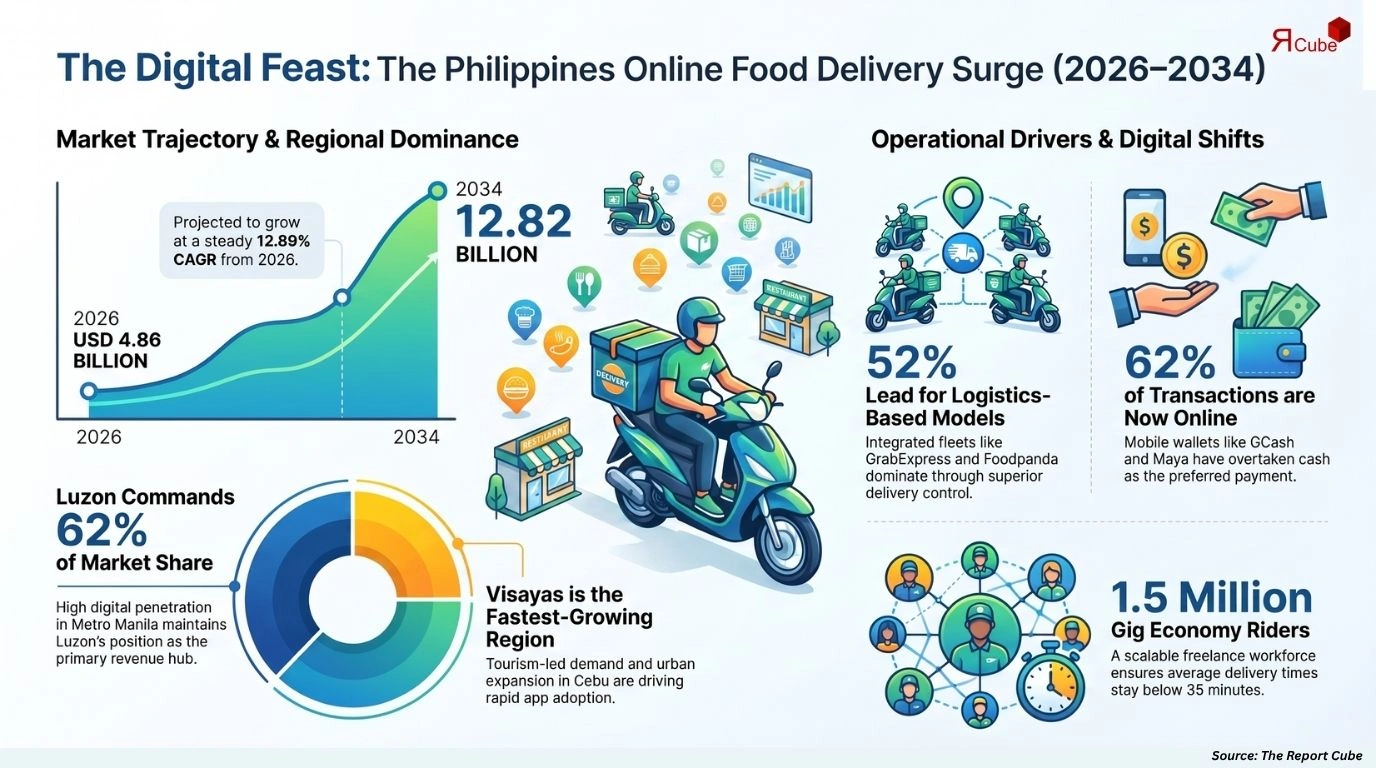
A new study by The Report Cube on the Philippines Online Food Delivery Market tracks how a market once defined by cash-on-delivery defaults is being reshaped by wallet-native payments, dark-store rollouts, and aggressive subscription pricing - faster than most regional peers anticipated. The market was valued at USD 4.86 billion in 2026, is expected to grow at a CAGR of 12.89%, and should reach USD 12.82 billion by 2034.
Key Dynamics Affecting the Philippines Online Food Delivery Market
The Philippines sits in an unusual position: it is simultaneously the most mobile-wallet-dominated payment market in ASEAN and the one with the highest cash usage of any tracked market in the region. GCash has 94 million registered users - more than Germany's population - and Maya has roughly 50 million. Together they account for about 57.4% of transaction volume via the national QR Ph standard. Cash on delivery has not disappeared - it still covers around 42% of in-store value - but its share is falling in Metro Manila and the cost problem is becoming clearer. Failed deliveries, returns, and cash-handling overhead all add to per-order cost, and platforms are actively pricing customers away from it.
In March 2026, Pandamart became the first online-only full grocery platform in the Philippines to operate 24/7 nationwide, running dark-store nodes across Metro Manila, Baguio, Pampanga, Cebu, and Davao. The move is not just a logistics announcement - it establishes the pricing and availability floor for competitors. GrabFood and GrabMart responded by deepening their tie-up with Robinsons Easymart, keeping competitive investment concentrated in the Metro Manila corridor while both platforms begin testing geographic reach in secondary cities. In 2024, GrabFood held approximately 61% platform market share versus Foodpanda's 39%, but the gap is being contested on pricing and loyalty mechanics rather than geography alone.
Subscription pricing is changing unit economics across the market. Grab revised its GrabUnlimited plan to PHP 240 annually - PHP 20 per month - making the cost of belonging to the platform lower than a single delivery fee. Foodpanda's "Negosyo Like a Panda" program extends merchant business loans in partnership with Jia Financing Inc., which matters: it ties restaurant partners financially to the platform, not just operationally. These are retention strategies as much as growth strategies, and they signal how competitive the platform layer has become when the underlying delivery infrastructure is no longer a differentiator.
Cloud kitchens added over 450 new delivery-only establishments, and there are now roughly 150,000 active delivery riders in the Philippines. The structural problem is that none of this eliminates the country's core logistics constraint: the Philippines carries the highest logistics-cost-to-GDP ratio in ASEAN, and per-order fulfillment pressure remains elevated. Island geography means the Metro Manila-Cebu-Davao triangle concentrates investment, while Visayas and Mindanao remain underserved despite Shopee's February 2026 logistics expansion that cut average delivery times in those regions from roughly 7 days to 3-4 days.
AI is entering the market at the inventory and fulfillment layer, not just the consumer-facing recommendation layer. A 2025 study by Packworks and Ateneo de Manila University found that AI-led demand forecasting lifted daily GMV by 46% and total sales by 17% across more than 300 sari-sari stores. Foodpanda's October 2025 partnership with TabSquare.AI introduced Smart QR codes and automated order fulfillment at partner restaurants. These are operational efficiency plays - reducing restocking errors, improving order accuracy - rather than marketing tools.
Which of the Segments, Under Business Model Classification, Influences the Market Share?
The Philippines Online Food Delivery Market is segmented across multiple dimensions reflecting distinct consumer behaviors, operational models, and regional dynamics. Platforms increasingly differentiate through business model innovation, payment flexibility, and geographic expansion strategies targeting underserved urban corridors across the archipelago.
Across Business Model, the Philippines Online Food Delivery Industry is segmented as:
- Order-Focused
- Logistics-Based
- Restaurant-Specific
The logistics-based segment holds an estimated 52% share of the Philippines Online Food Delivery Market. Platforms such as GrabExpress Inc. and Foodpanda operate integrated rider fleets and proprietary delivery management systems, giving them direct control over delivery timelines, quality standards, and operational data. That end-to-end visibility enables continuous service optimization in a way order-focused models cannot replicate. In high-density urban areas - Metro Manila, Cebu, and Davao - where regular users have the highest delivery accuracy expectations, the logistics-based model is the default choice. The restaurant-specific segment is the fastest-growing, as chains including Jollibee, McDonald's Philippines, and Mang Inasal invest in proprietary delivery channels to reduce platform fee dependency and retain direct customer relationships at scale.
Regional Analysis: Philippines Online Food Delivery Market
- Luzon
- Visayas
- Mindanao
Luzon, anchored by Metro Manila, leads on volume. The capital region concentrates platform investment, dark-store infrastructure, and digital payment density - Pandamart's 24/7 rollout, GrabMart's Robinsons Easymart partnership, and the deepest GCash and Maya merchant penetration all sit in this corridor. Visayas is the fastest-growing region at a 13.4% CAGR, with Cebu and Iloilo driving the pace through a combination of tourism-linked dining demand and improving last-mile logistics. Pandamart's explicit inclusion of Cebu in its 24/7 dark-store network signals that leading operators already treat it as a full operating node, not a pilot. Mindanao remains the longest-term opportunity - Shopee's delivery-time reduction and TikTok Shop's Unlad Lokal expansion into the region both indicate that infrastructure is improving, but reliable sub-24-hour delivery coverage outside Davao is still limited.
Company Profile: Leading Philippines Online Food Delivery Market Players
GrabFood and Foodpanda occupy the two dominant positions, but they compete differently. GrabFood's 61% platform share in 2024 is partly a product of the GrabEcosystem - GrabCar, GrabMart, and GrabPay all create cross-platform stickiness that a delivery-only competitor cannot replicate. Foodpanda, operating under Delivery Hero SE, has moved toward merchant financing and AI-enabled in-restaurant tools as its differentiation levers. Jollibee Foods Corporation brings its own logic to the competitive picture: with 3,445 domestic branches as of September 2025 generating ₱305.11 billion in consolidated 2025 revenue, JFC operates at a scale where platform dependency is optional - Jollibee, Chowking, and Mang Inasal all maintain proprietary delivery channels alongside third-party platform listings.
Key players include: Grab Holdings Inc. (GrabFood), Delivery Hero SE (Foodpanda Philippines), Jollibee Foods Corporation, McDonald's Philippines (Golden Arches Development Corp.), Chowking, Mang Inasal, Red Ribbon Bakeshop, Shakey's Pizza Asia Ventures, Yellow Cab Pizza Co., LalaFood, MetroMart Technologies Inc., Pick.A.Roo (Hatch Tech Solutions Inc.), and Others.
Questions Answered in the Philippines Online Food Delivery Market Research Report
- What is the current market size & future growth forecast underlined in the Philippines Online Food Delivery Market research report?
- Which major factors are driving the rapid expansion of the Philippines Online Food Delivery Industry across major regions?
- What emerging trends are restructuring the competitive landscape according to the latest market insights?
- How is consumer demand evolving, and what impact does it have on the Philippines Online Food Delivery Market growth?
- Which leading companies are dominating the Philippines Online Food Delivery Industry, and what strategies are they adopting?
- What technological advancements are influencing product adoption & market penetration?
- How does the report evaluate regional performance & identify high-growth market opportunities?
- What challenges & risks could potentially affect market stability, according to the research findings by the analysts?