



Build Your Custom Market Intelligence Report
Customize Your ReportPhilippines Online Food Delivery Market Key Takeaways
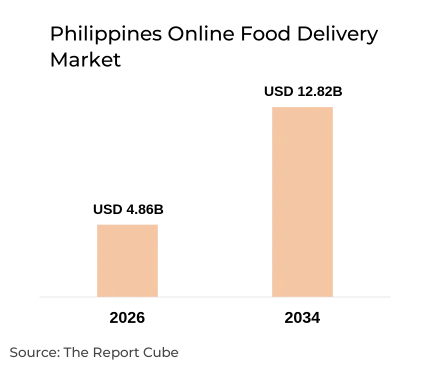
- Market valued at USD 4.86 billion in 2026, reflecting accelerating digital food ordering adoption.
- Industry projected to reach USD 12.82 billion by 2034, expanding at a 12.89% CAGR.
- Logistics-based business model dominates the market due to superior delivery fleet control.
- Online payment methods lead as GCash and Maya reshape transaction behavior nationally.
- Luzon maintains regional leadership driven by Metro Manila's density and digital infrastructure.
- Visayas emerges as the fastest-growing region with tourism-led and urban demand expansion.
- Leading companies include Delivery Hero Philippines Inc., GrabExpress Inc., LAHAT Food, Jollibee Foods Corporation, and Habit Food Group.
- Cloud kitchen expansion, gig economy growth, and hyperlocal delivery strategies continue accelerating market adoption.
Philippines Online Food Delivery Market Insights & Analysis
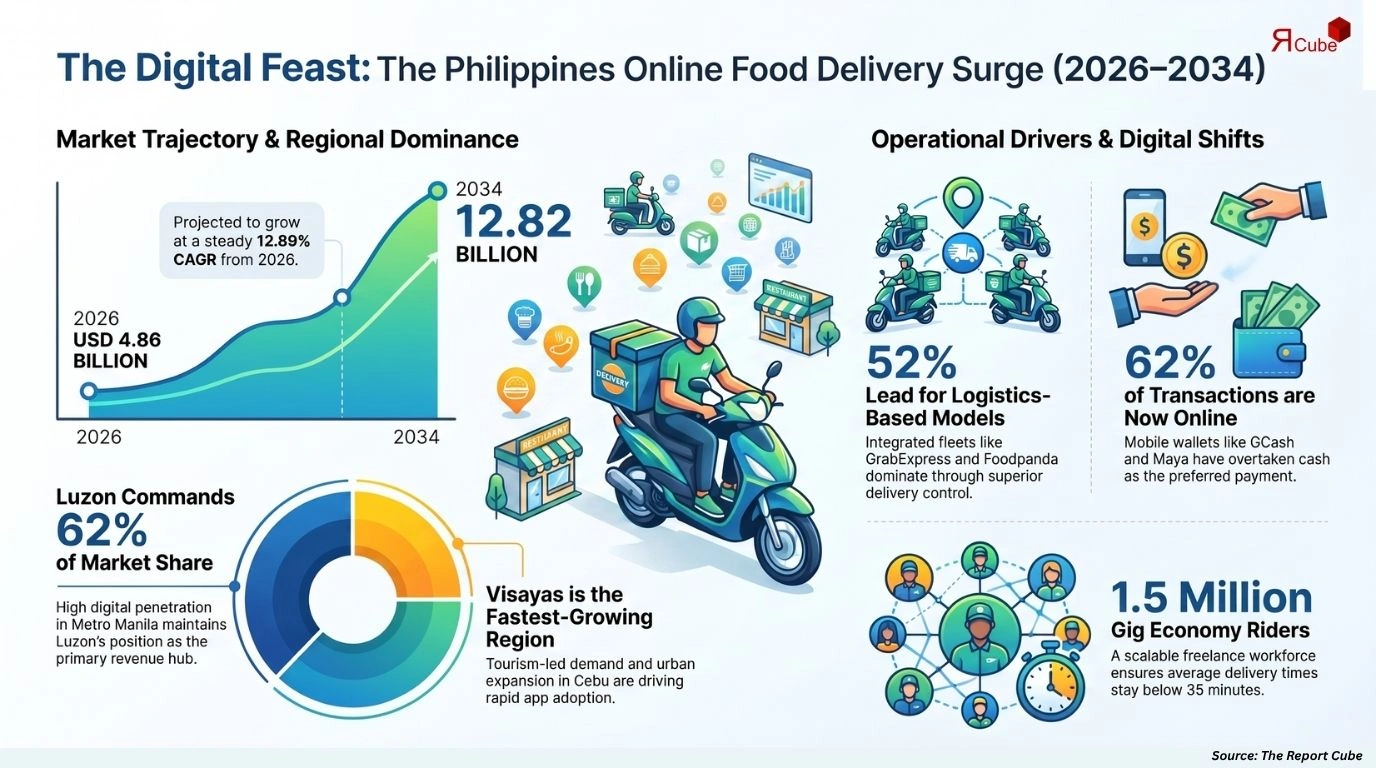
The Philippines Online Food Delivery Market is anticipated to register a 12.89% CAGR during 2026–2034. The market size was valued at USD 4.86 billion in 2026 and is projected to reach USD 12.82 billion by 2034. The industry is benefiting from rising smartphone penetration across the archipelago, with over 84 million smartphone users now active, combined with rapid growth in mobile wallet infrastructure and the expanding role of cloud kitchens as delivery-only supply nodes enabling platforms to serve broader, previously underserved populations.
Government digitalization efforts, including the E-Commerce Philippines Roadmap and the Digital Cities initiative, are accelerating connectivity investments in secondary urban centers. Cloud Eats raised USD 7 million in Series funding to scale food tech infrastructure across Southeast Asia, while Kitchen City secured USD 2 million in pre-Series funding, signaling strong investor confidence in the Philippines' online food ordering and delivery ecosystem. Delivery apps now generate 60 to 70 percent of total sales for successful quick-service restaurant operators, reflecting a structural shift from dine-in to platform-mediated fulfillment.
Philippines Online Food Delivery Market Dynamics
The Philippines Online Food Delivery Market continues expanding as urbanization accelerates, digital payment infrastructure matures, and food businesses restructure around platform-driven revenue streams. Increasing gig economy participation, rising consumer appetite for convenience, and strong QSR investment in proprietary digital channels are reinforcing market momentum. The convergence of mobile commerce, cloud kitchen proliferation, and subscription-based ordering models is elevating the strategic importance of online food delivery across all major regions.
|
Factor |
Type |
Specific Impact on Market |
Magnitude |
|---|---|---|---|
|
Gig economy and rider supply growth |
Driver |
Reduces delivery costs and shortens fulfillment timelines |
Very High |
|
GCash and Maya mobile wallet adoption |
Opportunity |
Increases cashless transaction conversion across platforms |
High |
|
Cloud kitchen infrastructure expansion |
Driver |
Lowers market entry barriers for virtual restaurant brands |
High |
|
QSR proprietary app investment |
Trend |
Shifts order volumes toward restaurant-specific channels |
High |
|
Hyperlocal delivery in secondary cities |
Opportunity |
Opens untapped consumer segments in Visayas and Mindanao |
High |
Key Market Driver: Gig Economy Fueling Rider Supply
The rapid expansion of the Philippines' gig economy is directly strengthening the operational backbone of online food delivery platforms. Over 1.5 million Filipinos now participate in app-based freelance and delivery work, providing platforms with a scalable, cost-efficient rider network. This supply of riders enables shorter delivery windows, expanded geographic coverage, and competitive fulfillment costs. GrabExpress and Foodpanda leverage this infrastructure extensively, with rider density in Metro Manila enabling average delivery times below 35 minutes, reinforcing consumer satisfaction and repeat order frequency across the logistics-focused delivery platform segment.
Major Industry Challenge: Inconsistent Internet Infrastructure Outside Metro Areas
Despite strong broadband coverage in Metro Manila, connectivity quality across Visayas and Mindanao remains uneven, creating performance gaps for app-based platforms dependent on real-time GPS tracking, dynamic pricing, and live order management. Rural and peri-urban zones report average mobile internet speeds 42 percent below Metro Manila benchmarks, limiting platform reliability and discouraging user adoption in lower-tier cities. Delivery platforms are responding with offline order-caching features and lightweight app versions, but infrastructure standardization across the archipelago remains a structural constraint requiring continued public-private investment to resolve.
Emerging Trend Shaping Outlook: Restaurant-Specific App Acceleration
Quick-service restaurant brands are accelerating investments in proprietary delivery applications that bypass third-party aggregators entirely. Jollibee Foods Corporation operates its own delivery app with in-house logistics, app-exclusive promotions, and loyalty point integration, enabling direct control over the customer relationship and margin retention. This model eliminates platform commission fees - typically 15 to 30 percent of order value - while building first-party data assets that support personalized marketing. The restaurant-specific segment is growing faster than the broader market and is expected to reshape commission dynamics across aggregator platforms through 2034, intensifying competitive pressure on order-focused and logistics-based models.
Need Specific Data, Let’s Customize the Report for You
Request CustomizationPhilippines Online Food Delivery Market Segment-wise Analysis
The Philippines Online Food Delivery Market is segmented across multiple dimensions reflecting distinct consumer behaviors, operational models, and regional dynamics. Platforms increasingly differentiate through business model innovation, payment flexibility, and geographic expansion strategies targeting underserved urban corridors across the archipelago.
By Business Model
- Order-Focusd
- Logistics-Based
- Restaurant-Specific
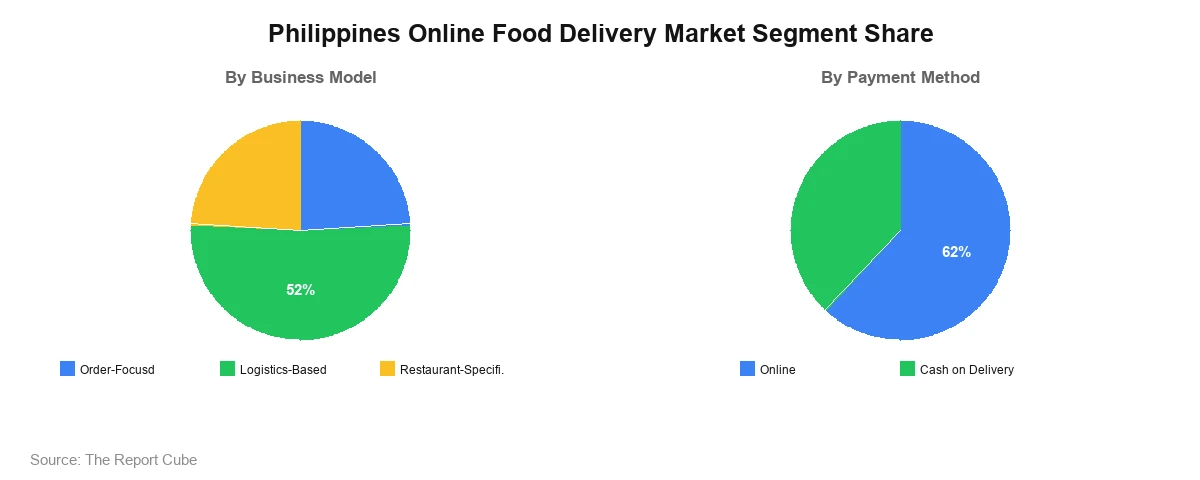
The logistics-based segment dominates the Philippines Online Food Delivery Market with an estimated 52% share, driven by platforms such as GrabExpress Inc. and Foodpanda, which operate integrated rider fleets and proprietary delivery management systems. This model provides platforms with direct control over delivery timelines, quality standards, and operational data, enabling continuous service optimization. Strong operational infrastructure and end-to-end visibility make this model the preferred choice for consumers prioritizing reliability and speed across high-density urban areas including Metro Manila, Cebu, and Davao, where delivery accuracy expectations are highest among regular platform users.
The order-focused segment captures an estimated 31% share by connecting consumers to restaurant partners while outsourcing fulfillment. The restaurant-specific model, representing approximately 17%, is the fastest-growing sub-segment as QSR brands invest in proprietary digital ordering channels for customer retention. Jollibee, McDonald's Philippines, and Chowking are deploying app-only promotions and exclusive loyalty integrations that drive repeat engagement without third-party commission obligations, compressing aggregator margins and encouraging order-focused platforms to diversify their value propositions through subscription services and merchant financing programs.
By Payment Method
- Online
- Cash on Delivery
Online payment methods account for an estimated 62% of total transaction volume within the Philippines Online Food Delivery Market, with GCash and Maya collectively processing the majority of cashless food delivery payments across major urban centers. The post-pandemic entrenchment of contactless payment preferences has permanently altered consumer behavior, with app-based incentives including cashback rewards, loyalty points, and promotional vouchers further accelerating digital wallet adoption. Credit and debit card integration across platforms has additionally expanded the accessible payment base beyond mobile wallet users, supporting higher average order values among professional and higher-income consumer segments.
Cash on delivery retains an estimated 38% share, remaining structurally relevant in tier-2 cities, peri-urban areas, and among first-time platform users who are not yet enrolled in mobile wallet services. Platforms recognize this dynamic and continue offering COD as a market access tool, particularly in Mindanao and provincial Luzon zones where digital financial inclusion is still progressing. However, the shift toward online payments is accelerating as GCash's expanding merchant network across secondary Philippine cities reduces friction for new digital wallet users, with platforms deploying onboarding incentives specifically designed to convert COD-dependent users to cashless transactions.
Regional Projection of Philippines Online Food Delivery Market
The Philippines Online Food Delivery Market exhibits significant regional variation shaped by population density, digital infrastructure quality, income levels, and the maturity of local logistics networks. Luzon leads overall revenue generation, while Visayas is emerging as the fastest-growing region, and Mindanao represents an expanding frontier market with improving urban delivery coverage.
|
Region |
Estimated Market Share |
Key Growth Factors |
Consumer Trends |
|---|---|---|---|
|
Luzon |
62% |
Metro Manila density, advanced logistics, high digital penetration |
Subscription plan adoption, premium meal category growth |
|
Visayas |
22% |
Tourism-driven demand, Cebu urban expansion, tech-savvy youth base |
Regional cuisine delivery, fast food platform growth |
|
Mindanao |
16% |
Davao urbanization, rising middle class, improving connectivity |
COD to digital payment transition, cloud kitchen entry |
- Luzon: Luzon commands approximately 62% of total market revenue, anchored by Metro Manila's concentration of logistics infrastructure, high-income consumers, and extensive platform competition driving service quality and order variety.
- Visayas: The Visayas region is the fastest-growing regional market, supported by Cebu's expanding professional workforce, thriving tourism industry, and a young digitally engaged population that is rapidly adopting app-based food ordering as a default consumption behavior.
- Mindanao: Mindanao is an emerging market where cities including Davao and Cagayan de Oro are driving Mindanao's expanding online food service penetration, with platforms deploying hyperlocal logistics models suited to lower population density and varied terrain.
Philippines Online Food Delivery Market: Recent Development (2025)
- Delivery Hero Philippines expanded Foodpanda's AI-powered routing system, improving average delivery speed across Metro Manila.
- GrabExpress Inc. launched an enhanced GrabUnlimited subscription with multi-month plans priced at PHP 20 monthly.
- Jollibee Foods Corporation upgraded its proprietary delivery app integrating app-only loyalty rewards and exclusive promotional offers.
- LAHAT Food deepened its hyperlocal expansion into Visayas tier-2 cities, adding community kitchen partnerships for local cuisine access.
Philippines Online Food Delivery Market Future Outlook (2034)
The Philippines Online Food Delivery Market is projected to expand at a 12.89% CAGR, reaching approximately USD 12.82 billion by 2034. Sustained growth will be driven by continued cloud kitchen proliferation, expanding gig economy rider supply, and progressive digital financial inclusion enabling cashless transactions in previously cash-dependent provincial markets. Platforms will increasingly deploy AI-driven demand forecasting, dynamic pricing engines, and predictive inventory tools to optimize fulfillment efficiency and reduce food waste across restaurant partner networks.
Long-term market expansion will be shaped by the deepening integration of food delivery within super-app ecosystems, subscription-led user retention strategies, and the accelerating entry of restaurant brands into proprietary direct-to-consumer delivery channels. Geographic expansion into Visayas and Mindanao will unlock substantial incremental revenue as infrastructure investment bridges the connectivity gap between Metro Manila and secondary urban centers. Platforms capable of combining Southeast Asian online food delivery model innovation with hyperlocal operational intelligence will establish the most durable competitive positions across the Philippine archipelago through 2034.
Philippines Online Food Delivery Market Report Coverage
|
Report Attribute |
Details |
|---|---|
|
Market Name |
Philippines Online Food Delivery Market |
|
Market Size (2026) |
USD 4.86 Billion |
|
Market Size (2034) |
USD 12.82 Billion |
|
Forecast Period |
2026–2034 |
|
CAGR |
12.89% |
|
Base Year |
2026 |
|
Historical Years |
2021–2025 |
|
Forecast Years |
2026–2034 |
|
Segments Covered |
By Business Model, By Payment Method, By Region |
|
Regions Covered |
Luzon, Visayas, Mindanao |
|
Key Companies |
Delivery Hero Philippines Inc., GrabExpress Inc., LAHAT Food, Jollibee Foods Corporation, Habit Food Group, Others |
|
Report Format |
PDF, Excel, PPT |
|
Customization |
Available as per client requirements |
Why Choose This Report?
- Comprehensive analysis covering all major business models across the Philippines market.
- Accurate market sizing with a reliable data-backed forecast through 2034.
- Detailed segmentation highlighting logistics-based, order-focused, and restaurant-specific revenue dynamics.
- Regional insights covering Luzon, Visayas, and Mindanao with growth factor analysis.
- Competitive profiling of Delivery Hero Philippines, GrabExpress, Jollibee, and emerging players.
- Analysis of GCash and digital payment adoption reshaping consumer transaction behavior.
- Strategic insights on cloud kitchen investment and gig economy delivery supply trends.
- Data-driven research aligned with current government digitalization and e-commerce initiatives.
Table of Contents
- Introduction
- Objective of the Study
- Product Definition
- Market Segmentation
- Study Variables
- Research Methodology
- Secondary Data Points
- Companies Interviewed
- Primary Data Points
- Breakdown of Primary Interviews
- Secondary Data Points
- Executive Summary
- Market Dynamics
- Drivers
- Challenges
- Opportunity Assessment
- Recent Trends and Developments
- Policy and Regulatory Landscape
- Philippines Online Food Delivery Market Overview and Forecast Analysis (2021-2034)
- Market Size, By Value, By Growth Rate (CAGR/USD Billions)
- Demand – Supply Trends
- Market Share, By Platform Type
- Mobile Applications
- Websites
- Market Share, By Business Model
- Order-Focused
- Logistics-Based
- Restaurant Specific
- Market Share, By Payment Method
- Online
- Cash On Delivery
- Market Share, By Region
- Luzon
- Visayas
- Mindanao
- Market Share, By Competitors
- Competition Characteristics
- Revenue Shares
- Mobile Applications Philippines Online Food Delivery Market Overview, 2021-2034F
- By Value (USD Million)
- By Business Model – Market Size & Forecast 2021-2034, USD Million
- Order-Focused
- Logistics-Based
- Restaurant Specific
- Websites Philippines Online Food Delivery Market Overview, 2021-2034F
- By Value (USD Million)
- By Business Model – Market Size & Forecast 2021-2034, USD Million
- Order-Focused
- Logistics-Based
- Restaurant Specific
- Competitive Outlook (Company Profile - Partial List)
- Delivery Hero Philippines Inc.
- Company Overview
- Business Segments
- Strategic Alliances/Partnerships
- Recent Developments
- GrabExpress Inc.
- Company Overview
- Business Segments
- Strategic Alliances/Partnerships
- Recent Developments
- LAHAT Food
- Company Overview
- Business Segments
- Strategic Alliances/Partnerships
- Recent Developments
- Jollibee Foods Corporation
- Company Overview
- Business Segments
- Strategic Alliances/Partnerships
- Recent Developments
- Habit Food Group
- Company Overview
- Business Segments
- Strategic Alliances/Partnerships
- Recent Developments
- Others
- Delivery Hero Philippines Inc.
- Contact Us & Disclaimer
Top Key Players & Market Share Outlook
- Delivery Hero Philippines Inc.
- GrabExpress Inc.
- LAHAT Food
- Jollibee Foods Corporation
- Habit Food Group
- Others
Frequently Asked Questions






