



Build Your Custom Market Intelligence Report
Customize Your ReportAsia Pacific Online Food Delivery Market Insights & Analysis
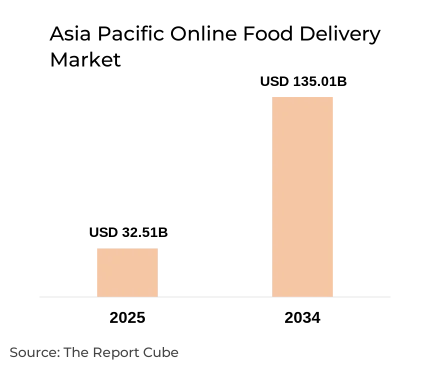
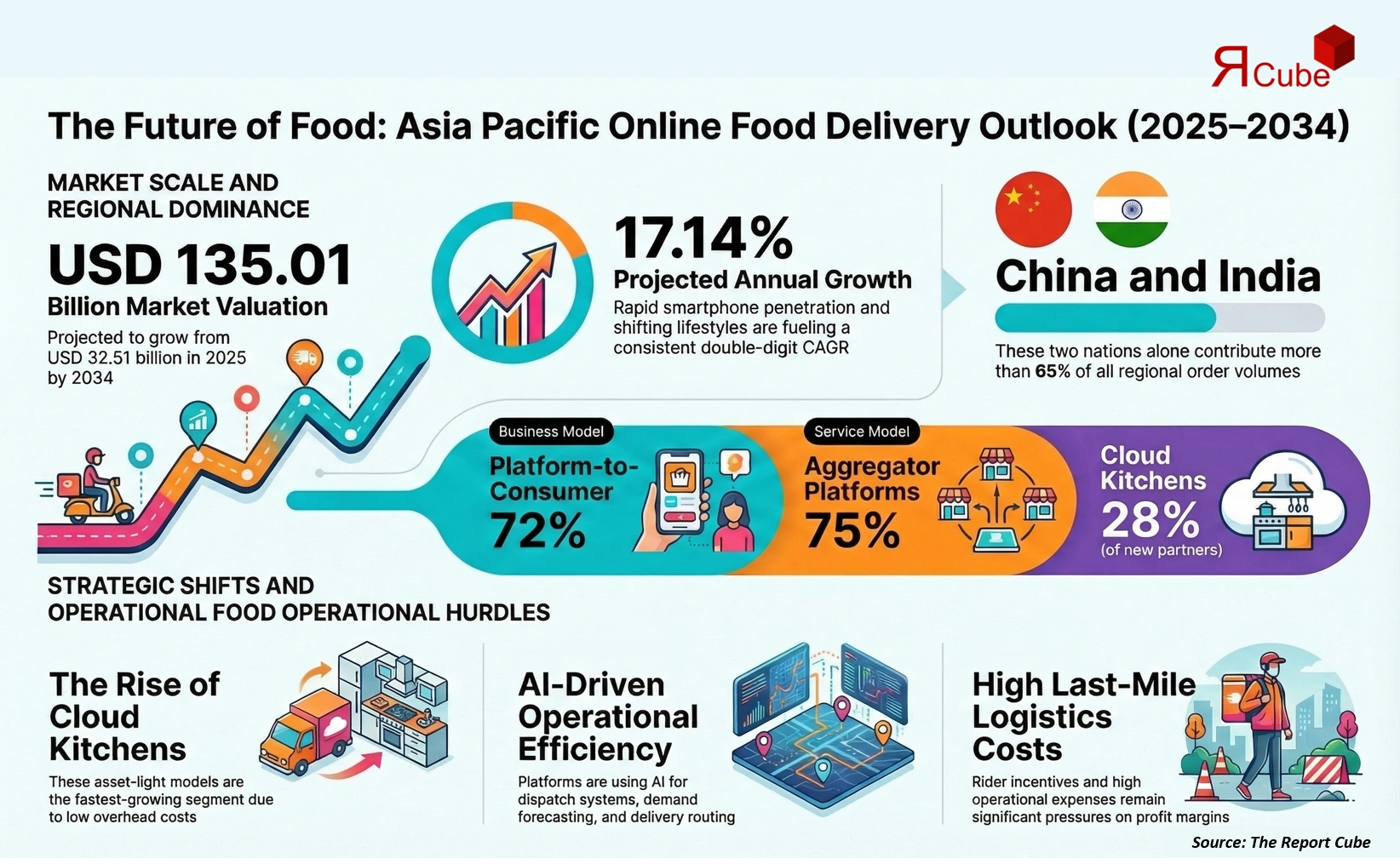
The Asia Pacific Online Food Delivery Market is anticipated to register a CAGR of 17.14% during 2026-2034. The market size was valued at USD 32.51 billion in 2025 and is projected to reach USD 135.01 billion by 2034. The market has evolved into a core component of the region’s digital consumer economy, supported by rapid smartphone penetration, expanding urban populations, and shifting consumer preferences toward convenience-based food consumption.
Asia Pacific remains the world’s most dynamic online food delivery landscape, led by China and India, which together contribute more than 65% of regional order volumes. The growing working-class population, rising disposable income levels, and lifestyle changes have significantly increased reliance on app-based food ordering platforms. Additionally, the expansion of digital payment infrastructure and real-time order tracking has improved consumer trust and engagement, resulting in higher order frequency.
Cloud kitchen proliferation, hyperlocal logistics optimization, and AI-powered demand forecasting have further strengthened operational efficiency for platforms and restaurant partners. As competition intensifies, companies are focusing on service differentiation, faster delivery times, and loyalty programs. With food delivery becoming deeply embedded in daily consumption habits, the Asia Pacific Online Food Delivery Market is expected to witness sustained, high-growth momentum throughout the forecast period.
Asia Pacific Online Food Delivery Market Recent Developments
- 2025: Meituan expanded its instant delivery network using AI-based dispatch systems to improve delivery efficiency.
- 2025: Zomato launched advanced subscription dining programs across multiple Asia Pacific markets.
Government Initiatives & Policies
- India Digital India Initiative: Promotes digital platforms, online payments, and internet accessibility supporting food delivery growth.
- China Digital Economy Development Plan: Supports platform-based services, logistics digitization, and urban delivery ecosystems.
Asia Pacific Online Food Delivery Market Dynamics
Key Driver: Rising Demand for Convenience and Digital Consumption
The primary driver of the Asia Pacific Online Food Delivery Market is the increasing consumer preference for convenience-driven dining solutions. Urban consumers are increasingly opting for app-based food delivery due to time constraints, longer working hours, and changing lifestyles. In major metropolitan areas, over 55% of consumers place online food orders at least once per week. The rapid adoption of smartphones and mobile wallets has further simplified ordering and payment processes. Promotional pricing, subscription models, and personalized recommendations are also driving higher order volumes, particularly among millennials and Gen Z consumers.
Book your FREE 30-minute expert consultation today
Contact UsIndustry Trends: Growth of Cloud Kitchens and AI-Driven Platforms
The market is witnessing a strong shift toward cloud kitchens, which now account for nearly 28% of newly registered restaurant partners in Asia Pacific. These asset-light models allow operators to scale quickly with lower overhead costs. Additionally, AI and data analytics are increasingly used to optimize menu pricing, predict demand surges, and enhance delivery routing efficiency. Aggregator platforms are investing heavily in automation, dark stores, and micro-fulfillment hubs to reduce delivery times and improve customer satisfaction. Sustainability initiatives such as eco-friendly packaging and electric delivery fleets are also gaining traction.
Major Challenge: High Operational and Logistics Costs
Despite rapid growth, high operational costs remain a key challenge for the market. Expenses related to last-mile delivery, rider incentives, platform commissions, and customer acquisition significantly impact profitability. Intense competition has led to aggressive discounting strategies, putting pressure on margins for both platforms and restaurant partners. Additionally, regulatory scrutiny around gig worker welfare and data privacy compliance may increase operational complexity, potentially slowing expansion in certain markets.
Opportunity: Expansion into Tier-2 Cities and Subscription-Based Models
Untapped demand in tier-2 and tier-3 cities across India, Indonesia, and Vietnam presents a significant growth opportunity. These markets are witnessing rising internet penetration and increasing digital payment adoption. Subscription-based delivery models offering free deliveries and exclusive discounts are improving customer retention and lifetime value. Furthermore, partnerships with grocery retailers and convenience stores are enabling platforms to diversify revenue streams beyond restaurant food delivery.
Asia Pacific Online Food Delivery Market Segment-wise Analysis
By Business Model:
- Platform to Consumer
- Restaurant to Consumer
The platform-to-consumer model dominates the market, accounting for approximately 72% of total revenue in 2025. Aggregator platforms provide end-to-end services including ordering, delivery, and customer support, making them highly attractive to both consumers and restaurants. Restaurant-to-consumer models remain relevant for established chains with in-house delivery capabilities but face scalability limitations compared to platform-driven ecosystems.
By Service Model:
- Aggregator Platforms
- Cloud Kitchens
Aggregator platforms hold the largest market share, contributing nearly 75% of total orders in 2025 due to their extensive restaurant networks and logistical reach. Cloud kitchens are the fastest-growing segment, supported by low setup costs and data-driven menu optimization. Their ability to rapidly adapt to consumer demand trends is accelerating adoption across urban Asia Pacific markets.
Regional Projection of Asia Pacific Online Food Delivery Industry
- China
- India
- Japan
- Southeast Asia
China leads the Asia Pacific Online Food Delivery Market, holding approximately 45% of regional market share in 2025, driven by platforms such as Meituan and Ele.me. India follows as the fastest-growing market, supported by rapid urbanization and increasing smartphone usage. Southeast Asia, particularly Singapore, Malaysia, and Indonesia, is emerging as a high-growth cluster due to expanding middle-class populations and strong platform penetration. Japan and South Korea focus on premium services and operational efficiency, contributing steady growth.
Need insights for a specific region within this market?
Request Regional DataWhy Choose This Report?
- Provides a comprehensive overview of the overall market analysis, encompassing key trends, consumer behavior analysis, and risk assessment to support strategic decision-making.
- Provides accurate, up-to-date insights into market size, segmentation, and emerging opportunities, helping to minimize risk & capitalizing on growth.
- Gives deep understanding of target audience preferences, investment habits, and communication channels for enhanced product development & marketing effectiveness.
- Delivers competitive analysis & benchmarking, uncovering the strengths & weaknesses of market competitors to guide strategies.
- Consolidate comprehensive market intelligence, reducing reasoning & streamlining research efforts.
- Facilitates customized market segmentation & risk mitigation strategies, fine-tuned to the business objectives.
- Aids in identifying both market challenges & untapped opportunities within the industry to drive long-term business growth.
- Provides valuable information based on actual customer data & search trends.
Table of Contents
- Introduction
- Objective of the Study
- Product and Category Definition
- Market Segmentation
- Study Variables
- Research Methodology
- Secondary Data Points
- Breakdown of Secondary Sources
- Primary Data Points
- Breakdown of Primary Interviews
- Secondary Data Points
- Executive Summary
- Market Dynamics
- Drivers
- Challenges
- Opportunity Assessment
- Recent Trends and Developments
- Regulatory and Policy Landscape
- Asia Pacific Online Food Delivery Market Overview (2020-2034)
- Market Size, By Value (USD Billion)
- Market Share, By Business Model
- Platform to Consumer
- Restaurant to Consumer
- Market Share, By Service Model
- Aggregator Platforms
- Cloud Kitchens
- Market Share, By Order Type
- App Orders
- Website Orders
- Market Share, By Product Type
- Meal Delivery
- Grocery Delivery
- Market Share, By End User
- Individual Consumers
- Corporate Orders
- Market Share, By Country
- China
- India
- Japan
- South Korea
- Australia
- Singapore
- Malaysia
- Rest of Asia Pacific
- Market Share, By Company
- Market Share, By Company
- Competition Characteristics
- Revenue Shares & Analysis
- Country-Level Analysis
- China Online Food Delivery Market
- Market Size, By Value (USD Billion)
- Market Share, By Business Model
- Market Share, By Service Model
- Market Share, By Order Type
- Market Share, By Product Type
- Market Share, By End User
- India Online Food Delivery Market
- Market Size, By Value (USD Billion)
- Market Share, By Business Model
- Market Share, By Service Model
- Market Share, By Order Type
- Market Share, By Product Type
- Market Share, By End User
- Japan Online Food Delivery Market
- Market Size, By Value (USD Billion)
- Market Share, By Business Model
- Market Share, By Service Model
- Market Share, By Order Type
- Market Share, By Product Type
- Market Share, By End User
- South Korea Online Food Delivery Market
- Market Size, By Value (USD Billion)
- Market Share, By Business Model
- Market Share, By Service Model
- Market Share, By Order Type
- Market Share, By Product Type
- Market Share, By End User
- Australia Online Food Delivery Market
- Market Size, By Value (USD Billion)
- Market Share, By Business Model
- Market Share, By Service Model
- Market Share, By Order Type
- Market Share, By Product Type
- Market Share, By End User
- Singapore Online Food Delivery Market
- Market Size, By Value (USD Billion)
- Market Share, By Business Model
- Market Share, By Service Model
- Market Share, By Order Type
- Market Share, By Product Type
- Market Share, By End User
- Malaysia Online Food Delivery Market
- Market Size, By Value (USD Billion)
- Market Share, By Business Model
- Market Share, By Service Model
- Market Share, By Order Type
- Market Share, By Product Type
- Market Share, By End User
- China Online Food Delivery Market
- Competitive Outlook and Company Profiles
- Meituan
- Company Overview
- Service Portfolio
- Geographic Presence
- Strategic Alliances/Partnerships
- Recent Developments
- Zomato
- Company Overview
- Service Portfolio
- Geographic Presence
- Strategic Alliances/Partnerships
- Recent Developments
- Swiggy
- Company Overview
- Service Portfolio
- Geographic Presence
- Strategic Alliances/Partnerships
- Recent Developments
- GrabFood (Grab)
- Company Overview
- Service Portfolio
- Geographic Presence
- Strategic Alliances/Partnerships
- Recent Developments
- Delivery Hero (foodpanda)
- Company Overview
- Service Portfolio
- Geographic Presence
- Strategic Alliances/Partnerships
- Recent Developments
- GoFood (Gojek)
- Company Overview
- Service Portfolio
- Geographic Presence
- Strategic Alliances/Partnerships
- Recent Developments
- Uber Eats
- Company Overview
- Service Portfolio
- Geographic Presence
- Strategic Alliances/Partnerships
- Recent Developments
- LINE MAN
- Company Overview
- Service Portfolio
- Geographic Presence
- Strategic Alliances/Partnerships
- Recent Developments
- Baidu Waimai
- Company Overview
- Service Portfolio
- Geographic Presence
- Strategic Alliances/Partnerships
- Recent Developments
- Ele.me
- Company Overview
- Service Portfolio
- Geographic Presence
- Strategic Alliances/Partnerships
- Recent Developments
- Others
- Meituan
- Contact Us and Disclaimer
Top Key Players & Market Share Outlook
- Meituan
- Zomato
- Swiggy
- GrabFood (Grab)
- Delivery Hero (foodpanda)
- GoFood (Gojek)
- Uber Eats
- LINE MAN
- Baidu Waimai
- Ele.me
- Others
Frequently Asked Questions






