Singapore Bio-Based Polymers Market to Reach USD 4.91 Billion by 2034, Driven by Jurong Island Expansion, DGC Funding & Optical-Grade Demand
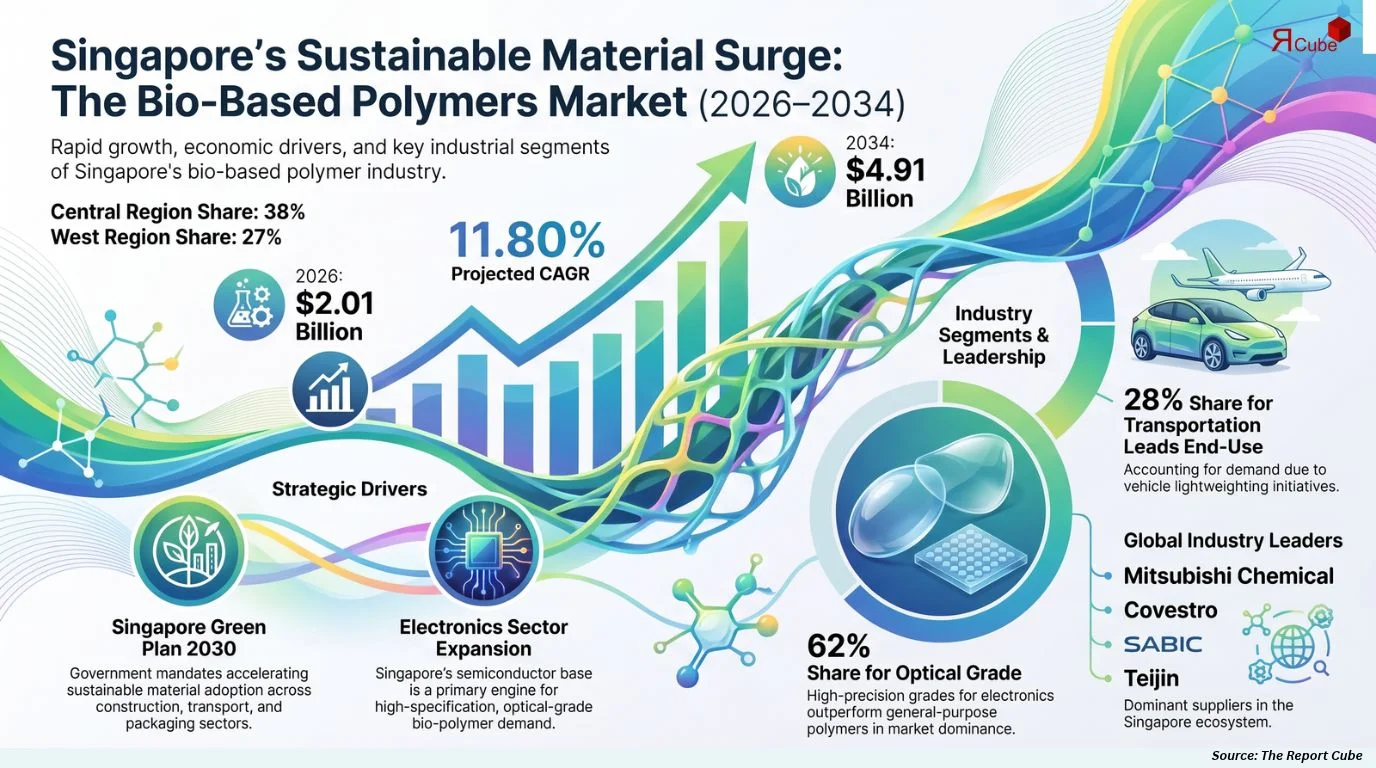
A new study by The Report Cube on the Singapore Bio-Based Polymers Market finds the sector moving well past early-stage adoption, with Jurong Island's chemical cluster now hosting several large-scale bio-based production facilities and government policy committing significant capital to low-carbon material technologies. The market was valued at USD 2.01 billion in 2026, is expected to expand at a CAGR of 11.80%, and should reach USD 4.91 billion by 2034.
Key Dynamics Affecting the Singapore Bio-Based Polymers Market
In July 2025, Arkema opened a €400 million plant on Jurong Island dedicated to producing Rilsan® polyamide 11 and Oleris® oleochemicals from castor beans - the world's largest integrated factory for bio-circular materials. The polyamide production unit became fully operational in January 2026, tripling Arkema's global PA-11 capacity and giving Singapore the largest transparent polyamides production capacity in Asia. This single facility shift changed the conversation about Jurong Island from a petrochemical hub into a credible bio-based advanced materials base.
In April 2026, Singapore launched the S$800 million Decarbonisation Grand Challenge (DGC) under its Research, Innovation and Enterprise (RIE) initiative. The DGC runs over five years and specifically targets R&D and commercialisation of low-carbon technologies for the industry sector. For bio-based polymer producers, the SPEED programme within DGC supports technology pilots ahead of full deployment - which shortens the gap between lab formulation and commercial production scale. This matters for bio-based polymer manufacturers who need cost-competitive pathways before they can displace petroleum-based grades in volume contracts.
The Singapore Green Plan 2030, coordinated across five ministries since 2021, set mandatory packaging reporting requirements and an Extended Producer Responsibility (EPR) framework for packaging waste. Singapore's Mandatory Packaging Reporting scheme requires large producers and importers to report packaging data annually and submit reduction plans - which directly creates procurement pressure for bio-based polymer alternatives across food packaging, consumer goods, and industrial formats. Compliance is not optional, and the cost of non-compliance now enters purchasing decisions.
Need Specific Data, Let’s Customize the Report for You
Request CustomizationWhich of the Segments, Under Type Classification, Influences the Market Share?
Across Type, the Singapore Bio-Based Polymers Industry is segmented as:
- Optical Grade
- General Purpose Grade
Optical Grade bio-based polymers lead with an estimated 62% share in 2026. The segment's dominance is not driven by volume but by specification - electronics, semiconductor lens, and optical media manufacturers on the island require grades meeting international optoelectronic component standards that general-purpose materials cannot satisfy. Mitsubishi Chemical Group Corp and Teijin Ltd serve as primary suppliers. General Purpose Grade holds 38% and serves a broader client base: transportation component manufacturers, construction material suppliers, and mid-market fabricators. Covestro AG and SABIC supply this segment, targeting cost-competitive formulations with reliable mechanical performance across automotive parts and construction applications. The fastest-growing segment is General Purpose Grade, pulled by Singapore's expanding green construction pipeline and growing automotive component manufacturing for regional EV supply chains.
Regional Analysis: Singapore Bio-Based Polymers Market
- Central Region
- West Region
- East Region
- North Region
- North-East Region
The Central Region leads with 38% share, concentrated in corporate headquarters, R&D centers, and advanced manufacturing clusters where premium optical-grade and medical-grade bio-polymer procurement decisions are made. The West Region at 27% is the production heartland - Jurong Industrial Estate and Jurong Island's petrochemical and bio-refinery infrastructure make it the physical location for most large-scale bio-based polymer manufacturing, including Arkema's PA-11 facility and the incoming Kuraray EVOH plant. South India East Region at 18% draws from Changi aerospace and precision engineering demand, alongside logistics proximity that makes it a natural distribution hub. North and North-East regions, together at 17%, reflect earlier-stage adoption - light industrial parks, SME manufacturing clusters, and sustainability compliance pressure among smaller packagers and construction suppliers are the primary demand drivers there.
Company Profile: Leading Singapore Bio-Based Polymers Market Players
Competition in the Singapore Bio-Based Polymers Market separates into two layers. The first is global specialty chemical companies using Singapore as a production base and regional hub - firms like Arkema, SABIC, Covestro, and Mitsui Chemicals that have made direct capital commitments to Jurong Island facilities and supply downstream manufacturers across ASEAN from here. The second is Japanese advanced materials companies - Mitsubishi Chemical Group Corp, Teijin, and Kuraray - operating through Asia Pacific subsidiaries to serve Singapore's electronics and packaging sectors with high-specification grades that command pricing above commodity-market rates.
Arkema's Jurong Island investment is the single most significant capital event in this market in recent years. The €400 million facility producing Rilsan® PA-11 from castor beans, fully operational since January 2026, is the world's largest integrated bio-circular materials factory. Its Singapore location - chosen for feedstock logistics, ASEAN market access, and Singapore's advanced manufacturing ecosystem - means the facility supplies not just Singapore-based manufacturers but regional clients across Malaysia, Thailand, and Vietnam. No other bio-based polymer producer in Southeast Asia currently operates at equivalent scale from a single site.
Key players include: Arkema S.A., Mitsubishi Chemical Group Corp., Teijin Ltd., Covestro AG, SABIC, Mitsui Chemicals Inc., Kuraray Asia Pacific Pte. Ltd., NatureWorks LLC, BASF SE, TotalEnergies Corbion, Corbion N.V., and Others.
Questions Answered in the Singapore Bio-Based Polymers Market Research Report
- What is the current market size & future growth forecast underlined in the Singapore Bio-Based Polymers Market research report?
- Which major factors are driving the rapid expansion of the Singapore Bio-Based Polymers Industry across major regions?
- What emerging trends are restructuring the competitive landscape according to the latest market insights?
- How is consumer demand evolving, and what impact does it have on the Singapore Bio-Based Polymers Market growth?
- Which leading companies are dominating the Singapore Bio-Based Polymers Industry, and what strategies are they adopting?
- What technological advancements are influencing product adoption & market penetration?
- How does the report evaluate regional performance & identify high-growth market opportunities?
- What challenges & risks could potentially affect market stability, according to the research findings by the analysts?