



Build Your Custom Market Intelligence Report
Customize Your ReportKey Takeaways
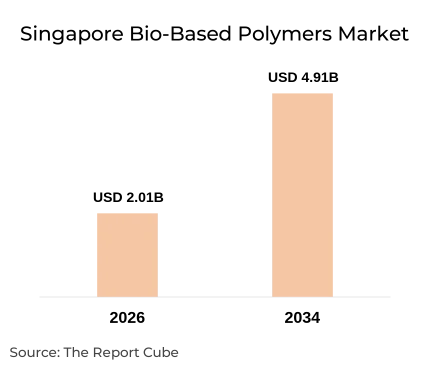
- Singapore Bio-Based Polymers Market valued at USD 2.01 billion in 2026, reflecting accelerating sustainable materials adoption.
- Market projected to reach USD 4.91 billion by 2034, growing at an impressive 11.80% CAGR through the forecast period.
- Optical grade segment leads the by type classification driven by growing demand in advanced electronics and precision optics applications.
- Transportation remains the dominant end-use segment, supported by lightweighting initiatives and green material mandates across the automotive sector.
- Electrical and electronics is the fastest-growing end-use segment, fueled by Singapore's semiconductor and consumer electronics manufacturing base.
- Mitsubishi Chemical Group Corp, Covestro AG, SABIC, and Teijin Ltd represent the leading bio-based polymer suppliers active in Singapore.
- Green building initiatives under Singapore's Green Plan 2030 are reinforcing bio-based polymer adoption in construction and infrastructure applications.
- Circular economy policies and extended producer responsibility regulations are accelerating transition toward bio-derived material platforms across manufacturing industries.
Market Overview
A comprehensive Singapore Bio-Based Polymers Market Analysis reveals a high-growth specialty materials sector expanding at an 11.80% CAGR from 2026 through 2034. The market was valued at USD 2.01 billion in 2026 and is projected to reach USD 4.91 billion by 2034. Singapore's advanced manufacturing ecosystem, strong government commitment to sustainability through the Singapore Green Plan 2030, and robust trade infrastructure collectively underpin demand for bio-based polymers across transportation, electronics, construction, and medical industries. Leading suppliers including Mitsubishi Chemical Group Corp, Covestro AG, and SABIC maintain established regional distribution networks serving Singapore's diverse manufacturing sectors.
Growing adoption of bio-based and biodegradable materials across Singapore's precision engineering and electronics sectors continues driving procurement volumes for optical-grade and general-purpose bio-based polymers. Singapore's positioning as a Southeast Asian manufacturing and logistics hub amplifies regional demand aggregation, enabling international suppliers to serve broader ASEAN markets through Singapore-based distribution platforms. Increasing pressure from multinational corporate sustainability commitments, combined with consumer expectations for environmentally responsible product design, has accelerated bio-based polymer integration across product development cycles. Teijin Ltd and Covestro AG have deepened market engagement through application engineering support and customization services targeting Singapore's high-specification manufacturing requirements.
Market Size & Forecast
|
Metric |
Details |
|---|---|
|
Market Size (2026) |
USD 2.01 Billion |
|
Market Size (2034) |
USD 4.91 Billion |
|
CAGR (2026–2034) |
11.80% |
|
Base Year |
2026 |
|
Historical Years |
2021–2025 |
|
Forecast Years |
2026–2034 |
The Singapore Bio-Based Polymers Market Size study values the industry at USD 2.01 billion in 2026, with the market projected to expand to USD 4.91 billion by 2034, representing an 11.80% CAGR. This growth outpaces the broader Southeast Asian materials market average, driven by Singapore's integrated advanced manufacturing base, escalating corporate net-zero commitments, and government-backed circular economy infrastructure enabling bio-based polymer commercialization at industrial scale.
Market Dynamics
Singapore's bio-based polymers sector is gaining structural momentum as sustainability mandates, high-value manufacturing growth, and circular economy policy frameworks converge to accelerate bio-derived material adoption. The Singapore Bio-Based Polymers Market Growth trajectory is shaped by escalating demand from electronics and transportation manufacturers, green building requirements, and increasing integration of bio-polymers into precision medical and optical applications across the city-state's industrial ecosystem.
|
Factor |
Type |
Specific Impact on Market |
Magnitude |
|---|---|---|---|
|
Singapore Green Plan 2030 implementation |
Driver |
Accelerates mandatory sustainable material adoption across construction, transportation, and packaging sectors |
High |
|
Expanding electronics manufacturing demand |
Driver |
Increases optical-grade bio-based polymer procurement for precision component production |
High |
|
High production cost relative to petrochemical polymers |
Restraint |
Limits adoption among cost-sensitive mid-tier manufacturers and SME supply chains |
Medium |
|
Bio-based polymer circular economy infrastructure development |
Opportunity |
Enables closed-loop material recovery, reducing lifecycle costs and improving regulatory compliance credentials |
High |
|
Feedstock supply chain concentration risk |
Challenge |
Disrupts consistent bio-based monomer supply and elevates input cost volatility for downstream processors |
Medium |
|
Lightweighting mandates in automotive and aerospace |
Trend |
Drives substitution of conventional polymers with high-performance bio-based alternatives across transportation supply chains |
High |
Growth Drivers - Singapore Green Plan 2030 and Electronics Sector Expansion
Singapore's government-mandated sustainability frameworks under the Green Plan 2030 are directly stimulating bio-based polymer demand across construction, transportation, and packaging sectors. Simultaneously, Singapore's world-class semiconductor and consumer electronics manufacturing base is generating sustained procurement volumes for optical-grade bio-based polymers from Mitsubishi Chemical Group Corp and Covestro AG, supporting above-average market growth through 2034.
Market Restraints - Cost Premium Over Conventional Polymers
Bio-based polymers continue to carry a significant price premium over petrochemical-derived equivalents, constraining adoption among Singapore's cost-sensitive SME manufacturers and mid-tier fabricators. The higher upstream processing costs associated with fermentation-based and plant-derived feedstocks limit market penetration below premium-grade application segments, requiring continued scale-up and process efficiency improvements to achieve broader adoption parity.
Market Opportunities - Circular Economy Infrastructure Development
Singapore's investment in industrial symbiosis parks and bio-refinery infrastructure creates expanding commercial pathways for closed-loop bio-based polymer recovery and reprocessing. Development of end-of-life bio-polymer collection and reprocessing capacity reduces total material lifecycle costs, strengthens corporate sustainability compliance credentials, and opens new market segments for recycled-content bio-based polymer grades across electronics and building applications.
Industry Challenges - Feedstock Supply Chain Concentration
Heavy dependence on a limited number of bio-based feedstock origins - primarily Southeast Asian agricultural biomass and imported plant-based monomers - exposes Singapore manufacturers to supply chain concentration risk. Seasonal production variability, geopolitical trade disruptions, and competing biomass demand from energy and food sectors collectively elevate input cost volatility, creating planning complexity for procurement teams across bio-polymer-dependent manufacturing operations.
Need Specific Data, Let’s Customize the Report for You
Request CustomizationMarket Trends
- Emerging Trends: Among the most significant Singapore Bio-Based Polymers Market Trends is the accelerating substitution of petroleum-derived materials with bio-based alternatives across Singapore's precision manufacturing sectors. Artisanal and boutique bio-material compounders are establishing specialty formulation capabilities targeting medical device manufacturers and advanced electronics producers requiring certified bio-based material declarations for export compliance.
- Technology Trends: Advanced fermentation platform technologies and synthetic biology applications are enabling cost-competitive production of high-performance bio-based monomers for polymer synthesis. Singapore's biomedical and chemical research institutions are commercializing novel polylactic acid (PLA) blends, polyhydroxyalkanoates (PHA), and bio-based polycarbonate formulations with enhanced thermal and mechanical properties meeting optical-grade and electronics-grade specifications.
- Consumer / Buyer Trends: Professional procurement managers in Singapore's manufacturing sector increasingly require suppliers to provide full bio-content certification, life cycle assessment documentation, and third-party sustainability verification as baseline sourcing conditions. Over 70% of Singapore's multinational manufacturing operations have incorporated bio-based material targets into supplier qualification frameworks, driving Mitsubishi Chemical Group Corp and SABIC to expand certified bio-based polymer product lines serving local procurement requirements.
- Regulatory Trends: Singapore's Extended Producer Responsibility (EPR) framework for packaging and plastics is accelerating mandatory adoption of bio-based and biodegradable polymer alternatives across consumer-facing manufacturing categories. International standards including ISO 16620 for bio-based content determination and evolving EU sustainability import requirements are reshaping material specification practices for Singapore exporters. Singapore's National Environment Agency (NEA) continues advancing chemical waste management regulations affecting bio-polymer processing and end-of-life classification.
Singapore Bio-Based Polymers Market Segment Analysis
Singapore's bio-based polymers market serves distinct application categories across industrial type grades and end-use industries, each defined by unique performance specifications, regulatory requirements, and procurement scales. Segment demand is shaped by Singapore's advanced manufacturing concentration, government sustainability mandates, and integration into regional ASEAN supply chains.
By Type
- Optical Grade
- General Purpose Grade
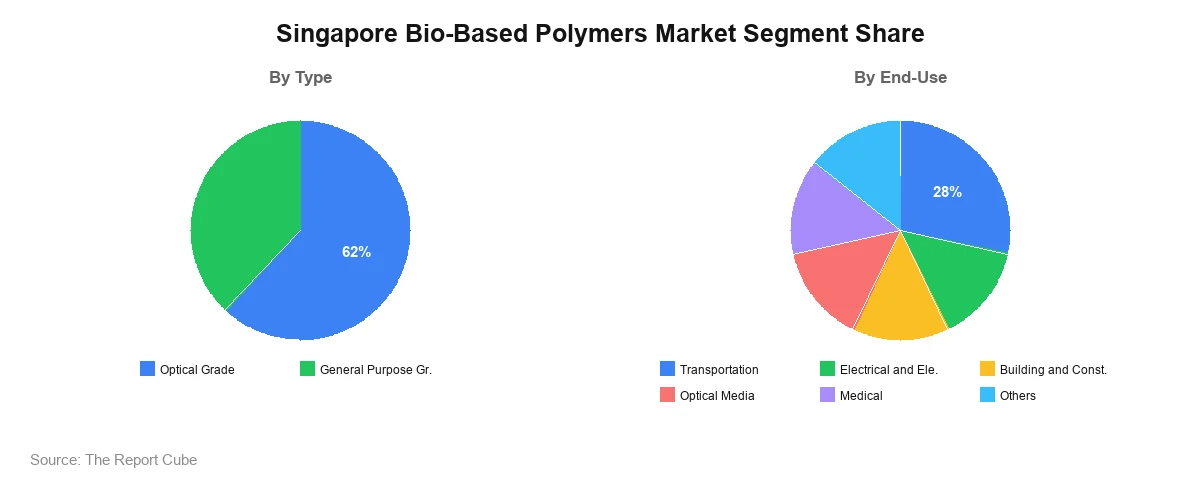
Optical grade bio-based polymers command the leading position in the By Type segment, capturing an estimated 62% share of the Singapore Bio-Based Polymers Market Share in 2026. Mitsubishi Chemical Group Corp and Teijin Ltd are the primary optical-grade bio-based polymer suppliers serving Singapore's electronics, semiconductor lens, and optical media manufacturing sectors. These high-specification grades require precise refractive index consistency, ultra-low birefringence, and exceptional transparency meeting international optoelectronic component standards. General purpose grade bio-based polymers hold the remaining 38% share, serving transportation component manufacturers, building material producers, and mid-market fabricators. Covestro AG and SABIC are active general-purpose grade suppliers targeting Singapore's construction and automotive parts manufacturing clients requiring cost-competitive bio-based formulations with reliable mechanical performance.
By End-Use
- Transportation
- Electrical and Electronics
- Building and Construction
- Optical Media
- Medical
- Others
Transportation represents the dominant end-use segment, accounting for an estimated 28% of total market demand in 2026, as Singapore-based automotive parts exporters and regional vehicle manufacturers integrate bio-based polymer composites for lightweighting and sustainability compliance. Electrical and electronics captures approximately 25% market share and is the fastest-growing end-use category, driven by bio-based encapsulant, substrate, and connector demand from Singapore's semiconductor and consumer electronics industries. SABIC and Mitsubishi Chemical Group Corp supply bio-based polymer grades meeting IEC and UL flame-retardancy standards required for electronics applications. Building and construction holds 18% share, medical applications account for 14%, optical media represents 10%, and all remaining end-use categories collectively make up the final 5%.
Regional Analysis
|
Region |
Estimated Market Share |
Key Growth Factors |
Consumer Trends |
|---|---|---|---|
|
Central Region |
38% |
Corporate headquarters, R&D centers, advanced manufacturing clusters |
Premium optical-grade and medical-grade bio-polymer adoption |
|
West Region |
27% |
Jurong Industrial Estate, petrochemical and bio-refinery infrastructure |
General-purpose and transportation-grade bio-polymer procurement |
|
East Region |
18% |
Changi aerospace and precision engineering, logistics hub proximity |
Transportation and electronics-grade bio-material demand |
|
North Region |
10% |
Light industrial parks, emerging bio-material processing facilities |
General-purpose grade bio-polymers, construction material applications |
|
North-East Region |
7% |
SME manufacturing clusters, growing sustainability compliance awareness |
Packaging bio-polymer adoption, medical-grade material interest |
- Central Region - Accounting for approximately 38% of total Singapore Bio-Based Polymers Market demand, the Central Region hosts Singapore's highest concentration of multinational manufacturing headquarters, advanced materials R&D centers, and specialty chemical procurement operations. Premium optical-grade and medical-grade bio-based polymer adoption is concentrated here, with Mitsubishi Chemical Group Corp and Covestro AG maintaining primary commercial relationships with Central Region-based buyers.
- West Region - The West Region commands approximately 27% market share, anchored by Jurong Island's integrated chemical and bio-refinery complex and the broader Jurong Industrial Estate manufacturing corridor. General-purpose bio-polymer volumes are highest in this region, servicing transportation component fabricators and construction material manufacturers. SABIC's regional operations in the West Region support consistent supply of bio-based polyolefins and polycarbonates to industrial-scale end-users.
- East Region - Capturing approximately 18% market share, the East Region's demand is shaped by Changi aerospace and precision engineering operations alongside significant logistics and distribution infrastructure. Transportation-grade bio-based polymer composites and electronics-encapsulant materials represent the primary procurement categories, with Teijin Ltd and Covestro AG serving key aerospace and electronics manufacturers operating in this corridor.
- North Region - The North Region accounts for approximately 10% of market demand, driven by light industrial parks and emerging bio-material processing facilities. General-purpose bio-based polymers dominate procurement here, with growing uptake in construction application grades aligned with Singapore's green building certification standards. Procurement scales remain smaller relative to central and western industrial clusters.
- North-East Region - Representing approximately 7% market share, the North-East Region hosts SME manufacturing clusters and growing sustainability-compliance-driven demand for packaging bio-polymers and medical material alternatives. This region shows the fastest adoption growth rate as SME exporters respond to multinational customer sustainability sourcing requirements, positioning it for above-average share gains through 2034.
Market Share & Competitive Landscape
The Singapore Bio-Based Polymers Market competitive landscape is defined by global specialty chemical and polymer manufacturers with established Asia-Pacific operational infrastructure. Key players compete across application-grade breadth, sustainability certification portfolios, technical application support capabilities, and supply chain reliability serving Singapore's high-specification manufacturing base.
|
Company |
Competitive Strength |
Primary Segment Served |
|---|---|---|
|
Mitsubishi Chemical Group Corp |
Optical-grade bio-polymer expertise, broad bio-based product portfolio |
Optical Media, Electrical and Electronics |
|
Covestro AG |
Bio-based polycarbonate innovation, sustainability-certified supply chains |
Transportation, Building and Construction |
|
SABIC |
Integrated bio-based feedstock processing, global distribution scale |
Transportation, Electrical and Electronics |
|
Teijin Ltd |
High-performance bio-based engineering polymers, aerospace-grade supply |
Transportation, Medical |
|
Others |
Niche formulation specialists, regional distributors, compounders |
Building and Construction, Others |
Key Companies in the Singapore Bio-Based Polymers Market
Mitsubishi Chemical Group Corp
Mitsubishi Chemical Group Corp, headquartered in Tokyo, Japan, operates as one of Asia's largest integrated chemical and advanced materials conglomerates, with extensive bio-based polymer development capabilities. In 2025, the company expanded its Singapore-facing bio-based polycarbonate and optical-grade bioplastics distribution network, strengthening supply to local electronics and optical media manufacturers. Its proprietary bio-methanol feedstock platform and bio-based engineering polymer certifications position it as the preferred supplier for premium-grade Singapore applications.
Covestro AG
Covestro AG, headquartered in Leverkusen, Germany, is a global leader in high-performance polymer materials including bio-based and circular polycarbonates and polyurethanes. In 2024, Covestro advanced its bio-attributed polycarbonate supply program for Singapore's electronics and transportation sectors, aligning material certification with Singapore Green Plan compliance requirements. Its ISCC PLUS certified bio-based supply chain and dedicated Asia-Pacific application engineering team provide competitive differentiation in Singapore's demanding manufacturing procurement environment.
Recent Developments
|
Year |
Company |
Development |
|---|---|---|
|
2025 |
Mitsubishi Chemical Group Corp |
Expanded bio-based polycarbonate and optical-grade bioplastics distribution network targeting Singapore electronics and optical media manufacturers |
|
2025 |
SABIC |
Launched ISCC-certified bio-attributed polyolefin grades for Singapore's transportation and industrial manufacturing customers under its Trucircle portfolio |
Future Outlook
The Singapore Bio-Based Polymers Market Forecast projects the sector to reach USD 4.91 billion by 2034, expanding at an 11.80% CAGR through the forecast period. Continued growth across Singapore's electronics, transportation, and medical manufacturing industries will sustain high-specification bio-polymer demand. Mitsubishi Chemical Group Corp, SABIC, and Teijin Ltd are expected to deepen Singapore market penetration through certified bio-content material expansion, application engineering investment, and alignment with Singapore's evolving sustainable procurement mandates across industrial and government supply chains through 2034.
Technological advancement in bio-based polymer synthesis - including synthetic biology-derived feedstocks, enzymatic polymerization platforms, and bio-based flame-retardant additive systems - will progressively reduce the cost gap between bio-derived and petrochemical alternatives. Sustainability certification frameworks including ISCC PLUS, Rainforest Alliance biomass standards, and Singapore's forthcoming mandatory bio-content labeling requirements for manufacturing inputs will establish bio-based polymers as a baseline procurement standard across Singapore's export-oriented manufacturing economy by 2034.
Singapore Bio-Based Polymers Market Report Coverage
This Singapore Bio-Based Polymers Market Report provides comprehensive coverage of the sector across the full 2026–2034 forecast period, incorporating segmentation depth, regional intelligence, competitive profiling, and verified recent developments.
|
Report Attribute |
Details |
|---|---|
|
Market Name |
Singapore Bio-Based Polymers Market |
|
Market Size (2026) |
USD 2.01 Billion |
|
Market Size (2034) |
USD 4.91 Billion |
|
Forecast Period |
2026–2034 |
|
CAGR |
11.80% |
|
Base Year |
2026 |
|
Historical Years |
2021–2025 |
|
Forecast Years |
2026–2034 |
|
Segments Covered |
By Type (Optical Grade, General Purpose Grade); By End-Use (Transportation, Electrical and Electronics, Building and Construction, Optical Media, Medical, Others) |
|
Regions Covered |
Central Region, West Region, East Region, North Region, North-East Region |
|
Key Companies |
Mitsubishi Chemical Group Corp, Covestro AG, SABIC, Teijin Ltd, Others |
|
Report Format |
PDF, Excel, PPT |
|
Customization |
Available as per client requirements |
Why Choose This Singapore Bio-Based Polymers Market Report?
- Comprehensive coverage of Singapore's rapidly expanding bio-based polymer materials market across all major application segments.
- Accurate market sizing from USD 2.01 billion in 2026 through the full 2034 forecast horizon.
- Detailed segmentation by product type (Optical Grade vs. General Purpose Grade) and six end-use industry categories.
- Country-level regional insights across all five Singapore planning regions with estimated market share breakdowns.
- Competitive profiling of leading global bio-polymer suppliers including Mitsubishi Chemical Group Corp, Covestro AG, SABIC, and Teijin Ltd.
- In-depth analysis of Singapore Green Plan 2030 policy impacts on bio-based material adoption timelines and procurement mandates.
- Verified recent developments and technology trend analysis supporting strategic sourcing and investment planning decisions.
- Forecast data and regional intelligence aligned with Singapore's sustainability vision and circular economy policy framework through 2034.
Table of Contents
- Introduction
- Objective of the Study
- Product Definition
- Market Segmentation
- Study Variables
- Research Methodology
- Secondary Data Points
- Companies Interviewed
- Primary Data Points
- Breakdown of Primary Interviews
- Secondary Data Points
- Executive Summary
- Market Dynamics
- Drivers
- Challenges
- Opportunity Assessment
- Recent Trends and Developments
- Policy and Regulatory Landscape
- Singapore Bio-Based Polymers Market Overview and Forecast Analysis (2021-2034)
- Market Size, By Value, By Growth Rate (CAGR/USD Billions)
- Demand – Supply Trends
- Market Share, By Type
- Optical Grade
- General Purpose Grade
- Market Share, By End-use
- Transportation
- Electrical and Electronics
- Building and Construction
- Optical Media
- Medical
- Others
- Market Share, By Region
- Central Region
- East Region
- North Region
- North-East Region
- West Region
- Market Share, By Competitors
- Competition Characteristics
- Revenue Shares
- Optical Grade Singapore Bio-Based Polymers Market Overview, 2021-2034F
- By Value (USD Million)
- By End-use – Market Size & Forecast 2021-2034, USD Million
- Transportation
- Electrical and Electronics
- Building and Construction
- Optical Media
- Medical
- Others
- General Purpose Grade Singapore Bio-Based Polymers Market Overview, 2021-2034F
- By Value (USD Million)
- By End-use – Market Size & Forecast 2021-2034, USD Million
- Transportation
- Electrical and Electronics
- Building and Construction
- Optical Media
- Medical
- Others
- Competitive Outlook (Company Profile - Partial List)
- Mitsubishi Chemical Group Corp
- Company Overview
- Business Segments
- Strategic Alliances/Partnerships
- Recent Developments
- Covestro AG
- Company Overview
- Business Segments
- Strategic Alliances/Partnerships
- Recent Developments
- SABIC
- Company Overview
- Business Segments
- Strategic Alliances/Partnerships
- Recent Developments
- Teijin Ltd
- Company Overview
- Business Segments
- Strategic Alliances/Partnerships
- Recent Developments
- Others
- Mitsubishi Chemical Group Corp
- Contact Us & Disclaimer
Top Key Players & Market Share Outlook
- Mitsubishi Chemical Group Corp
- Covestro AG
- SABIC
- Teijin Ltd
- Others
Frequently Asked Questions






