South Korea 5G IoT Market to Observe Dramatic Growth Pattern: CAGR of 52.10% & USD 38.34 Billion by 2034
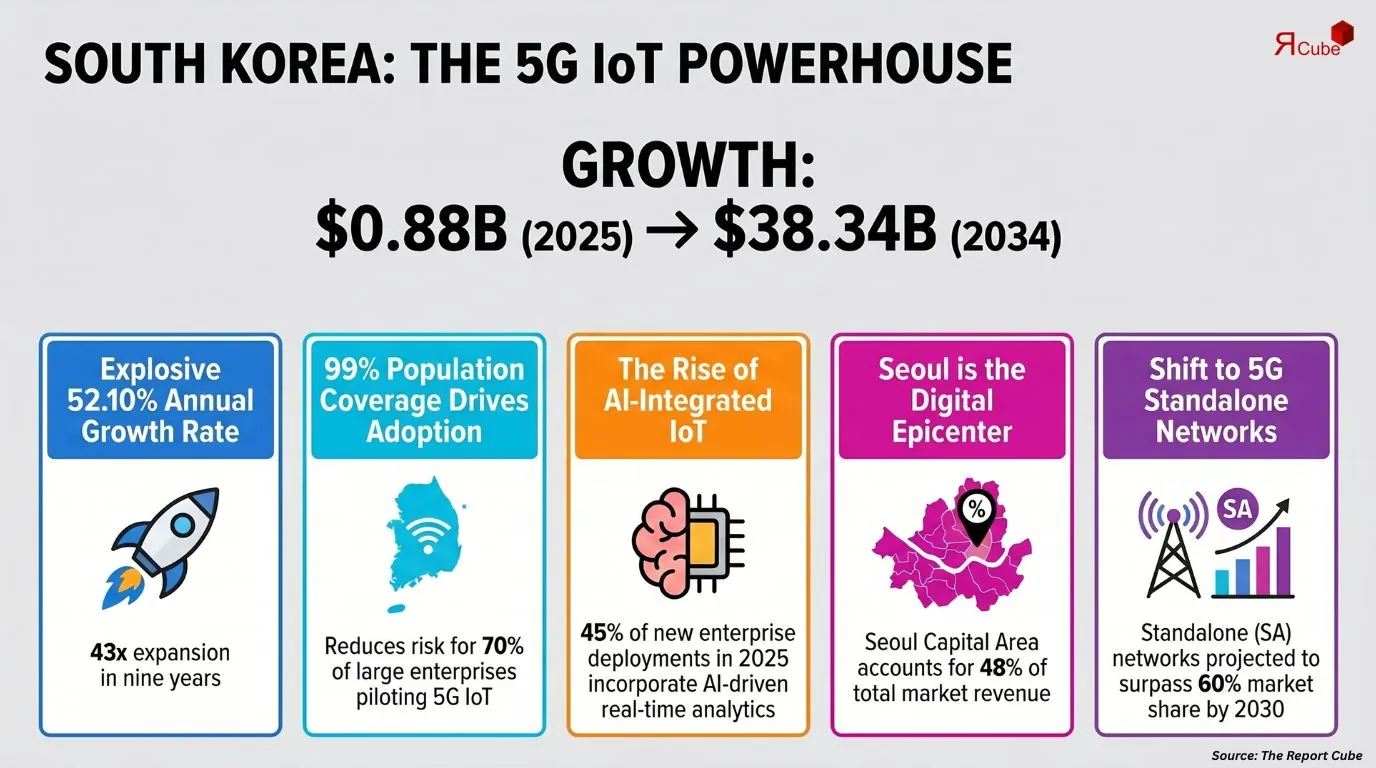
In line with the latest research studies by The Report Cube, the South Korea 5G IoT Market Research Report underlines that the industry is destined to experience exceptional growth throughout the 2026–2034 forecast period. The market, valued at about USD 0.88 billion in 2025, is projected to expand at a robust compound annual growth rate (CAGR) of nearly 52.10%, reaching approximately USD 38.34 billion by 2034.
South Korea’s robust growth outlook is reinforced by its early leadership in 5G commercialization, a mature telecommunications ecosystem, and sustained government support for digital transformation initiatives. The rising penetration of IoT-enabled solutions in manufacturing, smart cities, mobility, healthcare, and logistics is further solidifying the nation’s position as a regional hub for next-generation connectivity.
Key Dynamics Affecting the South Korea 5G IoT Market
- The quick growth of smart manufacturing & Industry 4.0 initiatives remains a primary growth driver for the South Korea 5G IoT Industry. Businesses are progressively deploying 5G-enabled IoT systems to support real-time monitoring, predictive maintenance, and automation, thereby improving operational efficiency & reducing downtime.
- In parallel, the growing adoption of connected vehicles, autonomous driving technologies, and intelligent transportation systems is creating strong demand for ultra-low-latency & high-reliability 5G networks. These applications need seamless, high-speed data transmission to support vehicle-to-everything (V2X) communication & real-time decision-making.
- In addition, increasing investments in smart city projects, like intelligent traffic management, public safety surveillance, environmental monitoring, and energy optimization, are augmenting IoT adoption across urban infrastructure. Also, the convergence of artificial intelligence (AI), edge computing, and cloud-based IoT platforms is further improving the value proposition of 5G IoT by enabling faster analytics & data-driven insights at the network edge.
- However, despite strong growth prospects, the market continues to face certain challenges. High initial deployment costs, concerns related to cybersecurity vulnerabilities, and rising data privacy & regulatory compliance necessities might act as restraining factors, particularly for small- & mid-sized enterprises. However, supportive government policies, spectrum availability, and the expansion of private 5G networks are expected to mitigate these challenges over the forecast period.
Which of the segments, under Network Type Classification, influences the Market Share?
Across the Network Type, the South Korea 5G IoT Industry is segmented as:
- 5G Non-Standalone
- 5G Standalone
Of them, 5G Non-Standalone accounts for a substantial share of the South Korea 5G IoT Market. Its ability to leverage existing 4G LTE infrastructure enables faster deployment timelines & cost-effective implementation, making it a preferred option during the early stages of 5G IoT adoption.
Nevertheless, 5G Standalone networks are predicted to witness accelerated growth during the forecast period. Also, rising demand for ultra-reliable low-latency communication (URLLC), network slicing, and advanced enterprise IoT use cases is projected to drive the transition toward standalone architectures, particularly for mission-critical applications.
Regional Coverage: South Korea 5G IoT Market
- Seoul Capital Area
- Yeongnam
- Honam
- Hoseo
- Others
Geographically, the Seoul Capital Area captures a leading position across the South Korea 5G IoT Market. The region benefits from dense 5G network coverage, great enterprise concentration, early acceptance of emerging technologies, and continuous investments in smart city development. Furthermore, other regions, such as Yeongnam, Honam, and Hoseo, are also seeing sturdy growth as infrastructure expansion & digital initiatives extend beyond major metropolitan centers.
Company Profile: Leading South Korea 5G IoT Market Players
The competitive landscape of the South Korea 5G IoT Market is described by the presence of established telecom operators, technology manufacturers, and IoT solution providers. Major market players are: SK Telecom, KT Corporation, LG Uplus, Samsung Electronics, Hyundai Motor Group, LG Electronics, Hanwha Systems, Hyosung Group, Sensorview, Nearthlab, and Others.
All these leading companies are actively focusing on advanced connectivity platforms, private 5G deployments, semiconductor innovation, and integrated IoT solutions to reinforce their market presence. Among them, Samsung Electronics develops as a potential innovator across the South Korea 5G IoT Market, supported by its strong capabilities across semiconductors, network infrastructure, and IoT platforms. Also, the company continues to play a crucial role in enabling scalable, secure, and high-performance 5G IoT deployments in multiple industry verticals.
Questions Answered in the South Korea 5G IoT Market Research Report
- What is the current market size & future growth forecast underlined in the South Korea 5G IoT Market research report?
- Which major factors are driving the rapid expansion of the South Korea 5G IoT Industry across major regions?
- What emerging trends are restructuring the competitive landscape according to the latest market insights?
- How is consumer / end-user demand evolving, and what impact does it have on the South Korea 5G IoT Market growth?
- Which leading companies are dominating the South Korea 5G IoT Industry, and what strategies are they adopting?
- What technological advancements are influencing product adoption & market penetration?
- How does the report evaluate regional performance & identify high-growth market opportunities?
- What challenges & risks could potentially affect market stability, according to the research findings by the analysts?