



Build Your Custom Market Intelligence Report
Customize Your ReportSouth Korea 5G IoT Market Insights & Analysis
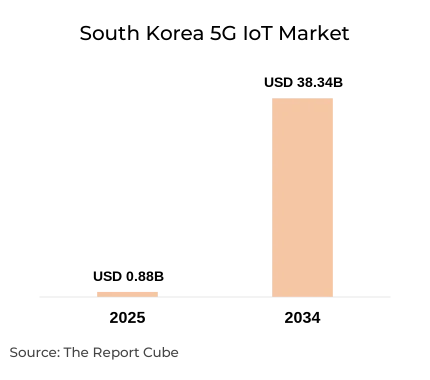
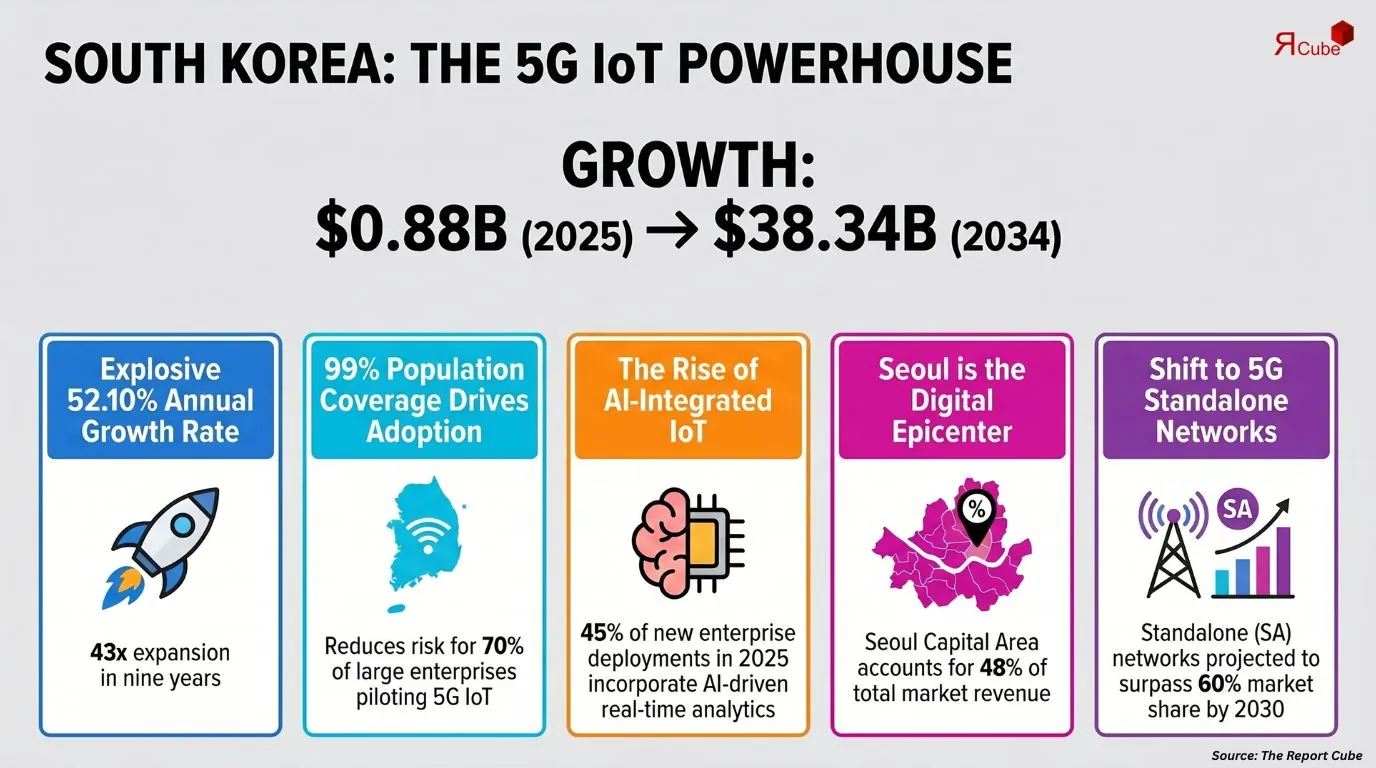
The South Korea 5G IoT Market is anticipated to register a CAGR of 52.10% during 2026-2034. The market size was valued at USD 0.88 billion in 2025 and is projected to reach USD 38.34 billion by 2034. South Korea’s early leadership in 5G deployment, combined with its advanced digital infrastructure, positions the country as a global testbed for large-scale IoT commercialization. Strong collaboration between telecom operators, electronics manufacturers, and automotive leaders is accelerating real-world 5G IoT use cases across smart cities, autonomous mobility, manufacturing automation, and defense systems.
Market momentum is further supported by South Korea’s technology-savvy population and high enterprise readiness for digital transformation. Industries are increasingly adopting ultra-low latency and massive device connectivity enabled by 5G IoT to improve productivity, safety, and real-time decision-making. Government-backed digital innovation programs and sustained capital investment into next-generation networks are ensuring rapid scalability of IoT ecosystems across regions.
Moreover, South Korea’s export-oriented industrial base is leveraging 5G IoT to maintain global competitiveness. Smart factories, connected logistics, and AI-integrated IoT platforms are becoming standard operational tools, creating a robust foundation for long-term market expansion through 2034.
South Korea 5G IoT Market Recent Developments
- 2025: AT&T expanded nationwide 5G standalone-based IoT network slicing for smart manufacturing clients.
- 2025: Qualcomm Technologies, Inc. introduced an industrial 5G IoT module optimized for smart factories and autonomous systems.
Government Initiatives & Policies
- Korea Digital New Deal 2.0: National initiative accelerating 5G, IoT, AI, and smart infrastructure adoption.
- Smart Factory Expansion Program: Government-backed program supporting 5G IoT integration across manufacturing SMEs.
South Korea 5G IoT Market Dynamics
Key Driver: Nationwide 5G Infrastructure Leadership Accelerating IoT Commercialization
South Korea’s early and comprehensive rollout of 5G infrastructure is the single most powerful driver of the 5G IoT Market. With over 99% population coverage for 5G services and rapidly expanding standalone (SA) networks, enterprises gain access to ultra-reliable low-latency communication essential for mission-critical IoT applications. Manufacturing, automotive, and logistics sectors increasingly rely on 5G IoT for real-time monitoring, predictive maintenance, and automation. Approximately 70% of large enterprises in South Korea have already initiated 5G-based IoT pilots or deployments, reflecting strong market readiness. This infrastructure maturity significantly reduces adoption risk and accelerates large-scale commercialization.
Book your FREE 30-minute expert consultation today
Contact UsIndustry Trends: Rapid Shift Toward 5G Standalone Networks and AI-Integrated IoT
A defining trend in the South Korea 5G IoT Market is the transition from non-standalone to standalone 5G architectures. Standalone networks unlock full 5G capabilities, including network slicing and ultra-low latency, enabling advanced IoT use cases such as autonomous driving and remote robotics. In parallel, AI integration within IoT platforms is rising sharply, allowing real-time analytics at the network edge. Over 45% of new enterprise IoT deployments in 2025 incorporated AI-driven analytics, improving operational efficiency and decision accuracy. This convergence of 5G, IoT, and AI is reshaping competitive dynamics and accelerating innovation cycles.
Major Challenge: High Capital Investment and Integration Complexity
Despite exceptional growth potential, the South Korea 5G IoT Market faces challenges related to high upfront investment and system integration complexity. Deploying private 5G networks, IoT sensors, and edge computing infrastructure requires significant capital, particularly for small and mid-sized enterprises. Additionally, integrating legacy systems with new 5G IoT platforms often demands specialized skills and extended implementation timelines. Interoperability across hardware, platforms, and connectivity layers remains a concern, slowing adoption in cost-sensitive sectors. These factors create short-term barriers, even as long-term benefits remain compelling.
Opportunity: Smart Mobility and Autonomous Systems Driving Next-Phase Growth
The rapid evolution of smart mobility and autonomous systems presents a major growth opportunity for the South Korea 5G IoT Market. Connected vehicles, intelligent traffic systems, and drone-based monitoring rely heavily on ultra-low latency and high data throughput. Automotive leaders and city governments are increasingly deploying 5G IoT-enabled vehicle-to-everything (V2X) solutions to enhance road safety and traffic efficiency. With autonomous mobility pilots expanding across multiple regions, demand for high-performance 5G IoT connectivity and platforms is expected to surge, unlocking substantial revenue streams through 2034.
South Korea 5G IoT Market Segment-wise Analysis
By Component:
- Hardware
- Platform
- Connectivity
- Services
Connectivity dominates the component segment, accounting for approximately 41% of the South Korea 5G IoT Market in 2025. The high demand for reliable, low-latency network services across industrial IoT, smart cities, and defense applications drives this leadership. Hardware follows closely, supported by domestic manufacturing strengths in sensors and modules. Platforms and services are gaining momentum as enterprises seek end-to-end solutions, but connectivity remains the foundational revenue driver due to recurring service models.
By Network Type:
- 5G Non-Standalone
- 5G Standalone
5G Standalone networks are emerging as the fastest-growing segment and are projected to surpass 60% market share by 2030. Enterprises increasingly prioritize standalone networks to unlock advanced IoT capabilities such as deterministic latency and network slicing. While non-standalone networks supported early adoption, standalone deployments are becoming essential for mission-critical applications, positioning this segment as the long-term growth engine.
Regional Projection of South Korea 5G IoT Industry
- Seoul Capital Area
- Yeongnam
- Honam
- Hoseo
- Others
The Seoul Capital Area dominates the South Korea 5G IoT market, contributing nearly 48% of total revenue in 2025. As the nation's digital transformation epicenter, Seoul hosts advanced telecommunications infrastructure, major technology corporations, and the highest concentration of enterprise IoT deployments. The region's leadership stems from its dense population, robust 5G network coverage, and early adoption of smart city initiatives, industrial automation, and connected healthcare solutions. The capital area benefits from government-backed digital innovation programs and significant private sector investments, making it the primary hub for 5G IoT development and commercialization. Other regions like Yeongnam, Honam, and Hoseo are experiencing growth but remain behind Seoul's market dominance in revenue generation and technological deployment scale.
Need insights for a specific region within this market?
Request Regional DataWhy Choose This Report?
- Provides a comprehensive overview of the overall market analysis, encompassing key trends, consumer behavior analysis, and risk assessment to support strategic decision-making.
- Provides accurate, up-to-date insights into market size, segmentation, and emerging opportunities, helping to minimize risk & capitalizing on growth.
- Gives deep understanding of target audience preferences, investment habits, and communication channels for enhanced product development & marketing effectiveness.
- Delivers competitive analysis & benchmarking, uncovering the strengths & weaknesses of market competitors to guide strategies.
- Consolidate comprehensive market intelligence, reducing reasoning & streamlining research efforts.
- Facilitates customized market segmentation & risk mitigation strategies, fine-tuned to the business objectives.
- Aids in identifying both market challenges & untapped opportunities within the industry to drive long-term business growth.
- Provides valuable information based on actual customer data & search trends.
Table of Contents
- Introduction
- Objective of the Study
- Product and Category Definition
- Market Segmentation
- Study Variables
- Research Methodology
- Secondary Data Points
- Breakdown of Secondary Sources
- Primary Data Points
- Breakdown of Primary Interviews
- Secondary Data Points
- Executive Summary
- Market Dynamics
- Drivers
- Challenges
- Opportunity Assessment
- Recent Trends and Developments
- Regulatory and Policy Landscape
- South Korea 5G IoT Market Overview (2020-2034)
- Market Size, By Value (USD Billion)
- Market Share, By Component
- Hardware
- Platform
- Connectivity
- Services
- Integration & Installation
- Training & Consulting
- Support & Maintenance
- Network Connectivity Services
- Market Share, By Network Type
- 5G Non‑Standalone
- 5G Standalone
- Market Share, By Connectivity
- Critical IoT
- Broadband IoT
- Sub-Massive IoT
- Industrial Automation IoT
- Market Share, By Application Type
- Massive IoT
- Broadband IoT
- Critical IoT
- Industrial IoT
- Market Share, By End User
- Manufacturing
- Smart Cities
- Energy Utilities
- Transport Logistics
- Enterprises
- Healthcare
- Oil Gas
- Other Verticals
- Market Share, By Connectivity
- Public Networks
- Private Networks
- Hybrid Networks
- Market Share, By Region
- Seoul Capital Area
- Yeongnam
- Honam
- Hoseo
- Others
- Market Share, By Company
- Competition Characteristics
- Revenue Shares & Analysis
- Capital Region 5G IoT Market
- Market Size, By Value (USD Billion)
- Market Share, By Component
- Market Share, By Network Type
- Market Share, By Connectivity
- Market Share, By Application Type
- Market Share, By End User
- Market Share, By Connectivity
- Central Region 5G IoT Market
- Market Size, By Value (USD Billion)
- Market Share, By Component
- Market Share, By Network Type
- Market Share, By Connectivity
- Market Share, By Application Type
- Market Share, By End User
- Market Share, By Connectivity
- Yeongnam Region 5G IoT Market
- Market Size, By Value (USD Billion)
- Market Share, By Component
- Market Share, By Network Type
- Market Share, By Connectivity
- Market Share, By Application Type
- Market Share, By End User
- Market Share, By Connectivity
- Honam Region 5G IoT Market
- Market Size, By Value (USD Billion)
- Market Share, By Component
- Market Share, By Network Type
- Market Share, By Connectivity
- Market Share, By Application Type
- Market Share, By End User
- Market Share, By Connectivity
- Jeju Region 5G IoT Market
- Market Size, By Value (USD Billion)
- Market Share, By Component
- Market Share, By Network Type
- Market Share, By Connectivity
- Market Share, By Application Type
- Market Share, By End User
- Market Share, By Connectivity
- Competitive Outlook and Company Profiles
- SK Telecom
- Company Overview
- Product Portfolio
- Strategic Alliances/Partnerships
- Recent Developments
- KT Corporation
- Company Overview
- Product Portfolio
- Strategic Alliances/Partnerships
- Recent Developments
- LG Uplus
- Company Overview
- Product Portfolio
- Strategic Alliances/Partnerships
- Recent Developments
- Samsung Electronics
- Company Overview
- Product Portfolio
- Strategic Alliances/Partnerships
- Recent Developments
- Hyundai Motor Group
- Company Overview
- Product Portfolio
- Strategic Alliances/Partnerships
- Recent Developments
- LG Electronics
- Company Overview
- Product Portfolio
- Strategic Alliances/Partnerships
- Recent Developments
- Hanwha Systems
- Company Overview
- Product Portfolio
- Strategic Alliances/Partnerships
- Recent Developments
- Hyosung Group
- Company Overview
- Product Portfolio
- Strategic Alliances/Partnerships
- Recent Developments
- Sensorview
- Company Overview
- Product Portfolio
- Strategic Alliances/Partnerships
- Recent Developments
- Nearthlab
- Company Overview
- Product Portfolio
- Strategic Alliances/Partnerships
- Recent Developments
- Others
- SK Telecom
- Contact Us and Disclaimer
Top Key Players & Market Share Outlook
- SK Telecom
- KT Corporation
- LG Uplus
- Samsung Electronics
- Hyundai Motor Group
- LG Electronics
- Hanwha Systems
- Hyosung Group
- Sensorview
- Nearthlab
- Others
Frequently Asked Questions






