



Build Your Custom Market Intelligence Report
Customize Your ReportCanada Cloud Computing Market Key Highlights
By Service Model:
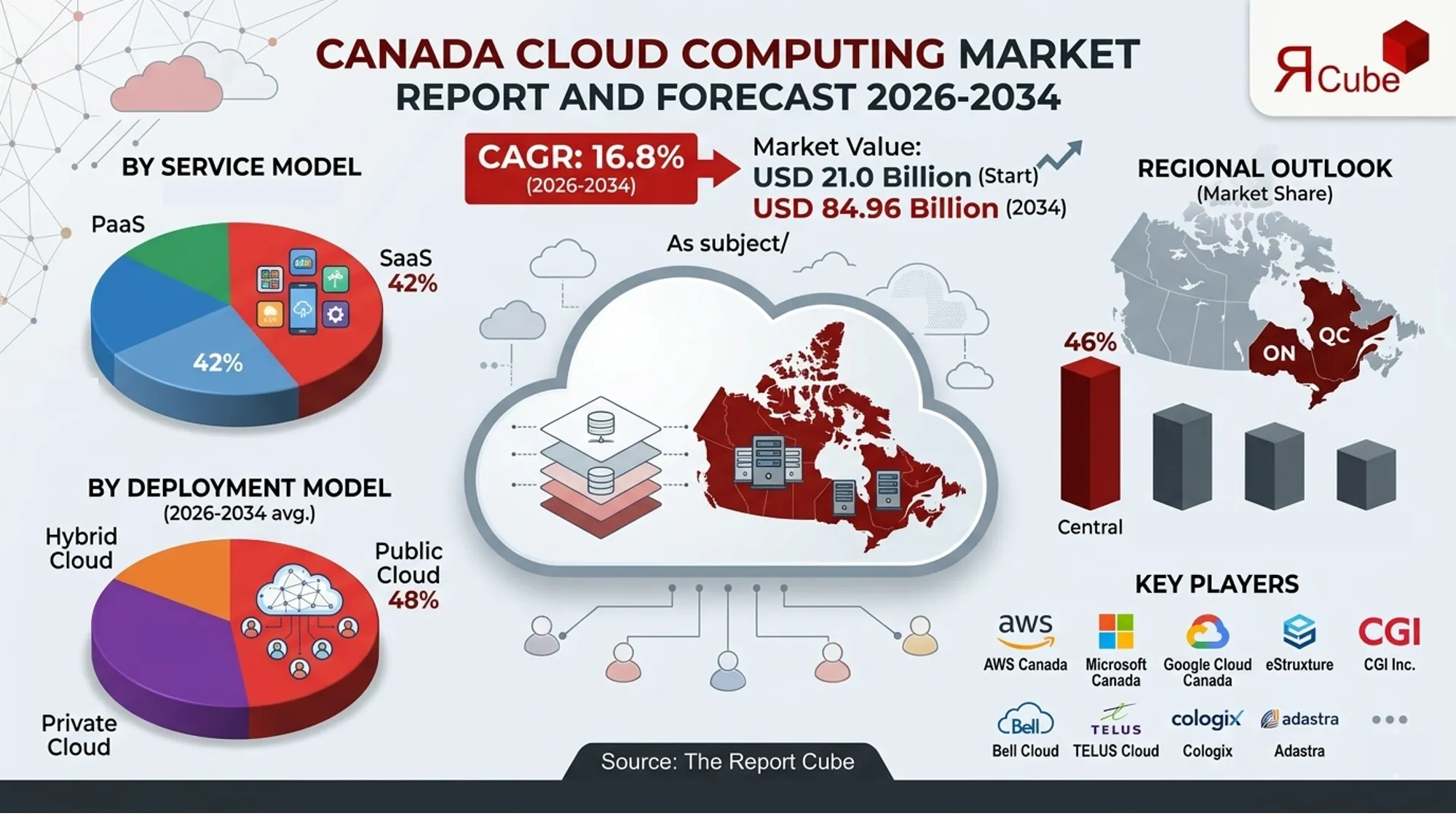
Software as a Service (SaaS) segment leads the market, with around 42% share.
By Deployment Model:
Public Cloud segment dominates the market, accounting for nearly 48% of total revenue.
Regional Outlook:
Central region dominates the Canada cloud computing market, with around 46% share.
Canada Cloud Computing Market Insights & Analysis
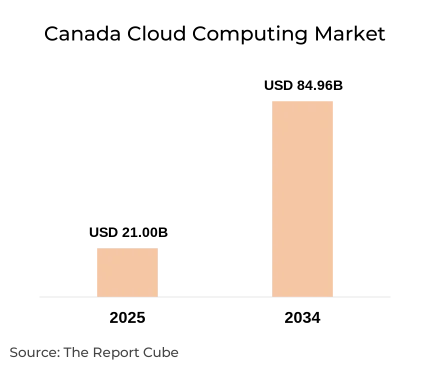
The Canada Cloud Computing Market is anticipated to register a 16.8% during 2026-2034. the market size was valued at USD 21.0 billion and is projected to reach USD 84.96 billion by 2034. This growth reflects Canada’s strong digital economy foundation, supported by enterprise modernization, data sovereignty requirements, and increased AI integration across industries.
Canada has emerged as one of North America’s fastest-growing cloud ecosystems, driven by sustained investment in hyperscale infrastructure. In 2025, major providers collectively expanded more than 25 new data center facilities across Ontario and Quebec, reflecting a 30% rise in localized cloud capacity. This surge is closely tied to regulatory requirements emphasizing data residency, especially in sectors such as BFSI and public services. Organizations are increasingly prioritizing local cloud environments to meet compliance standards while maintaining operational flexibility.
Canada Cloud Computing Market Dynamics
Key Driver: Rising Demand for Data Sovereignty and Regulatory Compliance
One of the primary forces accelerating the Canada cloud computing market is the growing emphasis on data sovereignty. Canadian enterprises, particularly in banking, healthcare, and government sectors, are required to ensure that sensitive data remains within national borders. By 2025, nearly 72% of organizations handling regulated data workloads migrated to domestic cloud environments. This shift is encouraging global cloud providers to expand local infrastructure aggressively.
At the same time, businesses are becoming more conscious of cybersecurity frameworks and privacy standards, leading to higher adoption of compliant cloud solutions. As regulations evolve, companies are integrating hybrid and private cloud models to maintain control over critical data while leveraging scalability. This demand is not just regulatory-driven; it reflects a broader organizational shift toward secure and resilient digital ecosystems.
Book your FREE 30-minute expert consultation today
Contact UsIndustry Trends: Acceleration of AI-Integrated Cloud and Hybrid Architectures
The market is witnessing a strong transition toward AI-integrated cloud platforms combined with hybrid deployment strategies. By 2025, over 60% of large enterprises in Canada adopted hybrid cloud frameworks to balance performance and flexibility. This approach allows organizations to run mission-critical workloads on private infrastructure while leveraging public cloud scalability for analytics and innovation. Additionally, AI workloads are reshaping infrastructure priorities, with demand for high-performance computing growing by nearly 35% annually. Enterprises are increasingly using cloud-native AI tools for predictive analytics, automation, and customer experience enhancements. The shift toward hybrid models is also improving cost optimization and operational efficiency, enabling organizations to scale resources dynamically while maintaining governance over sensitive data.
Major Challenge: High Complexity in Multi-Cloud Integration and Talent Shortage
As organizations adopt multi-cloud strategies, integration complexity is emerging as a significant challenge. Managing workloads across multiple platforms requires advanced orchestration tools and skilled professionals, which remain in short supply. In 2025, nearly 48% of Canadian enterprises reported difficulties in managing interoperability between cloud environments. This complexity increases operational risks, including data silos and inconsistent security policies. At the same time, the demand for cloud engineers and AI specialists continues to outpace supply, creating a talent gap that slows deployment timelines. Smaller enterprises, in particular, face challenges in aligning infrastructure strategies with business objectives due to limited expertise. Addressing these issues requires investment in workforce development and simplified cloud management solutions.
Opportunity: Expansion of Cloud Adoption Among SMEs and Industry-Specific Solutions
The growing adoption of cloud computing among small and medium-sized enterprises presents a major growth opportunity. By 2025, SMEs accounted for nearly 45% of new cloud subscriptions in Canada, driven by affordability and scalability benefits. Government-backed digital programs are further supporting this transition by offering financial incentives and technical guidance.
Additionally, industry-specific cloud solutions are gaining traction, particularly in healthcare, retail, and manufacturing. These tailored platforms address unique operational needs, such as real-time patient data management or supply chain optimization. As cloud providers continue to develop vertical-specific offerings, businesses are finding it easier to adopt solutions that align with their operational workflows, driving deeper market penetration.
Canada Cloud Computing Market Segment-wise Analysis
By Service Model:
- Infrastructure as a Service (IaaS)
- Platform as a Service (PaaS)
- Software as a Service (SaaS)
Among all service models, Software as a Service (SaaS) dominates the Canada cloud computing market, holding approximately 42% share in 2025. This dominance is closely linked to the rapid adoption of enterprise applications such as CRM, ERP, and collaboration tools delivered via cloud platforms. Canadian businesses are increasingly shifting away from traditional software deployment to subscription-based SaaS models that reduce upfront costs and improve accessibility. In sectors like BFSI and retail, SaaS solutions have enhanced customer engagement and operational efficiency.
Additionally, remote and hybrid work trends have accelerated demand for cloud-based productivity tools, with adoption rates rising by over 30% in the past two years. The scalability and ease of integration offered by SaaS platforms make them particularly attractive for SMEs, further strengthening their market position.
By Deployment Model:
- Public Cloud
- Private Cloud
- Hybrid Cloud
- Community Cloud
The public cloud segment leads the deployment model category, accounting for nearly 48% of the total market share. This growth is driven by its cost efficiency, scalability, and widespread availability of services. Enterprises are leveraging public cloud platforms to manage fluctuating workloads and support digital transformation initiatives. In 2025, over 65% of new cloud workloads in Canada were deployed on public cloud environments. The segment is particularly strong in industries such as media, e-commerce, and IT services, where rapid scalability is critical.
At the same time, public cloud providers are enhancing their offerings with advanced security features and compliance certifications, addressing concerns related to data privacy. This balance between performance and security continues to drive adoption across diverse industry verticals.
Regional Projection of Canada Cloud Computing Industry
- Central
- West Coast
- Atlantic
- North
- Others
The Central region leads the Canada cloud computing market, capturing approximately 46% of the overall share. This dominance is largely attributed to the concentration of data centers and technology hubs in Ontario and Quebec. Toronto and Montreal serve as key digital infrastructure hubs, hosting a significant number of hyperscale facilities operated by global cloud providers. In 2025, the region accounted for over 60% of new cloud infrastructure investments in Canada. The presence of a strong enterprise base, coupled with advanced connectivity and skilled workforce availability, further strengthens the region’s position.
Additionally, government initiatives supporting digital transformation and AI development are heavily focused in this region, creating a favorable environment for cloud adoption. As businesses continue to expand their digital capabilities, the Central region is expected to maintain its leadership in the coming years.
Government Initiatives & Policies
- Canada Digital Adoption Program (CDAP): A federal initiative supporting SMEs in adopting cloud technologies, offering grants and advisory support to accelerate digital transformation. https://ised-isde.canada.ca/site/canada-digital-adoption-program/en
- Pan-Canadian Artificial Intelligence Strategy (Phase II Expansion 2025): Strengthens AI infrastructure and cloud integration capabilities through investments in compute capacity and data ecosystems. https://ised-isde.canada.ca/site/ai-strategy/en
Canada Cloud Computing Market Recent Developments
- 2025: Microsoft Canada announced a C$7.5 billion investment to expand Azure Canada Central and Canada East regions with AI-ready data centers, significantly enhancing domestic cloud capacity and supporting data sovereignty requirements across regulated industries.
- 2025: Google Cloud Canada introduced Oracle Database@Google Cloud services in Montreal and Toronto regions, enabling enterprises to run Oracle workloads locally while supporting multicloud strategies and improving compliance with Canadian data residency regulations.
- 2025: TELUS Cloud launched Canada’s Sovereign AI Factory powered by NVIDIA, deploying advanced GPU infrastructure to offer AI-as-a-Service while ensuring all enterprise data remains securely within national borders.
- 2025: CGI Inc. expanded its cloud and digital transformation capabilities through the acquisition of Online Business Systems, strengthening its footprint in Winnipeg and enhancing service offerings in cybersecurity, AI, and enterprise cloud solutions.
- 2025: Converge Technology Solutions entered a C$1.3 billion acquisition agreement with H.I.G. Capital, positioning the company to scale hybrid cloud, cybersecurity, and digital infrastructure services across Canadian enterprises.
Need insights for a specific region within this market?
Request Regional DataWhy Choose This Report?
- Provides a comprehensive overview of the overall market analysis, encompassing key trends, consumer behavior analysis, and risk assessment to support strategic decision-making.
- Provides accurate, up-to-date insights into market size, segmentation, and emerging opportunities, helping to minimize risk & capitalizing on growth.
- Gives deep understanding of target audience preferences, investment habits, and communication channels for enhanced product development & marketing effectiveness.
- Delivers competitive analysis & benchmarking, uncovering the strengths & weaknesses of market competitors to guide strategies.
- Consolidate comprehensive market intelligence, reducing reasoning & streamlining research efforts.
- Facilitates customized market segmentation & risk mitigation strategies, fine-tuned to the business objectives.
- Aids in identifying both market challenges & untapped opportunities within the industry to drive long-term business growth.
- Provides valuable information based on actual customer data & search trends.
Table of Contents
- Introduction
- Objective of the Study
- Product and Category Definition
- Market Segmentation
- Study Variables and Assumptions
- Research Methodology
- Secondary Data Points
- Breakdown of Secondary Sources
- Data Validation and Triangulation
- Primary Data Points
- Breakdown of Primary Interviews
- Sampling Approach and Respondent Profile
- Market Estimation and Forecasting Approach
- Scope and Limitations
- Secondary Data Points
- Executive Summary
- Market Dynamics
- Drivers
- Challenges
- Opportunity Assessment
- Technological and Regulatory Influences
- Recent Trends and Developments
- Regulatory and Policy Landscape
- Canada Cloud Computing Market Overview (2021-2034)
- Market Size, By Value (USD Billion)
- Market Share, By Service Model
- Infrastructure as a Service (IaaS)
- Platform as a Service (PaaS)
- Software as a Service (SaaS)
- Market Share, By Deployment Model
- Public Cloud
- Private Cloud
- Hybrid Cloud
- Community Cloud
- Market Share, By Organization Size
- Large Enterprises
- Small and Medium-sized Enterprises (SMEs)
- Market Share, By Industry Vertical
- Banking, Financial Services and Insurance (BFSI)
- Telecommunications and IT
- Government and Public Sector
- Healthcare and Life Sciences
- Retail and E-commerce
- Manufacturing
- Energy and Utilities
- Media and Entertainment
- Education
- Others
- Market Share, By Workload Type
- Storage and Backup
- Compute and High Performance Computing
- Business Applications
- Database and Analytics
- Collaboration and Productivity
- Security and Compliance
- Disaster Recovery and Business Continuity
- Others
- Market Share, By Region
- Central
- West Coast
- Atlantic
- North
- Others
- Market Share, By Company
- Revenue Shares and Analysis
- Competitive Landscape
- Central Canada Cloud Computing Market
- Market Size, By Value (USD Billion/Million)
- Market Share, By Service Model
- Infrastructure as a Service (IaaS)
- Platform as a Service (PaaS)
- Software as a Service (SaaS)
- Market Share, By Deployment Model
- Public Cloud
- Private Cloud
- Hybrid Cloud
- Community Cloud
- Market Share, By Organization Size
- Large Enterprises
- Small and Medium-sized Enterprises (SMEs)
- Market Share, By Industry Vertical
- West Coast Canada Cloud Computing Market
- Market Size, By Value (USD Billion/Million)
- Market Share, By Service Model
- Infrastructure as a Service (IaaS)
- Platform as a Service (PaaS)
- Software as a Service (SaaS)
- Market Share, By Deployment Model
- Public Cloud
- Private Cloud
- Hybrid Cloud
- Community Cloud
- Market Share, By Organization Size
- Large Enterprises
- Small and Medium-sized Enterprises (SMEs)
- Market Share, By Industry Vertical
- Atlantic Canada Cloud Computing Market
- Market Size, By Value (USD Billion/Million)
- Market Share, By Service Model
- Infrastructure as a Service (IaaS)
- Platform as a Service (PaaS)
- Software as a Service (SaaS)
- Market Share, By Deployment Model
- Public Cloud
- Private Cloud
- Hybrid Cloud
- Community Cloud
- Market Share, By Organization Size
- Large Enterprises
- Small and Medium-sized Enterprises (SMEs)
- Market Share, By Industry Vertical
- North Canada Cloud Computing Market
- Market Size, By Value (USD Billion/Million)
- Market Share, By Service Model
- Infrastructure as a Service (IaaS)
- Platform as a Service (PaaS)
- Software as a Service (SaaS)
- Market Share, By Deployment Model
- Public Cloud
- Private Cloud
- Hybrid Cloud
- Community Cloud
- Market Share, By Organization Size
- Large Enterprises
- Small and Medium-sized Enterprises (SMEs)
- Market Share, By Industry Vertical
- Competitive Outlook and Company Profiles
- AWS Canada
- Company Overview
- Product Portfolio
- Strategic Alliances/Partnerships
- Recent Developments
- Microsoft Canada
- Company Overview
- Product Portfolio
- Strategic Alliances/Partnerships
- Recent Developments
- Google Cloud Canada
- Company Overview
- Product Portfolio
- Strategic Alliances/Partnerships
- Recent Developments
- eStruxture
- Company Overview
- Product Portfolio
- Strategic Alliances/Partnerships
- Recent Developments
- CGI Inc.
- Company Overview
- Product Portfolio
- Strategic Alliances/Partnerships
- Recent Developments
- Bell Cloud
- Company Overview
- Product Portfolio
- Strategic Alliances/Partnerships
- Recent Developments
- TELUS Cloud
- Company Overview
- Product Portfolio
- Strategic Alliances/Partnerships
- Recent Developments
- Cologix
- Company Overview
- Product Portfolio
- Strategic Alliances/Partnerships
- Recent Developments
- Adastra
- Company Overview
- Product Portfolio
- Strategic Alliances/Partnerships
- Recent Developments
- Carbon60
- Company Overview
- Product Portfolio
- Strategic Alliances/Partnerships
- Recent Developments
- CloudOps (Aptum)
- Company Overview
- Product Portfolio
- Strategic Alliances/Partnerships
- Recent Developments
- Hypertec Cloud
- Company Overview
- Product Portfolio
- Strategic Alliances/Partnerships
- Recent Developments
- ProServeIT
- Company Overview
- Product Portfolio
- Strategic Alliances/Partnerships
- Recent Developments
- BriteSky
- Company Overview
- Product Portfolio
- Strategic Alliances/Partnerships
- Recent Developments
- Converge Technology
- Company Overview
- Product Portfolio
- Strategic Alliances/Partnerships
- Recent Developments
- CloudOrbis
- Company Overview
- Product Portfolio
- Strategic Alliances/Partnerships
- Recent Developments
- Pythian
- Company Overview
- Product Portfolio
- Strategic Alliances/Partnerships
- Recent Developments
- Others
- AWS Canada
- Contact Us and Disclaimer
Top Key Players & Market Share Outlook
- AWS Canada
- Microsoft Canada
- Google Cloud Canada
- eStruxture
- CGI Inc.
- Bell Cloud
- TELUS Cloud
- Cologix
- Adastra
- Carbon60
- CloudOps (Aptum)
- Hypertec Cloud
- ProServeIT
- BriteSky
- Converge Technology
- CloudOrbis
- Pythian
Frequently Asked Questions






