



Build Your Custom Market Intelligence Report
Customize Your ReportIndonesia Retail Market Insights & Analysis
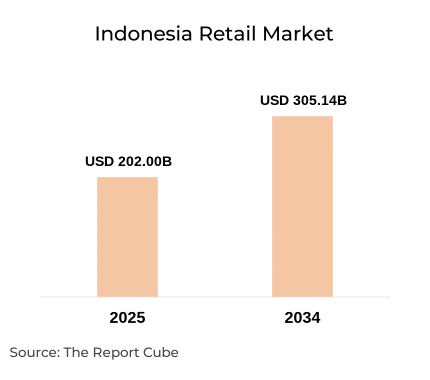
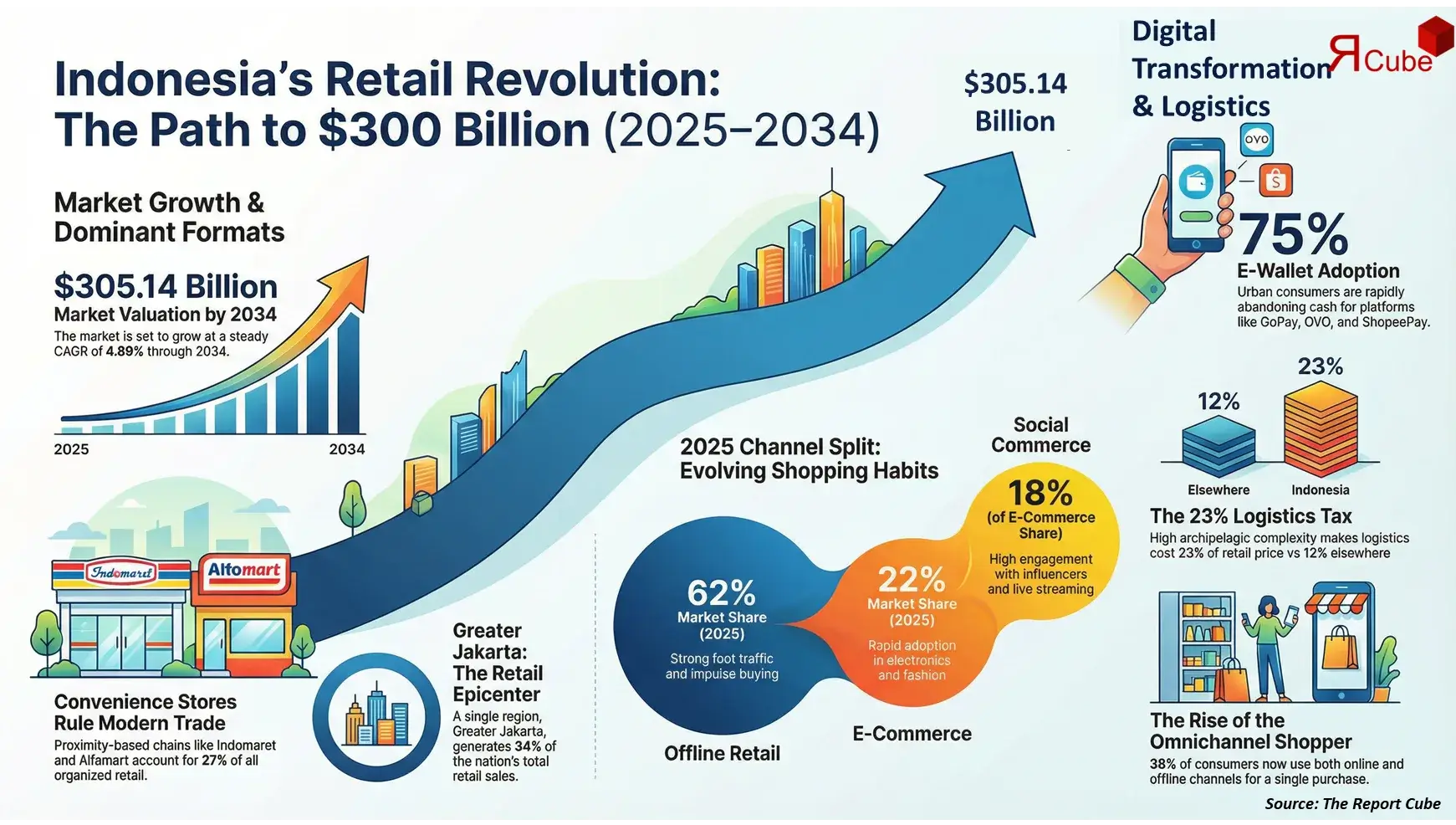
The Indonesia Retail Market is anticipated to register a CAGR of 4.69% during 2026-2034. The market size was valued at USD 202 billion in 2025 and is projected to reach USD 305.14 billion by 2034. Indonesia represents one of Southeast Asia’s most dynamic retail landscapes, supported by a population exceeding 275 million, rising urbanization, and steady growth in disposable incomes. The country’s expanding middle class, estimated to account for over 55% of households in 2025, continues to reshape consumption patterns toward modern retail formats, branded goods, and omnichannel shopping experiences.
Retail demand is further reinforced by favorable demographics, with nearly 70% of the population falling within the working-age bracket. Urban centers such as Greater Jakarta, Surabaya, Bandung, and Medan serve as consumption hubs, driving organized retail penetration. While traditional trade still contributes significantly, accounting for an estimated 42% of total retail sales in 2025, modern formats such as convenience stores, supermarkets, and department stores are rapidly expanding, particularly in urban and semi-urban areas.
Digital retail has emerged as a structural growth engine. Indonesia’s internet penetration crossed 78% in 2025, while smartphone usage exceeded 90% among urban consumers. This has accelerated e-commerce, mobile commerce, and social commerce adoption, particularly among younger consumers. Platforms such as Tokopedia and Shopee Indonesia are reshaping price transparency, logistics efficiency, and last-mile delivery models. As a result, the Indonesia Retail Market is transitioning from a predominantly offline ecosystem to a hybrid, digitally enabled model that supports sustained long-term growth.
Indonesia Retail Market Recent Developments
- 2025: Indomaret expanded over 1,000 new convenience outlets across secondary cities, strengthening last-mile neighborhood retail coverage.
- 2025: Shopee Indonesia introduced AI-driven seller analytics tools to improve pricing efficiency and inventory planning.
Government Initiatives & Policies
- National Digital Economy Blueprint: Program supporting MSME digitalization and e-commerce adoption across retail sectors.
- Trade Law No. 7/2014 Implementation: Policy promoting fair competition between modern retail and traditional trade.
Indonesia Retail Market Dynamics
Key Driver: Expanding Middle-Class Consumption and Urbanization
The most influential growth driver for the Indonesia Retail Market is the steady expansion of the middle-income population combined with rapid urbanization. Between 2020 and 2025, Indonesia added nearly 12 million urban residents, directly increasing demand for organized retail formats offering convenience, quality assurance, and diversified product assortments. Middle-class households allocate approximately 48% of monthly spending to food, apparel, personal care, and household products, benefiting supermarkets, department stores, and specialty retailers.
Modern retail chains leverage scale advantages, private labels, and centralized procurement to maintain competitive pricing, making them increasingly attractive to value-conscious consumers. Additionally, rising female workforce participation, which reached nearly 54% in 2025, supports demand for ready-to-consume products and one-stop shopping formats. These structural shifts collectively strengthen retail sales volumes and improve store productivity, positioning Indonesia as one of Asia’s fastest-growing consumer markets.
Book your FREE 30-minute expert consultation today
Contact UsIndustry Trends: Omnichannel Integration and Digital Payments
Omnichannel retailing has emerged as a defining trend within Indonesia’s retail ecosystem. Retailers are increasingly integrating offline stores with digital platforms to deliver seamless customer experiences. Click-and-collect services, in-store digital catalogs, and app-based loyalty programs are becoming standard across large retail chains. By 2025, nearly 38% of Indonesian shoppers used both online and offline channels for the same purchase cycle.
Digital payments further reinforce this trend. E-wallet adoption surpassed 75% among urban consumers, supported by platforms such as GoPay, OVO, and ShopeePay. Cashless transactions reduce checkout times, improve data collection, and support personalized promotions. Retailers adopting omnichannel strategies report sales uplifts of 15-20% compared to offline-only models, indicating strong momentum toward digitally enabled retail operations.
Major Challenge: Infrastructure Gaps and Logistics Complexity
Despite strong demand fundamentals, infrastructure limitations remain a significant challenge for the Indonesia Retail Market. As an archipelagic nation with over 17,000 islands, logistics costs account for nearly 23% of total retail product costs, compared to 12-15% in more centralized markets. Inconsistent cold-chain infrastructure impacts food retail, while limited warehousing capacity outside Java restricts inventory optimization.
Additionally, fragmented regulations across provinces increase compliance complexity for national retailers. These challenges disproportionately affect expansion into eastern regions such as Papua, Maluku, and parts of Kalimantan. Addressing infrastructure and logistics inefficiencies will be essential to unlock balanced nationwide retail growth.
Opportunity: Growth of Social Commerce and Local Brands
Social commerce represents one of the most promising growth opportunities within Indonesia’s retail sector. Platforms integrating live streaming, influencer marketing, and community-based selling are gaining rapid traction. By 2025, social commerce accounted for an estimated 18% of total online retail transactions, driven by high social media engagement and trust in peer recommendations.
This channel particularly benefits local and regional brands, enabling direct-to-consumer engagement with lower customer acquisition costs. Retailers that partner with creators and micro-influencers experience conversion rates nearly 2.5 times higher than traditional digital ads. As social commerce matures, it is expected to significantly reshape Indonesia’s retail value chain.
Indonesia Retail Market Segment-wise Analysis
By Type:
- Convenience Stores
- Supermarkets
- Hypermarkets
- Department Stores
- Specialty Stores
- Traditional Trade
- Other Formats
Convenience stores represent the leading sub-segment by type, accounting for approximately 27% of organized retail sales in 2025. Chains such as Indomaret and Alfamart dominate this segment, supported by dense outlet networks and proximity-based shopping. Their success is driven by high purchase frequency, affordable pricing, and extended operating hours. Convenience stores are particularly strong in urban and suburban neighborhoods, where they serve daily consumption needs. Supermarkets and hypermarkets follow, benefiting from bulk purchases and private-label growth, while traditional trade remains resilient in rural areas due to price sensitivity and personal relationships.
By Channel:
- Offline Retail
- E-Commerce
- Mobile Commerce
- Social Commerce
Offline retail continues to lead, contributing nearly 62% of total retail revenue in 2025, supported by strong foot traffic and impulse buying behavior. However, e-commerce is the fastest-growing channel, holding an estimated 22% market share. Mobile commerce and social commerce together account for the remaining share, driven by smartphone penetration and digital payment adoption. E-commerce growth is strongest in electronics, fashion, and beauty categories, while offline channels remain dominant for groceries and daily essentials.
Regional Projection of Indonesia Retail Industry
- Greater Jakarta
- Rest of Java
- Sumatra
- Kalimantan
- Sulawesi
- Bali & Nusa Tenggara
- Papua & Maluku
Greater Jakarta leads the Indonesia Retail Market, accounting for approximately 34% of total retail sales in 2025. The region benefits from the highest disposable incomes, advanced infrastructure, and dense retail networks. Mall-based retail, department stores, and omnichannel formats are highly concentrated in this region. Java outside Jakarta follows closely, supported by large population clusters and improving logistics. Sumatra and Kalimantan present emerging growth opportunities, while eastern regions remain underpenetrated but offer long-term expansion potential as infrastructure improves.
Need insights for a specific region within this market?
Request Regional DataWhy Choose This Report?
- Provides a comprehensive overview of the overall market analysis, encompassing key trends, consumer behavior analysis, and risk assessment to support strategic decision-making.
- Provides accurate, up-to-date insights into market size, segmentation, and emerging opportunities, helping to minimize risk & capitalizing on growth.
- Gives deep understanding of target audience preferences, investment habits, and communication channels for enhanced product development & marketing effectiveness.
- Delivers competitive analysis & benchmarking, uncovering the strengths & weaknesses of market competitors to guide strategies.
- Consolidate comprehensive market intelligence, reducing reasoning & streamlining research efforts.
- Facilitates customized market segmentation & risk mitigation strategies, fine-tuned to the business objectives.
- Aids in identifying both market challenges & untapped opportunities within the industry to drive long-term business growth.
- Provides valuable information based on actual customer data & search trends.
Table of Contents
- Introduction
- Objective of the Study
- Product and Category Definition
- Market Segmentation
- Study Variables
- Research Methodology
- Secondary Data Points
- Breakdown of Secondary Sources
- Primary Data Points
- Breakdown of Primary Interviews
- Secondary Data Points
- Executive Summary
- Market Dynamics
- Drivers
- Challenges
- Opportunity Assessment
- Recent Trends and Developments
- Regulatory and Policy Landscape
- Indonesia Retail Market Overview (2020-2034)
- Market Size, By Value (USD Billion)
- Market Share, By Type
- Convenience Stores
- Supermarkets
- Hypermarkets
- Department Stores
- Specialty Stores
- Traditional Trade
- Other Formats
- Market Share, By Channel
- Offline Retail
- E-Commerce
- Mobile Commerce
- Social Commerce
- Market Share, By Category
- Food & Grocery
- Fashion & Apparel
- Consumer Electronics
- Beauty & Personal Care
- Home & Living
- Other Categories
- Market Share, By Payment
- Cash
- Cards
- E-Wallets
- Bank Transfers
- Pay-Later
- Market Share, By Region
- Greater Jakarta
- Rest of Java
- Sumatra
- Kalimantan
- Sulawesi
- Bali & Nusa Tenggara
- Papua & Maluku
- Market Share, By Company
- Revenue Shares
- Competition Characteristics
- Revenue Shares & Analysis
- Greater Jakarta Retail Market
- Market Size, By Value (USD Billion)
- Market Share, By Format
- Market Share, By Channel
- Market Share, By Category
- Market Share, By Payment
- Rest of Java Retail Market
- Market Size, By Value (USD Billion)
- Market Share, By Format
- Market Share, By Channel
- Market Share, By Category
- Market Share, By Payment
- Sumatra Retail Market
- Market Size, By Value (USD Billion)
- Market Share, By Format
- Market Share, By Channel
- Market Share, By Category
- Market Share, By Payment
- Kalimantan Retail Market
- Market Size, By Value (USD Billion)
- Market Share, By Format
- Market Share, By Channel
- Market Share, By Category
- Market Share, By Payment
- Sulawesi Retail Market
- Market Size, By Value (USD Billion)
- Market Share, By Format
- Market Share, By Channel
- Market Share, By Category
- Market Share, By Payment
- Bali & Nusa Tenggara Retail Market
- Market Size, By Value (USD Billion)
- Market Share, By Format
- Market Share, By Channel
- Market Share, By Category
- Market Share, By Payment
- Papua & Maluku Retail Market
- Market Size, By Value (USD Billion)
- Market Share, By Format
- Market Share, By Channel
- Market Share, By Category
- Market Share, By Payment
- Competitive Outlook and Company Profiles
- Indomaret
- Company Overview
- Store Network & Formats
- Digital & Omnichannel Initiatives
- Recent Developments
- Alfamart
- Company Overview
- Store Network & Formats
- Digital & Omnichannel Initiatives
- Recent Developments
- Matahari
- Company Overview
- Store Network & Formats
- Digital & Omnichannel Initiatives
- Recent Developments
- Trans Retail Indonesia
- Company Overview
- Store Network & Formats
- Digital & Omnichannel Initiatives
- Recent Developments
- Hero Group
- Company Overview
- Store Network & Formats
- Digital & Omnichannel Initiatives
- Recent Developments
- Lotte Mart Indonesia
- Company Overview
- Store Network & Formats
- Digital & Omnichannel Initiatives
- Recent Developments
- Erajaya Swasembada
- Company Overview
- Store Network & Formats
- Digital & Omnichannel Initiatives
- Recent Developments
- Ramayana Lestari Sentosa
- Company Overview
- Store Network & Formats
- Digital & Omnichannel Initiatives
- Recent Developments
- Tokopedia
- Company Overview
- Platform & Categories
- Partnerships & Ecosystem
- Recent Developments
- Shopee Indonesia
- Company Overview
- Platform & Categories
- Partnerships & Ecosystem
- Recent Developments
- Others
- Indomaret
- Contact Us and Disclaimer
Top Key Players & Market Share Outlook
- Indomaret
- Alfamart
- Matahari
- Trans Retail Indonesia
- Hero Group
- Lotte Mart Indonesia
- Erajaya Swasembada
- Ramayana Lestari Sentosa
- Tokopedia
- Shopee Indonesia
- Others
Frequently Asked Questions






