



Build Your Custom Market Intelligence Report
Customize Your ReportEgypt Beauty and Personal Care Market Insights & Analysis
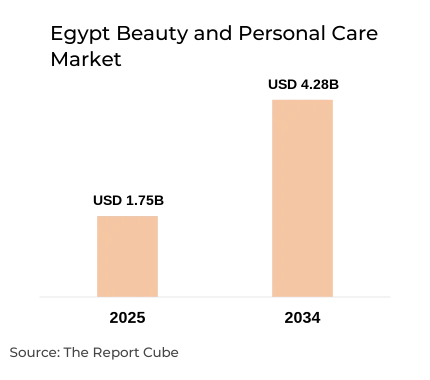
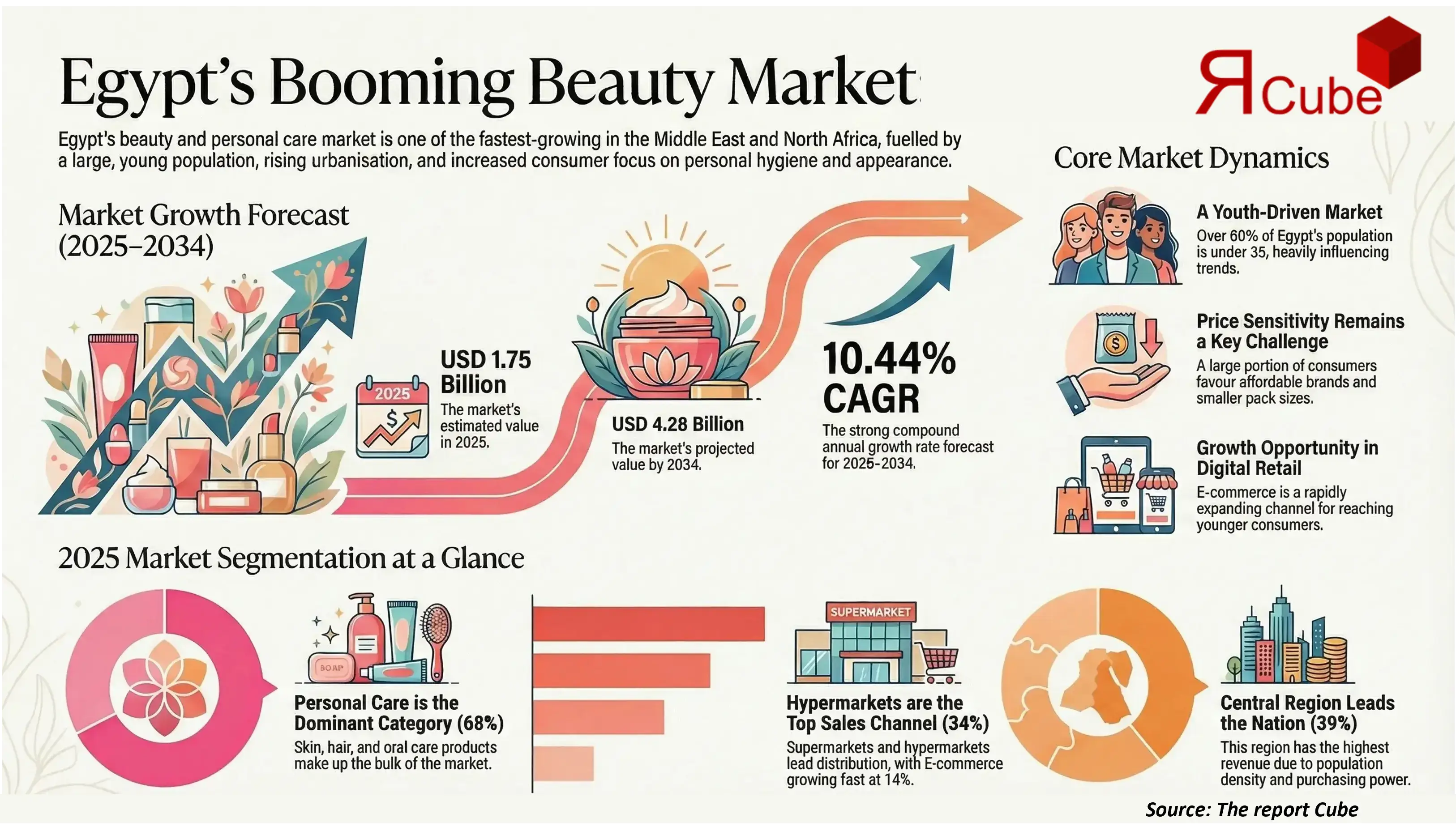
The Egypt Beauty and Personal Care Market is anticipated to register a CAGR of 10.44% during 2026-2034. The market size was valued at USD 1.75 billion in 2025 and is projected to reach USD 4.28 billion by 2034. Egypt represents one of the fastest-growing beauty and personal care markets in the Middle East and North Africa, supported by a young population, rising urbanization, and increasing consumer awareness around personal hygiene and appearance. With more than 60% of the population under the age of 35, demand is strongly influenced by social media exposure, evolving beauty standards, and aspirational consumption. Beauty and personal care products are transitioning from discretionary items to everyday essentials, particularly in skin care, hair care, and oral hygiene, driving sustained volume and value growth across the market.
Economic normalization, improving retail access, and expanding digital connectivity are reshaping consumption patterns within the Egypt Beauty and Personal Care Market. Urban consumers increasingly seek branded, dermatologically tested, and value-for-money products, while rural and semi-urban areas continue to drive volume growth through affordable mass-market offerings. Local manufacturers coexist with multinational brands, creating a competitive landscape that balances price sensitivity with brand trust. In addition, climate conditions such as heat, sun exposure, and humidity influence strong demand for skin protection, deodorants, and hair care solutions. These structural and cultural factors collectively underpin the market’s high-growth trajectory over the forecast period.
Egypt Beauty and Personal Care Market Recent Developments
- 2025: L’Oréal Egypt launched climate-adapted skin care formulations targeting heat protection and hydration for Egyptian consumers.
- 2025: Unilever Egypt expanded local manufacturing to increase affordable personal care supply across urban regions nationwide.
Government Initiatives & Policies
- Local Manufacturing Support Programs: Initiatives encouraging domestic production of consumer goods, including cosmetics and personal care products.
- Consumer Protection and Quality Regulations: Policies aimed at improving product safety, labeling standards, and import controls.
Egypt Beauty and Personal Care Market Dynamics
Key Driver: Young Demographics and Rising Personal Care Awareness
A rapidly growing young population is the primary driver of the Egypt Beauty and Personal Care Market. Younger consumers demonstrate higher engagement with grooming routines, beauty trends, and personal hygiene products, influenced heavily by social media, digital marketing, and peer consumption patterns. Increased awareness around skin health, hair maintenance, and oral hygiene has elevated everyday product usage across income groups. Additionally, women’s workforce participation and evolving lifestyle habits are expanding demand for convenience-oriented and multi-functional products. These demographic and behavioral shifts ensure that demand growth is broad-based and sustained, rather than limited to premium segments alone.
Major Challenge: Price Sensitivity and Income Disparities
Despite strong growth momentum, price sensitivity remains a key constraint in the Egypt Beauty and Personal Care Market. A large portion of consumers operate within tight household budgets, favoring affordable brands and smaller pack sizes. Inflationary pressures and currency fluctuations can impact imported raw materials and finished products, influencing retail pricing. While premium brands are gaining traction in urban centers, mass-market products continue to dominate overall volume. Manufacturers must balance quality, compliance, and affordability to maintain competitiveness, making pricing strategy a central challenge for both local and international players.
Industry Trends: Shift Toward Skin Care, Natural Ingredients, and Men’s Grooming
Several notable trends are reshaping the Egypt Beauty and Personal Care Market. Skin care has emerged as a priority category, driven by concerns around sun exposure, acne, and pollution-related skin issues. Consumers increasingly prefer products with natural ingredients, herbal extracts, and dermatological positioning. Men’s grooming products, including beard care, deodorants, and skin care, are also witnessing accelerated adoption as grooming norms evolve. These trends are influencing product innovation, marketing strategies, and shelf allocation across modern and traditional retail formats.
Opportunity Ahead: Digital Retail and Regional Market Penetration
Future growth opportunities lie in expanding digital retail channels and deepening penetration beyond major urban centers. E-commerce platforms enable brands to reach younger consumers, offer product education, and introduce new launches efficiently. At the same time, underserved regions present volume growth potential for affordable personal care products. Companies that invest in localized pricing, distribution partnerships, and culturally relevant marketing are well positioned to capture incremental demand across Egypt’s diverse consumer base.
Egypt Beauty and Personal Care Market Segment-wise Analysis
By Type:
- Cosmetic Products
- Personal Care Products
Personal care products represent the dominant segment within the Egypt Beauty and Personal Care Market, accounting for approximately 68% of total market value in 2025. This dominance reflects the essential nature of daily-use categories such as skin care, hair care, oral care, and bath products. Cosmetic products, including facial, eye, and lip make-up, account for the remaining share, supported by younger consumers and social-media-driven beauty adoption. Market shares are derived from retail sales data, consumption frequency, and household expenditure patterns.
By Distribution Channel:
- Hypermarkets & Supermarkets
- Convenience Stores & Traditional Retail
- Specialty Stores
- Departmental Stores
- E-commerce Platforms
- Direct Selling
- Others
Hypermarkets and supermarkets lead distribution, contributing approximately 34% of total sales in 2025, driven by high footfall and broad product availability. Convenience stores and traditional retail channels follow closely, particularly in non-urban areas. E-commerce platforms account for around 14% of sales and are growing rapidly due to mobile penetration and promotional pricing. Specialty stores and pharmacies serve higher-value skin care and cosmetic purchases, while direct selling maintains relevance in specific consumer segments.
Regional Projection of Egypt Beauty and Personal Care Industry
- East
- West
- South
- Central
- Others
The Central region leads the Egypt Beauty and Personal Care Market, accounting for approximately 39% of total market revenue in 2025. This leadership is driven by high population density, stronger purchasing power, and concentration of modern retail infrastructure. The East and West regions follow, supported by urban development and retail expansion. Southern regions contribute a smaller share but present long-term growth potential as distribution access improves. Regional shares are based on population distribution, retail density, and consumption expenditure trends.
Why Choose This Report?
- Provides a comprehensive overview of the overall market analysis, including key growth drivers and risk factors.
- Delivers accurate, up-to-date insights into market size, segmentation, and forecast trends.
- Offers deep understanding of consumer behavior and evolving beauty preferences.
- Supports competitive benchmarking and strategic planning.
- Reduces research complexity through structured, data-driven analysis.
- Facilitates customized segmentation and go-to-market strategies.
- Highlights both market challenges and untapped growth opportunities.
- Grounds insights in real consumer spending and retail data.
Table of Contents
- Introduction
- Objective of the Study
- Product/Category Definition
- Market Segmentation
- Study Variables
- Research Methodology
- Secondary Data Points
- Breakdown of Secondary Sources
- Primary Data Points
- Breakdown of Primary Interviews
- Secondary Data Points
- Executive Summary
- Market Dynamics
- Drivers
- Challenges
- Opportunity Assessment
- Recent Trends and Developments
- Policy and Regulatory Landscape
- Egypt Beauty and Personal Care Market Overview (2020-2034)
- Market Size, By Volume & Value (EGP Million / USD Million)
- Market Share, By Type
- Cosmetic Products
- Facial Make-up Products
- Eye Make-up Products
- Lip and Nail Make-up Products
- Hair Styling and Coloring Products
- Personal Care
- Skin Care
- Facial Skin Care Products
- Body Skin Care Products
- Lip Care Products
- Sun Care Products
- Hair Care
- Shampoo
- Conditioners
- Hair Oils
- Hair Styling Products
- Oral Care
- Toothpaste
- Toothbrushes
- Mouthwash and Rinses
- Bath and Shower
- Soaps
- Shower Gels
- Others
- Deodorants, Perfumes, and Antiperspirants
- Men’s Grooming Products
- Baby and Child Care Products
- Skin Care
- Cosmetic Products
- Market Share, By Distribution Channel
- Hypermarkets & Supermarkets
- Convenience Stores & Traditional Retail
- Specialty Stores
- Cosmetic Specialty Stores
- Pharmacies & Drug Stores
- Departmental Stores
- E-commerce Platforms
- Direct Selling
- Others
- Market Share, By Region
- East
- West
- South
- Central
- Market Share, By Company
- Revenue Shares
- Competitive Landscape
- East Egypt Beauty and Personal Care Market
- Market Size, By Volume & Value (EGP Million)
- Market Share, By Type
- Market Share, By Distribution Channel
- Market Share, By Key Consumer Groups
- West Egypt Beauty and Personal Care Market
- Market Size, By Volume & Value (EGP Million)
- Market Share, By Type
- Market Share, By Distribution Channel
- Market Share, By Key Consumer Groups
- South Egypt Beauty and Personal Care Market
- Market Size, By Volume & Value (EGP Million)
- Market Share, By Type
- Market Share, By Distribution Channel
- Market Share, By Key Consumer Groups
- Central Egypt Beauty and Personal Care Market
- Market Size, By Volume & Value (EGP Million)
- Market Share, By Type
- Market Share, By Distribution Channel
- Market Share, By Key Consumer Groups
- Competitive Outlook & Company Profiles
- L’Oréal Egypt
- Company Overview
- Brand Portfolio
- Strategic Alliances/Partnerships
- Recent Developments
- Unilever Egypt
- Company Overview
- Brand Portfolio
- Strategic Alliances/Partnerships
- Recent Developments
- Procter & Gamble Egypt
- Company Overview
- Brand Portfolio
- Strategic Alliances/Partnerships
- Recent Developments
- Beiersdorf AG
- Company Overview
- Brand Portfolio
- Strategic Alliances/Partnerships
- Recent Developments
- Reckitt Benckiser Egypt
- Company Overview
- Brand Portfolio
- Strategic Alliances/Partnerships
- Recent Developments
- Johnson & Johnson
- Company Overview
- Brand Portfolio
- Strategic Alliances/Partnerships
- Recent Developments
- Colgate-Palmolive Egypt
- Company Overview
- Brand Portfolio
- Strategic Alliances/Partnerships
- Recent Developments
- Henkel Egypt
- Company Overview
- Brand Portfolio
- Strategic Alliances/Partnerships
- Recent Developments
- Estée Lauder Companies
- Company Overview
- Brand Portfolio
- Strategic Alliances/Partnerships
- Recent Developments
- Coty Inc.
- Company Overview
- Brand Portfolio
- Strategic Alliances/Partnerships
- Recent Developments
- Eva Cosmetics
- Company Overview
- Brand Portfolio
- Strategic Alliances/Partnerships
- Recent Developments
- Oriflame Egypt
- Company Overview
- Brand Portfolio
- Strategic Alliances/Partnerships
- Recent Developments
- Others
- L’Oréal Egypt
- Contact Us / Disclaimer
Top Key Players & Market Share Outlook
- L’Oréal Egypt
- Unilever Egypt
- Procter & Gamble Egypt
- Beiersdorf AG
- Reckitt Benckiser Egypt
- Johnson & Johnson
- Colgate-Palmolive Egypt
- Henkel Egypt
- Estée Lauder Companies
- Coty Inc.
- Eva Cosmetics
- Oriflame Egypt
- Others
Frequently Asked Questions






