



Build Your Custom Market Intelligence Report
Customize Your ReportUAE Industrial IoT (IIoT) Market Insights & Analysis
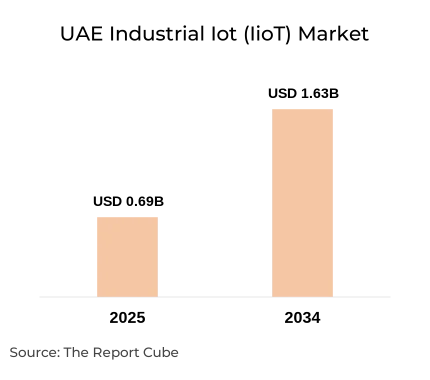
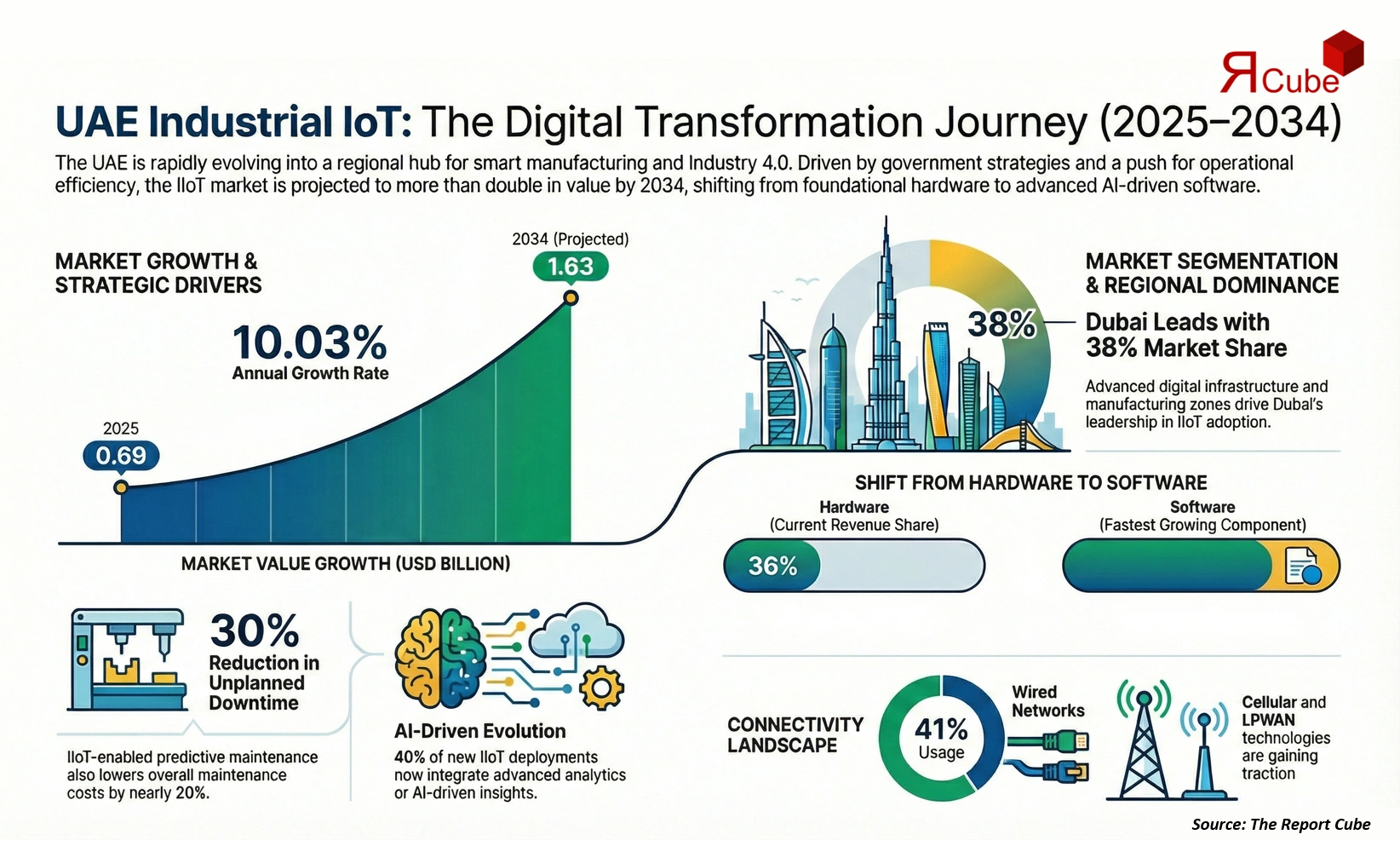
The UAE Industrial IoT (IIoT) Market is anticipated to register a CAGR of 10.03% during 2026-2034. The market size was valued at USD 0.69 billion in 2025 and is projected to reach USD 1.63 billion by 2034. The UAE is rapidly positioning itself as a regional hub for smart manufacturing and digital industrial transformation, driven by strong government backing and increasing private-sector investments. Industrial IoT adoption is becoming a strategic priority across energy, utilities, manufacturing, logistics, and construction sectors to enhance productivity, safety, and asset efficiency.
The market’s momentum is closely linked to the UAE’s push toward Industry 4.0, where connected sensors, real-time analytics, and automation platforms are integrated into industrial operations. Organizations are leveraging IIoT solutions to reduce downtime, optimize energy usage, and enable predictive maintenance. As industrial facilities modernize legacy infrastructure, IIoT platforms are increasingly viewed as long-term efficiency enablers rather than short-term technology upgrades.
Moreover, the growing convergence of cloud computing, edge analytics, and artificial intelligence is accelerating IIoT deployment across the country. With strong digital infrastructure and high connectivity readiness, the UAE IIoT market is expected to witness sustained adoption, supporting long-term industrial competitiveness and operational resilience through 2034.
UAE Industrial IoT (IIoT) Market Recent Developments
- 2025: ABB expanded its industrial automation portfolio in the UAE with advanced IIoT-enabled predictive maintenance solutions.
- 2025: Siemens strengthened partnerships with UAE manufacturers to deploy digital twin and smart factory platforms.
Government Initiatives & Policies
- UAE Industry 4.0 Strategy: National initiative promoting smart manufacturing and IIoT adoption across industrial sectors.
- Dubai Industrial Strategy 2030: Program supporting advanced manufacturing, automation, and digital industrial ecosystems.
UAE Industrial IoT (IIoT) Market Dynamics
Key Driver: Strong Push Toward Smart Manufacturing and Operational Efficiency
The primary driver of the UAE Industrial IoT Market is the strong national focus on smart manufacturing and operational efficiency. Industrial players are increasingly deploying IIoT solutions to monitor equipment performance, automate workflows, and reduce operational losses. Studies indicate that predictive maintenance enabled by IIoT can lower maintenance costs by nearly 20% while reducing unplanned downtime by over 30%. In energy-intensive industries such as oil and gas, real-time asset monitoring and remote operations are significantly improving safety and productivity. These measurable benefits are encouraging widespread IIoT investment across both large enterprises and mid-sized industrial operators.
Book your FREE 30-minute expert consultation today
Contact UsIndustry Trends: Integration of AI, Edge Computing, and Digital Twins
A major trend shaping the UAE IIoT landscape is the integration of artificial intelligence, edge computing, and digital twin technologies. Instead of relying solely on centralized cloud processing, industries are deploying edge devices to process data closer to the source, enabling faster decision-making and lower latency. Digital twins are gaining traction in manufacturing and utilities, allowing operators to simulate asset behavior and optimize performance before physical implementation. Approximately 40% of new IIoT deployments in the UAE now include some form of advanced analytics or AI-driven insights, highlighting the market’s evolution beyond basic connectivity.
Major Challenge: High Integration Complexity with Legacy Systems
Despite strong growth prospects, integration complexity with legacy industrial systems remains a significant challenge. Many UAE industrial facilities operate aging equipment that was not originally designed for connectivity or data exchange. Retrofitting such infrastructure with sensors, gateways, and secure communication layers requires high upfront investment and technical expertise. Additionally, ensuring interoperability between multi-vendor IIoT platforms can slow deployment timelines. Concerns around cybersecurity and data governance further add to implementation complexity, particularly for critical infrastructure sectors such as utilities and oil and gas.
Opportunity: Expanding Adoption Across Utilities and Smart Infrastructure
The expansion of smart utilities and infrastructure projects presents a major opportunity for the UAE Industrial IoT Market. Water management, power distribution, and district cooling systems are increasingly adopting IIoT solutions for real-time monitoring and demand forecasting. With urbanization and population growth driving higher utility consumption, IIoT-enabled optimization can deliver significant cost savings and sustainability benefits. As government-backed smart city initiatives scale, IIoT vendors have substantial opportunities to provide integrated platforms that support long-term infrastructure modernization.
UAE Industrial IoT (IIoT) Market Segment-wise Analysis
By Component:
- Hardware
- Software
- Services
- Connectivity
Among components, hardware dominates the UAE IIoT market, accounting for nearly 36% of total revenue in 2025. Sensors, gateways, and industrial controllers form the foundation of IIoT deployments, particularly in manufacturing and energy sectors. However, software is the fastest-growing component, driven by rising demand for analytics platforms, device management, and digital twin solutions. As IIoT maturity increases, spending is gradually shifting from hardware installation toward software-driven optimization and managed services.
By Connectivity:
- Wired Networks
- Cellular IoT
- LPWAN
- Short-Range IoT
Wired networks currently hold the largest share, representing approximately 41% of connectivity usage due to their reliability in industrial environments. However, cellular IoT is gaining rapid traction, particularly for remote asset monitoring and mobile equipment. LPWAN technologies are also emerging in utilities and smart metering applications, offering cost-effective, long-range connectivity. The diversification of connectivity options is enabling broader IIoT adoption across varied industrial use cases.
Regional Projection of UAE Industrial IoT (IIoT) Industry
- Dubai
- Abu Dhabi
- Sharjah
- Northern Emirates
Dubai leads the UAE Industrial IoT Market, contributing nearly 38% of total market revenue in 2025. The emirate’s advanced digital infrastructure, concentration of manufacturing zones, and strong smart city initiatives drive higher IIoT adoption. Abu Dhabi follows closely, supported by large-scale energy and industrial projects. Sharjah and the Northern Emirates are witnessing gradual uptake as industrial clusters expand and government incentives encourage digital transformation across smaller industrial operators.
Need insights for a specific region within this market?
Request Regional DataWhy Choose This Report?
- Provides a comprehensive overview of the overall market analysis, encompassing key trends, consumer behavior analysis, and risk assessment to support strategic decision-making.
- Provides accurate, up-to-date insights into market size, segmentation, and emerging opportunities, helping to minimize risk & capitalizing on growth.
- Gives deep understanding of target audience preferences, investment habits, and communication channels for enhanced product development & marketing effectiveness.
- Delivers competitive analysis & benchmarking, uncovering the strengths & weaknesses of market competitors to guide strategies.
- Consolidate comprehensive market intelligence, reducing reasoning & streamlining research efforts.
- Facilitates customized market segmentation & risk mitigation strategies, fine-tuned to the business objectives.
- Aids in identifying both market challenges & untapped opportunities within the industry to drive long-term business growth.
- Provides valuable information based on actual customer data & search trends.
Table of Contents
- Introduction
- Objective of the Study
- Product and Category Definition
- Market Segmentation
- Study Variables
- Research Methodology
- Secondary Data Points
- Breakdown of Secondary Sources
- Primary Data Points
- Breakdown of Primary Interviews
- Secondary Data Points
- Executive Summary
- Market Dynamics
- Drivers
- Challenges
- Opportunity Assessment
- Recent Trends and Developments
- Regulatory and Policy Landscape
- UAE Industrial IoT Market Overview (2020-2034)
- Market Size, By Value (USD Billion)
- Market Share, By Component
- Hardware
- Software
- Services
- Connectivity
- Market Share, By Connectivity
- Wired Networks
- Cellular IoT
- LPWAN
- Short‑Range IoT
- Market Share, By Application
- Predictive Maintenance
- Asset Tracking
- Process Automation
- Remote Monitoring
- Market Share, By End‑User
- Manufacturing
- Oil and Gas
- Utilities
- Transport & Logistics
- Market Share, By Region
- Dubai
- Abu Dhabi
- Sharjah
- Northern
- Market Share, By Company
- Revenue Shares
- Competitive Landscape
- Dubai Industrial IoT Market
- Market Size, By Value (USD Billion)
- Market Share, By Component
- Market Share, By Connectivity
- Market Share, By Application
- Market Share, By End‑User
- Abu Dhabi Industrial IoT Market
- Market Size, By Value (USD Billion)
- Market Share, By Component
- Market Share, By Connectivity
- Market Share, By Application
- Market Share, By End‑User
- Sharjah Industrial IoT Market
- Market Size, By Value (USD Billion)
- Market Share, By Component
- Market Share, By Connectivity
- Market Share, By Application
- Market Share, By End‑User
- Northern Industrial IoT Market
- Market Size, By Value (USD Billion)
- Market Share, By Component
- Market Share, By Connectivity
- Market Share, By Application
- Market Share, By End‑User
- Competitive Outlook and Company Profiles
- Siemens
- Company Overview
- Product Portfolio
- Strategic Alliances/Partnerships
- Recent Developments
- Cisco Systems
- Company Overview
- Product Portfolio
- Strategic Alliances/Partnerships
- Recent Developments
- Honeywell
- Company Overview
- Product Portfolio
- Strategic Alliances/Partnerships
- Recent Developments
- ABB
- Company Overview
- Product Portfolio
- Strategic Alliances/Partnerships
- Recent Developments
- Schneider Electric
- Company Overview
- Product Portfolio
- Strategic Alliances/Partnerships
- Recent Developments
- IBM
- Company Overview
- Product Portfolio
- Strategic Alliances/Partnerships
- Recent Developments
- Microsoft
- Company Overview
- Product Portfolio
- Strategic Alliances/Partnerships
- Recent Developments
- GE Digital
- Company Overview
- Product Portfolio
- Strategic Alliances/Partnerships
- Recent Developments
- PTC
- Company Overview
- Product Portfolio
- Strategic Alliances/Partnerships
- Recent Developments
- Dell Technologies
- Company Overview
- Product Portfolio
- Strategic Alliances/Partnerships
- Recent Developments
- Others
- Siemens
- Contact Us and Disclaimer
Top Key Players & Market Share Outlook
- Siemens
- Cisco Systems
- Honeywell
- ABB
- Schneider Electric
- IBM
- Microsoft
- GE Digital
- PTC
- Dell Technologies
- Others
Frequently Asked Questions






