



Build Your Custom Market Intelligence Report
Customize Your ReportUnited States (US) Blockchain Gaming Market Insights & Analysis
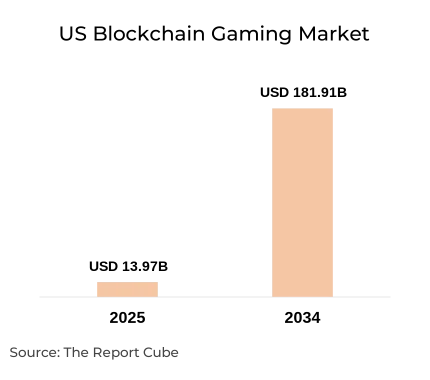
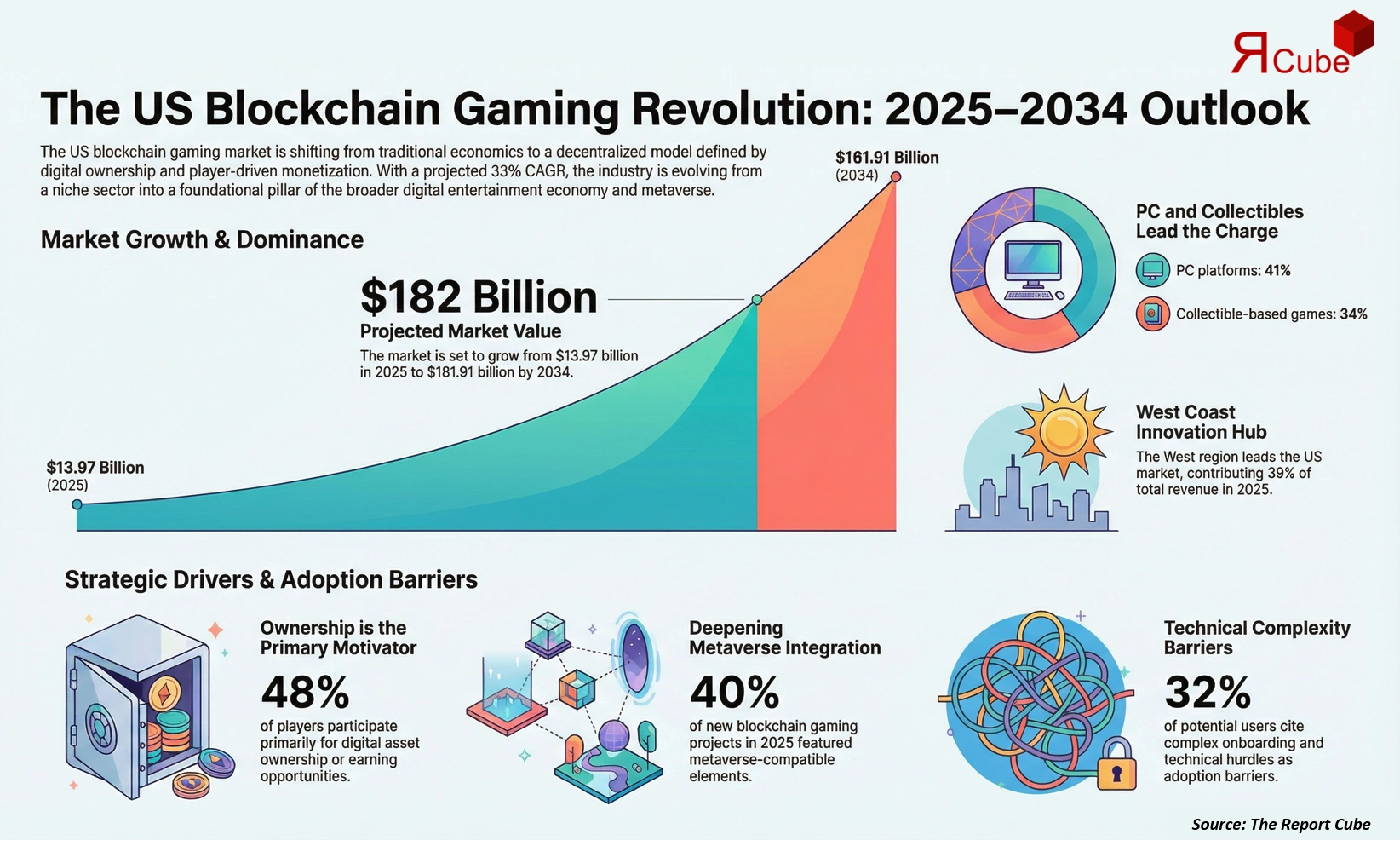
The United States Blockchain Gaming Market is anticipated to register a CAGR of 33% during 2026-2034. The market size was valued at USD 13.97 billion in 2025 and is projected to reach USD 181.91 billion by 2034. The market is undergoing exponential growth as blockchain technology reshapes traditional gaming economics by enabling true digital ownership, decentralized ecosystems, and player-driven monetization. Unlike conventional games, blockchain gaming introduces interoperable assets, non-fungible tokens, and transparent reward mechanisms, creating a fundamentally new value proposition for both developers and players.
This rapid expansion is further supported by strong venture capital inflows, widespread adoption of Web3 technologies, and increasing interest from mainstream gamers seeking ownership and earning opportunities. US-based studios are at the forefront of innovation, leveraging advanced game engines, scalable blockchains, and immersive gameplay to overcome early adoption barriers. Additionally, partnerships between gaming studios, crypto platforms, and entertainment brands are accelerating market penetration while enhancing user trust and accessibility.
Moreover, the convergence of blockchain gaming with metaverse environments is strengthening long-term market potential. As virtual worlds gain traction across social, entertainment, and commerce applications, blockchain-based games are becoming foundational layers within these ecosystems. This interconnected growth dynamic positions the US Blockchain Gaming Market as a key driver of the broader digital entertainment economy through 2034.
United States Blockchain Gaming Market Recent Developments
- 2025: Mythical Games expanded its NFT marketplace infrastructure to support multi-chain gaming assets.
- 2025: Gala Games launched a new US-based blockchain title integrating play-to-own mechanics.
Government Initiatives & Policies
- US Digital Asset Regulatory Framework Initiative: Supports innovation while improving clarity for blockchain-based businesses.
- National Blockchain Roadmap: Encourages responsible blockchain adoption across digital industries.
United States Blockchain Gaming Market Dynamics
Key Driver: Rising Adoption of Play-to-Earn and Play-to-Own Models
The accelerating adoption of play-to-earn and play-to-own gaming models is a primary driver of the US Blockchain Gaming Market. These models fundamentally shift value creation by rewarding players with tradable digital assets that carry real-world economic value. Nearly 48% of US blockchain gamers in 2025 participated primarily for asset ownership or earning opportunities, reflecting a major behavioral shift. This incentive-driven engagement boosts retention rates and community participation while encouraging secondary market activity. As players gain greater financial and creative control, developers benefit from decentralized economies that extend game lifecycles and reduce reliance on traditional monetization methods.
Book your FREE 30-minute expert consultation today
Contact UsIndustry Trends: Integration of Blockchain Gaming with the Metaverse
The integration of blockchain gaming with metaverse platforms is a defining industry trend shaping market evolution. Open-world and collectible blockchain games are increasingly embedded within persistent virtual environments, enabling cross-game asset interoperability and social interaction. In the US, over 40% of new blockchain gaming projects launched in 2025 included metaverse-compatible features. This trend enhances immersion and broadens user engagement beyond gameplay into social, creative, and commercial activities. As virtual land ownership, avatar customization, and in-game economies expand, blockchain gaming is emerging as a core pillar of the metaverse ecosystem.
Major Challenge: Scalability and User Experience Limitations
Despite strong growth, scalability and user experience challenges remain significant barriers to mass adoption. High transaction fees, network congestion, and complex wallet onboarding processes can deter mainstream gamers accustomed to seamless gameplay. Approximately 32% of potential US users cited technical complexity as a key adoption hurdle in 2025. While Layer-2 solutions and improved user interfaces are mitigating these issues, developers must continue prioritizing performance optimization and simplified onboarding to compete with traditional gaming platforms and sustain long-term growth.
Opportunity: Expansion into Mobile and Casual Gaming Segments
The expansion of blockchain gaming into mobile and casual gaming segments presents a substantial growth opportunity. Mobile gaming accounts for over 50% of total US gaming revenue, yet blockchain penetration remains relatively low. By introducing lightweight blockchain integrations, gas-free transactions, and familiar casual gameplay mechanics, developers can attract a broader demographic. This approach enables mass-market adoption while maintaining blockchain benefits in the background, positioning mobile blockchain games as a high-growth opportunity through 2034.
United States Blockchain Gaming Market Segment-wise Analysis
By Game Type:
- Role Playing
- Open World
- Collectible Games
- Casual Arcade
Collectible blockchain games lead the market by game type, accounting for approximately 34% market share in 2025. Their dominance stems from strong demand for NFT-based assets, digital trading, and community-driven economies. Collectible games benefit from lower development costs and higher asset liquidity compared to complex role-playing titles. Open-world games are gaining momentum, driven by metaverse integration, while role-playing games continue to attract core gamers seeking deeper engagement.
By Platform:
- PC/Desktop
- Mobile
- Console
- Browser
PC/Desktop platforms dominate the US Blockchain Gaming Market with nearly 41% share in 2025. This leadership is supported by higher processing capabilities, advanced graphics, and better wallet integration. However, mobile platforms are the fastest-growing segment, driven by improvements in blockchain scalability and increasing mobile gamer adoption. Browser-based games remain relevant for onboarding new users due to ease of access.
Regional Projection of United States Blockchain Gaming Industry
- Northeast
- Midwest
- South
- West
The West region leads the US Blockchain Gaming Market, contributing approximately 39% of total revenue in 2025. This dominance is driven by the concentration of blockchain startups, gaming studios, and venture capital firms across states such as California and Washington. The region benefits from strong developer ecosystems, early technology adoption, and favorable innovation culture. Meanwhile, the South is emerging as a high-growth region due to expanding tech hubs and increasing blockchain-friendly policies.
Need insights for a specific region within this market?
Request Regional DataWhy Choose This Report?
- Provides a comprehensive overview of the overall market analysis, encompassing key trends, consumer behavior analysis, and risk assessment to support strategic decision-making.
- Provides accurate, up-to-date insights into market size, segmentation, and emerging opportunities, helping to minimize risk & capitalizing on growth.
- Gives deep understanding of target audience preferences, investment habits, and communication channels for enhanced product development & marketing effectiveness.
- Delivers competitive analysis & benchmarking, uncovering the strengths & weaknesses of market competitors to guide strategies.
- Consolidate comprehensive market intelligence, reducing reasoning & streamlining research efforts.
- Facilitates customized market segmentation & risk mitigation strategies, fine-tuned to the business objectives.
- Aids in identifying both market challenges & untapped opportunities within the industry to drive long-term business growth.
- Provides valuable information based on actual customer data & search trends.
Table of Contents
- Introduction
- Objective of the Study
- Product and Category Definition
- Market Segmentation
- Study Variables
- Research Methodology
- Secondary Data Points
- Breakdown of Secondary Sources
- Primary Data Points
- Breakdown of Primary Interviews
- Secondary Data Points
- Executive Summary
- Market Dynamics
- Drivers
- Challenges
- Opportunity Assessment
- Recent Trends and Developments
- Regulatory and Policy Landscape
- US Blockchain Gaming Market Overview (2021-2034)
- Market Size, By Value (USD Billion)
- Market Share, By Game Type
- Role Playing
- Open World
- Collectible Games
- Casual Arcade
- Strategy/Card
- Market Share, By Platform
- PC/Desktop
- Mobile
- Console
- Browser
- Market Share, By Business Model
- Play-to-Earn
- Free-to-Play
- Pay-to-Play
- Subscription
- Market Share, By Technology
- Public Chains
- Sidechains
- Layer-2
- Private Chains
- Market Share, By Asset Type
- NFT Items
- Game Tokens
- Land Assets
- Utility Passes
- Market Share, By Region
- Northeast
- Midwest
- South
- West
- Market Share, By Company
- Competition Characteristics
- Revenue Shares & Analysis
- Northeast US Blockchain Gaming Market
- Market Size, By Value (USD Billion)
- Market Share, By Game Type
- Market Share, By Platform
- Market Share, By Business Model
- Market Share, By Technology
- Market Share, By Asset Type
- Midwest US Blockchain Gaming Market
- Market Size, By Value (USD Billion)
- Market Share, By Game Type
- Market Share, By Platform
- Market Share, By Business Model
- Market Share, By Technology
- Market Share, By Asset Type
- South US Blockchain Gaming Market
- Market Size, By Value (USD Billion)
- Market Share, By Game Type
- Market Share, By Platform
- Market Share, By Business Model
- Market Share, By Technology
- Market Share, By Asset Type
- West US Blockchain Gaming Market
- Market Size, By Value (USD Billion)
- Market Share, By Game Type
- Market Share, By Platform
- Market Share, By Business Model
- Market Share, By Technology
- Market Share, By Asset Type
- Competitive Outlook and Company Profiles
- Mythical Games
- Company Overview
- Product Portfolio
- Strategic Alliances/Partnerships
- Recent Developments
- Gala Games
- Company Overview
- Product Portfolio
- Strategic Alliances/Partnerships
- Recent Developments
- Dapper Labs
- Company Overview
- Product Portfolio
- Strategic Alliances/Partnerships
- Recent Developments
- Animoca Brands
- Company Overview
- Product Portfolio
- Strategic Alliances/Partnerships
- Recent Developments
- Sky Mavis
- Company Overview
- Product Portfolio
- Strategic Alliances/Partnerships
- Recent Developments
- Immutable
- Company Overview
- Product Portfolio
- Strategic Alliances/Partnerships
- Recent Developments
- Splinterlands
- Company Overview
- Product Portfolio
- Strategic Alliances/Partnerships
- Recent Developments
- Uplandme
- Company Overview
- Product Portfolio
- Strategic Alliances/Partnerships
- Recent Developments
- Wemade
- Company Overview
- Product Portfolio
- Strategic Alliances/Partnerships
- Recent Developments
- Decentraland Foundation
- Company Overview
- Product Portfolio
- Strategic Alliances/Partnerships
- Recent Developments
- Others
- Mythical Games
- Contact Us and Disclaimer
Top Key Players & Market Share Outlook
- Mythical Games
- Gala Games
- Dapper Labs
- Animoca Brands
- Sky Mavis
- Immutable
- Splinterlands
- Uplandme
- Wemade
- Decentraland Foundation
- Others
Frequently Asked Questions






