



Build Your Custom Market Intelligence Report
Customize Your ReportPhilippines Access Control Market Insights & Analysis
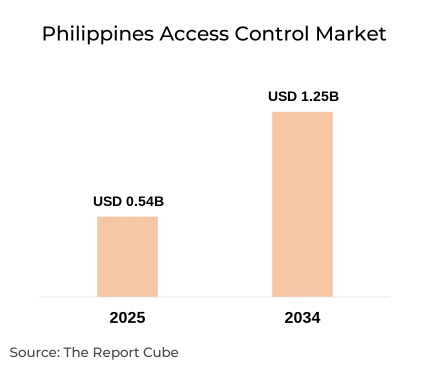
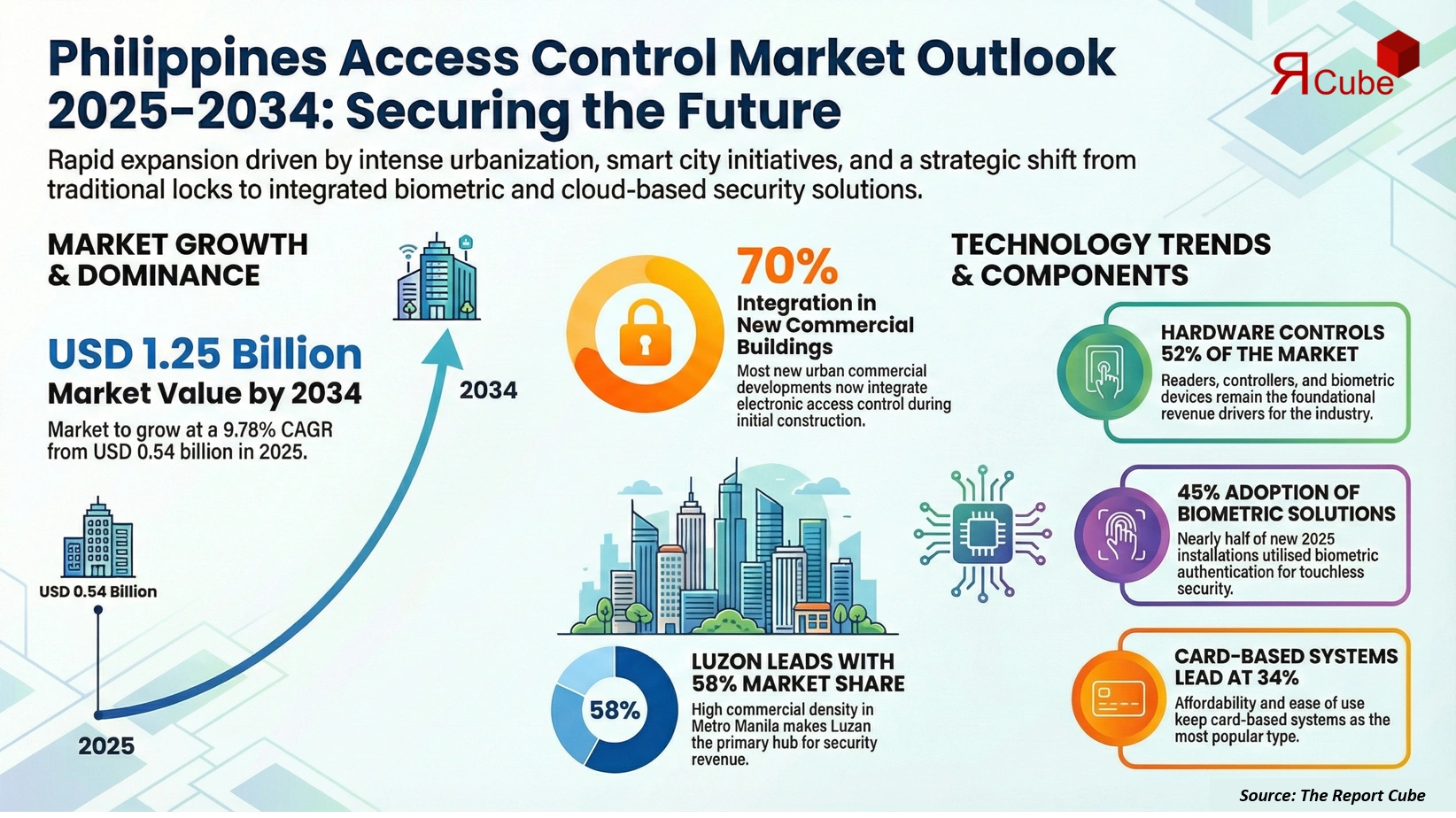
The Philippines Access Control Market is anticipated to register a CAGR of 9.78% during 2026-2034. The market size was valued at USD 0.54 billion in 2025 and is projected to reach USD 1.25 billion by 2034. The market is expanding rapidly as public and private organizations increasingly prioritize physical security, identity management, and controlled access across commercial buildings, transportation hubs, residential complexes, and critical infrastructure facilities.
This growth is closely linked to accelerating urbanization, rising commercial construction activity, and heightened awareness of security risks across the Philippines. Smart cities initiatives, increased investments in office parks, IT campuses, and mixed-use developments are creating sustained demand for advanced access control systems. Enterprises are shifting away from traditional lock-and-key mechanisms toward integrated electronic and biometric solutions that provide higher reliability, traceability, and real-time monitoring.
Moreover, the growing adoption of digital transformation strategies across industries is encouraging the integration of access control with video surveillance, building management systems, and time-attendance platforms. These interconnected systems improve operational efficiency while strengthening security compliance. As regulatory standards around workplace safety and data protection continue to evolve, the Philippines Access Control Market is expected to maintain strong momentum through 2034.
Philippines Access Control Market Recent Developments
- 2025: A leading global security provider expanded its biometric access portfolio in Manila to support large commercial deployments.
- 2025: A regional systems integrator partnered with local developers to deploy cloud-based access control across new office projects.
Government Initiatives & Policies
- Philippine Smart City Program: Promotes adoption of intelligent security and access management systems in urban infrastructure.
- National Cybersecurity Plan: Encourages secure identity management and controlled access for public institutions.
Philippines Access Control Market Dynamics
Key Driver: Rapid Commercial Infrastructure Development Across Urban Centers
The rapid expansion of commercial infrastructure across major Philippine cities is a primary driver of the access control market. Metro Manila, Cebu, and Davao are witnessing strong growth in office buildings, shopping malls, data centers, and hospitality facilities, all of which require robust security systems. Nearly 70% of newly constructed commercial buildings in urban areas now integrate electronic access control during initial development. Developers and facility managers favor access control solutions for their ability to restrict unauthorized entry, monitor movement, and enhance occupant safety. This trend is further reinforced by multinational companies establishing regional offices in the Philippines, driving demand for globally compliant security standards.
Book your FREE 30-minute expert consultation today
Contact UsIndustry Trends: Increasing Adoption of Biometric and Contactless Technologies
Biometric and contactless access technologies are becoming a defining trend in the Philippines Access Control Market. Fingerprint, facial recognition, and mobile-based credentials are gaining popularity due to their convenience and improved accuracy. The shift accelerated following heightened hygiene awareness, with organizations seeking touchless solutions to reduce physical contact. Approximately 45% of new access control installations in 2025 incorporated biometric authentication. Additionally, cloud-based access management platforms are enabling remote monitoring and centralized control, particularly attractive to enterprises with multi-site operations. This trend reflects a broader move toward smart, scalable, and user-friendly security ecosystems.
Major Challenge: High Initial Investment and Integration Complexity
Despite strong growth prospects, high upfront costs remain a key challenge for market adoption, particularly among small and medium-sized enterprises. Advanced access control systems require investment in hardware, software licenses, installation, and ongoing maintenance. Integration with legacy infrastructure and existing IT systems can further increase costs and complexity. Many organizations delay upgrades due to budget constraints or lack of technical expertise. Additionally, concerns around data privacy and biometric data storage create hesitation among some end users, slowing adoption in price-sensitive segments of the market.
Opportunity: Growing Demand from Residential and Gated Communities
The expanding residential real estate sector presents a significant opportunity for the Philippines Access Control Market. Gated communities, condominiums, and mixed-use residential developments are increasingly incorporating access control systems to enhance security and property value. Developers are offering smart access solutions as premium features, appealing to middle- and high-income buyers. Demand for card-based and mobile-enabled access systems is particularly strong in residential applications due to ease of use and cost efficiency. As urban living density increases, residential security is expected to become a major growth engine for the market.
Philippines Access Control Market Segment-wise Analysis
By Component:
- Hardware
- Software
- Services
Hardware dominates the Philippines Access Control Market by component, accounting for nearly 52% of total market share in 2025. This includes readers, controllers, locks, and biometric devices that form the foundation of access systems. Demand for hardware remains strong due to new installations across commercial and residential projects. Software solutions are growing steadily as organizations seek centralized management and analytics capabilities, while services such as installation, maintenance, and system upgrades play a critical role in ensuring long-term system reliability.
By Type:
- Card-Based
- Biometric
- Electronic Locks
- Perimeter Systems
Card-based access control systems lead the market by type, holding approximately 34% market share in 2025. These systems remain popular due to affordability, ease of deployment, and widespread user familiarity. However, biometric systems are the fastest-growing segment, driven by demand for higher security and contactless authentication. Electronic locks and perimeter systems continue to see adoption in industrial and high-security facilities, supporting diversified market growth across application areas.
Regional Projection of Philippines Access Control Industry
- Luzon
- Visayas
- Mindanao
Luzon leads the Philippines Access Control Market, contributing approximately 58% of total revenue in 2025. The region benefits from dense commercial activity, government institutions, and large-scale infrastructure projects concentrated in Metro Manila and surrounding provinces. High adoption of advanced security technologies and strong presence of multinational corporations support market leadership. Visayas and Mindanao are emerging regions, driven by rising urban development and increased investment in commercial and residential projects, indicating balanced regional growth over the forecast period.
Need insights for a specific region within this market?
Request Regional DataWhy Choose This Report?
- Provides a comprehensive overview of the overall market analysis, encompassing key trends, consumer behavior analysis, and risk assessment to support strategic decision-making.
- Provides accurate, up-to-date insights into market size, segmentation, and emerging opportunities, helping to minimize risk & capitalizing on growth.
- Gives deep understanding of target audience preferences, investment habits, and communication channels for enhanced product development & marketing effectiveness.
- Delivers competitive analysis & benchmarking, uncovering the strengths & weaknesses of market competitors to guide strategies.
- Consolidate comprehensive market intelligence, reducing reasoning & streamlining research efforts.
- Facilitates customized market segmentation & risk mitigation strategies, fine-tuned to the business objectives.
- Aids in identifying both market challenges & untapped opportunities within the industry to drive long-term business growth.
- Provides valuable information based on actual customer data & search trends.
Table of Contents
- Introduction
- Objective of the Study
- Product and Category Definition
- Market Segmentation
- Study Variables
- Research Methodology
- Secondary Data Points
- Breakdown of Secondary Sources
- Primary Data Points
- Breakdown of Primary Interviews
- Secondary Data Points
- Executive Summary
- Market Dynamics
- Drivers
- Challenges
- Opportunity Assessment
- Recent Trends and Developments
- Regulatory and Policy Landscape
- Philippines Access Control Market Overview (2020-2034)
- Market Size, By Value (USD Billion)
- Market Share, By Component
- Hardware
- Software
- Services
- Market Share, By Type
- Card-Based
- Biometric
- Electronic Locks
- Perimeter Systems
- Market Share, By Deployment
- On-Premises
- Cloud-Based
- Hybrid
- Market Share, By End User
- Commercial
- Government
- Residential
- Industrial
- Healthcare
- Education
- Market Share, By Region
- Luzon
- Visayas
- Mindanao
- Market Share, By Company
- Competition Characteristics
- Revenue Shares & Analysis
- Luzon Access Control Market
- Market Size, By Value (USD Billion)
- Market Share, By Component
- Market Share, By Type
- Market Share, By Deployment
- Market Share, By End User
- Visayas Access Control Market
- Market Size, By Value (USD Billion)
- Market Share, By Component
- Market Share, By Type
- Market Share, By Deployment
- Market Share, By End User
- Mindanao Access Control Market
- Market Size, By Value (USD Billion)
- Market Share, By Component
- Market Share, By Type
- Market Share, By Deployment
- Market Share, By End User
- Competitive Outlook and Company Profiles
- Hikvision
- Company Overview
- Product Portfolio
- Strategic Alliances/Partnerships
- Recent Developments
- HID Global
- Company Overview
- Product Portfolio
- Strategic Alliances/Partnerships
- Recent Developments
- Bosch Security
- Company Overview
- Product Portfolio
- Strategic Alliances/Partnerships
- Recent Developments
- Johnson Controls
- Company Overview
- Product Portfolio
- Strategic Alliances/Partnerships
- Recent Developments
- Honeywell
- Company Overview
- Product Portfolio
- Strategic Alliances/Partnerships
- Recent Developments
- Axis Communications
- Company Overview
- Product Portfolio
- Strategic Alliances/Partnerships
- Recent Developments
- Panasonic
- Company Overview
- Product Portfolio
- Strategic Alliances/Partnerships
- Recent Developments
- Alcon Philippines
- Company Overview
- Product Portfolio
- Strategic Alliances/Partnerships
- Recent Developments
- DTSI Group
- Company Overview
- Product Portfolio
- Strategic Alliances/Partnerships
- Recent Developments
- Esscor Philippines
- Company Overview
- Product Portfolio
- Strategic Alliances/Partnerships
- Recent Developments
- Others
- Hikvision
- Contact Us and Disclaimer
Top Key Players & Market Share Outlook
- Hikvision
- HID Global
- Bosch Security
- Johnson Controls
- Honeywell
- Axis Communications
- Panasonic
- Alcon Philippines
- DTSI Group
- Esscor Philippines
- Others
Frequently Asked Questions






