Southeast Asia Construction Market to Record Strong Growth with CAGR of 6.2% & USD 981.20 billion by 2034
According to the latest research insights published by The Report Cube, the Southeast Asia Construction Market Research Report indicates that the industry is destined for robust expansion during 2026–2034, backed by enhanced infrastructure investment, increasing urbanization, and government-led smart city developments in Indonesia, Vietnam, Thailand, Malaysia, the Philippines, and Singapore. Also, the market is projected to grow at a CAGR of about 6.2%, valued at nearly USD 571 billion in 2025, and predicted to reach around USD 981.20 billion by 2034, driven by rapid commercial development & sustainable construction adoption.
Key Dynamics Affecting the Southeast Asia Construction Market
- Substantial infrastructure spending, megaproject execution, and public–private partnerships (PPPs) in Indonesia, Vietnam, Thailand, and Malaysia are substantially accelerating demand for residential growth, industrial facilities, highways, and commercial buildings.
- Inconsistent regulatory frameworks, land acquisition challenges, and permitting delays escalate construction timelines & raise operational complexities across the regional landscape.
- Expanding urban population & growing disposable incomes boost demand for high-rise residential projects, mixed-use buildings, smart homes, and modern commercial complexes.
- Adoption of prefabrication, modular construction, and BIM (Building Information Modeling) supports enhanced project efficiency, real-time planning, cost control, and precision engineering.
- Southeast Asia’s sustainability thrust, such as green building standards, renewable-integrated designs, and energy-efficient building practices, fortifies the shift toward environmentally aware construction.
- AI-driven project monitoring, digital twin technology, and automated equipment improve construction accuracy, productivity, and predictive maintenance, restructuring the region’s engineering & infrastructure landscape.
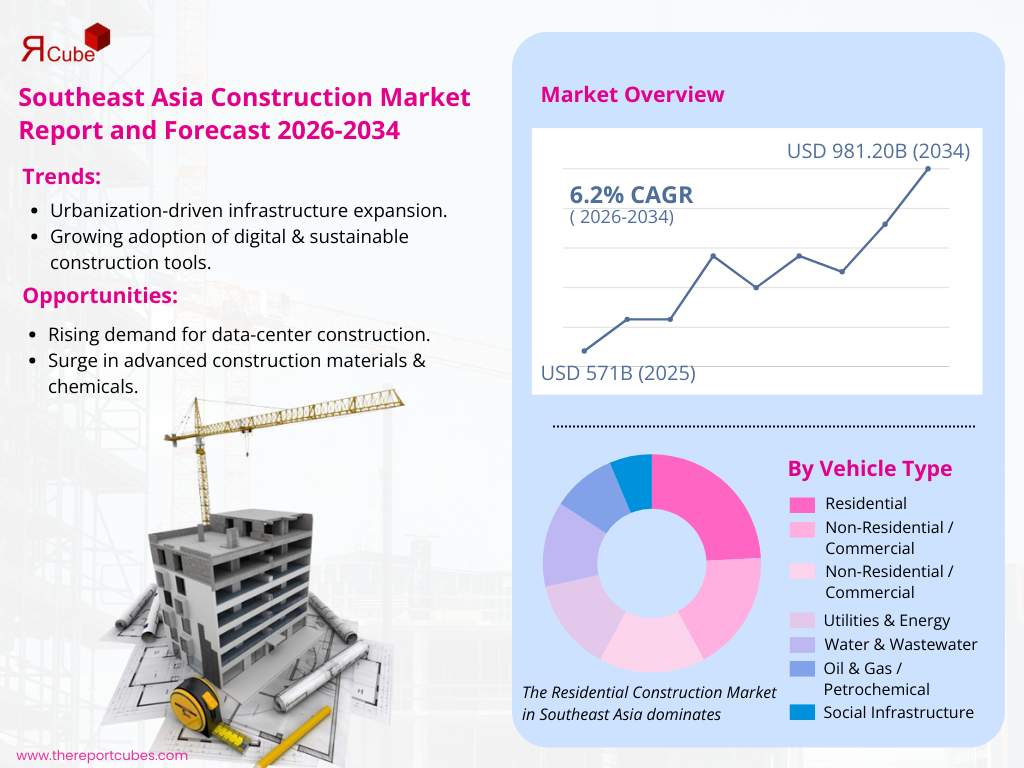
Which of the Segments, under End-Use Classification, Influences the Industry Share?
Across the End-Use, the Southeast Asia Construction Market is segmented as:
- Residential
- Non-Residential / Commercial
- Industrial Infrastructure / Public Works
- Utilities & Energy
- Water & Wastewater
- Oil & Gas / Petrochemical
- Social Infrastructure
Of them all, the Residential & Non-Residential Construction segments leads, commanding for biggest market share as rising urbanization elevates the market demand for housing, commercial hubs, retail spaces, and tourism infrastructure. Also, rapid expansion of smart cities, increasing investments in office spaces, rising metro rail projects, and the requirement for sustainable housing make this setor the primary revenue generators across Southeast Asia.
Regional Coverage: Southeast Asia Construction Market
- Indonesia
- Vietnam
- Thailand
- Malaysia
- Singapore
- Philippines
- Rest of Southeast Asia
Among all the countries geographically, Indonesia retains a leading position owing to extensive infrastructure programs, large-scale housing initiatives, smart city expansions, industrial corridor development, and strong government support for investment inflows. Furthermore, its expanding construction ecosystem, strong public–private collaborations, and continuous innovation efforts make Indonesia a strategic hub for regional construction activity.
Company Profile: Leading Southeast Asia Construction Market Players
Key companies driving Southeast Asia’s construction development include major regional contractors, engineering firms, and technology integrators offering advanced construction solutions, EPC services, BIM platforms, and sustainable infrastructure capabilities. Leading players include: Gamuda Berhad, IJM Corporation Berhad, Sunway Construction Group Berhad, WCT Holdings Berhad, Muhibbah Engineering, UEM Group Berhad, Bina Puri Holdings, Caterpillar Inc., Hitachi Construction Machinery, and Others.
Gamuda Berhad stands out as the prominent regional player, influenced by its large infrastructure portfolios, strong EPC capabilities, digital construction adoption, and widespread presence across Malaysia & key Southeast Asian markets.
Questions Answered in the Southeast Asia Construction Market Research Report
- What is the current market size & future growth forecast underlined in the Southeast Asia Construction Market research report?
- Which major factors are driving the rapid expansion of the Southeast Asia Construction Industry across major regions?
- What emerging trends are restructuring the competitive landscape according to the latest market insights?
- How is consumer / end-user demand evolving, and what impact does it have on the Southeast Asia Construction Market growth?
- Which leading companies are dominating the Southeast Asia Construction Industry, and what strategies are they adopting?
- What technological advancements are influencing product adoption & market penetration?
- How does the report evaluate regional performance & identify high-growth market opportunities?
- What challenges & risks could potentially affect market stability, according to the research findings by the analysts?