US Baby and Children Clothing Market to See Sturdy Growth with CAGR of 2.0% & USD 49B by 2034
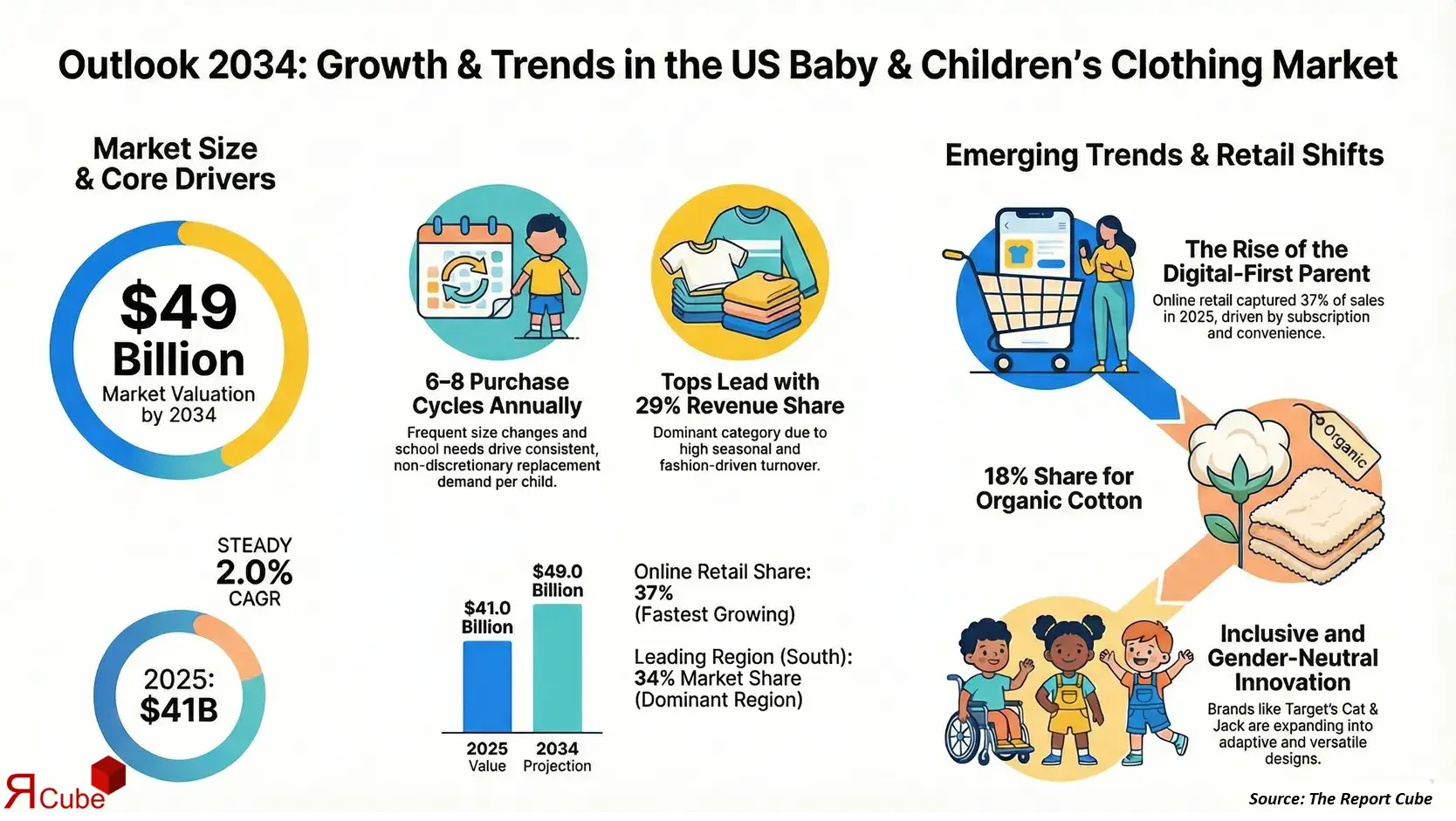
As per the latest research findings by The Report Cube, the US Baby and Children’s Clothing Market Research Report highlights that the industry is destined for even growth during 2026–2034, instigated by emerging fashion preferences, increasing premiumization of kids’ apparel, and expanding omnichannel retail strategies across the nation. In line with the progression & the market research it is predicted that the market is estimated to record a CAGR of around 2.0% (2026–34), further being valued at about USD 41.0 billion in 2025, and projected to reach nearly USD 49 billion by 2034.
The market signifies a mature yet resilient consumer segment reinforced by constant replacement demand & regular wardrobe updates as children outgrow clothing rapidly. Parents & caregivers progressively prioritize clothing that provides durability, safety-certified fabrics, and enhanced comfort for infants & toddlers. Along with this, increasing customer inclination toward organic cotton, sustainable fabrics, and premium branded apparel continues to reinforce long-term demand fundamentals across the US market.
Moreover, the rising influence of digital retail channels is also altering the competitive landscape. Further, potential brands are also incorporating omnichannel retail strategies, together with e-commerce platforms, mobile apps, and in-store experiences to improve customer engagement & convenience. The upsurge of millennial & Gen-Z parents, who value sustainability, comfort, and ethical sourcing, has further augmented demand for eco-friendly fabrics & gender-neutral children’s clothing designs.
Additionally, constant modernization in apparel design, enhanced supply chain efficiencies, and the growth of private labels by mass retailers are redesigning the industry dynamics. Furthermore, online retail channels now represent a substantial share of market sales, fueled by convenience, flexible return policies, and personalized recommendations via digital marketing technologies.
Major Market Dynamics Influencing the US Baby and Children’s Clothing Market
- Due to children’s fast growth & seasonal wardrobe upgrade the demand for frequent clothing replacement cycles is tend to increase, further enhancing the market share.
- Rising consumer preference for premium fabrics, organic cotton apparel, and eco-friendly clothing reinforces product innovation & value-driven sales growth.
- Growth of omnichannel retail ecosystems integrating mobile commerce, online platforms, and physical stores improves customer convenience & buying flexibility.
- Digital-native brands & private labels from mass retailers strengthen competition while reshaping costing strategies across midrange & mass segments.
- Growing consciousness regarding infant skin sensitivity & product safety standards motivates demand for hypoallergenic fabrics & certified materials.
- Personalized product recommendations, data-driven marketing, and subscription-based apparel models enhance consumer engagement & brand loyalty among parents.
Need Specific Data, Let’s Customize the Report for You
Request Regional DataWhich of the segments, under Product Type Classification, influences the Market Share?
Across the Product Type, the US Baby and Children’s Clothing Industry is segmented as:
- Outerwear
- Tops
- Bottoms
- Sleepwear
- Underwear
- Accessories
- Footwear
- Others
Tops constitute the biggest product segment across the US Baby and Children’s Clothing Market, commanding for about 29% of total revenue in 2025. This product type’s’ dominance is driven by high replacement rates, changing seasonality, and strong fashion influence on buying decisions. Essential products like T-shirts, shirts, and casual tops are bought throughout the year & for all age groups, guaranteeing stable demand. Moreover, market companies stress upon design diversity, soft & breathable fabrics, and licensed character themes to sustain customer interest.
Regional Coverage: US Baby and Children’s Clothing Market
- Northeast
- Midwest
- South
- West
Geographically, the South region of the US dominates the overall Baby and Children’s Clothing Market, attaining nearly 34% of the market share. This prominence is influenced by greater population upgrade, larger household sizes, and strong retail penetration of mass & midrange apparel brands. Also, the region profits from expanding suburban communities & strong presence of large retail chains that safeguard wide product availability for parents seeking clothing for their children.
Company Profile: Leading US Baby and Children’s Clothing Market Players
There are numerous companies across the US competing around the Baby and Children’s Clothing Market, some of the leading market players that tend to support the industry’s expansion via strong brand portfolios, sustainable fabric innovation, omnichannel retail strategies, and improved supply chain capabilities, are: Carter’s, The Children’s Place, Gap Kids, Old Navy, OshKosh B’gosh, Gymboree, Hanna Andersson, Abercrombie Kids, Ralph Lauren Children, Target Brands (Cat & Jack), and Others.
“Carter’s”, which stands to be one of the most prominent clothing brands across the US Baby and Children’s Clothing Market, assists in strengthening its leadership via sustainable cotton apparel collections, robust brand recognition, and countrywide retail growth strategies engrossed on infants & toddlers.
Questions Answered in the US Baby and Children’s Clothing Market Research Report
- What is the current market size & future growth forecast underlined in the US Baby and Children’s Clothing Market research report?
- Which major factors are driving the rapid expansion of the US Baby and Children’s Clothing Industry across major regions?
- What emerging trends are restructuring the competitive landscape according to the latest market insights?
- How is consumer / end-user demand evolving, and what impact does it have on the US Baby and Children’s Clothing Market growth?
- Which leading companies are dominating the US Baby and Children’s Clothing Industry, and what strategies are they adopting?
- What technological advancements are influencing product adoption & market penetration?
- How does the report evaluate regional performance & identify high-growth market opportunities?
- What challenges & risks could potentially affect market stability, according to the research findings by the analysts?