



Build Your Custom Market Intelligence Report
Customize Your ReportUS Baby and Children’s Clothing Market Insights & Analysis
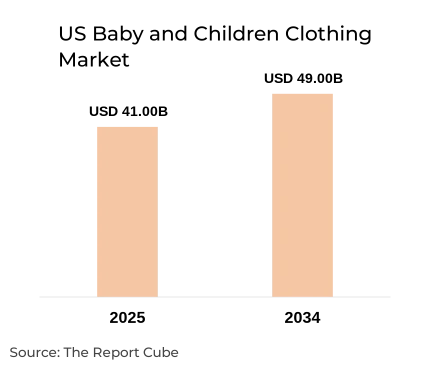
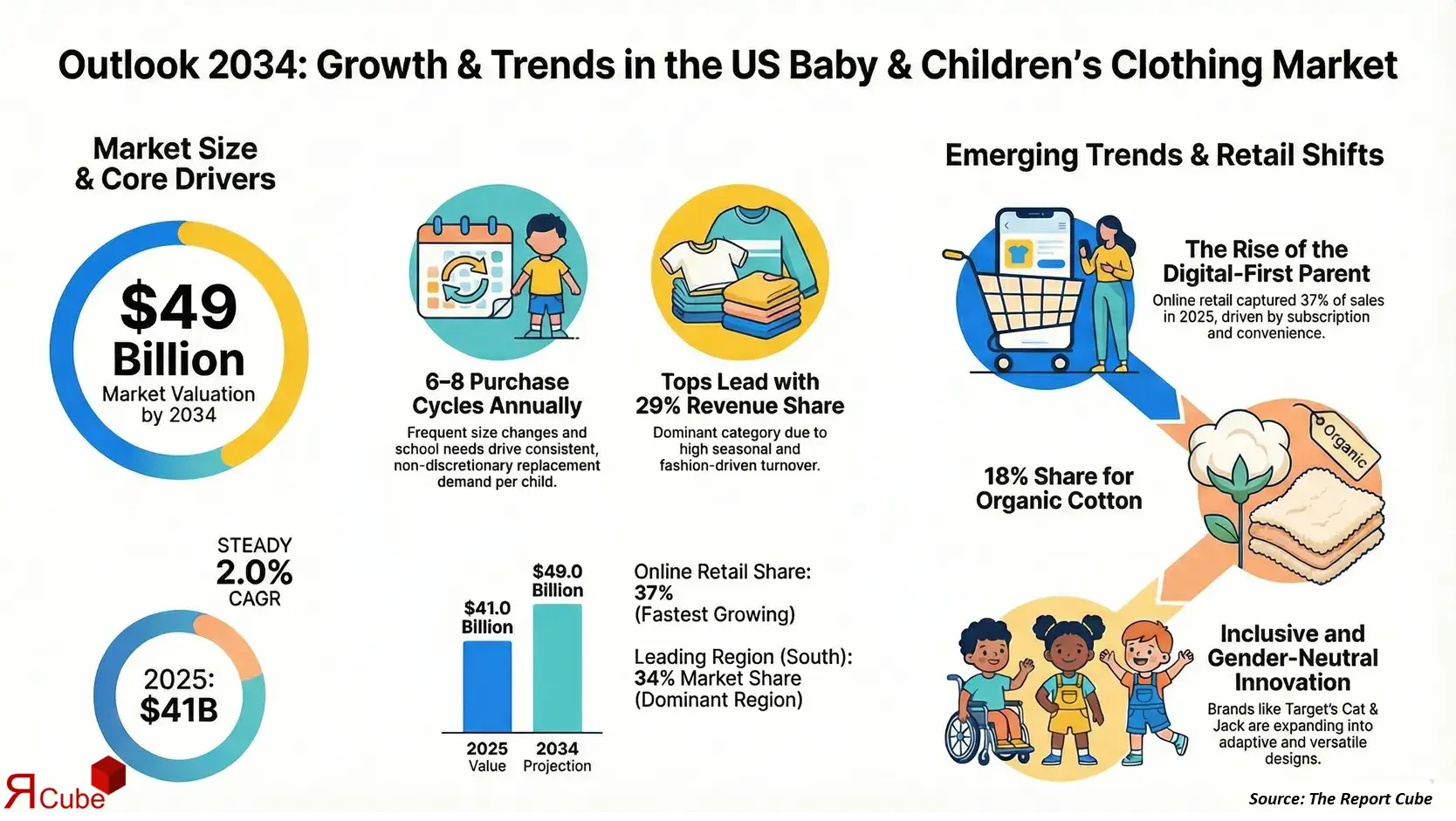
The US Baby and Children’s Clothing Market is anticipated to register a CAGR of 2.0% during 2026-2034. The market size was valued at USD 41.0 billion in 2025 and is projected to reach USD 49 billion by 2034. The US market for baby and children’s apparel represents a mature yet resilient consumer segment, driven by consistent demand fundamentals linked to population stability, replacement purchasing behavior, and evolving fashion preferences among parents and caregivers.
Children’s clothing remains a non-discretionary purchase category, supported by frequent size changes, seasonal wardrobe updates, and school-related apparel needs. While birth rates in the US have moderated, higher per-child spending and growing preference for premium, branded, and sustainable clothing have offset volume constraints. Parents increasingly prioritize comfort, durability, and safety certifications, especially for infants and toddlers, reinforcing steady baseline demand.
At the same time, the market is undergoing structural shifts. Digital-native brands, private labels from mass retailers, and omnichannel strategies are reshaping competitive dynamics. Sustainability, organic fabrics, and gender-neutral designs are gaining traction, particularly among millennial parents. These interconnected demand, retail, and product innovation factors collectively support the long-term expansion of the US Baby and Children’s Clothing Market.
US Baby and Children’s Clothing Market Recent Developments
- 2025: Carter’s expanded its sustainable cotton collections across baby and toddler apparel lines nationwide.
- 2025: Target’s Cat & Jack brand introduced adaptive children’s clothing with enhanced inclusivity features.
Government Initiatives & Policies
- US Consumer Product Safety Improvement Act (CPSIA): Enforces strict safety standards for children’s apparel and materials.
- US Organic Certification Program: Supports labeling and adoption of organic cotton and textiles in apparel manufacturing.
US Baby and Children’s Clothing Market Dynamics
Key Driver: Consistent Replacement Demand and Premiumization of Children’s Apparel
The primary driver of the US Baby and Children’s Clothing Market is consistent replacement demand combined with rising premiumization trends. Children outgrow clothing rapidly, creating repeat purchasing cycles regardless of economic conditions. On average, US households purchase children’s apparel 6-8 times annually per child, ensuring stable volume demand. Alongside this, parents are increasingly trading up to higher-quality garments that offer better fabric performance, safety, and longevity. Premium brands emphasizing organic cotton, hypoallergenic dyes, and reinforced stitching are benefiting from this shift. Higher dual-income households and delayed parenthood trends further amplify spending per child, strengthening market value growth despite modest population expansion.
Book your FREE 30-minute expert consultation today
Contact UsIndustry Trends: Growth of Sustainable, Gender-Neutral, and Omnichannel Offerings
Sustainability and inclusivity are shaping product innovation in the US Baby and Children’s Clothing Market. Organic cotton apparel now accounts for an estimated 18% of baby clothing sales, reflecting heightened awareness of skin sensitivity and environmental impact. Gender-neutral designs are also gaining visibility, particularly in the toddler and early childhood segments, as parents seek versatility and extended usability. In parallel, omnichannel retail strategies are becoming standard, with leading brands integrating online platforms, mobile apps, and in-store experiences. Online retail penetration exceeded 35% of total sales in 2025, driven by convenience, subscription models, and easy returns, reinforcing a digitally connected purchasing journey.
Major Challenge: Price Sensitivity and Margin Pressure in a Competitive Retail Landscape
Price sensitivity remains a key challenge within the US Baby and Children’s Clothing Market, particularly in the mass and midrange segments. While parents value quality, frequent purchases make affordability critical. Intense competition from private labels, discount retailers, and fast-fashion players has increased promotional activity, compressing margins for manufacturers and retailers. Rising input costs, including cotton prices and logistics expenses, further strain profitability. Brands must balance cost control with compliance to safety standards and sustainability commitments, making operational efficiency and supply chain optimization essential to maintain competitiveness.
Opportunity: Expansion of Premium, Organic, and Direct-to-Consumer Segments
Opportunities in the US Baby and Children’s Clothing Market are emerging through premium, organic, and direct-to-consumer (DTC) channels. Parents are increasingly willing to pay premiums for trusted brands offering certified organic fabrics, ethical sourcing, and transparent manufacturing practices. DTC models enable brands to control pricing, personalize offerings, and build long-term customer relationships. Subscription-based children’s apparel boxes and customization services are also gaining traction, particularly among urban families. These developments create pathways for value-driven growth beyond traditional retail constraints.
US Baby and Children’s Clothing Market Segment-wise Analysis
By Product Type:
- Outerwear
- Tops
- Bottoms
- Sleepwear
- Underwear
- Accessories
- Footwear
- Others
Tops represent the leading product type in the US Baby and Children’s Clothing Market, accounting for approximately 29% of total revenue in 2025. High replacement frequency, seasonal variation, and fashion-driven purchasing underpin this dominance. T-shirts, shirts, and casual tops are purchased year-round and across all age groups, supporting consistent sales volumes. Brands focus heavily on design variety, comfort fabrics, and licensed characters to maintain engagement. Sleepwear follows closely, supported by safety regulations and growing demand for organic, flame-resistant materials.
By Distribution Channel:
- Specialty Stores
- Department Stores
- Supermarkets
- Online Retail
- Others
Online retail is the fastest-growing distribution channel in the US Baby and Children’s Clothing Market, capturing nearly 37% market share in 2025. Convenience, wide assortment, competitive pricing, and easy size exchanges drive strong adoption. Leading brands and retailers invest heavily in digital marketing, data-driven personalization, and mobile commerce. While specialty and department stores remain important for tactile evaluation and brand experience, online channels increasingly influence purchase decisions across all income segments.
Regional Projection of US Baby and Children’s Clothing Industry
- Northeast
- Midwest
- South
- West
The South leads the US Baby and Children’s Clothing Market, accounting for approximately 34% of total revenue. Higher population growth, larger household sizes, and a strong presence of mass and midrange retailers support regional dominance. Warmer climates also contribute to frequent apparel purchases across seasons. The West follows closely, driven by higher premium and organic clothing adoption, particularly in urban centers such as California and Washington.
Need insights for a specific region within this market?
Request Regional DataWhy Choose This Report?
- Provides a comprehensive overview of the overall market analysis, encompassing key trends, consumer behavior analysis, and risk assessment to support strategic decision-making.
- Provides accurate, up-to-date insights into market size, segmentation, and emerging opportunities, helping to minimize risk & capitalizing on growth.
- Gives deep understanding of target audience preferences, investment habits, and communication channels for enhanced product development & marketing effectiveness.
- Delivers competitive analysis & benchmarking, uncovering the strengths & weaknesses of market competitors to guide strategies.
- Consolidate comprehensive market intelligence, reducing reasoning & streamlining research efforts.
- Facilitates customized market segmentation & risk mitigation strategies, fine-tuned to the business objectives.
- Aids in identifying both market challenges & untapped opportunities within the industry to drive long-term business growth.
- Provides valuable information based on actual customer data & search trends.
Table of Contents
- Introduction
- Objective of the Study
- Product and Category Definition
- Market Segmentation
- Study Variables
- Research Methodology
- Secondary Data Points
- Breakdown of Secondary Sources
- Primary Data Points
- Breakdown of Primary Interviews
- Secondary Data Points
- Executive Summary
- Market Dynamics
- Drivers
- Challenges
- Opportunity Assessment
- Recent Trends and Developments
- Regulatory and Policy Landscape
- US Baby and Children’s Clothing Market Overview (2021-2034)
- Market Size, By Value (USD Billion)
- Market Share, By Product Type
- Outerwear
- Tops
- Bottoms
- Sleepwear
- Underwear
- Accessories
- Footwear
- Others
- Market Share, By Age Group
- 5-10 Years
- Below 5 Years
- Above 10 Year
- Market Share, By Gender
- Boys
- Girls
- Unisex
- Market Share, By Fabric Type
- Cotton
- Organic Cotton
- Synthetic
- Blended
- Others
- Market Share, By Price Range
- Mass
- Midrange
- Premium
- Luxury
- Market Share, By Distribution Channel
- Specialty Stores
- Department Stores
- Supermarkets
- Online Retail
- Others
- Market Share, By Region
- Northeast
- Midwest
- South
- West
- Market Share, By Company
- Revenue Shares & Analysis
- Competitive Landscape
- Northeast US Baby and Children’s Clothing Market
- Market Size, By Value (USD Billion)
- Market Share, By Product Type
- Market Share, By Age Group
- Market Share, By Gender
- Market Share, By Fabric Type
- Market Share, By Price Range
- Market Share, By Distribution Channel
- Midwest US Baby and Children’s Clothing Market
- Market Size, By Value (USD Billion)
- Market Share, By Product Type
- Market Share, By Age Group
- Market Share, By Gender
- Market Share, By Fabric Type
- Market Share, By Price Range
- Market Share, By Distribution Channel
- South US Baby and Children’s Clothing Market
- Market Size, By Value (USD Billion)
- Market Share, By Product Type
- Market Share, By Age Group
- Market Share, By Gender
- Market Share, By Fabric Type
- Market Share, By Price Range
- Market Share, By Distribution Channel
- West US Baby and Children’s Clothing Market
- Market Size, By Value (USD Billion)
- Market Share, By Product Type
- Market Share, By Age Group
- Market Share, By Gender
- Market Share, By Fabric Type
- Market Share, By Price Range
- Market Share, By Distribution Channel
- Competitive Outlook and Company Profiles
- Carter’s
- Company Overview
- Product Portfolio
- Strategic Alliances/Partnerships
- Recent Developments
- The Children’s Place
- Company Overview
- Product Portfolio
- Strategic Alliances/Partnerships
- Recent Developments
- Gap Kids
- Company Overview
- Product Portfolio
- Strategic Alliances/Partnerships
- Recent Developments
- Old Navy
- Company Overview
- Product Portfolio
- Strategic Alliances/Partnerships
- Recent Developments
- OshKosh B’gosh
- Company Overview
- Product Portfolio
- Strategic Alliances/Partnerships
- Recent Developments
- Gymboree
- Company Overview
- Product Portfolio
- Strategic Alliances/Partnerships
- Recent Developments
- Hanna Andersson
- Company Overview
- Product Portfolio
- Strategic Alliances/Partnerships
- Recent Developments
- Abercrombie Kids
- Company Overview
- Product Portfolio
- Strategic Alliances/Partnerships
- Recent Developments
- Ralph Lauren Children
- Company Overview
- Product Portfolio
- Strategic Alliances/Partnerships
- Recent Developments
- Target Brands (Cat & Jack)
- Company Overview
- Product Portfolio
- Strategic Alliances/Partnerships
- Recent Developments
- Others
- Carter’s
- Contact Us and Disclaimer
Top Key Players & Market Share Outlook
- Carter’s
- The Children’s Place
- Gap Kids
- Old Navy
- OshKosh B’gosh
- Gymboree
- Hanna Andersson
- Abercrombie Kids
- Ralph Lauren Children
- Target Brands (Cat & Jack)
- Others
Frequently Asked Questions






