



Build Your Custom Market Intelligence Report
Customize Your ReportNigeria Large Cooking Appliance Market Insights & Analysis
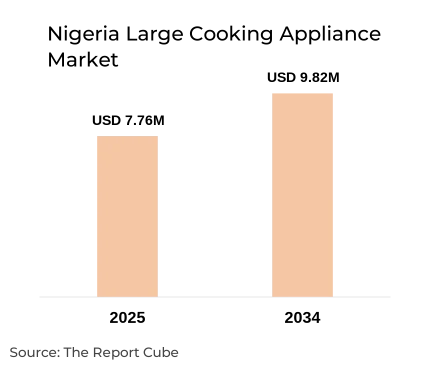
The Nigeria Large Cooking Appliance Market is anticipated to register a CAGR of 2.65% during 2026-2034. The market size was valued at USD 7.76 Million in 2025 and is projected to reach USD 9.82 Million by 2034. The Nigeria large cooking appliance market reflects a steadily developing consumer durables segment shaped by rapid urbanization, rising middle-class households, and gradual improvements in residential infrastructure. Demand is primarily driven by urban consumers seeking modern cooking solutions that offer efficiency, safety, and durability. While traditional cooking methods remain common in rural areas, urban households increasingly adopt freestanding ranges, cooktops, and built-in ovens as lifestyles modernize. Growth remains moderate due to income constraints and power supply challenges, yet replacement demand and new housing developments continue to provide a stable demand base across major cities.
Market dynamics are also influenced by changing household preferences, increased exposure to global appliance brands, and the expansion of organized retail and e-commerce channels. Nigerian consumers are becoming more aware of energy efficiency, product longevity, and after-sales service quality when making purchase decisions. Gas-powered appliances dominate due to unreliable electricity supply, while electric and induction appliances are gradually gaining acceptance in high-income urban households. International brands with localized distribution and service networks maintain a strong presence, while regional distributors focus on affordability and availability. Together, these factors support a stable but slowly evolving large cooking appliance market in Nigeria over the forecast period.
Nigeria Large Cooking Appliance Market Recent Developments
- 2025: LG Electronics Nigeria expanded its portfolio of gas-based cooking appliances to address urban household demand.
- 2025: Hisense Nigeria strengthened distribution partnerships to improve appliance availability across major cities.
Government Initiatives & Policies
- National LPG Expansion Program: Government initiative promoting LPG adoption to reduce reliance on traditional fuels.
- National Housing Program: Public housing development supporting demand for modern home appliances.
Nigeria Large Cooking Appliance Market Dynamics
Key Driver: Urbanization and Household Modernization
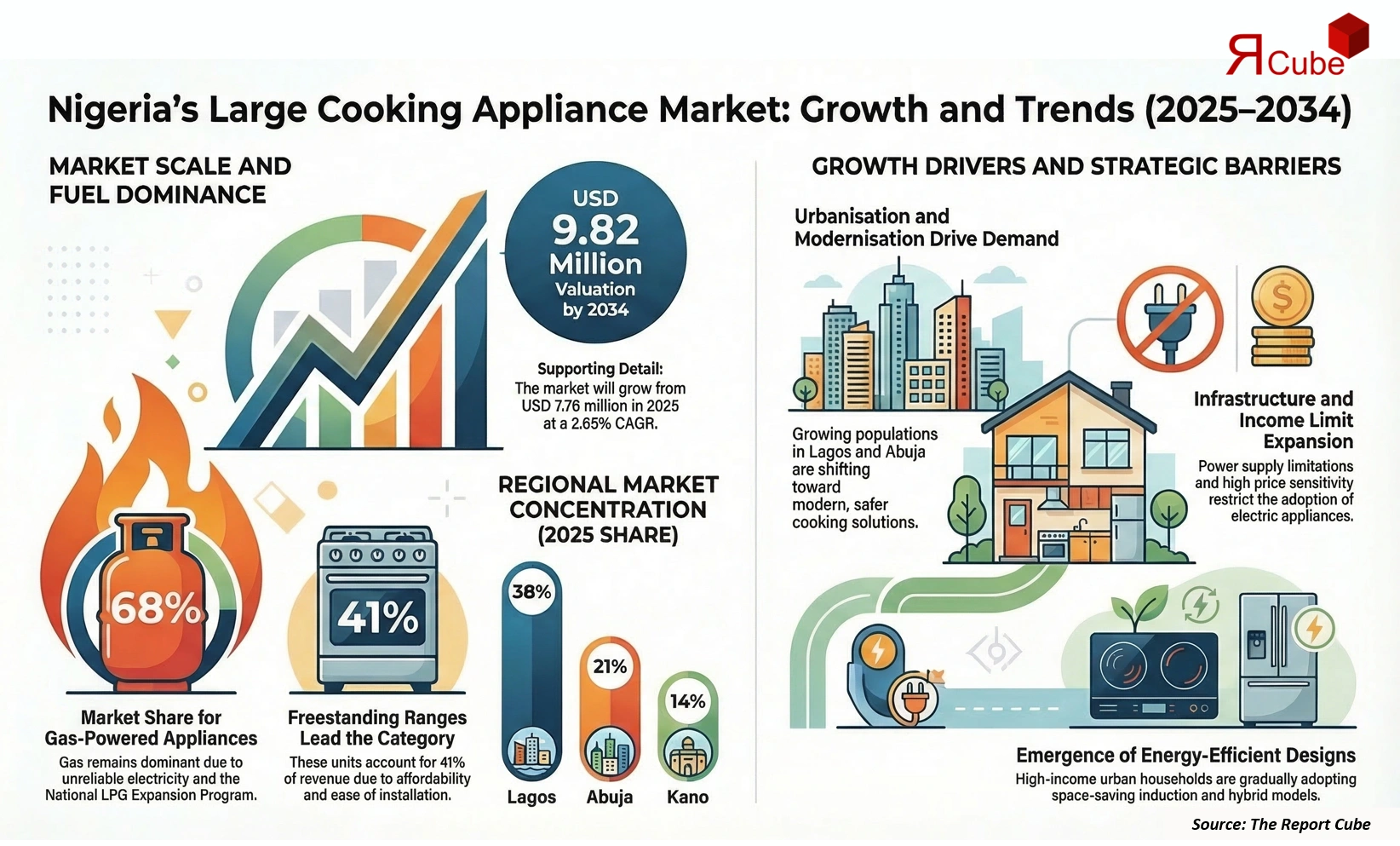
In Nigeria, the large cooking appliance market is primarily driven by rapid urbanization and gradual modernization of household kitchens. Growing urban populations in cities such as Lagos and Abuja are increasingly shifting from traditional cooking setups to modern appliances that offer convenience and improved safety. Rising exposure to global lifestyles through media and retail expansion has influenced consumer preferences toward freestanding ranges and gas cooktops. Additionally, new residential developments and renovation activities in urban centers are creating consistent demand for large cooking appliances. These structural drivers ensure stable baseline demand, even amid broader economic volatility.
Major Challenge: Income Constraints and Power Supply Limitations
A major challenge facing the Nigeria large cooking appliance market is limited purchasing power among a significant portion of the population. Price sensitivity remains high, restricting adoption of premium or built-in appliance categories. In addition, unreliable electricity supply discourages widespread adoption of electric and induction appliances, reinforcing dependence on gas-based solutions. Import dependence and currency fluctuations further affect appliance pricing. While manufacturers offer entry-level models to improve affordability, these constraints continue to limit faster market expansion beyond major urban areas.
Industry Trends: Gradual Shift Toward Energy-Efficient Appliances
An emerging trend in Nigeria’s large cooking appliance market is the gradual shift toward more energy-efficient and space-saving designs. Urban consumers increasingly prefer appliances that reduce fuel consumption and fit smaller kitchen layouts. Induction and hybrid appliances are slowly gaining attention among high-income households, driven by safety and efficiency considerations. Brands are also focusing on durable materials and simplified designs to suit local usage conditions. While adoption remains limited, these trends are reshaping product offerings and influencing long-term innovation strategies.
Opportunity Ahead: Expansion in Secondary Cities
Future opportunities lie in expanding appliance penetration beyond major metropolitan areas into secondary cities and emerging urban centers. Improved LPG access, housing development projects, and growth in organized retail can unlock new demand pockets. Brands that balance affordability with durability and invest in local service infrastructure are well positioned to capture incremental growth as Nigeria’s urban footprint continues to expand.
Nigeria Large Cooking Appliance Market Segment-wise Analysis
By Appliance Type:
- Freestanding Ranges
- Built-in Ovens
- Cooktops (Gas, Electric, Induction)
- Commercial Ranges
- Range Hoods
- Others
Freestanding ranges dominate the Nigeria large cooking appliance market, accounting for approximately 41% of total market revenue in 2025. Their dominance is driven by affordability, ease of installation, and suitability for both residential and small commercial kitchens. Cooktops follow due to widespread gas usage and flexible kitchen configurations. Built-in ovens and range hoods represent smaller shares, primarily concentrated in premium urban housing and hospitality projects. These shares reflect retail sales patterns and urban household preferences across Nigeria.
By Fuel/Power Type:
- Gas (LPG/Natural Gas)
- Electric
- Induction
- Hybrid
Gas-powered appliances hold the largest share of the market, representing approximately 68% of total sales in 2025. This dominance reflects inconsistent electricity supply and the growing availability of LPG across urban centers. Electric appliances account for a smaller share, largely limited to higher-income households with stable power access. Induction and hybrid appliances together represent a niche but growing segment, driven by safety awareness and efficiency considerations among urban consumers.
Regional Projection of Nigeria Large Cooking Appliance Industry
- Lagos
- Abuja
- Kano
- Port Harcourt
- Others
Lagos leads the Nigeria large cooking appliance market with an estimated 38% share in 2025, driven by high population density, strong retail presence, and higher household incomes. Abuja follows with approximately 21% share, supported by government housing projects and modern residential developments. Kano accounts for nearly 14%, reflecting growing urban demand in northern Nigeria. Port Harcourt contributes around 11%, supported by oil and gas-linked household spending, while other regions collectively represent about 16%. These regional shares are derived from population distribution, urban housing activity, and appliance retail concentration.
Why Choose This Report?
- Provides a comprehensive overview of the overall market analysis, encompassing key trends, consumer behavior analysis, and risk assessment to support strategic decision-making.
- Provides accurate, up-to-date insights into market size, segmentation, and emerging opportunities, helping to minimize risk & capitalizing on growth.
- Gives deep understanding of target audience preferences, investment habits, and communication channels for enhanced product development & marketing effectiveness.
- Delivers competitive analysis & benchmarking, uncovering the strengths & weaknesses of market competitors to guide strategies.
- Consolidate comprehensive market intelligence, reducing reasoning & streamlining research efforts.
- Facilitates customized market segmentation & risk mitigation strategies, fine-tuned to the business objectives.
- Aids in identifying both market challenges & untapped opportunities within the industry to drive long-term business growth.
- Provides valuable information based on actual customer data & search trends.
Table of Contents
- Introduction
- Objective of the Study
- Product/Category Definition
- Market Segmentation
- Study Variables
- Research Methodology
- Secondary Data Points
- Breakdown of Secondary Sources
- Primary Data Points
- Breakdown of Primary Interviews
- Secondary Data Points
- Executive Summary
- Market Dynamics
- Drivers
- Challenges
- Opportunity Assessment
- Recent Trends and Developments
- Policy and Regulatory Landscape
- Nigeria Large Cooking Appliance Market Overview (2020-2034)
- Market Size, By Units Sold & Value (NGN Million / USD Million)
- Market Share, By Appliance Type
- Freestanding Ranges
- Built-in Ovens
- Cooktops (Gas, Electric, Induction)
- Commercial Ranges
- Range Hoods
- Others
- Market Share, By Fuel/Power Type
- Gas (LPG/Natural Gas)
- Electric
- Induction
- Hybrid
- Market Share, By Distribution Channel
- Modern Trade (Supermarkets/Hypermarkets)
- Specialty Home Appliance Stores
- Online Retail
- Independent Retailers & Market Stalls
- B2B/Institutional Sales (Hotels, Restaurants)
- Market Share, By End User
- Residential
- Commercial (Hotels, Restaurants, Catering)
- Institutional (Schools, Hospitals)
- Others
- Market Share, By Region
- Lagos
- Abuja
- Kano
- Port Harcourt
- Others
- Market Share, By Company
- Revenue Shares
- Competitive Landscape
- Segment-wise & Industry-wise Market Forecast (2026-2034)
- By Appliance Type
- By Fuel/Power Type
- By Distribution Channel
- By End User
- By Region
- Lagos Large Cooking Appliance Market
- Market Size, By Units Sold & Value (NGN Million)
- Market Share, By Appliance Type
- Market Share, By Fuel/Power Type
- Market Share, By Distribution Channel
- Market Share, By Key Areas
- Abuja Large Cooking Appliance Market
- Market Size, By Units Sold & Value (NGN Million)
- Market Share, By Appliance Type
- Market Share, By Fuel/Power Type
- Market Share, By Distribution Channel
- Market Share, By Key Areas
- Kano Large Cooking Appliance Market
- Market Size, By Units Sold & Value (NGN Million)
- Market Share, By Appliance Type
- Market Share, By Fuel/Power Type
- Market Share, By Distribution Channel
- Market Share, By Key Areas
- Port Harcourt Large Cooking Appliance Market
- Market Size, By Units Sold & Value (NGN Million)
- Market Share, By Appliance Type
- Market Share, By Fuel/Power Type
- Market Share, By Distribution Channel
- Market Share, By Key Areas
- Competitive Outlook & Company Profiles
- LG Electronics Nigeria
- Company Overview
- Product Portfolio
- Strategic Alliances/Partnerships
- Recent Developments
- Samsung Nigeria
- Company Overview
- Product Portfolio
- Strategic Alliances/Partnerships
- Recent Developments
- Hisense Nigeria
- Company Overview
- Product Portfolio
- Strategic Alliances/Partnerships
- Recent Developments
- Bosch Nigeria
- Company Overview
- Product Portfolio
- Strategic Alliances/Partnerships
- Recent Developments
- Haier Nigeria
- Company Overview
- Product Portfolio
- Strategic Alliances/Partnerships
- Recent Developments
- Midea Nigeria
- Company Overview
- Product Portfolio
- Strategic Alliances/Partnerships
- Recent Developments
- TCL Nigeria
- Company Overview
- Product Portfolio
- Strategic Alliances/Partnerships
- Recent Developments
- Sharp Nigeria
- Company Overview
- Product Portfolio
- Strategic Alliances/Partnerships
- Recent Developments
- Panasonic Nigeria
- Company Overview
- Product Portfolio
- Strategic Alliances/Partnerships
- Recent Developments
- Other Players
- LG Electronics Nigeria
- Contact Us / Disclaimer
Top Key Players & Market Share Outlook
- LG Electronics Nigeria
- Samsung Nigeria
- Hisense Nigeria
- Bosch Nigeria
- Haier Nigeria
- Midea Nigeria
- TCL Nigeria
- Sharp Nigeria
- Panasonic Nigeria
- Other Players
Frequently Asked Questions






