



Build Your Custom Market Intelligence Report
Customize Your ReportNetherlands Childrenswear Market Insights & Analysis
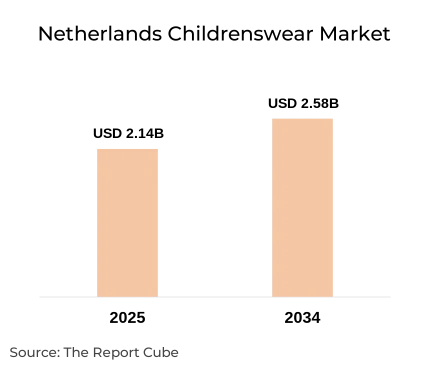
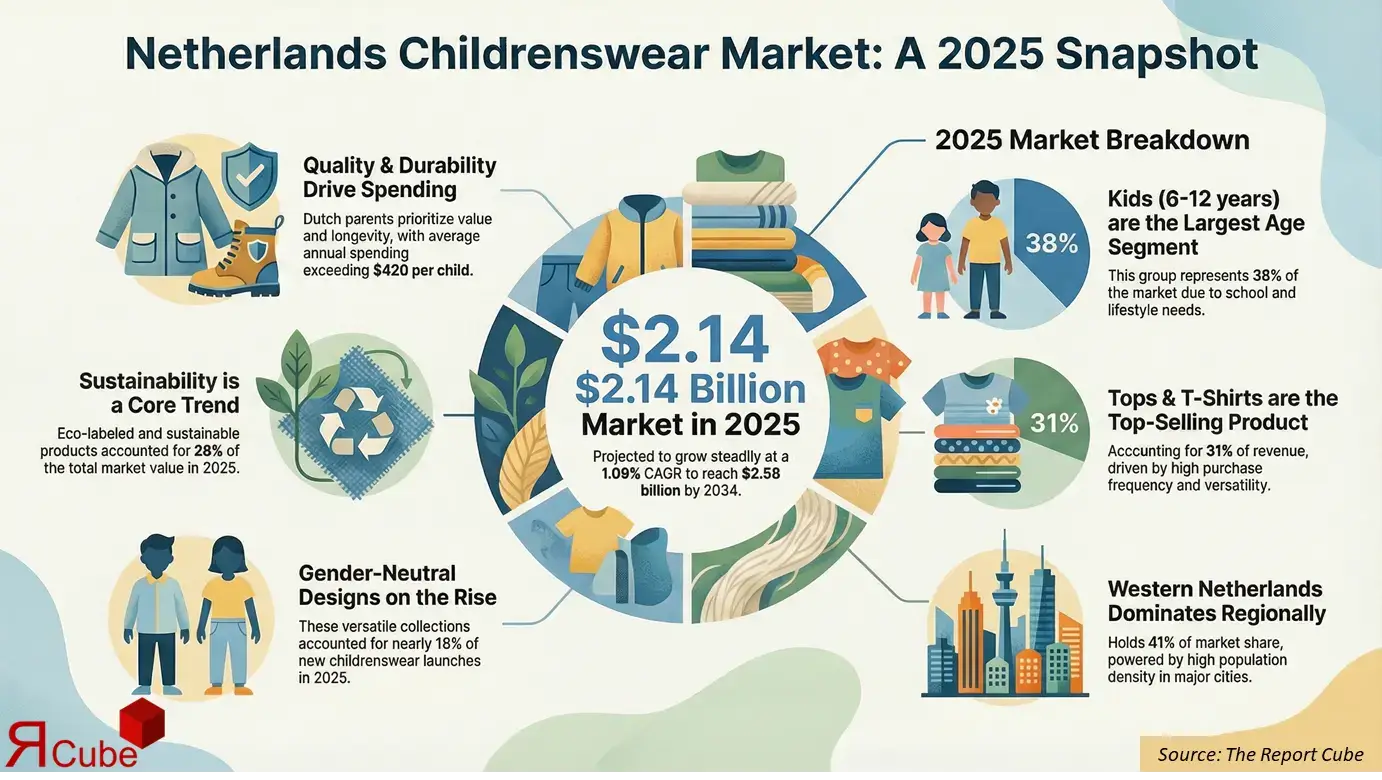
The Netherlands Childrenswear Market is anticipated to register a CAGR of 1.09% during 2026-2034. The market size was valued at USD 2.14 billion in 2025 and is projected to reach USD 2.58 billion by 2034. the market is a well-established and steadily evolving segment of the country’s broader apparel industry, supported by stable birth rates, high household spending power, and strong emphasis on quality, durability, and sustainability. Dutch consumers prioritize value-for-money clothing that balances comfort, functionality, and modern design, particularly for everyday wear. In 2025, childrenswear accounted for nearly 14% of total apparel retail sales in the Netherlands, reflecting consistent demand across infant, toddler, and school-age categories. The market benefits from high urbanization levels, widespread access to organized retail, and a strong presence of international fast-fashion brands alongside domestic labels. Parents increasingly favor versatile garments that support active lifestyles, cycling culture, and frequent outdoor activities, influencing product design and material selection across categories.
Netherlands Childrenswear Market Recent Developments
- 2025: H&M Kids expanded its sustainable childrenswear range using recycled and organic materials.
- 2025: C&A Netherlands introduced extended-size and adaptive kidswear collections.
Government Initiatives & Policies
- Netherlands Circular Textile Policy: National initiative promoting sustainable textile production and recycling.
- EU Textile Strategy: Regulatory framework encouraging durability, recyclability, and reduced environmental impact in apparel.
Market dynamics are also shaped by changing consumer attitudes toward sustainability and ethical sourcing. Dutch parents demonstrate higher-than-average awareness of environmental impact, driving demand for responsibly produced childrenswear made from organic cotton, recycled fibers, and low-impact dyes. In 2025, sustainable and eco-labeled childrenswear accounted for approximately 28% of total market value, a share that continues to rise gradually. Additionally, omnichannel retail strategies, including strong e-commerce penetration and click-and-collect models, are enhancing accessibility and convenience. While overall growth remains moderate due to market maturity and slower population growth, premiumization, product differentiation, and sustainability-driven purchasing behavior continue to support stable long-term expansion.
Netherlands Childrenswear Market Dynamics
Key Driver: Stable Household Spending and Focus on Quality
The primary driver of the Netherlands childrenswear market is stable household spending combined with strong parental focus on quality and longevity of clothing. Dutch households maintain relatively high disposable income levels, allowing parents to invest consistently in childrenswear across growth stages. Rather than frequent low-cost replacements, many consumers prefer durable garments that can be reused or passed down, supporting steady demand for mid-range and premium brands. In 2025, average annual spending on childrenswear per child exceeded USD 420, reflecting sustained purchasing power. This preference for quality over quantity benefits established brands with strong reputations for fit, comfort, and material performance, reinforcing market stability.
Major Challenge: Market Saturation and Price Sensitivity
A key challenge facing the Netherlands childrenswear market is its high level of saturation and growing price sensitivity among consumers. With extensive brand availability across physical stores and online platforms, competition is intense, placing pressure on pricing and margins. Private labels and promotional discounting are widespread, particularly in mass-market segments. Additionally, slower population growth limits volume expansion, forcing brands to compete primarily on differentiation and value rather than scale. Managing inventory efficiently and aligning collections with seasonal demand patterns remain critical challenges for retailers operating in this mature market environment.
Industry Trends: Sustainability and Gender-Neutral Designs
An important industry trend is the increasing adoption of sustainable materials and gender-neutral childrenswear designs. Dutch consumers are receptive to minimalist aesthetics and versatile clothing that transcends traditional gender categories. In 2025, gender-neutral collections accounted for nearly 16% of new childrenswear launches by leading brands. At the same time, sustainability-focused designs using organic cotton, recycled polyester, and eco-certified dyes are becoming standard rather than niche offerings. These trends reflect broader societal values around inclusivity and environmental responsibility, shaping product development and brand positioning strategies.
Opportunity Ahead: Premium Segments and Digital Engagement
Future opportunities lie in premium childrenswear segments and deeper digital engagement with consumers. Parents seeking higher-quality, stylish clothing for special occasions or older children are driving demand for differentiated designs and limited collections. Additionally, brands that leverage digital platforms for personalized marketing, loyalty programs, and seamless online-to-offline experiences can strengthen customer retention. Expanding resale, rental, and circular fashion models also presents emerging opportunities aligned with sustainability-conscious consumer behavior.
Netherlands Childrenswear Market Segment-wise Analysis
By Product Type:
- Tops & T-Shirts
- Bottoms (Pants, Shorts, Skirts)
- Dresses & Skirts
- Outerwear
- Sleepwear & Loungewear
- Activewear
- Others
Tops and T-shirts represent the largest product type segment, accounting for approximately 31% of total market revenue in 2025. High purchase frequency, seasonal replacement, and versatility across age groups support this dominance. Bottoms and outerwear follow, with outerwear benefiting from demand for weather-resistant clothing suited to the Netherlands’ climate. Activewear is gaining momentum, driven by sports participation and outdoor activities among children.
By Age Group:
- Infants (0-2 Years)
- Toddlers (3-5 Years)
- Kids (6-12 Years)
- Teens (13-17 Years)
The kids (6–12 years) segment leads the market with nearly 38% share in 2025, reflecting frequent wardrobe updates driven by growth, school attendance, and lifestyle activities. Infant and toddler segments remain stable, supported by gifting and essentials purchasing, while the teen segment shows growing influence of fashion trends and brand preferences similar to adult apparel.
Regional Projection of Netherlands Childrenswear Industry
- North
- South
- East
- West
Western Netherlands dominates the childrenswear market with approximately 41% share in 2025, supported by higher population density, urbanization, and concentration of retail outlets in cities such as Amsterdam, Rotterdam, and The Hague. The South follows with strong family-oriented demographics, while the East and North contribute moderate demand driven by regional retail networks and online shopping penetration. Regional consumption patterns closely align with population distribution and income levels.
Why Choose This Report?
- Provides a comprehensive overview of the overall market analysis, encompassing key trends, consumer behavior analysis, and risk assessment to support strategic decision-making.
- Provides accurate, up-to-date insights into market size, segmentation, and emerging opportunities, helping to minimize risk & capitalizing on growth.
- Gives deep understanding of target audience preferences, investment habits, and communication channels for enhanced product development & marketing effectiveness.
- Delivers competitive analysis & benchmarking, uncovering the strengths & weaknesses of market competitors to guide strategies.
- Consolidate comprehensive market intelligence, reducing reasoning & streamlining research efforts.
- Facilitates customized market segmentation & risk mitigation strategies, fine-tuned to the business objectives.
- Aids in identifying both market challenges & untapped opportunities within the industry to drive long-term business growth.
- Provides valuable information based on actual customer data & search trends.
Table of Contents
- Introduction
- Objective of the Study
- Product/Category Definition
- Market Segmentation
- Study Variables
- Research Methodology
- Secondary Data Points
- Breakdown of Secondary Sources
- Primary Data Points
- Breakdown of Primary Interviews
- Secondary Data Points
- Executive Summary
- Market Dynamics
- Drivers
- Challenges
- Opportunity Assessment
- Recent Trends and Developments
- Policy and Regulatory Landscape
- Netherlands Childrenswear Market Overview (2020-2034)
- Market Size, By Value (EUR Million)
- Market Share, By Product Type
- Tops & T-Shirts
- Bottoms (Pants, Shorts, Skirts)
- Dresses & Skirts
- Outerwear
- Sleepwear & Loungewear
- Activewear
- Others
- Market Share, By Age Group
- Infants (0-2 Years)
- Toddlers (3-5 Years)
- Kids (6-12 Years)
- Teens (13-17 Years)
- Market Share, By Distribution Channel
- Specialty Kidswear Stores
- Department Stores
- Online Retail
- Supermarkets & Hypermarkets
- Others
- Market Share, By Price Tier
- Premium
- Mid-Tier
- Economy
- Market Share, By Region
- North
- South
- East
- West
- Market Share, By Company
- Revenue Shares
- Competitive Landscape
- Segment-wise & Category-wise Forecast (2026-2034)
- By Product Type
- By Age Group
- By Distribution Channel
- By Price Tier
- By Region
- North Netherlands Childrenswear Market
- Market Size, By Value (EUR Million)
- Market Share, By Product Type
- Market Share, By Age Group
- Market Share, By Distribution Channel
- Market Share, By Key Cities
- South Netherlands Childrenswear Market
- Market Size, By Value (EUR Million)
- Market Share, By Product Type
- Market Share, By Age Group
- Market Share, By Distribution Channel
- Market Share, By Key Cities
- East Netherlands Childrenswear Market
- Market Size, By Value (EUR Million)
- Market Share, By Product Type
- Market Share, By Age Group
- Market Share, By Distribution Channel
- Market Share, By Key Cities
- West Netherlands Childrenswear Market
- Market Size, By Value (EUR Million)
- Market Share, By Product Type
- Market Share, By Age Group
- Market Share, By Distribution Channel
- Market Share, By Key Cities
- Competitive Outlook & Company Profiles
- C&A Netherlands
- Company Overview
- Product Portfolio
- Strategic Alliances/Partnerships
- Recent Developments
- Zara Kids (Inditex)
- Company Overview
- Product Portfolio
- Strategic Alliances/Partnerships
- Recent Developments
- H&M Kids (H&M Group)
- Company Overview
- Product Portfolio
- Strategic Alliances/Partnerships
- Recent Developments
- HEMA Kidswear
- Company Overview
- Product Portfolio
- Strategic Alliances/Partnerships
- Recent Developments
- WE Fashion Kids
- Company Overview
- Product Portfolio
- Strategic Alliances/Partnerships
- Recent Developments
- Tumble ’N Dry
- Company Overview
- Product Portfolio
- Strategic Alliances/Partnerships
- Recent Developments
- Blue Rebel
- Company Overview
- Product Portfolio
- Strategic Alliances/Partnerships
- Recent Developments
- Palomino (C&A Brand)
- Company Overview
- Product Portfolio
- Strategic Alliances/Partnerships
- Recent Developments
- Vingino
- Company Overview
- Product Portfolio
- Strategic Alliances/Partnerships
- Recent Developments
- Quapi
- Company Overview
- Product Portfolio
- Strategic Alliances/Partnerships
- Recent Developments
- Others
- C&A Netherlands
- Contact Us / Disclaimer
Top Key Players & Market Share Outlook
- C&A Netherlands
- Zara Kids (Inditex)
- H&M Kids (H&M Group)
- HEMA Kidswear
- WE Fashion Kids
- Tumble ’N Dry
- Blue Rebel
- Palomino (C&A Brand)
- Vingino
- Quapi
- Others
Frequently Asked Questions






