The US NGS Services Market Is About to 4x - Here's the Real Story Behind the Numbers
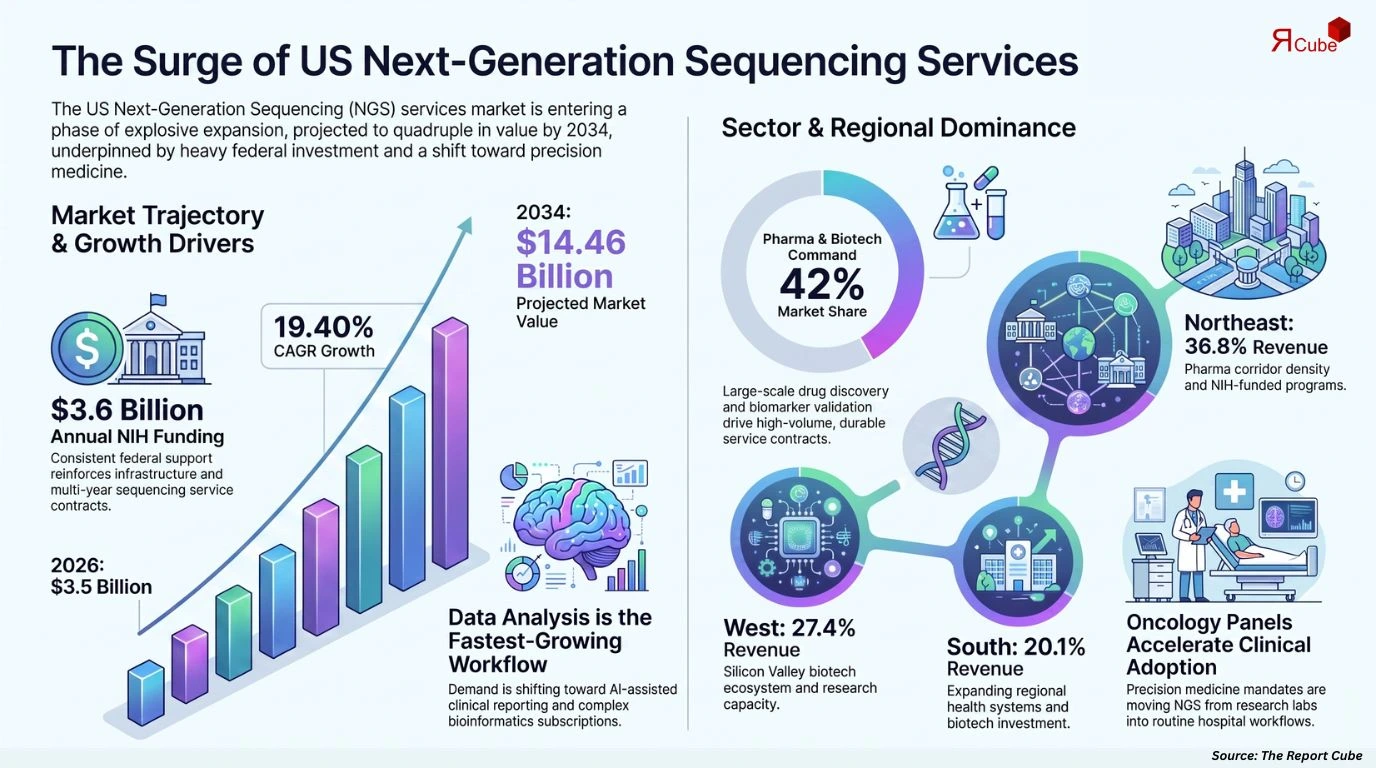
A 19.40% CAGR is not a normal growth rate. For context, most mature healthcare technology markets grow at 8–12%. When a market is projected to nearly quadruple in eight years - from USD 3.5 billion to USD 14.46 billion - something structural is happening, not just cyclical demand. That's exactly what's going on with next-generation sequencing (NGS) services in the US. The question worth asking isn't whether this market is growing. It clearly is. The better question is: what's actually pulling it forward, and who benefits?
Federal Money Is the Foundation Nobody Talks About
Everyone knows the big drivers - precision medicine, oncology genomics, rare disease diagnosis. But the less-discussed engine underneath all of it is federal funding.
NIH genomics programs have consistently poured more than USD 3.6 billion annually into research infrastructure, directly creating sequencing service demand across universities, academic medical centers, and federally funded labs. The All of Us Research Program alone has enrolled over one million participants - each requiring genomic sequencing. The Cancer Moonshot initiative keeps generating multi-year service contracts for clinical labs.
This matters because federal contracts give sequencing service providers predictable, durable revenue. Unlike consumer markets that swing with sentiment, NIH-backed sequencing programs don't stop mid-project. That stability is a large part of why this market sustains a nearly 20% CAGR rather than spiking and correcting.
The Three Workflow Stages - and Where the Real Growth Is
The NGS services market breaks down across three workflow stages: Pre-Sequencing, Sequencing, and Data Analysis. Understanding which one is growing fastest changes how you read this market entirely.
- Sequencing Service still accounts for the largest share - roughly 48% of total revenue. This is the core work: whole-genome, whole-exome, RNA sequencing, and targeted panel services. Illumina's short-read platforms dominate installed capacity here, and pharmaceutical clients sign volume-based agreements that keep utilization rates stable.
- Pre-Sequencing is getting renewed investment as labs standardize library preparation workflows to handle multi-omics and long-read sequencing inputs. It's the unglamorous prep work, but getting it right is essential for data quality downstream.
- Data Analysis Service is the fastest-growing segment - and honestly, the most interesting one. It has moved well beyond basic variant calling. Today it includes structural variant annotation, polygenic risk scoring, single-cell transcriptomics, and AI-assisted clinical report generation. Cloud-based bioinformatics platforms are letting service providers offer scalable pipelines and build recurring SaaS-style revenue with pharma and hospital clients. That shift from one-time projects to subscription-style contracts is a significant business model upgrade for the sector.
Need Specific Data, Let’s Customize the Report for You
Request CustomizationWho's Competing - and the Dynamics Worth Watching
- Illumina remains the dominant platform provider. Its NovaSeq X Plus upgrade (launched in 2025) improves throughput for clinical workflows, and its proprietary sequencing-by-synthesis chemistry runs on the majority of short-read instruments across US labs. Illumina's challenge is that it's both a platform provider and a services competitor - which creates friction with lab partners who also buy its instruments.
- Thermo Fisher Scientific runs Ion Torrent sequencing and recently expanded service capacity specifically targeting oncology companion diagnostic validation programs. It's less dominant than Illumina in research settings, but its clinical diagnostics relationships give it a different entry point.
- QIAGEN partnered with Quest Diagnostics in 2025 to integrate QIAseq panels directly into clinical lab workflows - a smart move that combines QIAGEN's sample prep and variant interpretation strengths with Quest's scale and hospital relationships.
- PacBio is the long-read story. Its HiFi sequencing platform detects structural variants and repeat expansion disorders that short-read platforms routinely miss. It's not replacing Illumina for high-volume routine work, but for complex structural genomics and rare disease cases, long-read is increasingly the right tool. The M&A chatter around PacBio is loud - Danaher, Thermo Fisher, and QIAGEN have all been floated as potential acquirers.
- Azenta Life Sciences (GENEWIZ) extended its automated library preparation capacity nationally in 2025. It's the contract sequencing services player - less platform, more capacity and turnaround. Biotech and academic clients who don't want to run in-house labs are GENEWIZ's core.
- Eurofins Scientific brings geographic breadth and competitive pricing, making it a strong option for clients running multi-site studies that need consistent sequencing results across different locations.
Where the Revenue Is Concentrated
Northeast and West dominate. The Northeast holds approximately 36.8% of national revenue - Boston-Cambridge's pharma cluster, NYC academic medical centers, and Philadelphia's cell and gene therapy corridor collectively generate enormous sequencing service demand. The West (27.4%) runs on Bay Area biotech and Stanford/UCSF research capacity.
The South is the fastest-growing region - Texas Medical Center's network of over 60 institutions, combined with expanding Medicaid reimbursement policies, is pulling clinical sequencing adoption forward quickly.
The Takeaway
By 2034, the US NGS services market won't just be bigger - it'll be structurally different. Liquid biopsy for continuous tumor monitoring, spatial transcriptomics at scale, and AI-driven variant interpretation will expand what sequencing services can bill for and who buys them. The providers investing now in long-read infrastructure, cloud bioinformatics, and direct pharma partnerships are the ones most likely to disproportionately capture that USD 14.46 billion opportunity.
The market isn't complicated. Sequencing is getting cheaper, faster, and more clinically actionable - and the US has both the research ecosystem and the payer infrastructure to absorb that growth faster than anywhere else.
For complete segmentation data, regional projections, and competitive profiles, view the full US Next-Generation Sequencing Services Market Report by Report Cube.