



Build Your Custom Market Intelligence Report
Customize Your ReportUS Next-Generation Sequencing Services Market Key Takeaways
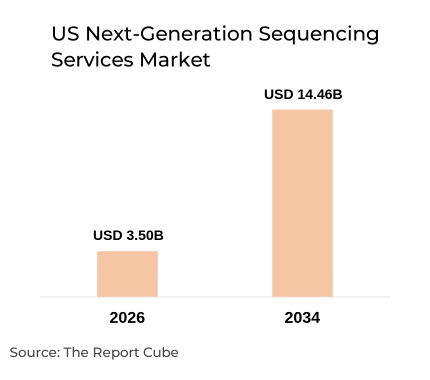
- Market valued at USD 3.5 billion in 2026, reflecting strong genomic services demand.
- Industry projected to reach USD 14.46 billion by 2034, expanding at 19.40% CAGR.
- Data Analysis Service emerges as the fastest-growing workflow segment nationally.
- Pharma and biotech entities represent a dominant and revenue-leading end-use segment.
- Illumina, Thermo Fisher, QIAGEN, and PacBio anchor competitive leadership across workflows.
- Northeast and West regions drive the highest sequencing service revenue contributions nationally.
- Precision medicine mandates and NIH funding continue accelerating next-generation sequencing adoption.
- Long-read sequencing, multi-omics integration, and AI-driven variant calling reshape service delivery.
US Next-Generation Sequencing Services Market Insights & Analysis
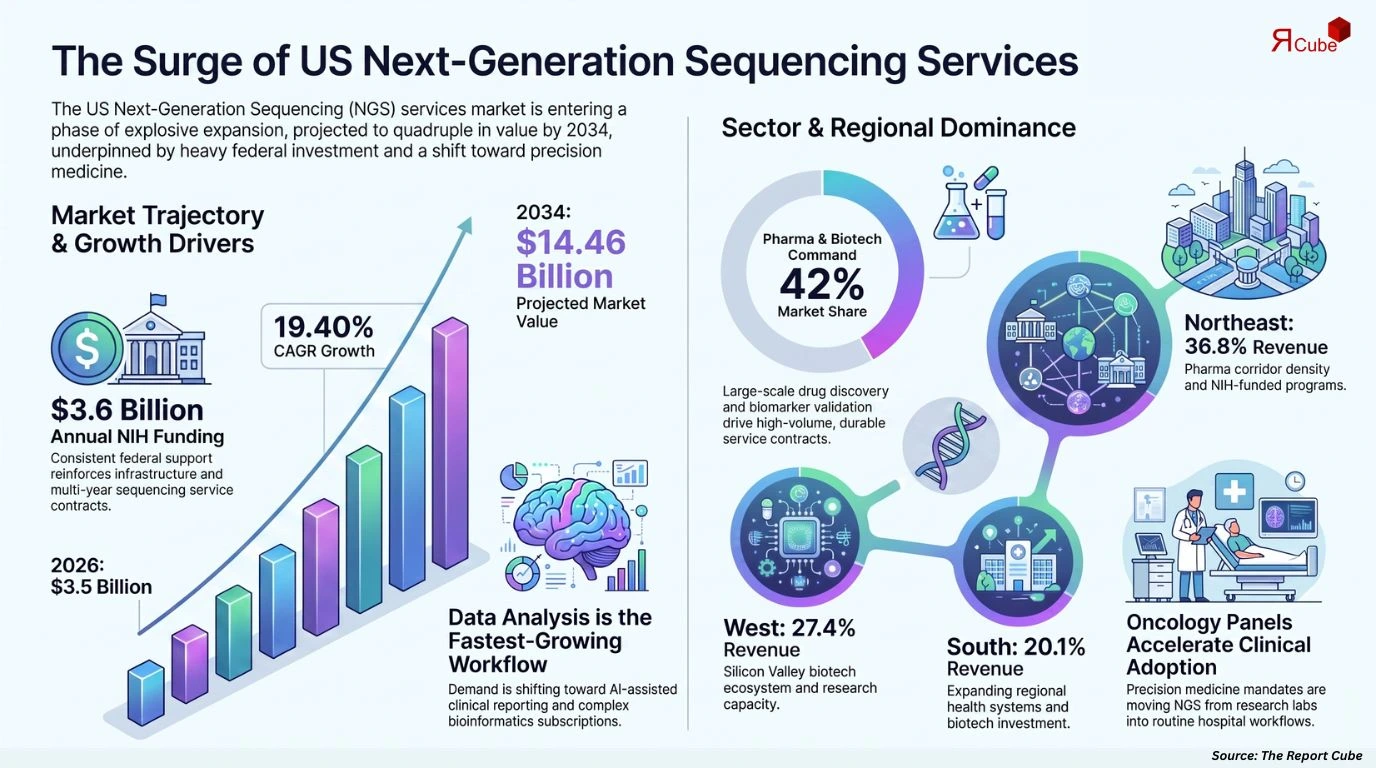
The US NGS Services Market is anticipated to register a 19.40% CAGR during 2026–2034. The market size was valued at USD 3.5 billion in 2026 and is projected to reach USD 14.46 billion by 2034. Sustained growth is driven by expanding clinical adoption of whole-genome and whole-exome sequencing, rising demand for oncology genomic profiling, and increasing integration of sequencing-as-a-service platforms for rare disease diagnosis. Federal investments exceeding USD 3.6 billion annually through the National Institutes of Health genomics programs continue reinforcing infrastructure development, while the All of Us Research Program has already enrolled over one million participants, generating unprecedented sequencing demand.
The US market benefits from one of the world's most advanced genomics research ecosystems, with academic medical centers, contract research organizations, and specialty genomics laboratories actively expanding sequencing capacity. Increasing multi-omics workflow adoption - combining genomics, transcriptomics, epigenomics, and proteomics - is extending service complexity and average revenue per sample. Biopharma companies are deploying next-generation sequencing for companion diagnostic development and regulatory submissions at an accelerating pace, creating durable, high-volume service contracts with leading genomics service providers across the country.
US Next-Generation Sequencing Services Market Dynamics
The US Next-Generation Sequencing Services Market continues expanding across research, clinical, and translational genomics applications as sequencing costs decline and turnaround times improve. Increasing biopharma pipeline activity, expanding hospital-based genomics programs, and growing demand for reproductive genetic testing are reinforcing sustained service provider revenue growth. Regulatory clarity around clinical sequencing reimbursement further strengthens the market's long-term commercial foundation.
|
Factor |
Type |
Specific Impact on Market |
Magnitude |
|---|---|---|---|
|
NIH and federal genomics funding |
Driver |
Supports sequencing service contracts at academic centers |
Very High |
|
Oncology companion diagnostic demand |
Driver |
Increases sequencing throughput for biopharma clients |
High |
|
Reimbursement expansion for clinical NGS |
Opportunity |
Accelerates hospital and clinic adoption of sequencing |
High |
|
Data interoperability and HIPAA compliance |
Challenge |
Increases complexity for cross-institutional data sharing |
Medium |
|
Long-read and multi-omics integration |
Trend |
Expands service portfolios and per-sample revenue |
Very High |
Key Market Driver: Federal Genomics Funding Strengthens Demand
National Institutes of Health genomics research funding has consistently exceeded USD 3.6 billion annually, directly supporting sequencing service procurement across universities, academic medical centers, and federally funded research institutions. Programs including the All of Us Research Program, Cancer Moonshot initiative, and Undiagnosed Diseases Network have generated multi-year sequencing service contracts. This federal commitment has reinforced whole-genome sequencing service adoption across US research institutions, enabling service providers to invest in capacity expansion, automation, and bioinformatics capabilities while maintaining stable utilization rates independent of private sector cycles.
Major Industry Challenge: Clinical Data Interoperability Barriers
Despite rapid clinical adoption, the US Next-Generation Sequencing Services Market faces significant friction from fragmented electronic health record ecosystems, inconsistent variant interpretation standards, and complex HIPAA-compliant data transfer requirements across institutions. Sequencing service providers managing data pipelines for hospital clients must navigate multiple compliance frameworks, proprietary data formats, and variable bioinformatics infrastructure maturity. These barriers extend project timelines, increase operational costs, and create reimbursement uncertainty for clinical laboratory improvement amendments-certified sequencing laboratories operating across multi-state healthcare systems.
Emerging Trend Shaping Outlook: Long-Read Sequencing Service Expansion
Pacific Biosciences HiFi sequencing and Oxford Nanopore long-read platforms are fundamentally reshaping the US sequencing service landscape by enabling complete structural variant detection, phased genome assembly, and methylation profiling within a single workflow. Leading service providers are rapidly integrating long-read offerings alongside short-read platforms to address structural genomics, repeat expansion disorders, and complex oncology profiling use cases. This transition is expanding long-read sequencing and epigenomics service portfolios beyond traditional short-read applications, increasing per-project service value and opening entirely new clinical and translational revenue streams for specialized genomics laboratories.
Need Specific Data, Let’s Customize the Report for You
Request CustomizationUS Next-Generation Sequencing Services Market Segment-wise Analysis
The US Next-Generation Sequencing Services Market exhibits distinct service demand patterns across workflow stages and end-use categories. Pre-sequencing, sequencing, and data analysis services each command differentiated pricing and turnaround structures, while end-use demand reflects the growing divergence between research-driven and clinically oriented sequencing applications.
By Workflow
- Pre-sequencing Service
- Sequencing Service
- Data Analysis Service
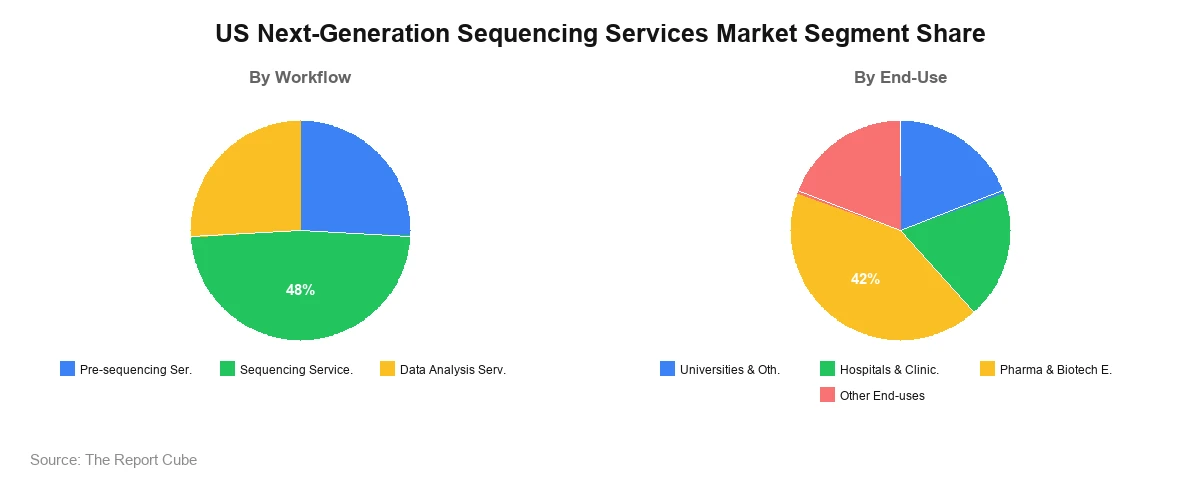
Sequencing Service accounts for the largest workflow share at an estimated 48% of total market revenue, anchored by demand for whole-genome, whole-exome, RNA sequencing, and targeted panel services across biopharma, academic, and clinical clients. Illumina short-read platforms dominate installed capacity at US service providers, enabling high-throughput sample processing at competitive per-base costs. Standardized library preparation kits, sequencing reagent contracts, and volume-based pricing agreements with pharmaceutical clients reinforce the sequencing service segment's revenue stability and market leadership.
Pre-sequencing Service is experiencing renewed investment as service providers standardize nucleic acid extraction, library preparation, and quality control workflows to support multi-omics and long-read sequencing compatibility. Data Analysis Service represents the fastest-growing workflow segment, expanding beyond basic variant calling to include structural variant annotation, polygenic risk scoring, single-cell transcriptomics analysis, and AI-assisted clinical report generation. The integration of cloud-based genomic data analysis platforms is enabling service providers to offer scalable bioinformatics pipelines, reduce turnaround time for large cohort projects, and build recurring revenue through software-as-a-service bioinformatics subscriptions targeting biopharma and hospital clients.
By End-Use
- Universities & Other Research Entities
- Hospitals & Clinics
- Pharma & Biotech Entities
- Other End-uses
Pharma and biotech entities represent the dominant end-use segment with an estimated 42% market share, driven by expanding genomics-enabled drug discovery pipelines, companion diagnostic development programs, and regulatory-grade biomarker validation studies requiring certified sequencing service providers. Large pharmaceutical companies are increasingly outsourcing sequencing workflows to specialized service providers to access accredited laboratory infrastructure, validated bioinformatics pipelines, and rapid scalability without capital-intensive instrument procurement. Multi-year service agreements with global biopharma clients provide sequencing service providers with predictable revenue and utilization rates that support continued capacity investments.
Universities and other research entities constitute a critical demand segment, accessing sequencing services through NIH-funded grants, institutional genomics core facilities, and collaborative research consortia. Hospitals and clinics represent the fastest-growing end-use category as oncology panel testing, pharmacogenomics, and rare disease diagnostics transition from academic research into routine clinical workflows. The expansion of Medicare and commercial insurance reimbursement for clinical next-generation sequencing panel testing in oncology is accelerating hospital adoption, while direct-to-consumer genetic testing companies and reproductive health service providers contribute incremental volume across Other End-uses.
Regional Projection of US Next-Generation Sequencing Services Market
The US Next-Generation Sequencing Services Market demonstrates significant regional concentration, with the Northeast and West regions anchoring national revenue generation due to dense academic medical center networks, biopharmaceutical industry clusters, and established genomics research infrastructure. Southern and Midwestern markets are accelerating adoption driven by regional health system expansion and emerging biotech ecosystems.
|
Region |
Estimated Market Share |
Key Growth Factors |
Consumer Trends |
|---|---|---|---|
|
Northeast |
36.8% |
Leading academic medical centers, pharma corridor density, NIH-funded programs |
High demand for clinical oncology and rare disease sequencing |
|
West |
27.4% |
Silicon Valley biotech ecosystem, UCSF and Stanford research capacity |
Multi-omics, single-cell, and long-read sequencing adoption |
|
South |
20.1% |
Expanding regional health systems, Texas Medical Center, biotech investment growth |
Increasing clinical panel testing and reproductive genomics |
|
Midwest |
15.7% |
University research networks, Mayo Clinic, emerging CRO presence |
Growing academic and translational sequencing service demand |
- Northeast: The Northeast commands approximately 36.8% of total US market revenue, anchored by Boston-Cambridge's global biopharmaceutical cluster, New York City's academic medical centers, and Philadelphia's cell and gene therapy ecosystem generating high-volume sequencing service demand.
- West: The West region benefits from the San Francisco Bay Area's concentration of genomics-native biotechnology firms, leading academic research institutions, and a mature venture-backed startup ecosystem continuously commissioning sequencing services for drug target discovery and biomarker programs.
- South: The South is the market's most rapidly expanding regional segment, with Texas Medical Center's network of over 60 institutions, Research Triangle Park's life science corridor, and expanding Medicaid genomics reimbursement policies accelerating clinical and translational sequencing adoption.
- Midwest: The Midwest anchors stable sequencing service demand through research universities including University of Michigan, University of Chicago, and Northwestern, complemented by Mayo Clinic's clinical genomics programs and a growing network of contract research organizations expanding sequencing capabilities.
US Next-Generation Sequencing Services Market: Recent Development (2025)
- Illumina launched a next-generation NovaSeq X Plus upgrade improving throughput for clinical sequencing workflows.
- Thermo Fisher expanded Ion Torrent sequencing service capacity targeting oncology companion diagnostic validation programs.
- QIAGEN partnered with Quest Diagnostics to integrate QIAseq panels into clinical laboratory sequencing workflows.
- Azenta Life Sciences extended GENEWIZ sequencing service capacity with automated library preparation lines nationally.
US Next-Generation Sequencing Services Market Future Outlook (2034)
The US Next-Generation Sequencing Services Market is projected to expand at a 19.40% CAGR, reaching approximately USD 14.46 billion by 2034. Continued acceleration in precision oncology programs, rare disease genomics, and population health sequencing initiatives will sustain high sequencing service volumes across research and clinical settings. Expanding biopharma investment in genomics-driven drug development, multi-omics biomarker discovery, and regulatory-grade companion diagnostic programs will continue generating durable high-value service contracts for certified sequencing providers. Integration of AI-driven variant interpretation, automated phenotype-to-genotype correlation platforms, and real-world genomic data consortia will further expand service provider capabilities.
Long-term growth will be reinforced by increasing single-cell sequencing adoption, spatial transcriptomics commercialization, and expanding reimbursement coverage for clinically actionable genomic panels. Service providers investing in CLIA-certified long-read sequencing infrastructure, cloud-based bioinformatics scalability, and direct biopharma partnership models will capture disproportionate revenue share. The convergence of liquid biopsy sequencing services and circulating tumor DNA monitoring will open substantial new clinical revenue streams by 2034 as oncology sequencing transitions from diagnostic to continuous monitoring applications across hospital and outpatient settings.
US Next-Generation Sequencing Services Market Report Coverage
|
Report Attribute |
Details |
|---|---|
|
Market Name |
US Next-Generation Sequencing Services Market |
|
Market Size (2026) |
USD 3.5 Billion |
|
Market Size (2034) |
USD 14.46 Billion |
|
Forecast Period |
2026–2034 |
|
CAGR |
19.40% |
|
Base Year |
2026 |
|
Historical Years |
2021–2025 |
|
Forecast Years |
2026–2034 |
|
Segments Covered |
By Workflow, By End-Use, By Service Type |
|
Regions Covered |
Northeast, West, South, Midwest |
|
Key Companies |
Illumina, Inc., Thermo Fisher Scientific Inc., Eurofins Scientific SE, PerkinElmer, Inc., QIAGEN, Quest Diagnostics Incorporated, Azenta Life Sciences (GENEWIZ), NanoString, PacBio, Others |
|
Report Format |
PDF, Excel, PPT |
|
Customization |
Available as per client requirements |
Why Choose This Report?
- Comprehensive analysis of all three NGS service workflow stages nationally.
- Accurate market sizing with reliable 19.40% CAGR forecast through 2034.
- Detailed end-use segmentation identifying pharma and clinical revenue leaders.
- US regional insights covering Northeast, West, South, and Midwest markets.
- Competitive profiling of ten leading sequencing service providers.
- Analysis of long-read sequencing, multi-omics, and AI-driven bioinformatics trends.
- Strategic intelligence supporting investment, partnership, and capacity decisions.
- Data-driven research aligned with current NIH funding and reimbursement developments.
Table of Contents
- Introduction
- Objective of the Study
- Product Definition
- Market Segmentation
- Study Variables
- Research Methodology
- Secondary Data Points
- Companies Interviewed
- Primary Data Points
- Breakdown of Primary Interviews
- Secondary Data Points
- Executive Summary
- Market Dynamics
- Drivers
- Challenges
- Opportunity Assessment
- Recent Trends and Developments
- Policy and Regulatory Landscape
- US Next-Generation Sequencing Services Market Overview and Forecast Analysis (2021-2034)
- Market Size, By Value, By Growth Rate (CAGR/USD Billions)
- Demand – Supply Trends
- Market Share, By Service Type
- Human Genome Sequencing Services
- Single Cell Sequencing Services
- Microbial Genome-based Sequencing Services
- Gene Regulation Services
- Animal & Plant Sequencing Services
- Other Sequencing Services
- Market Share, By Workflow
- Pre-sequencing Service
- Sequencing Service
- Data Analysis Service
- Market Share, By End-Use
- Universities & Other Research Entities
- Hospitals & Clinics
- Pharma & Biotech Entities
- Other End-uses
- Market Share, By Region
- Midwest
- West
- South
- Northeast
- Market Share, By Competitors
- Competition Characteristics
- Revenue Shares
- Human Genome Sequencing Services US Next-Generation Sequencing Services Market Overview, 2021-2034F
- By Value (USD Million)
- By Workflow – Market Size & Forecast 2021-2034, USD Million
- Pre-sequencing Service
- Sequencing Service
- Data Analysis Service
- Single Cell Sequencing Services US Next-Generation Sequencing Services Market Overview, 2021-2034F
- By Value (USD Million)
- By Workflow – Market Size & Forecast 2021-2034, USD Million
- Pre-sequencing Service
- Sequencing Service
- Data Analysis Service
- Microbial Genome-based Sequencing Services US Next-Generation Sequencing Services Market Overview, 2021-2034F
- By Value (USD Million)
- By Workflow – Market Size & Forecast 2021-2034, USD Million
- Pre-sequencing Service
- Sequencing Service
- Data Analysis Service
- Gene Regulation Services US Next-Generation Sequencing Services Market Overview, 2021-2034F
- By Value (USD Million)
- By Workflow – Market Size & Forecast 2021-2034, USD Million
- Pre-sequencing Service
- Sequencing Service
- Data Analysis Service
- Animal & Plant Sequencing Services US Next-Generation Sequencing Services Market Overview, 2021-2034F
- By Value (USD Million)
- By Workflow – Market Size & Forecast 2021-2034, USD Million
- Pre-sequencing Service
- Sequencing Service
- Data Analysis Service
- Other Sequencing Services US Next-Generation Sequencing Services Market Overview, 2021-2034F
- By Value (USD Million)
- By Workflow – Market Size & Forecast 2021-2034, USD Million
- Pre-sequencing Service
- Sequencing Service
- Data Analysis Service
- Competitive Outlook (Company Profile – Partial List)
- Illumina
- Company Overview
- Business Segments
- Strategic Alliances/Partnerships
- Recent Developments
- Inc.
- Company Overview
- Business Segments
- Strategic Alliances/Partnerships
- Recent Developments
- Thermo Fisher Scientific Inc.
- Company Overview
- Business Segments
- Strategic Alliances/Partnerships
- Recent Developments
- Eurofins Scientific SE
- Company Overview
- Business Segments
- Strategic Alliances/Partnerships
- Recent Developments
- PerkinElmer
- Company Overview
- Business Segments
- Strategic Alliances/Partnerships
- Recent Developments
- QIAGEN
- Company Overview
- Business Segments
- Strategic Alliances/Partnerships
- Recent Developments
- Quest Diagnostics Incorporated
- Company Overview
- Business Segments
- Strategic Alliances/Partnerships
- Recent Developments
- Azenta Life Sciences (GENEWIZ)
- Company Overview
- Business Segments
- Strategic Alliances/Partnerships
- Recent Developments
- NanoString
- Company Overview
- Business Segments
- Strategic Alliances/Partnerships
- Recent Developments
- PacBio
- Company Overview
- Business Segments
- Strategic Alliances/Partnerships
- Recent Developments
- Illumina
- Contact Us & Disclaimer
Top Key Players & Market Share Outlook
- Illumina, Inc.
- Thermo Fisher Scientific Inc.
- Eurofins Scientific SE
- PerkinElmer, Inc.
- QIAGEN
- Quest Diagnostics Incorporated
- Azenta Life Sciences (GENEWIZ)
- NanoString
- PacBio
- Others
Frequently Asked Questions






