



Build Your Custom Market Intelligence Report
Customize Your ReportUS Direct-to-Device (D2D) Connectivity Market Key Highlights
By Service Type:
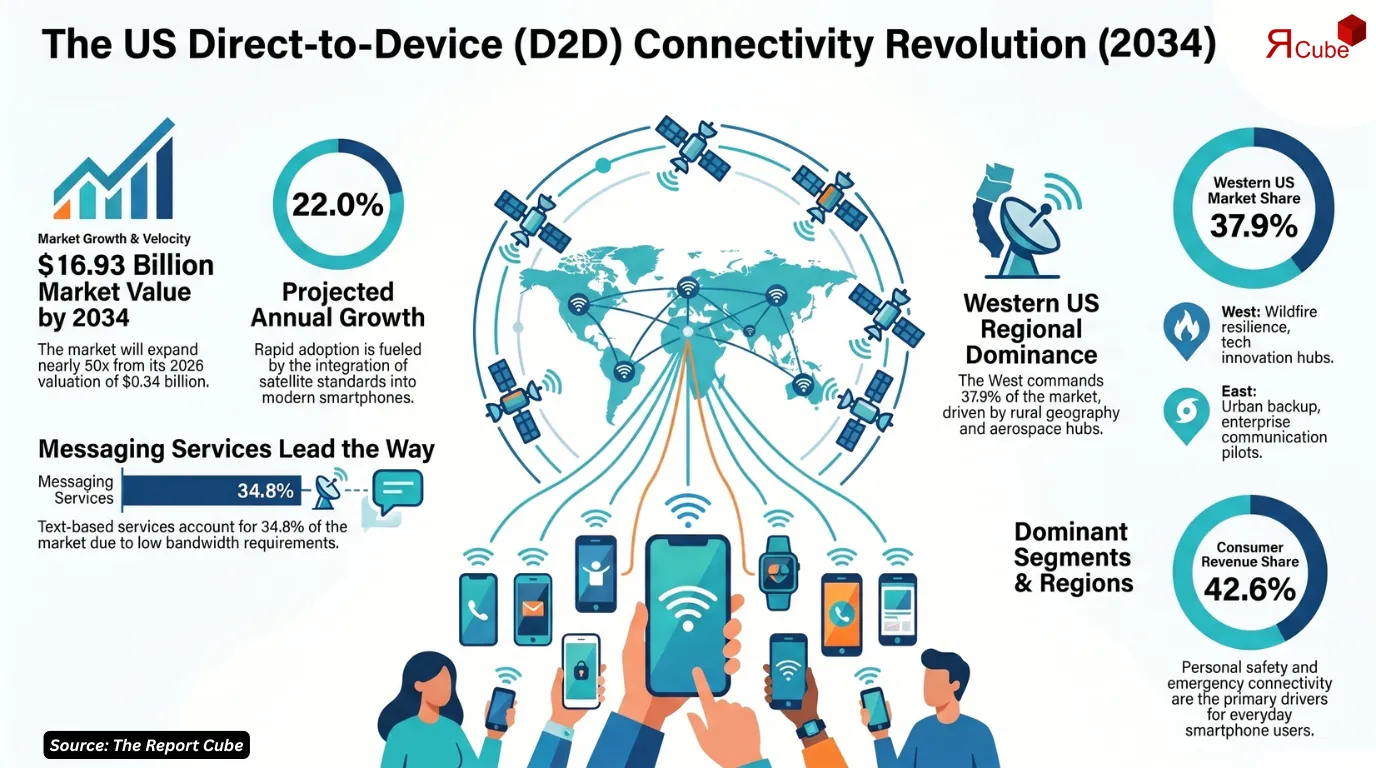
Messaging Services segment leads the market with nearly 34.8% share.
By End User:
Consumers segment dominates the market with approximately 42.6% of revenue.
Regional Outlook:
West region dominates the US Direct-to-Device (D2D) Connectivity Market with around 37.9% share.
US Direct-to-Device (D2D) Connectivity Market Insights & Analysis
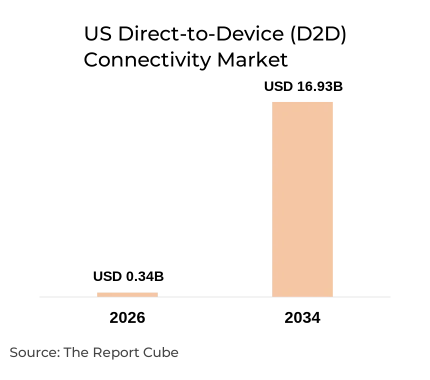
The US Direct-to-Device (D2D) Connectivity Market is anticipated to register a CAGR of around 22.0% during the forecast period 2026-2034. The market size is valued at USD 0.34 billion in 2026 and is projected to reach USD 16.93 billion by 2034. Commercial satellite operators, wireless carriers, and device manufacturers are accelerating investments to establish nationwide direct-to-device communication ecosystems. The market is gaining momentum as satellite-enabled messaging and emergency communication capabilities transition from pilot deployments into commercial service offerings. Growing integration of non-terrestrial network standards within modern smartphones is enabling users to maintain connectivity beyond traditional cellular coverage zones. Industry participants are also expanding low-Earth-orbit satellite infrastructure to improve latency, network reliability, and service availability, creating a stronger foundation for long-term D2D adoption across the United States.
Demand continues to strengthen across public safety, transportation, utilities, defense, and enterprise communications where network resilience remains a critical operational requirement. Federal agencies and telecommunications regulators have increasingly supported initiatives that encourage supplemental coverage from space, helping accelerate commercialization efforts. Strategic collaborations between satellite network operators and major mobile carriers are expanding service reach while improving interoperability between terrestrial and non-terrestrial networks. As connected vehicles, industrial monitoring systems, and remote workforce applications require uninterrupted communications, D2D connectivity is emerging as a practical solution for closing coverage gaps and enhancing national communication infrastructure. These developments are expected to reinforce market expansion throughout the forecast horizon.
US Direct-to-Device (D2D) Connectivity Market Impact Analysis
| Factor | Type | Specific Impact on Market | Magnitude | Business Implication |
|---|---|---|---|---|
| Rural Coverage and Safety Needs | Market | Unserved US areas seek basic messaging and emergency links | High | Supports rapid uptake for backup connectivity in remote zones |
| High Growth Revenue Outlook | Market | US D2D revenues grow above thirty percent annually this decade | High | Justifies strong capital deployment and ecosystem partnership bets |
| Spectrum Access Constraints | Regulatory | Limited MSS and shared bands restrict large scale capacity gains | High | Requires lobbying, smart sharing models and efficient wave use |
| Partnerships with US MNOs | Competitive | Deals with carriers enable handset reach but tighten bargaining | Medium | Needs flexible revenue shares and co-branded service packaging |
| Performance and Capacity Limits | Technological | Low speeds and shared beams keep use cases narrow and targeted | Medium | Focuses offers on texts, alerts and niche data not full mobile |
| AI Enabled Device Intelligence | Technological | AI modules optimize links and enable smarter hybrid routing | Medium | Creates premium plans around resilience and autonomous control |
| Policy Focus on Resilience | Regulatory | US policy interest favors resilient links for disasters and gaps | Medium | Opens doors for subsidies, pilots and public safety contracts |
US Direct-to-Device (D2D) Connectivity Market Dynamics
Key Driver: Expanding Need for Reliable Communication Beyond Terrestrial Coverage
Reliable connectivity has become a strategic requirement across both consumer and enterprise environments. Millions of Americans travel, work, or operate assets in locations where cellular coverage remains inconsistent, creating strong demand for communication solutions that function independently of terrestrial infrastructure. Direct-to-device connectivity addresses this gap by allowing smartphones, wearables, and connected assets to communicate through satellite networks without requiring dedicated satellite hardware. This capability is increasingly valuable for emergency responders, transportation fleets, utility operators, outdoor recreation users, and remote workforce personnel.
Telecommunications providers are accelerating commercial deployments to capitalize on this demand. Industry investments are focused on expanding satellite coverage, improving device compatibility, and increasing network capacity to support larger subscriber bases. As service reliability improves, D2D connectivity is becoming a practical extension of existing wireless services rather than a specialized backup solution. This shift is expected to strengthen market penetration across both consumer and enterprise segments during the forecast period.
Industry Trends: Commercialization of Satellite-Enabled Mobile Ecosystems
The U.S. market is witnessing a transition from pilot projects toward large-scale commercialization of direct-to-device communication services. Satellite operators, wireless carriers, infrastructure providers, and smartphone manufacturers are forming long-term partnerships aimed at delivering seamless connectivity experiences. Commercial launches are increasingly focused on supporting messaging, voice services, and low-bandwidth data transmission before expanding into higher-capacity applications. These developments are reshaping the competitive landscape and creating new revenue opportunities for both satellite and telecommunications companies.
Technology innovation remains a defining characteristic of the market. Recent advancements in satellite payload design, spectrum efficiency, network orchestration, and device integration are improving service performance while reducing operational complexity. The industry is also experiencing growing demand for satellite IoT connectivity across logistics, energy, agriculture, and transportation sectors. As ecosystem maturity improves, direct-to-device connectivity is expected to become an integral component of next-generation wireless communication infrastructure throughout the United States.
Book your FREE 30-minute expert consultation today
Contact UsMajor Challenge: Regulatory Complexity and Network Scalability Constraints
Market participants continue to face challenges associated with spectrum coordination, regulatory approvals, and network scalability. Delivering direct-to-device services requires effective integration between satellite networks and terrestrial mobile infrastructure while maintaining compliance with evolving federal regulations. Managing spectrum resources across multiple operators remains a technically demanding process, particularly as service adoption accelerates and network traffic volumes increase.
Commercial scalability presents an additional challenge. Expanding nationwide coverage requires significant investment in satellite deployment, ground infrastructure, and network management systems. Service providers must also balance growing consumer expectations regarding speed, latency, and reliability with the technical limitations of satellite-based communications. Addressing these challenges will remain essential for sustaining long-term market growth and ensuring widespread commercial adoption.
Opportunity: Enterprise and Critical Infrastructure Adoption Creating New Revenue Streams
Demand from enterprise and government organizations is emerging as a major growth catalyst for the U.S. Direct-to-Device (D2D) Connectivity Market. Industries operating in geographically dispersed environments increasingly require uninterrupted communication capabilities to support workforce safety, operational visibility, and asset monitoring. Utilities, transportation operators, energy companies, agricultural enterprises, and logistics providers are actively evaluating D2D solutions as part of broader digital transformation initiatives.
Critical infrastructure operators are particularly attracted to satellite-enabled connectivity because it strengthens operational resilience during emergencies and network outages. Federal and state agencies are also exploring direct-to-device capabilities to enhance disaster response coordination and public safety communications. As regulatory support increases and enterprise-focused service offerings mature, the market is expected to unlock substantial opportunities across industrial, governmental, and mission-critical applications.
US Direct-to-Device (D2D) Connectivity Market Segment-wise Analysis
By Service Type:
- Messaging Services
- Voice Services
- Data Services
- Emergency & SOS Services
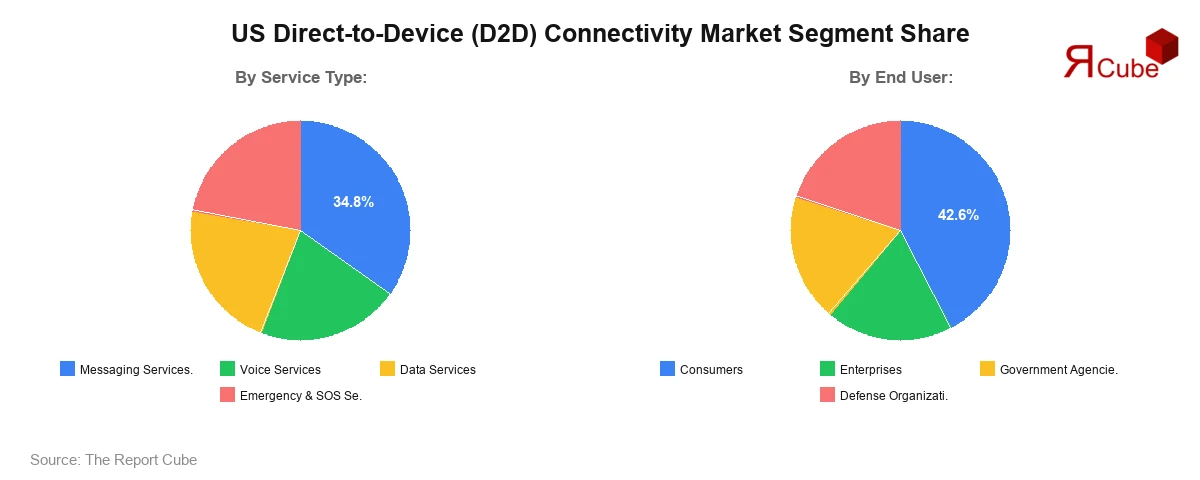
Messaging Services account for the largest share of the US Direct-to-Device (D2D) Connectivity Market, representing an estimated 34.8% of total revenue in 2026. Market leadership stems from the relatively low bandwidth requirements and broad compatibility of satellite-enabled messaging applications. Wireless operators have prioritized messaging functionality as the first commercially deployable D2D service because it delivers immediate value in emergency situations while requiring less network capacity than voice or broadband data applications. Consumer adoption has been particularly strong among travelers, outdoor enthusiasts, and users located in coverage-constrained regions.
Industry assessments indicate that text-based communication remains the primary entry point for satellite-enabled mobile services, with adoption rates rising as smartphone manufacturers expand compatibility across premium and mid-range device categories. Messaging services also support critical use cases including emergency alerts, location sharing, and business continuity communications. These advantages are expected to sustain segment leadership while creating a foundation for future voice and data service expansion.
By End User:
- Consumers
- Enterprises
- Government Agencies
- Defense Organizations
The Consumers segment holds the largest market share, accounting for approximately 42.6% of total industry revenue. Increasing consumer awareness regarding emergency connectivity, personal safety, and uninterrupted communication is driving adoption across the United States. The integration of satellite communication capabilities into commercially available smartphones has significantly expanded market accessibility, eliminating the need for specialized satellite devices in many use cases.
Growing participation in outdoor recreation, adventure tourism, remote travel, and recreational boating activities has further strengthened consumer demand. Users increasingly view satellite-enabled connectivity as a valuable extension of traditional mobile services rather than an emergency-only feature. As wireless carriers continue introducing consumer-focused service plans and device manufacturers expand hardware compatibility, the consumer segment is expected to remain the largest contributor to overall market growth through 2034.
Regional Projection of US Direct-to-Device (D2D) Connectivity Industry
- West
- East
- South
- Midwest
- Others
The West region commands the largest share of the US Direct-to-Device (D2D) Connectivity Market, accounting for nearly 37.9% of industry revenue. Regional leadership is supported by a unique combination of technology innovation, extensive rural geography, and strong satellite industry presence. States across the western United States host major aerospace companies, satellite communication providers, and wireless technology developers that continue to drive commercialization efforts and infrastructure investment.
Demand is further reinforced by large areas where terrain and population density create challenges for traditional cellular coverage. Industries operating across remote locations, including mining, agriculture, forestry, energy, and transportation, increasingly rely on resilient communication solutions to support daily operations. The region also experiences substantial recreational activity in remote environments, strengthening consumer demand for satellite-enabled services. Continued investment in next-generation satellite networks and wireless infrastructure is expected to preserve the West's leading position throughout the forecast period.
Need insights for a specific region within this market?
Request Regional DataRegional Analysis of US Direct-to-Device (D2D) Connectivity Market
The US D2D market is growing fast with strong regional usage differences in 2026.
| Region | Demand Level | Key Areas | System Dominance | Core Demand Logic | Growth Nature |
|---|---|---|---|---|---|
| West | Very High | California, Washington, Nevada | Smartphone D2D & IoT links | Tech hubs and wildfire resilience needs | Innovation-led rapid scaling |
| East | High | New York, DC, Boston | Hybrid cellular plus D2D | Urban backup and enterprise pilots | Steady enterprise expansion |
| South | Very High | Texas, Florida, Georgia | D2D emergency and rural links | Hurricane recovery and grid outages | Risk-driven strong growth |
| Midwest | Medium | Illinois, Ohio, Michigan | IoT D2D for farms and fleets | Precision agriculture and logistics | Use-case led gradual rise |
| Others | Medium | Mountain and frontier states | Satellite-first D2D coverage | Sparse coverage and remote users | Coverage fill-in growth |
Government Initiatives & Policies
- FCC Supplemental Coverage from Space Framework (2025-2026): The Federal Communications Commission continues advancing rules that allow satellite operators and mobile carriers to provide direct-to-device services using terrestrial spectrum, supporting broader nationwide connectivity and emergency communications.
- NTIA Public Safety and Resilient Communications Programs (2025-2026): The National Telecommunications and Information Administration supports initiatives that improve resilient communications infrastructure and expand connectivity access for public safety and underserved regions.
US Direct-to-Device (D2D) Connectivity Industry Recent Developments
- 2026: Lynk Global, Inc. and Anterix received FCC approval to test 900 MHz satellite-enabled direct-to-device communications for enterprise and critical infrastructure applications. The initiative aims to extend connectivity to utilities, industrial facilities, and remote operations beyond terrestrial network coverage. The development highlights increasing regulatory support for enterprise-focused D2D services and is expected to accelerate adoption across industrial and public-sector applications.
Why Choose This Report?
- Provides a comprehensive overview of the overall market analysis, encompassing key trends, consumer behavior analysis, and risk assessment to support strategic decision-making.
- Provides accurate, up-to-date insights into market size, segmentation, and emerging opportunities, helping to minimize risk & capitalizing on growth.
- Gives deep understanding of target audience preferences, investment habits, and communication channels for enhanced product development & marketing effectiveness.
- Delivers competitive analysis & benchmarking, uncovering the strengths & weaknesses of market competitors to guide strategies.
- Consolidate comprehensive market intelligence, reducing reasoning & streamlining research efforts.
- Facilitates customized market segmentation & risk mitigation strategies, fine-tuned to the business objectives.
- Aids in identifying both market challenges & untapped opportunities within the industry to drive long-term business growth.
- Provides valuable information based on actual customer data & search trends.
Table of Contents
- Introduction
- Objective of the Study
- Product and Category Definition
- Market Segmentation
- Study Variables
- Research Methodology
- Secondary Data Points
- Breakdown of Secondary Sources
- Primary Data Points
- Breakdown of Primary Interviews
- Secondary Data Points
- Executive Summary
- Market Dynamics
- Emerging Opportunities
- Adoption Trends
- Demand Drivers
- Disruption Analysis (Challenges)
- Industry Analysis & Strategic Insights
- Supply/Value Chain Analysis
- Pricing Analysis
- Go-To-Market (GTM) Strategy
- BCG Matrix
- Recent Trends and Developments
- Import and Export Analysis
- Regulatory and Policy Landscape
- Region-wise Policies
- Government Initiatives
- US Direct-to-Device (D2D) Connectivity Market Overview and Forecast Analysis (2021-2034)
- Market Size, By Value, By Growth Rate (CAGR/USD Billion)
- Market Share, By Service Type
- Messaging Services
- Voice Services
- Data Services
- Emergency & SOS Services
- Market Share, By Device Type
- Smartphones
- Wearables
- IoT Devices
- Connected Vehicles
- Others
- Market Share, By Connectivity Type
- Satellite-to-Cellular
- Satellite IoT
- Market Share, By Application
- Consumer Connectivity
- Emergency & Public Safety
- Transportation & Logistics
- Agriculture
- Energy & Utilities
- Maritime & Aviation
- Defense & Government
- Others
- Market Share, By End User
- Consumers
- Enterprises
- Government Agencies
- Defense Organizations
- Market Share, By Region
- West
- East
- South
- Midwest
- Others
- Market Share, By Company
- Revenue Shares & Analysis
- Competitive Landscape
- West US Direct-to-Device (D2D) Connectivity Market Overview and Forecast Analysis (2021-2034)
- Market Size, By Value, By Growth Rate (CAGR/USD Billion/Million)
- Market Share, By Service Type
- Market Share, By Device Type
- Market Share, By Connectivity Type
- Market Share, By Application
- Market Share, By End User
- East US Direct-to-Device (D2D) Connectivity Market Overview and Forecast Analysis (2021-2034)
- Market Size, By Value, By Growth Rate (CAGR/USD Billion/Million)
- Market Share, By Service Type
- Market Share, By Device Type
- Market Share, By Connectivity Type
- Market Share, By Application
- Market Share, By End User
- South US Direct-to-Device (D2D) Connectivity Market Overview and Forecast Analysis (2021-2034)
- Market Size, By Value, By Growth Rate (CAGR/USD Billion/Million)
- Market Share, By Service Type
- Market Share, By Device Type
- Market Share, By Connectivity Type
- Market Share, By Application
- Market Share, By End User
- Midwest US Direct-to-Device (D2D) Connectivity Market Overview and Forecast Analysis (2021-2034)
- Market Size, By Value, By Growth Rate (CAGR/USD Billion/Million)
- Market Share, By Service Type
- Market Share, By Device Type
- Market Share, By Connectivity Type
- Market Share, By Application
- Market Share, By End User
- Competitive Analysis, 2026
- Market Share of Key Players
- Competitive Mapping for Each Segment and Companies Operating Regionally
- West US Direct-to-Device (D2D) Connectivity Companies Share & Competitive Analysis, 2026
- East US Direct-to-Device (D2D) Connectivity Companies Share & Competitive Analysis, 2026
- South US Direct-to-Device (D2D) Connectivity Companies Share & Competitive Analysis, 2026
- Midwest US Direct-to-Device (D2D) Connectivity Companies Share & Competitive Analysis, 2026
- Company Profile (Partial List)
- Viasat, Inc.
- Company Overview
- Product Portfolio
- Strategic Alliances/Partnerships
- Recent Developments
- Globalstar, Inc.
- Company Overview
- Product Portfolio
- Strategic Alliances/Partnerships
- Recent Developments
- SES S.A.
- Company Overview
- Product Portfolio
- Strategic Alliances/Partnerships
- Recent Developments
- AST SpaceMobile, Inc.
- Company Overview
- Product Portfolio
- Strategic Alliances/Partnerships
- Recent Developments
- T-Mobile US, Inc.
- Company Overview
- Product Portfolio
- Strategic Alliances/Partnerships
- Recent Developments
- ORBCOMM Inc.
- Company Overview
- Product Portfolio
- Strategic Alliances/Partnerships
- Recent Developments
- Space Exploration Technologies Corp.
- Company Overview
- Product Portfolio
- Strategic Alliances/Partnerships
- Recent Developments
- Omnispace, LLC
- Company Overview
- Product Portfolio
- Strategic Alliances/Partnerships
- Recent Developments
- AT&T Inc.
- Company Overview
- Product Portfolio
- Strategic Alliances/Partnerships
- Recent Developments
- Skylo Technologies, Inc.
- Company Overview
- Product Portfolio
- Strategic Alliances/Partnerships
- Recent Developments
- Lynk Global, Inc.
- Company Overview
- Product Portfolio
- Strategic Alliances/Partnerships
- Recent Developments
- Iridium Communications Inc.
- Company Overview
- Product Portfolio
- Strategic Alliances/Partnerships
- Recent Developments
- Others (Partial List)
- Viasat, Inc.
- Contact Us and Disclaimer
Top Key Players & Market Share Outlook
- Viasat, Inc.
- Globalstar, Inc.
- SES S.A.
- AST SpaceMobile, Inc.
- T-Mobile US, Inc.
- ORBCOMM Inc.
- Space Exploration Technologies Corp.
- Omnispace, LLC
- AT&T Inc.
- Skylo Technologies, Inc.
- Lynk Global, Inc.
- Iridium Communications Inc.
- Others
Frequently Asked Questions






