



Build Your Custom Market Intelligence Report
Customize Your ReportIndonesia Telecommunications Tower Market Key Highlights
By Tower Type:
Ground-Based Towers segment leads the market, with around 48% share.
By Technology:
4G and LTE Networks segment dominate the market, accounting for nearly 52% of total revenue.
Regional Outlook:
Java region dominates the Indonesia telecommunications tower market, with around 58% share.
Government Initiatives & Policies
- Indonesia Digital Roadmap 2021–2024 and Continued Infrastructure Expansion Program: The Indonesian government continues to accelerate telecommunications infrastructure development including towers, fiber networks, and 5G readiness to strengthen national connectivity and digital economy growth.
- Palapa Ring Broadband Infrastructure Program Expansion: Indonesia’s national backbone broadband project supports telecommunications tower expansion and high-speed connectivity across remote regions including Papua and Maluku.
Indonesia Telecommunications Tower Market Insights & Analysis
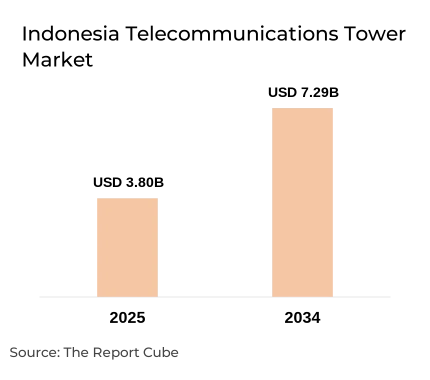
The Indonesia Telecommunications Tower Market is anticipated to register a CAGR of 7.5% during 2026-2034. The market size was valued at USD 3.8 billion in 2025 and is projected to reach USD 7.29 billion by 2034. The rapid digital transformation occurring across Indonesia has significantly increased the need for reliable telecommunications infrastructure, positioning tower networks as a critical backbone of the country’s connectivity ecosystem. As mobile data usage continues to expand, telecom operators require more dense tower networks to maintain signal quality, enhance coverage, and support advanced technologies such as 5G.
Indonesia’s unique geographic landscape consisting of more than 17,000 islands makes telecommunications towers essential for bridging connectivity gaps between urban centers and remote areas. Telecom operators increasingly rely on independent tower companies to build and manage infrastructure, allowing them to focus on service delivery and digital expansion. This model has driven large investments in tower infrastructure across the country, especially in regions experiencing high population density and rising mobile internet consumption.
Over the past decade, Indonesia has witnessed rapid growth in smartphone penetration and mobile broadband adoption. By 2025, more than 79% of the population had access to mobile internet services, creating continuous pressure on telecom operators to improve network capacity. Tower infrastructure companies play a major role in enabling this expansion by deploying shared infrastructure that allows multiple tenants to operate on a single tower, improving operational efficiency while reducing deployment costs.
Investment momentum within the Indonesian telecommunications infrastructure sector remains strong. Independent tower companies are expanding aggressively through acquisitions, new tower construction, and fiber integration strategies. These investments are supported by Indonesia’s growing digital economy, which is projected to exceed USD 130 billion by the end of the decade. As mobile connectivity becomes fundamental to commerce, digital services, and financial inclusion, the telecommunications tower market is expected to maintain consistent growth supported by infrastructure modernization and network densification.
Indonesia Telecommunications Tower Market Dynamics
Key Driver: Expanding Mobile Data Consumption and Network Coverage Demand
Indonesia has experienced a remarkable surge in mobile data consumption as millions of consumers increasingly depend on smartphones for communication, entertainment, and digital services. Mobile internet traffic in the country has grown at an average annual rate exceeding 30%, largely driven by video streaming, mobile gaming, and social media platforms. This rapid increase in data traffic requires stronger network infrastructure to maintain connectivity quality and minimize congestion across telecom networks.
Telecommunications towers are central to this expansion because they support radio access networks that deliver mobile connectivity to users across urban and rural environments. Telecom operators are investing heavily in tower densification strategies, particularly in metropolitan regions such as Jakarta, Surabaya, and Bandung where mobile usage intensity is significantly higher. These investments help ensure improved signal quality, reduced latency, and increased network capacity.
Another important factor driving tower demand is Indonesia’s growing digital services ecosystem. E-commerce platforms, fintech solutions, and ride-hailing services rely heavily on reliable mobile connectivity. As these digital platforms expand into smaller cities and rural areas, telecom providers must deploy additional towers to maintain service reliability. Consequently, infrastructure sharing models offered by independent tower companies allow operators to expand coverage quickly without incurring heavy capital expenditure.
Book your FREE 30-minute expert consultation today
Contact UsIndustry Trends: Infrastructure Sharing and Tower Consolidation Strategies
Infrastructure sharing has emerged as a dominant trend in the Indonesia telecommunications tower market. Instead of building proprietary towers, telecom operators increasingly lease space from independent tower companies that specialize in infrastructure management. This strategy significantly reduces capital expenditure while enabling faster network rollout across densely populated and geographically complex regions.
Tower companies in Indonesia are also integrating fiber infrastructure with tower networks to strengthen connectivity capabilities. Fiber connectivity allows telecom operators to support high-capacity networks required for 4G and emerging 5G services. As a result, many infrastructure providers now position themselves as integrated digital infrastructure platforms offering towers, fiber, and connectivity solutions.
Another trend shaping the industry is network densification to support next-generation connectivity technologies. Small cells, rooftop towers, and in-building solutions are becoming increasingly common in high-traffic urban zones where traditional towers alone cannot provide sufficient coverage. These infrastructure enhancements help telecom operators improve network performance in crowded environments such as commercial districts, shopping centers, and transportation hubs.
Major Challenge: Regulatory Approvals and Complex Land Acquisition Processes
One of the primary challenges affecting the Indonesia telecommunications tower market involves regulatory procedures and land acquisition requirements. Deploying new towers often requires approvals from multiple local authorities and community stakeholders. These administrative processes can significantly extend deployment timelines and increase project costs for tower infrastructure providers.
Land acquisition challenges also arise due to Indonesia’s fragmented geography and complex property ownership structures. Many rural or semi-urban areas lack clear land documentation, making it difficult for companies to secure tower construction sites quickly. Delays in acquiring land or obtaining permits can slow down infrastructure rollout, particularly in remote regions where connectivity improvements are most needed.
Community concerns regarding tower construction occasionally create additional barriers for infrastructure providers. Residents sometimes raise objections related to environmental impact, visual appearance, or health concerns associated with telecommunications towers. Tower companies must therefore invest in community engagement initiatives and regulatory compliance strategies to ensure smooth deployment processes.
Opportunity: Rapid 5G Deployment and Rural Connectivity Expansion
The transition toward 5G technology presents one of the most significant opportunities for the Indonesia telecommunications tower market. While 4G remains the dominant mobile technology across the country, telecom operators are gradually expanding 5G networks in major cities to support advanced digital services and high-speed connectivity. This transition requires a higher density of telecommunications infrastructure compared with previous generations of mobile networks.
5G networks rely heavily on small cells and dense tower networks to deliver faster speeds and lower latency. As operators continue to expand their 5G coverage, tower infrastructure providers will play a central role in enabling network deployment. Urban centers such as Jakarta and Surabaya are expected to experience rapid tower densification as telecom operators compete to deliver improved digital services.
Another significant opportunity lies in expanding connectivity across Indonesia’s underserved regions. Many islands and rural communities still experience limited telecommunications coverage. Government initiatives aimed at improving digital inclusion encourage telecom operators to expand network infrastructure into these regions. As connectivity expands across remote provinces, tower companies will benefit from increased demand for new infrastructure deployment and long-term leasing agreements.
Indonesia Telecommunications Tower Market Segment-wise Analysis
By Tower Type:
- Ground-Based Towers
- Rooftop Towers
- Small Cells
- In-Building Solutions
Ground-based towers hold the largest share in the Indonesia telecommunications tower market, accounting for nearly 48% of total infrastructure deployments. These towers remain the most widely used form of telecom infrastructure due to their ability to support multiple tenants and deliver strong signal coverage across wide geographic areas. In Indonesia’s diverse terrain, ground-based towers play a vital role in connecting suburban districts, highways, and rural communities where rooftop solutions may not be feasible.
Telecom operators rely heavily on ground-based towers to support macro network coverage, particularly for 4G and expanding 5G services. Independent tower companies continue to invest in constructing these towers because they generate consistent leasing revenue from multiple telecom tenants. A single tower often accommodates two to four mobile network operators, significantly improving infrastructure utilization rates. With Indonesia’s mobile subscriber base exceeding 350 million active connections, demand for these towers continues to grow steadily.
By Technology:
- 2G and Legacy Networks
- 3G Networks
- 4G and LTE Networks
- 5G and Emerging Technologies
The 4G and LTE networks segment currently dominates the Indonesia telecommunications tower market with approximately 52% market share. Over the past decade, telecom operators have invested heavily in expanding 4G infrastructure to meet the country’s growing demand for mobile internet services. High-speed LTE connectivity supports essential digital applications including video streaming, mobile payments, and cloud-based services.
Indonesia’s rapid smartphone adoption has further accelerated LTE deployment across both urban and semi-urban regions. Telecom operators continue to upgrade older 3G infrastructure while expanding LTE coverage across underserved provinces. This transition allows operators to deliver improved data speeds while maintaining efficient network performance. As a result, tower infrastructure providers benefit from increasing tenancy ratios, as multiple telecom companies deploy LTE equipment on shared tower platforms.
Regional Projection of Indonesia Telecommunications Tower Industry
- Sumatra
- Java
- Kalimantan
- Sulawesi
- Nusa Tenggara
- Maluku
- Papua
The Java region leads the Indonesia telecommunications tower market, holding an estimated 58% share due to its dense population and strong economic activity. Java is home to more than half of Indonesia’s population, making it the country’s largest telecommunications market. Cities such as Jakarta, Surabaya, and Bandung represent major digital hubs where mobile connectivity demand remains consistently high.
Telecom operators prioritize infrastructure investments in Java to support the region’s thriving digital economy. E-commerce platforms, financial technology companies, and online entertainment services generate massive volumes of mobile data traffic, requiring reliable network infrastructure. Consequently, tower companies continue to deploy new macro towers, rooftop installations, and small cells to enhance coverage and capacity across urban centers.
At the same time, regional governments within Java actively support telecommunications infrastructure expansion through streamlined licensing procedures and digital development initiatives. These efforts encourage faster tower deployment and improved network performance, ensuring that businesses and consumers benefit from seamless connectivity. As Indonesia’s digital transformation accelerates, Java will remain the primary driver of tower infrastructure demand.
Indonesia Telecommunications Tower Market Recent Developments
- 2025: PT Profesional Telekomunikasi Indonesia (Protelindo) reported in its 1Q 2025 results that the company added 4,457 new towers and 32,265 kilometers of revenue-generating fiber infrastructure over the previous twelve months, strengthening its integrated tower and fiber platform to support increasing data traffic and network expansion across Indonesia.
- 2025: PT Profesional Telekomunikasi Indonesia (Protelindo) announced continued infrastructure expansion in its 2Q 2025 results presentation, highlighting the addition of 4,323 towers and 27,622 kilometers of revenue-generating fiber over the previous year, reinforcing its strategy to capture growing internet and connectivity demand nationwide.
- 2025: PT Bali Towerindo Sentra Tbk revealed its 2025 business strategy targeting revenue of IDR 1.355 trillion with capital expenditure of IDR 471 billion. The investment focuses on deploying 50 microcell pole towers, expanding fiber coverage to 30,000 homes, and installing approximately 4,000 additional VSAT RTGS service points.
- 2025: Dayamitra Telekomunikasi (Mitratel) continued strengthening its national tower footprint by expanding strategic partnerships with telecom operators to accelerate network densification across high-traffic urban areas and underserved regions, supporting Indonesia’s digital infrastructure modernization.
Need insights for a specific region within this market?
Request Regional DataWhy Choose This Report?
- Provides a comprehensive overview of the overall market analysis, encompassing key trends, consumer behavior analysis, and risk assessment to support strategic decision-making.
- Provides accurate, up-to-date insights into market size, segmentation, and emerging opportunities, helping to minimize risk & capitalizing on growth.
- Gives deep understanding of target audience preferences, investment habits, and communication channels for enhanced product development & marketing effectiveness.
- Delivers competitive analysis & benchmarking, uncovering the strengths & weaknesses of market competitors to guide strategies.
- Consolidate comprehensive market intelligence, reducing reasoning & streamlining research efforts.
- Facilitates customized market segmentation & risk mitigation strategies, fine-tuned to the business objectives.
- Aids in identifying both market challenges & untapped opportunities within the industry to drive long-term business growth.
- Provides valuable information based on actual customer data & search trends.
Table of Contents
- Introduction
- Objective of the Study
- Product and Category Definition
- Market Segmentation
- Study Variables
- Research Methodology
- Secondary Data Points
- Breakdown of Secondary Sources
- Primary Data Points
- Breakdown of Primary Interviews
- Secondary Data Points
- Executive Summary
- Market Dynamics
- Drivers
- Challenges
- Opportunity Assessment
- Recent Trends and Developments
- Regulatory and Policy Landscape
- Indonesia Telecommunications Tower Market Overview (2021-2034)
- Market Size, By Value (USD Billion)
- Market Share, By Tower Type
- Ground-Based Towers
- Rooftop Towers
- Small Cells
- In-Building Solutions
- Market Share, By Structure Type
- Lattice Towers
- Monopole Towers
- Guyed Towers
- Camelback and Other Structures
- Market Share, By Ownership Model
- Captive Towers
- Independent Tower Companies
- Operator-Led TowerCo Models
- Market Share, By Tenant Type
- Mobile Network Operators
- Internet Service Providers
- Broadcast and Other Tenants
- Market Share, By Technology
- 2G and Legacy Networks
- 3G Networks
- 4G and LTE Networks
- 5G and Emerging Technologies
- Market Share, By Region
- Sumatra
- Java
- Kalimantan
- Sulawesi
- Nusa Tenggara
- Maluku
- Papua
- Market Share, By Company
- Revenue Shares and Analysis
- Competitive Landscape
- Sumatra Telecommunications Tower Market
- Market Size, By Value (USD Billion/Million)
- Market Share, By Tower Type
- Market Share, By Structure Type
- Market Share, By Ownership Model
- Market Share, By Tenant Type
- Market Share, By Technology
- Java Telecommunications Tower Market
- Market Size, By Value (USD Billion/Million)
- Market Share, By Tower Type
- Market Share, By Structure Type
- Market Share, By Ownership Model
- Market Share, By Tenant Type
- Market Share, By Technology
- Kalimantan Telecommunications Tower Market
- Market Size, By Value (USD Billion/Million)
- Market Share, By Tower Type
- Market Share, By Structure Type
- Market Share, By Ownership Model
- Market Share, By Tenant Type
- Market Share, By Technology
- Sulawesi Telecommunications Tower Market
- Market Size, By Value (USD Billion/Million)
- Market Share, By Tower Type
- Market Share, By Structure Type
- Market Share, By Ownership Model
- Market Share, By Tenant Type
- Market Share, By Technology
- Nusa Tenggara Telecommunications Tower Market
- Market Size, By Value (USD Billion/Million)
- Market Share, By Tower Type
- Market Share, By Structure Type
- Market Share, By Ownership Model
- Market Share, By Tenant Type
- Market Share, By Technology
- Maluku Telecommunications Tower Market
- Market Size, By Value (USD Billion/Million)
- Market Share, By Tower Type
- Market Share, By Structure Type
- Market Share, By Ownership Model
- Market Share, By Tenant Type
- Market Share, By Technology
- Papua Telecommunications Tower Market
- Market Size, By Value (USD Billion/Million)
- Market Share, By Tower Type
- Market Share, By Structure Type
- Market Share, By Ownership Model
- Market Share, By Tenant Type
- Market Share, By Technology
- Competitive Outlook and Company Profiles
- Dayamitra Telekomunikasi (Mitratel)
- Company Overview
- Product Portfolio
- Strategic Alliances/Partnerships
- Recent Developments
- Profesional Telekomunikasi Indonesia (Protelindo)
- Company Overview
- Product Portfolio
- Strategic Alliances/Partnerships
- Recent Developments
- Tower Bersama Infrastructure (TBIG)
- Company Overview
- Product Portfolio
- Strategic Alliances/Partnerships
- Recent Developments
- Centratama Telekomunikasi Indonesia
- Company Overview
- Product Portfolio
- Strategic Alliances/Partnerships
- Recent Developments
- Solusi Tunas Pratama (STP)
- Company Overview
- Product Portfolio
- Strategic Alliances/Partnerships
- Recent Developments
- Bali Towerindo Sentra
- Company Overview
- Product Portfolio
- Strategic Alliances/Partnerships
- Recent Developments
- Gihon Telekomunikasi Indonesia
- Company Overview
- Product Portfolio
- Strategic Alliances/Partnerships
- Recent Developments
- Inti Bangun Sejahtera (IBST)
- Company Overview
- Product Portfolio
- Strategic Alliances/Partnerships
- Recent Developments
- iForte Solusi Infotek
- Company Overview
- Product Portfolio
- Strategic Alliances/Partnerships
- Recent Developments
- Komet Infra Nusantara (KIN)
- Company Overview
- Product Portfolio
- Strategic Alliances/Partnerships
- Recent Developments
- Telkom Infranusantara
- Company Overview
- Product Portfolio
- Strategic Alliances/Partnerships
- Recent Developments
- EdgePoint Indonesia
- Company Overview
- Product Portfolio
- Strategic Alliances/Partnerships
- Recent Developments
- Visi Telekomunikasi Infrastruktur
- Company Overview
- Product Portfolio
- Strategic Alliances/Partnerships
- Recent Developments
- Daya Mitra Sarana
- Company Overview
- Product Portfolio
- Strategic Alliances/Partnerships
- Recent Developments
- Persada Sokka Tama
- Company Overview
- Product Portfolio
- Strategic Alliances/Partnerships
- Recent Developments
- Solusindo Kreasi Pratama (SKP/IndoTower)
- Company Overview
- Product Portfolio
- Strategic Alliances/Partnerships
- Recent Developments
- Mitra Langgeng Perkasa
- Company Overview
- Product Portfolio
- Strategic Alliances/Partnerships
- Recent Developments
- Others
- Dayamitra Telekomunikasi (Mitratel)
- Contact Us and Disclaimer
Top Key Players & Market Share Outlook
- Dayamitra Telekomunikasi (Mitratel)
- Profesional Telekomunikasi Indonesia (Protelindo)
- Tower Bersama Infrastructure (TBIG)
- Centratama Telekomunikasi Indonesia
- Solusi Tunas Pratama (STP)
- Bali Towerindo Sentra
- Gihon Telekomunikasi Indonesia
- Inti Bangun Sejahtera (IBST)
- iForte Solusi Infotek
- Komet Infra Nusantara (KIN)
- Telkom Infranusantara
- EdgePoint Indonesia
- Visi Telekomunikasi Infrastruktur
- Daya Mitra Sarana
- Persada Sokka Tama
- Solusindo Kreasi Pratama (SKP/IndoTower)
- Mitra Langgeng Perkasa
Frequently Asked Questions






