



Build Your Custom Market Intelligence Report
Customize Your ReportGlobal Private 5G Network Market Insights & Analysis
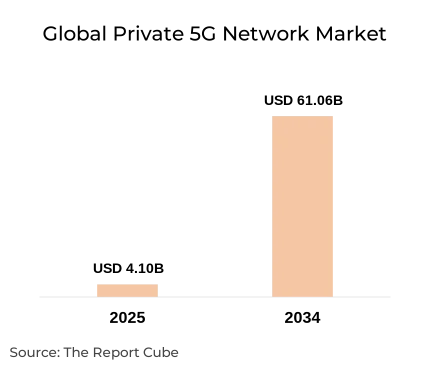
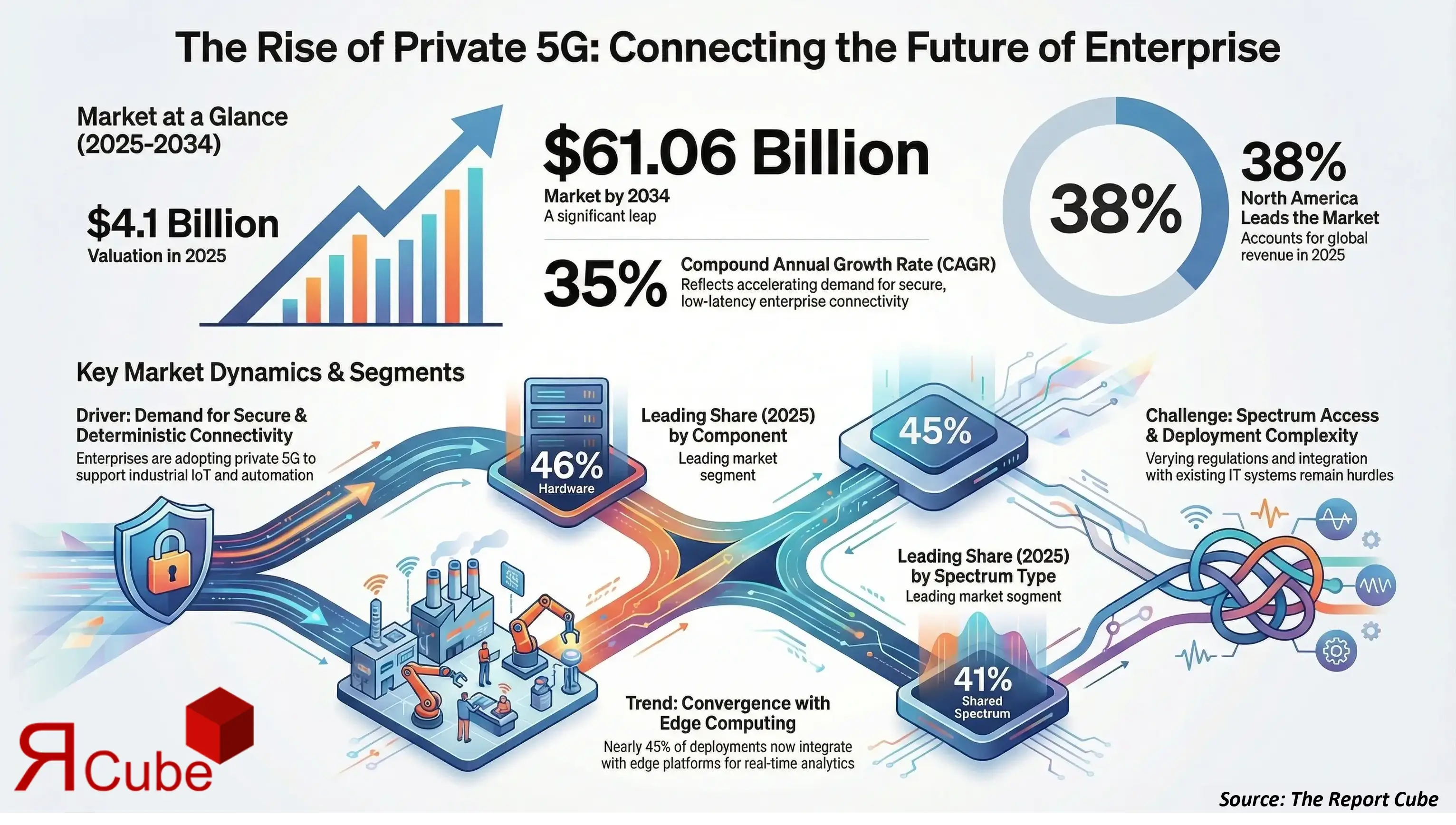
The Global Private 5G Network Market is anticipated to register a CAGR of 35% during the forecast period 2026-2034. The market size was valued at USD 4.1 billion in 2025 and is projected to reach USD 61.06 billion by 2034. This exceptional growth trajectory reflects the accelerating demand for secure, high-speed, and low-latency wireless connectivity across enterprises and industrial environments. Private 5G networks are increasingly deployed to support mission-critical operations, enabling reliable communication, real-time data processing, and seamless device connectivity. Industries such as manufacturing, energy, logistics, healthcare, and transportation are adopting private cellular infrastructure to overcome the limitations of traditional Wi-Fi and public networks.
Beyond core connectivity, enterprises are leveraging private 5G to support industrial automation, smart factories, and advanced digital transformation initiatives. The technology enables deterministic performance, enhanced security, and greater network control, which are essential for applications such as autonomous vehicles, robotics, and remote monitoring. Growing investments in Industry 4.0, combined with supportive spectrum policies and declining hardware costs, are further accelerating adoption. While North America and Europe lead early deployments, Asia Pacific is emerging as a high-growth region due to large-scale industrialization and smart city projects. Collectively, these dynamics position private 5G as a foundational technology for next-generation enterprise connectivity.
Global Private 5G Network Market Recent Developments
- 2025: Nokia expanded private 5G deployments for manufacturing campuses, focusing on ultra-reliable low-latency industrial use cases.
- 2025: Ericsson partnered with logistics operators to roll out private 5G networks supporting autonomous warehouse operations.
Government Initiatives & Policies
- U.S. CBRS Spectrum Program: Enables shared spectrum access to accelerate private 5G network deployments for enterprises.
- EU 5G Action Plan: Supports private 5G and industrial connectivity for digital transformation across member states.
Global Private 5G Network Market Dynamics
Key Driver: Rising Demand for Secure and Deterministic Enterprise Connectivity
The primary driver of the private 5G network market is the increasing need for secure, high-performance wireless connectivity within enterprise environments. Traditional Wi-Fi networks often struggle with interference, limited coverage, and inconsistent latency, particularly in large industrial facilities. Private 5G addresses these gaps by offering dedicated spectrum usage, enhanced reliability, and end-to-end network control. Studies indicate that nearly 60% of large manufacturing enterprises plan to invest in private cellular networks by 2030 to support automation and real-time monitoring. This growing reliance on industrial IoT, machine vision, and connected robotics is significantly boosting demand for private 5G solutions.
Major Challenge: Spectrum Availability and Deployment Complexity
Despite strong growth prospects, spectrum access and deployment complexity remain key challenges for the private 5G market. Spectrum regulations vary widely across regions, requiring enterprises to navigate licensing frameworks, shared spectrum models, or partnerships with mobile operators. Additionally, deploying private 5G infrastructure demands integration with existing IT and operational technology systems, increasing implementation complexity. Smaller enterprises may face skill gaps in network management and optimization. These challenges can extend deployment timelines and raise initial investment requirements, particularly in regions with less mature regulatory frameworks.
Industry Trends: Convergence of Private 5G with Edge Computing
A major industry trend is the convergence of private 5G networks with edge computing and localized data processing. Enterprises increasingly deploy edge nodes alongside private cellular infrastructure to enable real-time analytics, reduced latency, and improved data security. This combination supports advanced use cases such as predictive maintenance, digital twins, and immersive augmented reality applications. Nearly 45% of private 5G deployments are now integrated with edge computing platforms, highlighting a shift toward distributed network architectures. This trend enhances the value proposition of private 5G by enabling faster decision-making and operational efficiency.
Opportunity Ahead: Expansion Across Non-Traditional Enterprise Sectors
Significant growth opportunities lie in expanding private 5G adoption beyond traditional manufacturing into sectors such as healthcare, mining, ports, and smart campuses. Hospitals are increasingly exploring private 5G to support connected medical devices and telemedicine, while ports and airports deploy private networks for asset tracking and autonomous operations. As device ecosystems mature and deployment costs decline, private 5G is expected to penetrate mid-sized enterprises, creating a broader and more diversified customer base through 2034.
Global Private 5G Network Market Segment-wise Analysis
By Component:
- Hardware
- Radio Access Network (RAN)
- Core Network
- Edge Computing Infrastructure
- CPE or Devices
- Software
- Network Management and Orchestration
- Security and Policy Control
- Analytics and Monitoring
- Services
- Consulting
- Deployment and Integration
- Managed Services
- Support and Maintenance
Hardware represents the leading component segment, accounting for approximately 46% of total market revenue in 2025. Demand is driven by investments in RAN equipment, private core networks, and edge infrastructure required to establish dedicated enterprise networks. While software and services are growing rapidly, hardware remains the foundation of private 5G deployments, particularly in large-scale industrial campuses where coverage and performance are critical. As deployments scale, hardware replacement and upgrades continue to generate sustained revenue.
By Spectrum Type:
- Licensed
- Unlicensed
- Shared
The shared spectrum segment leads the market with an estimated 41% share in 2025, driven by flexible regulatory frameworks such as CBRS in the United States. Shared spectrum lowers entry barriers for enterprises by reducing licensing costs while still offering reliable performance. This model is particularly attractive for manufacturing, logistics, and campus networks. Licensed spectrum remains important for mission-critical deployments, while unlicensed options are gaining traction for smaller-scale or indoor applications.
Regional Projection of Global Private 5G Network Industry
- North America
- Europe
- Asia Pacific
- Middle East and Africa
- South America
North America dominates the private 5G network market, accounting for approximately 38% of global revenue in 2025. The region benefits from early spectrum availability, strong industrial digitalization, and high enterprise technology spending. The United States leads regional adoption, supported by large-scale manufacturing, logistics hubs, and advanced healthcare infrastructure. Europe follows with strong momentum from industrial automation initiatives, while Asia Pacific is the fastest-growing region due to expanding smart factories, ports, and government-backed 5G programs.
Why Choose This Report?
- Provides a comprehensive overview of the overall market analysis, encompassing key trends, consumer behavior analysis, and risk assessment to support strategic decision-making.
- Provides accurate, up-to-date insights into market size, segmentation, and emerging opportunities, helping to minimize risk & capitalizing on growth.
- Gives deep understanding of target audience preferences, investment habits, and communication channels for enhanced product development & marketing effectiveness.
- Delivers competitive analysis & benchmarking, uncovering the strengths & weaknesses of market competitors to guide strategies.
- Consolidate comprehensive market intelligence, reducing reasoning & streamlining research efforts.
- Facilitates customized market segmentation & risk mitigation strategies, fine-tuned to the business objectives.
- Aids in identifying both market challenges & untapped opportunities within the industry to drive long-term business growth.
- Provides valuable information based on actual customer data & search trends.
Table of Contents
- Introduction
- Objective of the Study
- Product and Category Definition
- Market Segmentation
- Study Variables
- Research Methodology
- Secondary Data Points
- Breakdown of Secondary Sources
- Primary Data Points
- Breakdown of Primary Interviews
- Secondary Data Points
- Executive Summary
- Market Dynamics
- Drivers
- Challenges
- Opportunity Assessment
- Recent Trends and Developments
- Regulatory and Policy Landscape
- Global Private 5G Network Market Overview (2020-2034)
- Market Size, By Value (USD Billion)
- Market Share, By Component
- Hardware
- Radio Access Network (RAN)
- Core Network
- Edge Computing Infrastructure
- CPE or Devices
- Software
- Network Management and Orchestration
- Security and Policy Control
- Analytics and Monitoring
- Services
- Consulting
- Deployment and Integration
- Managed Services
- Support and Maintenance
- Hardware
- Market Share, By Spectrum Type
- Licensed
- Unlicensed
- Shared
- Market Share, By Network Type
- Standalone Private 5G
- Hybrid
- Public-integrated Private 5G
- Market Share, By Deployment Mode
- On-premise
- Cloud
- Edge-hosted
- Market Share, By End-use Industry
- Manufacturing
- Industry 4.0
- Energy
- Transportation and Logistics
- Mining
- Oil and Gas
- Healthcare and Hospitals
- Smart Cities
- Enterprise and Campus Networks
- Defense and Public Safety
- Retail
- Agriculture
- Other Industries
- Market Share, By Region
- North America
- Europe
- Asia Pacific
- Middle East and Africa
- South America
- Market Share, By Company
- Revenue Shares
- Competitive Landscape
- North America Private 5G Network Market
- Market Size, By Value (USD Billion)
- Market Share, By Component
- Market Share, By Spectrum Type
- Market Share, By Network Type
- Market Share, By Deployment Mode
- Market Share, By End-use Industry
- Market Share, By Region/Country Group
- Market Share, By Country
- United States
- Canada
- Mexico
- Europe Private 5G Network Market
- Market Size, By Value (USD Billion)
- Market Share, By Component
- Market Share, By Spectrum Type
- Market Share, By Network Type
- Market Share, By Deployment Mode
- Market Share, By End-use Industry
- Market Share, By Region/Country Group
- Market Share, By Country
- Germany
- France
- United Kingdom
- Italy
- Spain
- Northern and Nordic Countries
- Rest of Europe
- Asia Pacific Private 5G Network Market
- Market Size, By Value (USD Billion)
- Market Share, By Component
- Market Share, By Spectrum Type
- Market Share, By Network Type
- Market Share, By Deployment Mode
- Market Share, By End-use Industry
- Market Share, By Region/Country Group
- Market Share, By Country
- China
- Japan
- India
- South Korea
- Australia
- Rest of Asia Pacific
- Middle East and Africa Private 5G Network Market
- Market Size, By Value (USD Billion)
- Market Share, By Component
- Market Share, By Spectrum Type
- Market Share, By Network Type
- Market Share, By Deployment Mode
- Market Share, By End-use Industry
- Market Share, By Region/Country Group
- Market Share, By Country
- Saudi Arabia
- United Arab Emirates
- Turkey
- South Africa
- Rest of Middle East and Africa
- South America Private 5G Network Market
- Market Size, By Value (USD Billion)
- Market Share, By Component
- Market Share, By Spectrum Type
- Market Share, By Network Type
- Market Share, By Deployment Mode
- Market Share, By End-use Industry
- Market Share, By Region/Country Group
- Market Share, By Country
- Brazil
- Argentina
- Chile
- Rest of South America
- Competitive Outlook and Company Profiles
- Huawei
- Company Overview
- Product Portfolio
- Strategic Alliances/Partnerships
- Recent Developments
- Ericsson
- Company Overview
- Product Portfolio
- Strategic Alliances/Partnerships
- Recent Developments
- Nokia
- Company Overview
- Product Portfolio
- Strategic Alliances/Partnerships
- Recent Developments
- Samsung
- Company Overview
- Product Portfolio
- Strategic Alliances/Partnerships
- Recent Developments
- ZTE
- Company Overview
- Product Portfolio
- Strategic Alliances/Partnerships
- Recent Developments
- Verizon Communications
- Company Overview
- Product Portfolio
- Strategic Alliances/Partnerships
- Recent Developments
- Vodafone
- Company Overview
- Product Portfolio
- Strategic Alliances/Partnerships
- Recent Developments
- Cisco Systems
- Company Overview
- Product Portfolio
- Strategic Alliances/Partnerships
- Recent Developments
- Juniper Networks
- Company Overview
- Product Portfolio
- Strategic Alliances/Partnerships
- Recent Developments
- Mavenir
- Company Overview
- Product Portfolio
- Strategic Alliances/Partnerships
- Recent Developments
- Others
- Huawei
- Contact Us and Disclaimer
Top Key Players & Market Share Outlook
- Huawei
- Ericsson
- Nokia
- Samsung
- ZTE
- Verizon Communications
- Vodafone
- Cisco Systems
- Juniper Networks
- Mavenir
- Others
Frequently Asked Questions






