




Build Your Custom Market Intelligence Report
Customize Your ReportSingapore Air Conditioners Market Key Highlights
By Product Type:
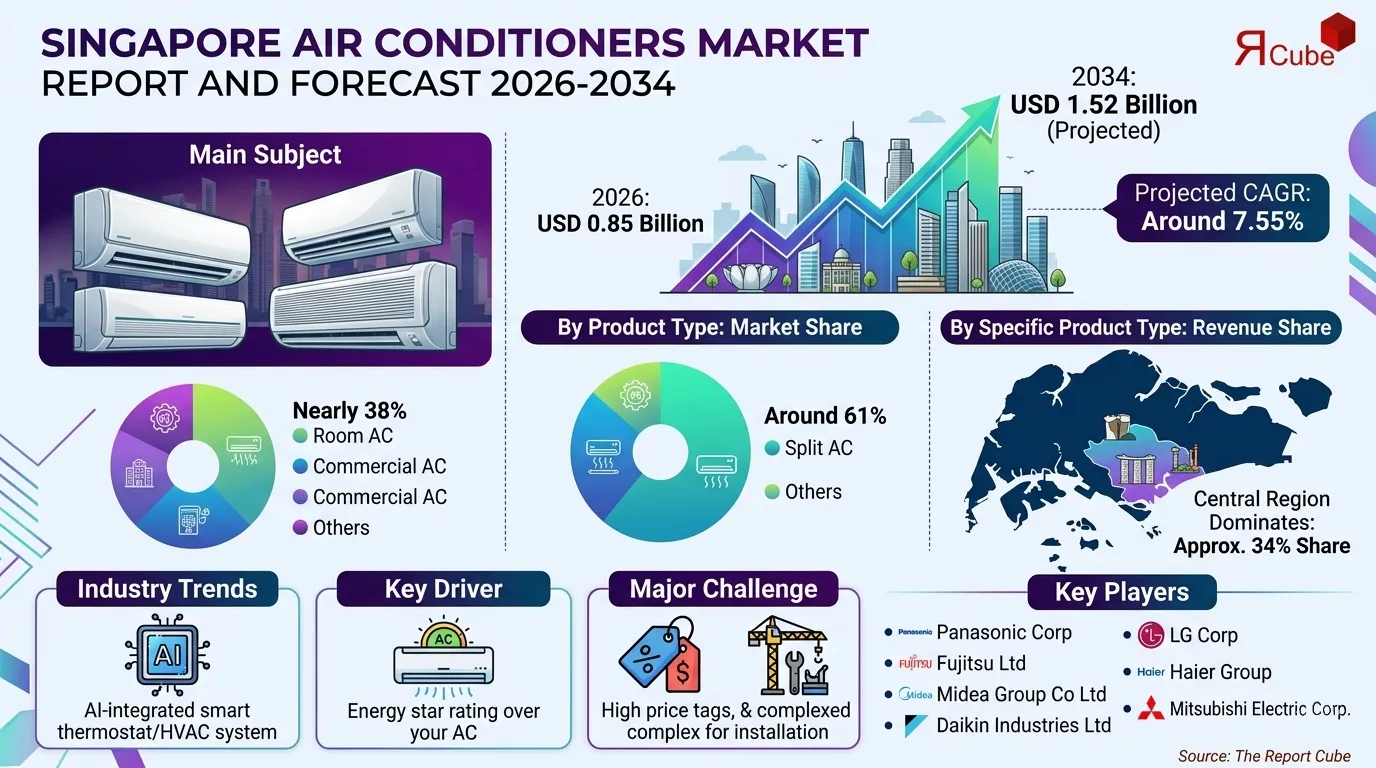
Room Air Conditioners segment leads the market with nearly 38% share.
By Product Type:
Split AC segment dominates the market with around 61% of revenue.
Regional Outlook:
Central region dominates the Singapore Air Conditioners Market with approximately 34% share.
Singapore Air Conditioners Market Insights & Analysis
The Singapore Air Conditioners Market is projected to grow at a CAGR of around 7.55% during 2026–2034, with market size increasing from USD 0.85 billion in 2026 to USD 1.52 billion by 2034. Unlike conventional markets driven by seasonal demand, Singapore’s air conditioning industry is shaped by its equatorial climate, high humidity levels, and year-round cooling requirements, making air conditioners an essential utility across residential, commercial, and industrial environments. Cooling demand is particularly concentrated in high-density residential zones such as Tampines, Woodlands, and Jurong, where public housing (HDB flats) dominates and split air conditioning systems are widely installed.
Market growth is strongly influenced by Singapore’s Green Mark certification framework and Building and Construction Authority (BCA) energy efficiency standards, which mandate high-performance cooling systems in new developments. As a result, there is a rapid transition toward inverter-based air conditioners and low-GWP refrigerants such as R32, especially in newly constructed condominiums and commercial buildings in areas like Marina Bay and the Central Business District (CBD). High replacement demand is another defining characteristic of the market, as urban consumers frequently upgrade systems due to intensive usage cycles and rising electricity costs, creating a strong aftermarket for energy-efficient and smart HVAC solutions.
The commercial and industrial segments are further driving market expansion, particularly with the growth of data centers in regions such as Jurong and Woodlands, where precision cooling systems are critical for thermal management. Singapore’s position as a regional logistics and digital infrastructure hub is accelerating the adoption of Variable Refrigerant Flow (VRF) systems and centralized ducted air conditioning solutions across warehouses, office complexes, and hyperscale facilities. In parallel, smart building integration is gaining traction, with increasing deployment of IoT-enabled air conditioners and AI-based energy optimization systems, particularly in Grade-A office spaces and smart residential projects.
From a distribution perspective, the market is witnessing a shift toward online appliance platforms and direct-to-consumer sales channels, especially among younger, tech-savvy urban households. However, authorized dealers and installation service providers remain critical, given the technical complexity of HVAC systems in high-rise environments. Competitive dynamics in Singapore are defined by energy efficiency ratings, smart connectivity features, and compliance with strict environmental regulations, with brands focusing on compact, high-performance systems tailored for space-constrained urban living.
Singapore Air Conditioners Market Impact Analysis
| Factor | Type | Specific Impact | Magnitude | Strategic Implication |
|---|---|---|---|---|
| Near-Total Market Penetration | Market Maturity | Almost all households already use AC systems | High | Growth driven by replacement cycles, not new adoption |
| Continuous Cooling Demand (No Seasonality) | Environmental Driver | AC usage remains stable throughout the year | High | Stable demand but high lifecycle cost sensitivity |
| High Electricity Tariffs Awareness | Behavioral Constraint | Consumers prioritize efficiency and usage optimization | High | Energy-efficient ACs outperform low-cost options |
| Data Center & Digital Infrastructure Growth | Demand Driver | Massive cooling requirements for IT infrastructure | High | Precision cooling & VRF systems drive high-value growth |
| High-Rise Residential Architecture | Structural Driver | Standardized apartment layouts dictate system types | High | Split & multi-split AC dominance remains unchanged |
| Government Green Mark & Efficiency Policies | Regulatory Driver | Encourages replacement of inefficient units | High | Accelerates upgrade cycles |
| Smart HVAC Integration | Technology Driver | Growth in IoT-enabled cooling systems | Medium–High | Competition shifts toward ecosystem & automation |
| Commercial Real Estate Density | Value Driver | Malls, offices, and hotels drive large-scale cooling demand | High | B2B HVAC segment dominates revenue share |
Singapore Air Conditioners Market Dynamics
Key Driver: Rising Demand for Energy-Efficient Cooling Solutions
Growing awareness of energy consumption and sustainability goals is driving demand in the Singapore air conditioners market size. Consumers and businesses are increasingly adopting inverter-based systems and energy-efficient models to reduce electricity costs. Government-backed green building certifications and incentives are encouraging adoption of eco-friendly cooling technologies. This shift is also supported by stricter regulations on refrigerants, pushing manufacturers to innovate with low-global-warming-potential alternatives.
Commercial infrastructure growth further supports demand, especially in office buildings, retail complexes, and healthcare facilities. High ambient temperatures and year-round cooling needs increase reliance on efficient air-conditioning systems. As a result, manufacturers are focusing on advanced compressors and smart temperature control features, boosting market share and strengthening overall industry growth trajectory.
Need Specific Data, Let’s Customize the Report for You
Request CustomizationIndustry Trends: Integration of Smart and AI-Based HVAC Systems
Smart air conditioning solutions are gaining strong traction across Singapore, influencing market trends and demand patterns. IoT-enabled devices allow real-time monitoring, predictive maintenance, and energy optimization, making them attractive for both residential and commercial users. This trend aligns with Singapore’s smart nation initiative, where digital transformation is a key priority.
Additionally, VRF systems and centralized cooling solutions are becoming popular in large-scale developments such as data centers and industrial parks. Manufacturers are investing in AI-driven cooling algorithms that adapt to occupancy patterns, improving efficiency. These advancements are shaping future market growth and increasing competition among key players aiming to capture higher market share.
Major Challenge: High Initial Costs and Installation Complexity
High upfront costs associated with advanced air conditioning systems remain a challenge for market growth. Technologies such as VRF systems and smart HVAC solutions require significant capital investment, which can limit adoption among small businesses and budget-conscious consumers. Installation complexity also adds to overall costs, particularly in retrofitting older buildings.
Maintenance requirements and skilled labor shortages further impact operational costs. While long-term energy savings are evident, initial expenditure remains a barrier. This challenge affects overall market demand, especially in price-sensitive segments, slowing the pace of adoption for high-end solutions in certain areas.
Opportunity: Expansion of Smart Buildings and Data Centers
The rapid development of smart buildings and data centers presents strong growth opportunities for the Singapore air conditioners market. Increased digitalization and cloud adoption are driving the need for advanced cooling systems capable of maintaining optimal temperatures in high-performance environments. This creates demand for precision air conditioning and high-capacity systems.
Furthermore, Singapore’s role as a regional technology hub is attracting investments in hyperscale data centers, boosting demand for ducted and VRF systems. Manufacturers can leverage this opportunity by offering customized solutions with enhanced energy efficiency and smart controls, strengthening market growth and competitive positioning.
Singapore Air Conditioners Market Segment-wise Analysis
By Product Type:
- Chillers
- Room Air Conditioners
- Cassette Air Conditioners
- Packaged Air Conditioners
- Ducted Split Systems
Room air conditioners lead the Singapore air conditioners market share, contributing nearly 38% of total demand. Within this category, split AC units dominate due to their energy efficiency, ease of installation, and suitability for residential applications. Rising urban housing developments and increasing household incomes are driving demand for split systems. These units are widely preferred for their quiet operation and inverter technology, which enhances energy savings. Continuous product upgrades and smart connectivity features are further strengthening this segment’s growth trajectory.
By Refrigerant Type:
- R290
- R410A
- R32
- R1234ze / R1234yf
- R134a
- Other Refrigerants
R32 refrigerant segment dominates the Singapore air conditioners market, accounting for around 42% of revenue share. Its lower environmental impact and higher efficiency compared to traditional refrigerants like R410A are key growth drivers. Regulatory support and environmental awareness are accelerating the transition toward low-global-warming-potential refrigerants. Manufacturers are actively promoting R32-based systems to align with sustainability goals, boosting market demand and influencing overall industry trends.
Singapore Air Conditioners Market Demand Cluster Analysis
Unlike large countries, Singapore’s air conditioning demand is segmented by usage clusters rather than geographic regions, driven by building types and infrastructure density.
| Region | Key Residential Areas / Industrial Zones | Demand Drivers | Consumer Segment | Popular AC Types | Price Sensitivity | Growth Potential | Key Challenges |
|---|---|---|---|---|---|---|---|
| East | Tampines, Bedok, Pasir Ris, Changi Business Park, Airport Zone | Mature estates with upgrade cycles, proximity to airport/commercial hubs, mid-high income households | Residential dominant; strong Commercial (aviation, offices) | Split AC (inverter), VRF & Central HVAC (commercial) | Medium | Medium-High - Replacement demand + commercial expansion near airport | Older HDB retrofitting constraints, rising installation costs, efficiency compliance |
| North | Woodlands, Yishun, Sembawang, Senoko Industrial Estate | New BTO supply, industrial growth, cross-border workforce influence | Residential (mid-income), Industrial (light manufacturing) | Split AC, Window AC (legacy units), Packaged systems | High | Medium - Volume growth from housing but limited premium adoption | Budget constraints, slower shift to energy-efficient models, aging estates |
| Northeast | Punggol, Sengkang, Hougang (smart town clusters) | Young population, smart home adoption, new housing developments | Residential dominant; emerging Commercial (retail, co-working) | Smart Split AC, Inverter systems | Medium | High - Strongest pipeline due to new housing & tech-driven upgrades | Smaller unit sizes, price competition, high reliance on promotional sales |
| West | Jurong East/West, Tuas, Jurong Industrial Estate, One-North | Industrial concentration, government mega projects, business parks | Industrial dominant; strong Commercial; mixed Residential | VRF, Central HVAC, Chillers, Split AC (residential) | Low-Medium | High - Industrial-scale demand + Jurong Lake District development | High energy usage, complex maintenance, regulatory pressure on emissions |
| Central | Orchard, Marina Bay, CBD, Bukit Timah, Toa Payoh | High-income households, dense commercial activity, tourism & retail demand | Commercial dominant; Premium Residential | Central HVAC, VRF systems, Premium Split & Smart AC | Low | Medium-High - Premium upgrades & retrofit demand in aging commercial buildings | High capex, strict regulations, retrofit complexity in older infrastructure |
Regional Projection of Singapore Air Conditioners Industry
- East
- North
- Northeast
- West
- Central
The Central region leads the Singapore air conditioners market with approximately 34% share, driven by dense commercial infrastructure and high-rise residential developments. This region hosts major business districts, retail hubs, and hospitality establishments, all of which require advanced cooling systems. Demand for VRF systems and ducted solutions is particularly strong due to large-scale building requirements. Additionally, ongoing redevelopment projects and smart city initiatives are boosting installation rates of energy-efficient HVAC systems, supporting regional market growth.
Government Initiatives & Policies
- Singapore Green Building Masterplan 2025: Promotes energy-efficient HVAC adoption and targets 80% of buildings to be green by 2030, encouraging sustainable cooling solutions.
- NEA Energy Efficiency Fund 2026: Supports businesses in adopting energy-efficient technologies, including advanced air-conditioning systems, reducing operational costs and emissions.
Singapore Air Conditioners Industry Recent Developments
- 2025: Daikin Industries Ltd partnered with G Element in Singapore to develop smart building management systems integrating advanced cooling and digital twin technologies, enhancing energy efficiency across commercial sectors.
- 2026: LG Corp hosted HVAC CONNECT ASIA, focusing on AI-driven energy-efficient systems, reinforcing innovation in Singapore’s HVAC ecosystem.
- 2026: Mitsubishi Electric Corp launched its updated HVAC product program, enhancing efficiency and expanding offerings tailored for advanced markets like Singapore.
Why Choose This Report? Singapore Air Conditioners Market
- Provides a comprehensive overview of the overall market analysis, encompassing key trends, consumer behavior analysis, and risk assessment to support strategic decision-making.
- Provides accurate, up-to-date insights into market size, segmentation, and emerging opportunities, helping to minimize risk & capitalizing on growth.
- Gives deep understanding of target audience preferences, investment habits, and communication channels for enhanced product development & marketing effectiveness.
- Delivers competitive analysis & benchmarking, uncovering the strengths & weaknesses of market competitors to guide strategies.
- Consolidate comprehensive market intelligence, reducing reasoning & streamlining research efforts.
- Facilitates customized market segmentation & risk mitigation strategies, fine-tuned to the business objectives.
- Aids in identifying both market challenges & untapped opportunities within the industry to drive long-term business growth.
- Provides valuable information based on actual customer data & search trends.
Table of Contents
- Introduction
- Objective of the Study
- Product and Category Definition
- Market Segmentation
- Study Variables
- Research Methodology
- Secondary Data Points
- Breakdown of Secondary Sources
- Primary Data Points
- Breakdown of Primary Interviews
- Secondary Data Points
- Executive Summary
- Market Dynamics
- Emerging Opportunities
- Adoption Trends
- Demand Drivers
- Disruption Analysis (Challenges)
- Industry Analysis & Strategic Insights
- Supply/Value Chain Analysis
- Pricing Analysis
- Go-To-Market (GTM) Strategy
- BCG Matrix
- Recent Trends and Developments
- Import and Export Analysis
- Regulatory and Policy Landscape
- Region-wise Policies
- Government Initiatives
- Singapore Air Conditioners Market Overview and Forecast Analysis (2021-2034)
- Market Size, By Value, By Growth Rate (CAGR/USD Million)
- Market Share, By Product Type
- Chillers
- Water-cooled Chillers
- Air-cooled Chillers
- Other Chillers
- Room Air Conditioners
- Split AC
- Up to 1 Ton
- 1 Ton to 1.5 Ton
- Above 1.6 to 2 Ton
- Above 2 Ton
- Window AC
- Up to 1 Ton
- 1 Ton to 2 Ton
- Above 2 Ton
- Split AC
- Cassette Air Conditioners
- Up to 2 Tons
- 2.1 to 4 Tons
- 4.1 to 5 Tons
- Above 5 Tons
- Packaged Air Conditioners
- Up to 5 Tons
- 6 to 10 Tons
- 11 to 20 Tons
- Above 20 Tons
- Ducted Split Systems
- VRF Systems
- Up to 5 Tons
- 6 to 10 Tons
- 11 to 20 Tons
- Above 20 Tons
- Others (Air Handling Units / Fan Coil Units, etc.)
- Chillers
- Market Share, By Refrigerant Type
- R290
- R410A
- R32
- R1234ze / R1234yf
- R134a
- Others
- Market Share, By Distribution Channel
- Multi-brand Stores
- Online
- Direct Sales
- Authorized Dealers and Distributors
- Market Share, By End User
- Retail and Malls
- Pharmaceuticals
- Food and Beverage
- Hotels and Hospitality
- Data Centers
- Offices
- Manufacturing
- Residential
- Educational Institutions
- Hospitals and Healthcare
- Other
- Market Share, By Region
- East
- North
- Northeast
- West
- Central
- Market Share, By Company
- Revenue Shares and Analysis
- Competitive Landscape
- East Singapore Air Conditioners Market Overview and Forecast Analysis (2021-2034)
- Market Size, By Value, By Growth Rate (CAGR/USD Million)
- Market Share, By Product Type
- Market Share, By Refrigerant Type
- Market Share, By Distribution Channel
- Market Share, By End User
- North Singapore Air Conditioners Market Overview and Forecast Analysis (2021-2034)
- Market Size, By Value, By Growth Rate (CAGR/USD Million)
- Market Share, By Product Type
- Market Share, By Refrigerant Type
- Market Share, By Distribution Channel
- Market Share, By End User
- Northeast Singapore Air Conditioners Market Overview and Forecast Analysis (2021-2034)
- Market Size, By Value, By Growth Rate (CAGR/USD Million)
- Market Share, By Product Type
- Market Share, By Refrigerant Type
- Market Share, By Distribution Channel
- Market Share, By End User
- West Singapore Air Conditioners Market Overview and Forecast Analysis (2021-2034)
- Market Size, By Value, By Growth Rate (CAGR/USD Million)
- Market Share, By Product Type
- Market Share, By Refrigerant Type
- Market Share, By Distribution Channel
- Market Share, By End User
- Central Singapore Air Conditioners Market Overview and Forecast Analysis (2021-2034)
- Market Size, By Value, By Growth Rate (CAGR/USD Million)
- Market Share, By Product Type
- Market Share, By Refrigerant Type
- Market Share, By Distribution Channel
- Market Share, By End User
- Competitive Analysis, 2026
- Market Share of Key Players
- Competitive Mapping for Each Product Type and Companies Operating Regionally
- East Singapore Air Conditioners Companies Share and Competitive Analysis, 2026
- North Singapore Air Conditioners Companies Share and Competitive Analysis, 2026
- Northeast Singapore Air Conditioners Companies Share and Competitive Analysis, 2026
- West Singapore Air Conditioners Companies Share and Competitive Analysis, 2026
- Central Singapore Air Conditioners Companies Share and Competitive Analysis, 2026
- Company Profile (Partial List)
- Panasonic Corp
- Company Overview
- Product Portfolio
- Strategic Alliances/Partnerships
- Recent Developments
- Fujitsu Ltd
- Company Overview
- Product Portfolio
- Strategic Alliances/Partnerships
- Recent Developments
- Midea Group Co Ltd
- Company Overview
- Product Portfolio
- Strategic Alliances/Partnerships
- Recent Developments
- Daikin Industries Ltd
- Company Overview
- Product Portfolio
- Strategic Alliances/Partnerships
- Recent Developments
- LG Corp
- Company Overview
- Product Portfolio
- Strategic Alliances/Partnerships
- Recent Developments
- Haier Group
- Company Overview
- Product Portfolio
- Strategic Alliances/Partnerships
- Recent Developments
- Mitsubishi Electric Corp
- Company Overview
- Product Portfolio
- Strategic Alliances/Partnerships
- Recent Developments
- Others (Partial List)
- Panasonic Corp
- Contact Us and Disclaimer
Top Key Players & Market Share Outlook
- Panasonic Corp
- Fujitsu Ltd
- Midea Group Co Ltd
- Daikin Industries Ltd
- LG Corp
- Haier Group
- Mitsubishi Electric Corp
Frequently Asked Questions






