



Build Your Custom Market Intelligence Report
Customize Your ReportMalaysia EV Charging Infrastructure Market Key Highlights
By Charger Type:
DC Fast segment leads the market, with around 42% share.
By Installation:
Public Charging segment dominates the market, accounting for nearly 48% of total revenue.
Regional Outlook:
Central region dominates the malaysia ev charging infrastructure market, with around 45% share.
Government Initiatives & Policies
- National Energy Transition Roadmap (NETR) 2023-2040, implementation updates 2025: Targets 10,000 EV charging points nationwide by 2025, supporting private sector investment and grid modernization.
- Low Carbon Mobility Blueprint (LCMB) 2021-2030, updated implementation guidelines 2025: Introduces fiscal incentives, import duty exemptions for EV chargers, and structured EV infrastructure rollout targets.
Malaysia EV Charging Infrastructure Market Insights & Analysis
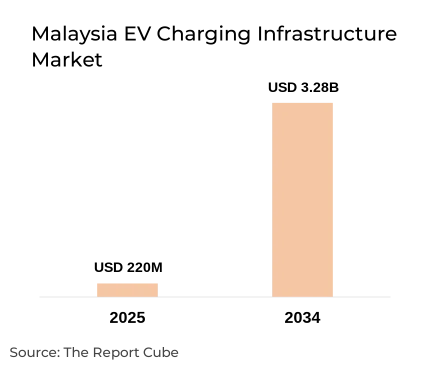
The Malaysia EV Charging Infrastructure Market is anticipated to register a 35% during 2026-34. The market size was valued at USD 220 million in 2025 and is projected to reach USD 3,276.62 million by 2034. Rapid EV adoption, government-backed electrification targets, and rising private sector participation are reshaping Malaysia’s transport energy ecosystem.
Malaysia’s EV registrations crossed an estimated 80,000 cumulative units by the end of 2025, reflecting annual growth exceeding 70% compared to 2024. The federal government’s target of 10,000 public charging points by 2025 accelerated deployment across highways, shopping malls, and residential hubs. DC fast charging infrastructure expanded at a faster rate than AC chargers, particularly along the North-South Expressway corridor connecting Kuala Lumpur, Penang, and Johor. High utilization rates at highway charging points, often exceeding 35% during peak holiday travel periods, signal rising demand for high-power charging solutions.
Utility companies such as TNB (Tenaga Nasional) are strengthening grid readiness through substation upgrades and load balancing systems, while private operators including Gentari Renewables and Yinson GreenTech are investing in scalable corridor-based charging hubs. By late 2025, Malaysia had surpassed 2,500 operational public charging points, with DC chargers accounting for nearly 40% of installed capacity but contributing over 60% of charging revenue due to higher pricing and utilization intensity.
Commercial fleet electrification, particularly in logistics and ride-hailing sectors, is further increasing demand for dedicated fleet charging depots. Meanwhile, property developers are integrating EV charging readiness into new residential and mixed-use developments. These structural drivers are positioning Malaysia as one of Southeast Asia’s fastest-growing EV infrastructure markets, supported by strong policy alignment and cross-sector investment.
Malaysia EV Charging Infrastructure Market Dynamics
Key Driver: Accelerated EV Adoption and National Charging Targets
The primary growth engine is Malaysia’s accelerating EV adoption supported by fiscal incentives and import tax exemptions. Passenger EV sales more than doubled between 2024 and 2025, increasing pressure on charging availability. Government targets for 10,000 chargers nationwide created a structured pipeline for infrastructure investments. Corporate fleet operators are also transitioning to electric vans and delivery vehicles to meet ESG commitments, driving depot charging demand. Rising fuel subsidy rationalization further strengthens the economic case for EV ownership. As EV penetration rises toward a projected 15% of new vehicle sales by 2030, charging density requirements will expand proportionally, sustaining long-term infrastructure growth.
Book your FREE 30-minute expert consultation today
Contact UsIndustry Trends: Expansion of High-Power Charging Corridors and Integrated Charging Hubs
High-power DC charging is emerging as the dominant trend, particularly for highway and intercity travel. Operators are deploying chargers with capacities ranging from 120 kW to 350 kW to reduce charging times below 30 minutes. Integrated charging hubs combining retail, F&B, and rest facilities are enhancing user experience and increasing dwell-time monetization. Smart charging systems with load management software are being introduced to balance grid demand and reduce peak stress. Additionally, roaming agreements among charging operators are improving interoperability, allowing users to access multiple networks through unified payment platforms, increasing utilization efficiency across installed assets.
Major Challenge: Grid Capacity Constraints and Uneven Regional Distribution
Rapid deployment of DC fast chargers creates localized grid stress, particularly in commercial districts and highway rest stops. Upgrading substations and distribution lines requires capital expenditure and coordination with utilities. Rural and East Coast regions experience slower charger deployment due to lower EV density and longer return-on-investment timelines. Land acquisition and permitting processes can delay project commissioning. Additionally, standardization across connector types and payment systems remains inconsistent, occasionally affecting user convenience. Addressing these constraints requires coordinated planning between utilities, regulators, and private operators to ensure reliable grid integration.
Opportunity: Fleet Electrification and Cross-Border Charging Connectivity
Fleet electrification presents a substantial opportunity, especially in logistics, e-commerce, and ride-hailing sectors. Dedicated fleet depots equipped with high-capacity DC chargers enable overnight bulk charging at optimized tariffs. Malaysia’s strategic location also supports cross-border EV travel between Singapore and Thailand, increasing demand for interoperable highway charging corridors. Smart energy integration, including solar-powered charging hubs paired with battery storage, can lower operational costs and improve sustainability credentials. By 2034, commercial fleet charging is projected to contribute nearly 30% of incremental infrastructure revenue, strengthening business case viability for large-scale operators.
Malaysia EV Charging Infrastructure Market Segment-wise Analysis
By Charger Type:
- AC Slow
- AC Fast
- DC Fast
- Ultra Fast
DC Fast chargers account for approximately 42% of total market revenue in 2025. Their dominance stems from growing highway travel demand and commercial fleet utilization. Charging capacities between 120 kW and 180 kW are most common, balancing installation cost and performance. Ultra-fast chargers above 250 kW are gradually expanding along premium corridors. Although AC slow chargers represent higher installation numbers, DC fast units generate greater revenue per unit due to higher pricing and turnover rates. Continued EV battery capacity improvements further increase reliance on high-power DC infrastructure to minimize charging downtime.
By Installation:
- Public Charging
- Private Charging
- Fleet Charging
Public charging holds nearly 48% of total market revenue, reflecting strong highway and urban deployment. Shopping malls, petrol stations, and mixed-use developments are key host locations. Public charging networks recorded average utilization rates between 18% and 30% in major cities during 2025. Private residential charging is growing steadily, particularly in landed properties, but faces installation limitations in high-rise apartments. Fleet charging is expanding rapidly, supported by corporate sustainability commitments and operational cost savings. Public infrastructure remains dominant due to government-backed deployment targets and strategic corridor development.
Regional Projection of Malaysia EV Charging Infrastructure Industry
- Central
- Northern
- Southern
- East
- Others
The Central region leads with around 45% market share, driven by Klang Valley’s high EV ownership concentration and commercial density. Kuala Lumpur and Selangor host the largest share of DC fast charging hubs and fleet depots. Northern states such as Penang are expanding infrastructure to support industrial EV adoption. Southern Malaysia, particularly Johor, benefits from cross-border EV travel with Singapore, increasing highway charging demand. East Malaysia is gradually scaling installations, though geographic dispersion and lower EV density slow expansion. Regional development closely mirrors vehicle ownership patterns and commercial activity clusters.
Malaysia EV Charging Infrastructure Market Recent Developments
- 2025: Shell Malaysia launched Malaysia's first high-power charging network connecting East Coast and West Coast corridors, significantly enhancing long-distance EV travel and strengthening national fast-charging connectivity.
- 2025: Tesla Malaysia announced deployment of six additional Supercharging stations across Klang Valley and Johor, expanding DC fast charging coverage to support growing Tesla vehicle adoption.
- 2025: Tesla Malaysia confirmed year-end deployment of 76 Supercharging stalls at 17 locations and 79 Destination Charging stalls nationwide, marking rapid ecosystem expansion.
- 2025: Yinson GreenTech advanced construction of Malaysia’s first highway-integrated EV Charging Hub with planned 1.2 MW installed capacity, supporting up to 20 simultaneous DC fast charging sessions.
Need insights for a specific region within this market?
Request Regional DataWhy Choose This Report?
- Provides a comprehensive overview of the overall market analysis, encompassing key trends, consumer behavior analysis, and risk assessment to support strategic decision-making.
- Provides accurate, up-to-date insights into market size, segmentation, and emerging opportunities, helping to minimize risk & capitalizing on growth.
- Gives deep understanding of target audience preferences, investment habits, and communication channels for enhanced product development & marketing effectiveness.
- Delivers competitive analysis & benchmarking, uncovering the strengths & weaknesses of market competitors to guide strategies.
- Consolidate comprehensive market intelligence, reducing reasoning & streamlining research efforts.
- Facilitates customized market segmentation & risk mitigation strategies, fine-tuned to the business objectives.
- Aids in identifying both market challenges & untapped opportunities within the industry to drive long-term business growth.
- Provides valuable information based on actual customer data & search trends.
Table of Contents
- Introduction
- Objective of the Study
- Product and Category Definition
- Market Segmentation
- Study Variables
- Research Methodology
- Secondary Data Points
- Breakdown of Secondary Sources
- Primary Data Points
- Breakdown of Primary Interviews
- Secondary Data Points
- Executive Summary
- Market Dynamics
- Drivers
- Challenges
- Opportunity Assessment
- Recent Trends and Developments
- Regulatory and Policy Landscape
- Malaysia EV Charging Infrastructure Market Overview (2021-2034)
- Market Size, By Value (USD Million)
- Market Share, By Charger Type
- AC Slow
- AC Fast
- DC Fast
- Ultra Fast
- Market Share, By Connector Type
- Type 2
- CCS
- CHAdeMO
- GB/T
- Others
- Market Share, By Installation
- Public Charging
- Private Charging
- Fleet Charging
- Market Share, By Charger Location
- Residential
- Workplace
- Highway
- Destination
- Fleet Depot
- Market Share, By Vehicle Type
- Passenger EV
- Commercial EV
- Bus & Coach
- Two-Wheeler
- Others
- Market Share, By Region
- Northern
- Central
- Southern
- East
- Others
- Market Share, By Company
- Revenue Shares & Analysis
- Competitive Landscape
- Northern Malaysia EV Charging Infrastructure Market
- Market Size, By Value (USD Million)
- Market Share, By Charger Type
- Market Share, By Connector Type
- Market Share, By Installation
- Market Share, By Charger Location
- Market Share, By Vehicle Type
- Central Malaysia EV Charging Infrastructure Market
- Market Size, By Value (USD Million)
- Market Share, By Charger Type
- Market Share, By Connector Type
- Market Share, By Installation
- Market Share, By Charger Location
- Market Share, By Vehicle Type
- Southern Malaysia EV Charging Infrastructure Market
- Market Size, By Value (USD Million)
- Market Share, By Charger Type
- Market Share, By Connector Type
- Market Share, By Installation
- Market Share, By Charger Location
- Market Share, By Vehicle Type
- East Malaysia EV Charging Infrastructure Market
- Market Size, By Value (USD Million)
- Market Share, By Charger Type
- Market Share, By Connector Type
- Market Share, By Installation
- Market Share, By Charger Location
- Market Share, By Vehicle Type
- Competitive Outlook and Company Profiles
- Gentari Renewables
- Company Overview
- Product Portfolio
- Strategic Alliances/Partnerships
- Recent Developments
- Yinson GreenTech
- Company Overview
- Product Portfolio
- Strategic Alliances/Partnerships
- Recent Developments
- EV Connection
- Company Overview
- Product Portfolio
- Strategic Alliances/Partnerships
- Recent Developments
- ChargeSini
- Company Overview
- Product Portfolio
- Strategic Alliances/Partnerships
- Recent Developments
- Shell Malaysia
- Company Overview
- Product Portfolio
- Strategic Alliances/Partnerships
- Recent Developments
- Tesla Malaysia
- Company Overview
- Product Portfolio
- Strategic Alliances/Partnerships
- Recent Developments
- Sime Darby (Mecomb)
- Company Overview
- Product Portfolio
- Strategic Alliances/Partnerships
- Recent Developments
- TNB (Tenaga Nasional)
- Company Overview
- Product Portfolio
- Strategic Alliances/Partnerships
- Recent Developments
- ABB Malaysia
- Company Overview
- Product Portfolio
- Strategic Alliances/Partnerships
- Recent Developments
- Siemens Malaysia
- Company Overview
- Product Portfolio
- Strategic Alliances/Partnerships
- Recent Developments
- Schneider Electric
- Company Overview
- Product Portfolio
- Strategic Alliances/Partnerships
- Recent Developments
- KPower Berhad
- Company Overview
- Product Portfolio
- Strategic Alliances/Partnerships
- Recent Developments
- V-Charge
- Company Overview
- Product Portfolio
- Strategic Alliances/Partnerships
- Recent Developments
- Carput Zap
- Company Overview
- Product Portfolio
- Strategic Alliances/Partnerships
- Recent Developments
- Delta Electronics
- Company Overview
- Product Portfolio
- Strategic Alliances/Partnerships
- Recent Developments
- Evolt
- Company Overview
- Product Portfolio
- Strategic Alliances/Partnerships
- Recent Developments
- Others
- Gentari Renewables
- Contact Us and Disclaimer
Top Key Players & Market Share Outlook
- Gentari Renewables
- Yinson GreenTech
- EV Connection
- ChargeSini
- Shell Malaysia
- Tesla Malaysia
- Sime Darby (Mecomb)
- TNB (Tenaga Nasional)
- ABB Malaysia
- Siemens Malaysia
- Schneider Electric
- KPower Berhad
- V-Charge
- Carput Zap
- Delta Electronics
- Evolt
- Others
Frequently Asked Questions






