




Build Your Custom Market Intelligence Report
Customize Your ReportUnited States Gluten-Free Products Market Key Takeaways
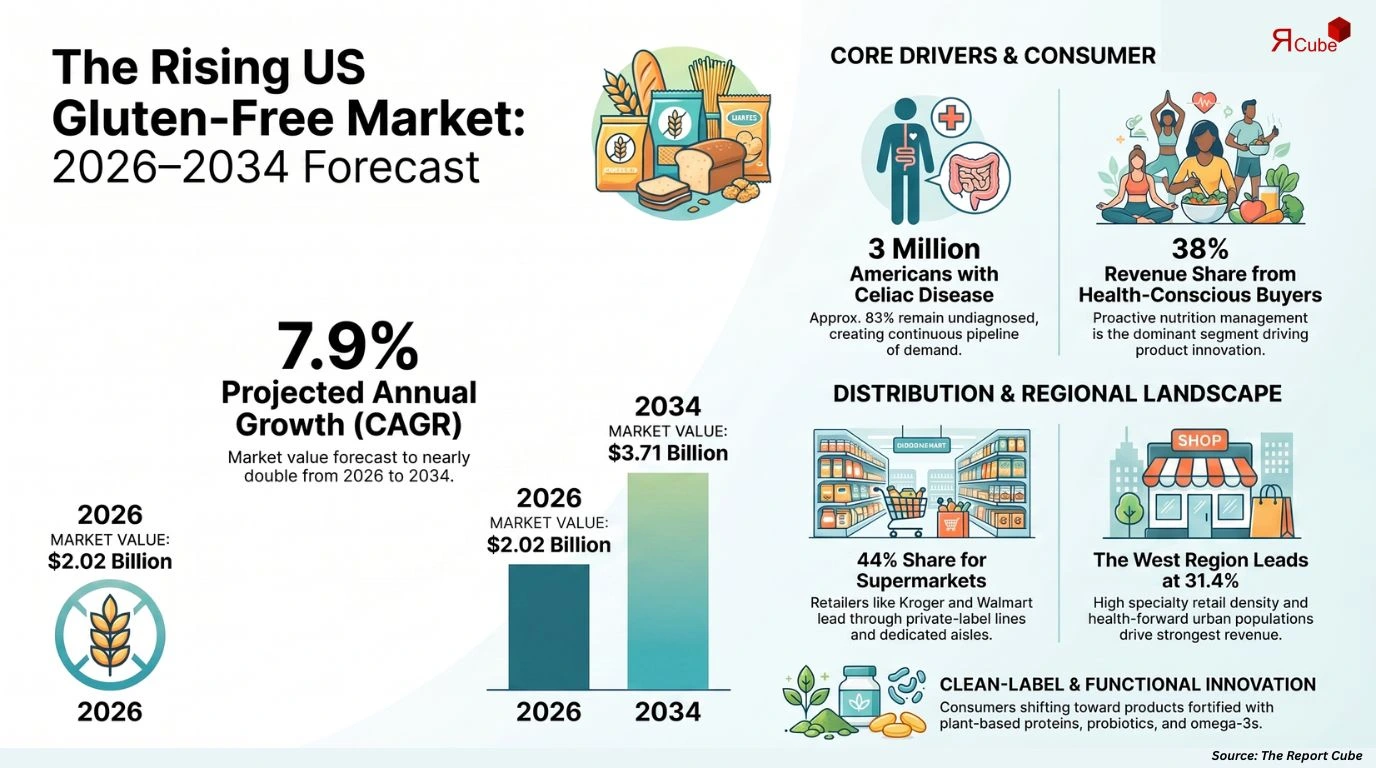
- Market valued at USD 2.02 billion in 2026, reflecting sustained demand for gluten-free dietary solutions.
- Industry projected to reach USD 3.71 billion by 2034, expanding at a 7.90% CAGR.
- Health-conscious consumers remain the dominant segment driving gluten-free product innovation and adoption.
- Supermarkets lead the distribution channel segment owing to extensive gluten-free product shelf space.
- The West region maintains leadership through high health awareness and specialty food retailer density.
- Clean-label ingredients, fortified nutrition profiles, and allergen-free certifications shape evolving consumer preferences.
- Leading companies include General Mills, Kraft Heinz, Nestle, PepsiCo, Schär, and Enjoy Life Foods.
- Rising celiac disease diagnoses and expanding sports nutrition adoption continue accelerating gluten-free market growth.
United States Gluten-Free Products Market Insights & Analysis
The United States Gluten-Free Products Market is anticipated to register a 7.90% CAGR during 2026–2034. The market size was valued at USD 2.02 billion in 2026 and is projected to reach USD 3.71 billion by 2034. Market expansion is underpinned by increasing celiac disease prevalence, which affects approximately 1% of the U.S. population, alongside surging demand from non-celiac gluten-sensitive individuals. Leading manufacturers are channeling significant capital into product reformulation, ingredient sourcing diversification, and third-party gluten-free certification programs. Federal labeling standards enforced by the FDA continue reinforcing consumer confidence and supporting category-wide investment.
Consumer spending on functional and specialty foods has accelerated as nutrition-awareness campaigns and clinical dietary guidance elevate the visibility of gluten-free eating beyond medical necessity. Retailers including Whole Foods Market and Kroger have expanded dedicated gluten-free sections, while e-commerce platforms enable direct-to-consumer subscription models that sustain repeat purchasing. Private-label gluten-free lines launched by major grocery chains are broadening accessibility and reducing price premiums, attracting general consumers who previously viewed gluten-free products as niche or cost-prohibitive dietary alternatives.
United States Gluten-Free Products Market Dynamics
Demand for gluten-free products continues strengthening as dietary health awareness, clinical diagnoses of gluten-related disorders, and preventive nutrition strategies reshape American food consumption patterns. Manufacturers, retailers, and ingredient suppliers are adapting supply chains to meet expanding product diversity requirements. Regulatory clarity, growing allergen transparency mandates, and sustained investment in specialty food retail infrastructure reinforce long-term market momentum.
|
Factor |
Type |
Specific Impact on Market |
Magnitude |
|---|---|---|---|
|
Rising celiac and gluten sensitivity diagnoses |
Driver |
Accelerates medical dietary product adoption and retail expansion |
Very High |
|
Clean-label and allergen-free consumer demand |
Driver |
Increases R&D investment in certified gluten-free formulations |
High |
|
Online retail and DTC channel expansion |
Opportunity |
Broadens consumer reach and supports subscription-based sales growth |
High |
|
Sports nutrition and athletic performance trends |
Opportunity |
Drives gluten-free adoption among performance-focused consumer segments |
Moderate |
|
Premium ingredient sourcing and supply chain complexity |
Challenge |
Elevates production costs and creates regional availability constraints |
High |
Key Market Driver: Celiac Disease and Gluten Sensitivity Prevalence
Celiac disease affects an estimated 3 million Americans, yet approximately 83% remain undiagnosed, creating a continuous pipeline of newly identified patients requiring strict gluten-free dietary regimens. Non-celiac gluten sensitivity affects a substantially larger population segment, with clinical estimates suggesting prevalence between 0.5% and 13% of the U.S. population. These diagnoses directly translate into sustained purchasing demand for certified gluten-free staples including breads, pastas, cereals, and snacks, compelling food manufacturers to invest in dedicated production facilities and rigorous cross-contamination prevention protocols across their supply chains.
Major Industry Challenge: Ingredient Sourcing and Nutritional Parity
Producing gluten-free products that match the taste, texture, and nutritional density of conventional wheat-based alternatives remains a persistent formulation challenge for manufacturers. Alternative grain bases including rice flour, tapioca starch, almond flour, and sorghum require complex blending ratios to replicate structural properties. Moreover, gluten-free formulations historically exhibit lower fiber and protein content, prompting regulatory and consumer scrutiny. Sourcing certified gluten-free oats, ancient grains, and fortifying agents at commercial scale introduces supply chain complexity that disproportionately affects mid-tier manufacturers lacking vertically integrated procurement capabilities.
Emerging Trend Shaping Outlook: Functional and Fortified Gluten-Free Innovation
Food manufacturers are increasingly integrating functional ingredients into gluten-free product lines, targeting immune support, gut microbiome optimization, and sports recovery alongside allergen-free positioning. Products formulated with added probiotics, plant-based protein isolates, omega-3 fatty acids, and prebiotic fibers are commanding premium shelf positioning and higher average selling prices. Brands including Enjoy Life Foods and Schär have introduced fortified snack and breakfast categories targeting health-conscious and athletic consumer segments, reflecting the broader industry shift toward positioning gluten-free products as proactive wellness solutions rather than purely reactive dietary accommodations.
Need Specific Data, Let’s Customize the Report for You
Request CustomizationUnited States Gluten-Free Products Market Segment-wise Analysis
The United States gluten-free products industry spans a diverse consumer base and multi-channel retail infrastructure, with demand driven by both medically necessary dietary requirements and voluntary lifestyle choices. Manufacturers are tailoring product formulations, packaging formats, and nutritional profiles to address the distinct preferences and purchasing behaviors of each identified consumer segment.
By Consumer Type
- Health Conscious
- Allergy Sufferers
- Dietary Restriction Followers
- General Consumers
- Athletes
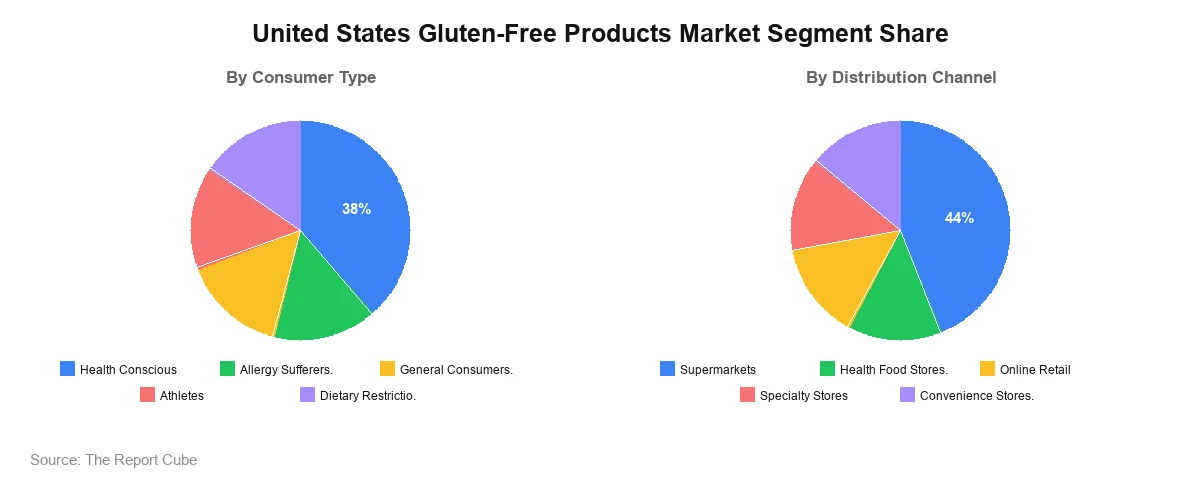
Health-conscious consumers represent the dominant buyer segment, accounting for an estimated 38% of total market revenue in 2026, driven by proactive nutrition management, preventive health strategies, and growing awareness of inflammatory dietary patterns. This group actively seeks products carrying third-party gluten-free certification, clean-label ingredient declarations, and organic credentials. Their purchasing behavior is strongly influenced by nutritional labeling transparency, social media wellness communities, and endorsements from registered dietitians. General Mills and Nestle have both expanded their health-oriented gluten-free portfolios specifically targeting this segment through reformulated snack and breakfast offerings.
Allergy sufferers and dietary restriction followers collectively represent a medically anchored consumer base exhibiting high brand loyalty and low price sensitivity due to the clinical necessity of strict gluten avoidance. Athletes represent the fastest-growing sub-segment as performance nutrition trends increasingly incorporate gluten-free eating to reduce systemic inflammation and accelerate muscle recovery. Brands including Boulder Brands and Udi's Gluten Free have introduced high-protein, gluten-free energy bars and grain bowls targeting endurance athletes and gym-focused consumers. General consumers continue broadening their participation in the category through trial purchases of gluten-free pasta and snacks promoted through mainstream grocery channels.
By Distribution Channel
- Supermarkets
- Health Food Stores
- Online Retail
- Specialty Stores
- Convenience Stores
Supermarkets dominate the distribution channel segment with an estimated 44% revenue share in 2026, supported by widespread private-label gluten-free line launches, dedicated free-from food aisles, and the purchasing convenience offered to mainstream shoppers. Major chains including Kroger, Walmart, and Target have significantly expanded their gluten-free product assortments, incorporating both national brands and proprietary labels at accessible price points. Supermarkets benefit from high weekly foot traffic, consumer price comparison behavior, and in-store nutritional education programs that increase trial rates among first-time gluten-free purchasers.
Health food stores and online retail represent the two fastest-growing distribution channels, respectively serving discovery-driven specialty shoppers and convenience-focused repeat buyers. Online retail platforms including Amazon, Thrive Market, and brand-owned DTC subscription services have accelerated category accessibility while enabling personalized product recommendation algorithms that support basket size expansion. Specialty stores including Whole Foods Market and Natural Grocers maintain a premium positioning advantage by curating certified gluten-free assortments and hosting in-store educational events. Convenience stores represent an emerging frontier as manufacturers including PepsiCo introduce gluten-free snack SKUs targeting on-the-go consumer occasions.
Regional Projection of United States Gluten-Free Products Market
The United States gluten-free products market reflects distinct regional consumption patterns influenced by health awareness levels, specialty retail infrastructure, population demographics, celiac disease awareness, and dietary lifestyle preferences. Revenue concentration varies significantly across the five major domestic regions.
|
Region |
Estimated Market Share |
Key Growth Factors |
Consumer Trends |
|---|---|---|---|
|
West |
31.4% |
High specialty food retail density, health-conscious demographics |
Strong demand for organic and certified gluten-free products |
|
Northeast |
26.8% |
Urban health food culture, high celiac disease awareness |
Premium gluten-free bakery and pasta adoption |
|
Southeast |
17.2% |
Expanding natural food retail footprint, rising dietary awareness |
Growing adoption of gluten-free snack and beverage products |
|
Midwest |
14.6% |
Mainstream grocery gluten-free expansion, food allergy awareness |
Private-label gluten-free product adoption increasing |
|
Southwest |
10.0% |
Hispanic health food crossover demand, urban wellness culture |
Rising interest in grain-alternative gluten-free staples |
- West: The West leads the United States gluten-free products market with approximately 31.4% revenue share, anchored by California's dense network of natural food retailers, health-forward urban populations, and high per-capita specialty food spending.
- Northeast: The Northeast maintains strong market presence driven by elevated celiac disease diagnosis rates in metropolitan areas, premium grocery retailer concentration, and high consumer willingness to pay for certified allergen-free bakery and pantry staples.
- Southeast: The Southeast is experiencing accelerating growth as natural and organic food retail expands beyond major metro areas, and rising consumer nutrition literacy drives trial adoption of gluten-free snack, cereal, and beverage product categories.
- Midwest: The Midwest demonstrates steady gluten-free product uptake through mainstream supermarket channel expansion and increasing physician-driven dietary referrals, with private-label gluten-free SKUs improving category accessibility for price-sensitive households.
- Southwest: The Southwest represents a developing growth corridor where urban wellness culture, growing Hispanic consumer interest in grain-alternative dietary formats, and expanding specialty food retail are collectively driving incremental gluten-free product demand.
United States Gluten-Free Products Market: Recent Development (2025)
- General Mills expanded its gluten-free Cheerios production line to meet surging consumer demand nationwide.
- Enjoy Life Foods launched a new certified gluten-free protein snack bar targeting athletic performance nutrition consumers.
- Schär partnered with leading U.S. supermarket chains to expand dedicated gluten-free bakery shelf space nationally.
- PepsiCo introduced a new line of certified gluten-free snacks under its mainstream retail distribution network.
United States Gluten-Free Products Market Future Outlook (2034)
The United States Gluten-Free Products Market is projected to expand at a 7.90% CAGR, reaching approximately USD 3.71 billion by 2034. Sustained growth will be driven by increasing celiac disease and non-celiac gluten sensitivity diagnoses, deepening consumer investment in preventive nutrition, and the accelerating integration of functional health ingredients into certified gluten-free formulations. AI-powered consumer data analytics are enabling manufacturers to identify segment-specific dietary demand patterns, optimize product development cycles, and personalize digital marketing outreach to high-intent gluten-free shoppers across multiple channels.
Long-term market expansion will be further supported by technological advancements in alternative grain processing, precision fermentation for gluten-free dough improvement, and clean-label ingredient innovation that closes the sensory and nutritional gap between gluten-free and conventional products. Retailers and brands will increasingly leverage subscription commerce, personalized nutrition platforms, and clinical partnership programs to build durable consumer relationships. Manufacturers investing in scalable certified gluten-free production infrastructure and diversified distribution channel strategies are best positioned to capture emerging demand across both established and high-growth regional markets through 2034.
United States Gluten-Free Products Market Report Coverage
|
Report Attribute |
Details |
|---|---|
|
Market Name |
United States Gluten-Free Products Market |
|
Market Size (2026) |
USD 2.02 Billion |
|
Market Size (2034) |
USD 3.71 Billion |
|
Forecast Period |
2026–2034 |
|
CAGR |
7.90% |
|
Base Year |
2026 |
|
Historical Years |
2021–2025 |
|
Forecast Years |
2026–2034 |
|
Segments Covered |
By End Use, By Application, By Product Type, By Consumer Type, By Distribution Channel |
|
Regions Covered |
West, Northeast, Southeast, Midwest, Southwest |
|
Key Companies |
General Mills, Kraft Heinz, Nestle, PepsiCo, Boulder Brands, Gluten Free Holdings, Enjoy Life Foods, Udi's Gluten Free, Schär, Others |
|
Report Format |
PDF, Excel, PPT |
|
Customization |
Available as per client requirements |
Why Choose This Report?
- Comprehensive analysis covering gluten-free consumer demand, segments, and trends.
- Accurate market sizing with reliable revenue forecast through 2034.
- Detailed consumer type and distribution channel segmentation with market share data.
- Regional insights covering all five major U.S. domestic market territories.
- Competitive profiling of leading gluten-free food and beverage manufacturers.
- Analysis of functional ingredient innovation and clean-label product development.
- Strategic insights supporting retail expansion and product portfolio investment decisions.
- Data-driven research aligned with current dietary health and wellness market trends.
Table of Contents
- Introduction
- Objective of the Study
- Product Definition
- Market Segmentation
- Study Variables
- Research Methodology
- Secondary Data Points
- Companies Interviewed
- Primary Data Points
- Breakdown of Primary Interviews
- Secondary Data Points
- Executive Summary
- Market Dynamics
- Drivers
- Challenges
- Opportunity Assessment
- Recent Trends and Developments
- Policy and Regulatory Landscape
- United States Gluten-Free Products Market Overview and Forecast Analysis (2021-2034)
- Market Size, By Value, By Growth Rate (CAGR/USD Billions)
- Demand – Supply Trends
- Market Share, By End Use
- Household
- Food Service
- Catering
- Restaurants
- Institutional
- Market Share, By Application
- Bakery Products
- Snacks
- Pasta
- Dairy Alternatives
- Beverages
- Market Share, By Product Type
- Flours
- Breads
- Cereals
- Pasta
- Snacks
- Market Share, By Consumer Type
- Health Conscious
- Allergy Sufferers
- Dietary Restriction Followers
- General Consumers
- Athletes
- Market Share, By Distribution Channel
- Supermarkets
- Health Food Stores
- Online Retail
- Specialty Stores
- Convenience Stores
- Market Share, By Region
- Northeast
- Midwest
- Southeast
- Southwest
- West
- Market Share, By Competitors
- Competition Characteristics
- Revenue Shares
- Household United States Gluten-Free Products Market Overview, 2021-2034F
- By Value (USD Million)
- By Application – Market Size & Forecast 2021-2034, USD Million
- Bakery Products
- Snacks
- Pasta
- Dairy Alternatives
- Beverages
- Food Service United States Gluten-Free Products Market Overview, 2021-2034F
- By Value (USD Million)
- By Application – Market Size & Forecast 2021-2034, USD Million
- Bakery Products
- Snacks
- Pasta
- Dairy Alternatives
- Beverages
- Catering United States Gluten-Free Products Market Overview, 2021-2034F
- By Value (USD Million)
- By Application – Market Size & Forecast 2021-2034, USD Million
- Bakery Products
- Snacks
- Pasta
- Dairy Alternatives
- Beverages
- Restaurants United States Gluten-Free Products Market Overview, 2021-2034F
- By Value (USD Million)
- By Application – Market Size & Forecast 2021-2034, USD Million
- Bakery Products
- Snacks
- Pasta
- Dairy Alternatives
- Beverages
- Institutional United States Gluten-Free Products Market Overview, 2021-2034F
- By Value (USD Million)
- By Application – Market Size & Forecast 2021-2034, USD Million
- Bakery Products
- Snacks
- Pasta
- Dairy Alternatives
- Beverages
- Competitive Outlook (Company Profile – Partial List)
- General Mills
- Company Overview
- Business Segments
- Strategic Alliances/Partnerships
- Recent Developments
- Kraft Heinz
- Company Overview
- Business Segments
- Strategic Alliances/Partnerships
- Recent Developments
- Nestle
- Company Overview
- Business Segments
- Strategic Alliances/Partnerships
- Recent Developments
- PepsiCo
- Company Overview
- Business Segments
- Strategic Alliances/Partnerships
- Recent Developments
- Boulder Brands
- Company Overview
- Business Segments
- Strategic Alliances/Partnerships
- Recent Developments
- Gluten Free Holdings
- Company Overview
- Business Segments
- Strategic Alliances/Partnerships
- Recent Developments
- Enjoy Life Foods
- Company Overview
- Business Segments
- Strategic Alliances/Partnerships
- Recent Developments
- Udi's Gluten Free
- Company Overview
- Business Segments
- Strategic Alliances/Partnerships
- Recent Developments
- Schär
- Company Overview
- Business Segments
- Strategic Alliances/Partnerships
- Recent Developments
- Others
- General Mills
- Contact Us & Disclaimer
Top Key Players & Market Share Outlook
- General Mills
- Kraft Heinz
- Nestle
- PepsiCo
- Boulder Brands
- Gluten Free Holdings
- Enjoy Life Foods
- Udi's Gluten Free
- Schär
- Others
Frequently Asked Questions