



Build Your Custom Market Intelligence Report
Customize Your ReportUnited States Ice Cream Market Key Takeaways
- United States Ice Cream Market valued at USD 20.03 billion in 2026, reflecting steady consumer indulgence spending.
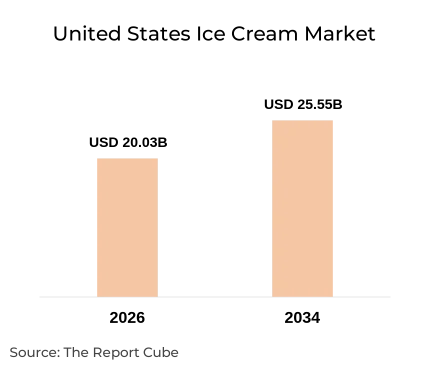
- Industry projected to reach USD 25.55 billion by 2034, expanding at a 3.09% CAGR.
- Dairy ice cream remains the dominant category owing to deep-rooted consumer preference and flavor variety.
- Off-trade distribution channels lead revenue generation driven by supermarket and retail grocery penetration.
- West region maintains strong market presence through premium artisanal brand concentration and consumer spending power.
- Plant-based and non-dairy ice cream segments are gaining rapid momentum across health-conscious consumer groups.
- Leading companies include Unilever, Nestlé, Ferrero International, Blue Bell Creameries, and Froneri International.
- Rising demand for clean-label, low-sugar, and functional frozen desserts continues reshaping product innovation pipelines.
United States Ice Cream Market Insights & Analysis
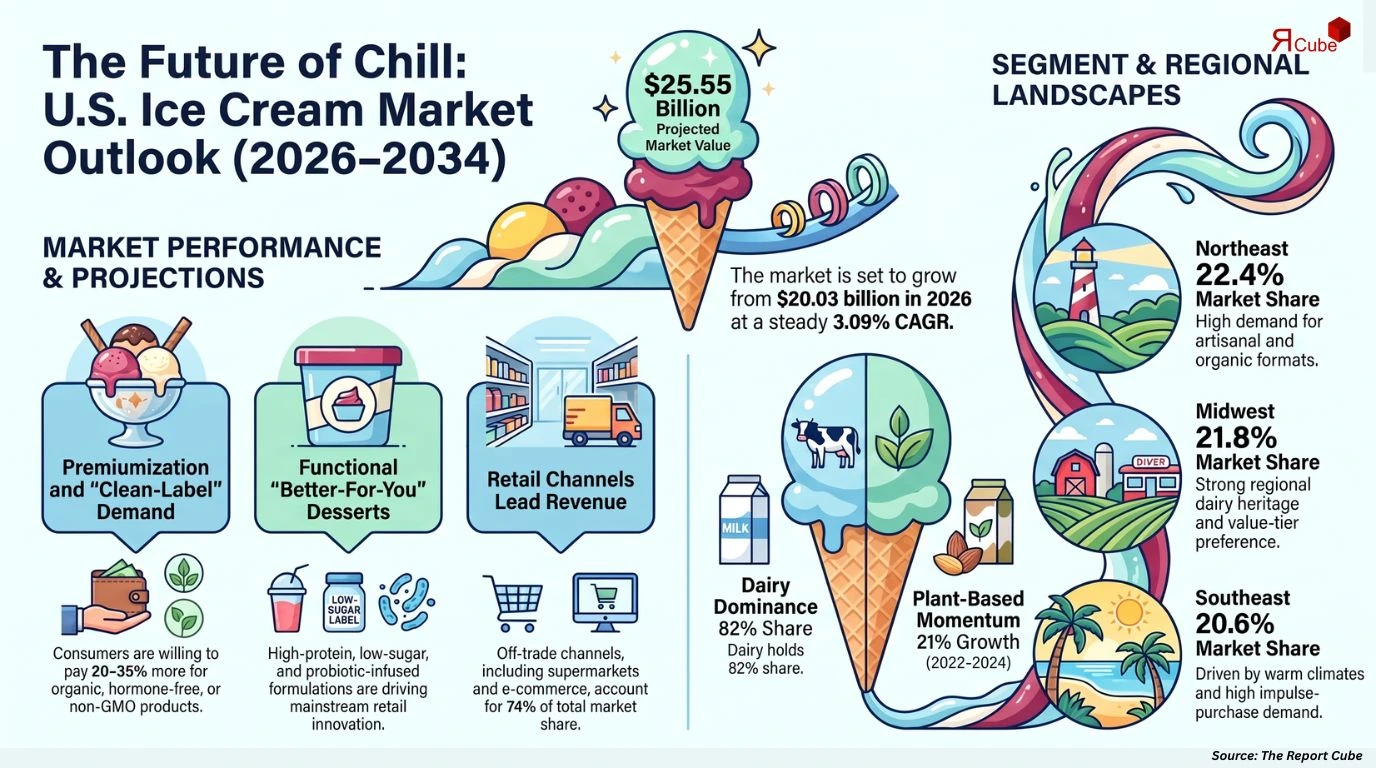
The United States Ice Cream Market is anticipated to register a 3.09% CAGR during 2026–2034. The market size was valued at USD 20.03 billion in 2026 and is projected to reach USD 25.55 billion by 2034. Consumption growth is underpinned by expanding product diversity, premiumization trends, and the integration of functional ingredients such as protein fortification, probiotics, and reduced-sugar formulations that appeal to evolving dietary preferences. Established manufacturers and emerging artisanal brands continue channeling significant investment into innovation, cold-chain infrastructure expansion, and direct-to-consumer distribution capabilities to capture shifting retail dynamics.
Government nutrition labeling modernization under the FDA's updated guidelines has accelerated reformulation activity across leading manufacturers, compelling brands to reduce artificial additives and trans fats while maintaining sensory appeal. Strategic mergers, licensing agreements, and regional co-manufacturing partnerships are further consolidating production capabilities and expanding geographic footprint. Private label frozen dessert lines at major retail chains are simultaneously intensifying competitive pressure on branded manufacturers, prompting accelerated differentiation through limited-edition seasonal flavors, licensed collaborations, and premium ingredient sourcing initiatives that support long-term revenue growth.
United States Ice Cream Market Dynamics
The United States Ice Cream Market continues demonstrating resilient growth momentum driven by sustained consumer indulgence behavior, expanding retail distribution networks, and accelerating product premiumization across both dairy and plant-based segments. Shifting demographics, rising disposable incomes among millennial and Gen Z cohorts, and increasing foodservice integration of novelty frozen dessert formats are reinforcing incremental demand. Continuous category innovation and strategic retail shelf expansion further support forward market trajectory.
|
Factor |
Type |
Specific Impact on Market |
Magnitude |
|---|---|---|---|
|
Premiumization and clean-label demand |
Driver |
Boosts average selling prices across branded portfolios |
Very High |
|
Plant-based product expansion |
Opportunity |
Expands addressable consumer base beyond dairy consumers |
High |
|
Seasonal consumption fluctuations |
Challenge |
Creates revenue variability across Q1 and Q4 quarters |
Moderate |
|
Specialty retail and DTC channel growth |
Trend |
Increases brand-consumer direct engagement and margins |
High |
|
Functional ingredient integration |
Driver |
Elevates perceived product value and health positioning |
High |
Key Market Driver: Premiumization and Clean-Label Consumer Demand
American consumers are increasingly prioritizing quality, transparency, and ingredient integrity when selecting frozen dessert products, driving a pronounced premiumization wave across the United States Ice Cream Market. Nielsen data indicates premium ice cream lines consistently outperform standard-tier equivalents in unit value growth, with consumers demonstrating willingness to pay 20–35% premiums for certified organic, hormone-free, or non-GMO products. Manufacturers including Tillamook County Creamery Association and Blue Bell Creameries have expanded farm-to-freezer narratives and clean-label reformulations to capture this evolving demand, reinforcing both brand equity and retail shelf positioning.
Major Industry Challenge: Dairy Commodity Price Volatility
Raw milk and cream price fluctuations present a persistent operational challenge for ice cream manufacturers operating across the United States, directly impacting gross margins and pricing strategy flexibility. The USDA reported Class III milk price variance exceeding 18% between 2023 and 2024, compelling manufacturers to hedge commodity exposure, renegotiate supplier contracts, and optimize formulation ratios to manage input costs without compromising product quality. Smaller regional creameries and independent brands face disproportionate exposure to this volatility compared to integrated dairy conglomerates, creating competitive disadvantages that could consolidate market share among larger players through 2034.
Emerging Trend Shaping Outlook: Functional and Better-For-You Innovation
Functional frozen desserts incorporating added protein, prebiotic fiber, adaptogens, collagen, and reduced sugar formulations are rapidly gaining mainstream retail presence across United States supermarket chains, specialty grocers, and e-commerce platforms. Brands such as Halo Top, which reported surpassing 100 million pints sold within its first five years, demonstrated viable commercial appetite for better-for-you ice cream formats. This trend is intensifying as millennial and Gen Z consumers increasingly seek products that reconcile indulgence with nutritional consciousness, compelling legacy manufacturers and emerging brands alike to accelerate functional positioning across core and innovation product lines.
Need Specific Data, Let’s Customize the Report for You
Request CustomizationUnited States Ice Cream Market Segment-wise Analysis
The United States Ice Cream Market encompasses diverse product categories and multi-channel distribution frameworks serving a broad consumer base ranging from everyday household consumption to premium foodservice experiences. Innovation across both segments continues expanding the addressable market while supporting incremental revenue generation for established and emerging industry participants.
By Category
- Dairy
- Non-Dairy (Plant-Based)
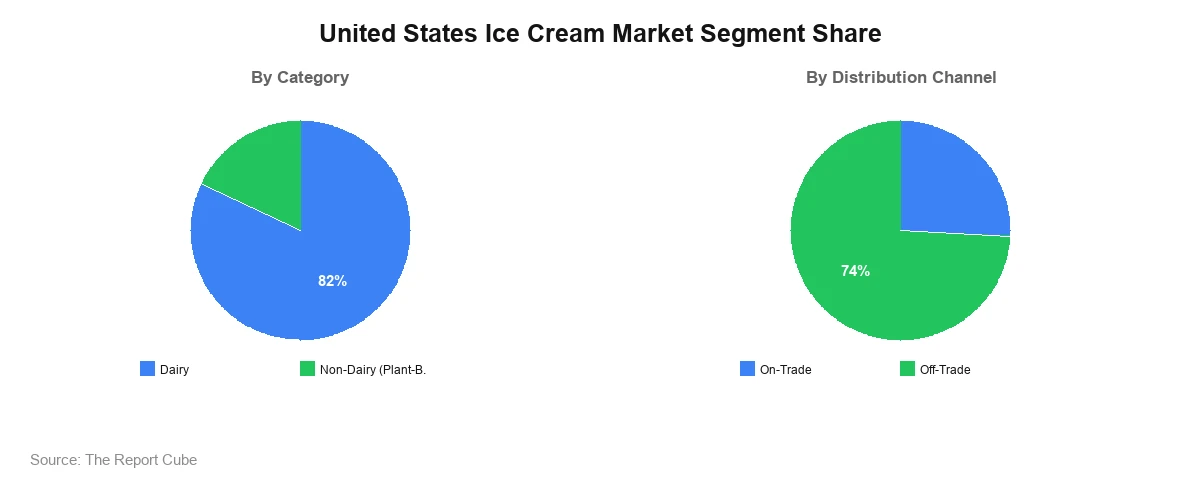
Dairy ice cream commands the dominant position within the United States Ice Cream Market, representing an estimated 82% market share owing to deeply entrenched consumer preference, superior texture profiles, and extensive flavor variety across premium, mid-tier, and private-label product lines. Major manufacturers including Nestlé, Unilever, Blue Bell Creameries, and Turkey Hill Dairy maintain extensive dairy portfolios supported by robust cold-chain logistics, retail distribution agreements, and seasonal promotional campaigns that sustain consistent household penetration throughout the year.
Non-dairy and plant-based ice cream is the fastest-growing sub-segment, expanding at a materially higher rate than the overall market as oat milk, coconut milk, cashew milk, and almond milk-based formulations achieve mainstream retail acceptance. SPINS retail data indicates plant-based frozen dessert sales grew approximately 21% between 2022 and 2024 across natural and conventional grocery channels. Brands including Froneri International and Dairy Farmers of America have initiated dedicated plant-based lines to capture this structural consumer shift, reinforcing the long-term commercial viability of non-dairy frozen dessert formats across the United States.
By Distribution Channel
- On-Trade
- Off-Trade
Off-trade distribution channels dominate revenue generation within the United States Ice Cream Market, accounting for approximately 74% market share driven by supermarket chains, mass merchandisers, warehouse clubs, convenience stores, and rapidly expanding e-commerce grocery platforms. Walmart, Kroger, Costco, and Target collectively represent critical retail shelf access points for major manufacturers, with private label frozen dessert penetration at these chains intensifying competition on price and packaging innovation across standard and premium tiers.
On-trade distribution through quick-service restaurants, casual dining establishments, ice cream parlors, stadium concessions, and hotel foodservice operations represents the fastest-growing channel, supported by experiential dining trends and the integration of artisanal scooped ice cream formats into mainstream restaurant menus. Focus Brands LLC and similar foodservice operators continue expanding frozen dessert integration across affiliated restaurant concepts, while independent scoop shops and regional creameries capitalize on consumer appetite for locally sourced, freshly crafted ice cream experiences that command significantly higher per-unit revenue margins than packaged retail equivalents.
Regional Projection of United States Ice Cream Market
The United States Ice Cream Market exhibits meaningful regional variation driven by population density, consumer income levels, foodservice infrastructure concentration, climate-driven seasonality, and the geographic distribution of premium artisanal and established national ice cream brands. Each region presents distinct growth dynamics and consumption patterns that shape localized investment and distribution strategies for industry participants.
|
Region |
Estimated Market Share |
Key Growth Factors |
Consumer Trends |
|---|---|---|---|
|
Northeast |
22.4% |
Dense urban foodservice, premium consumer spending |
High demand for artisanal and organic formats |
|
Midwest |
21.8% |
Strong regional dairy heritage and household consumption |
Preference for classic dairy flavors and value tiers |
|
Southeast |
20.6% |
Extended warm climate season, growing QSR penetration |
Rising demand for novelty and impulse formats |
|
Southwest |
16.5% |
Expanding Hispanic consumer demographic influence |
Growing adoption of paleta and traditional frozen desserts |
|
West |
18.7% |
Premium artisanal brand concentration, health-forward consumers |
Leading adoption of plant-based and functional formats |
- Northeast: The Northeast holds approximately 22.4% market share, driven by dense urban foodservice ecosystems, high disposable income concentrations, and strong consumer preference for premium artisanal and organic ice cream formats across major metropolitan markets.
- Midwest: The Midwest reflects deeply rooted dairy heritage and consistent household consumption patterns, with regional brands such as Blue Bell Creameries and Turkey Hill Dairy maintaining strong retail loyalty across traditional grocery and supermarket channels.
- Southeast: The Southeast benefits from extended warm-climate consumption seasons and accelerating quick-service restaurant penetration, supporting robust impulse-purchase ice cream demand across both branded and private label product formats throughout the year.
- Southwest: The Southwest is experiencing growing influence of Hispanic consumer demographics, driving increasing demand for traditional paleta formats, chamoy-flavored novelty items, and culturally inspired frozen dessert innovation across specialty and mainstream retail channels.
- West: The West represents the most innovation-forward regional market, leading national adoption of plant-based ice cream, functional formulations, and premium single-origin ingredient products, supported by concentrated health-conscious consumer populations across California, Oregon, and Washington.
United States Ice Cream Market: Recent Development (2025)
- Unilever expanded its Talenti gelato and Magnum premium ice cream portfolio across United States retail.
- Nestlé launched new reduced-sugar Häagen-Dazs variants targeting health-conscious consumers in mainstream supermarkets.
- Froneri International secured a co-manufacturing agreement expanding its United States frozen dessert production capacity significantly.
- Blue Bell Creameries introduced limited-edition regional flavor collaborations strengthening brand engagement across Southern United States markets.
United States Ice Cream Market Future Outlook (2034)
The United States Ice Cream Market is projected to expand at a steady 3.09% CAGR, reaching approximately USD 25.55 billion by 2034, underpinned by continuous premiumization, plant-based product mainstream adoption, and expanding foodservice channel integration. Emerging functional formats incorporating protein enrichment, prebiotic ingredients, and adaptogen infusions will create incremental category value while appealing to health-prioritizing consumer segments. Cold-chain technology investments and direct-to-consumer e-commerce expansion will simultaneously broaden geographic accessibility for specialty and artisanal brands beyond their traditional regional strongholds.
Long-term market growth will be reinforced by AI-driven flavor innovation, precision fermentation-derived dairy alternatives, and personalized nutrition positioning that align frozen dessert consumption with evolving wellness priorities. Strategic acquisitions among leading players including Unilever, Ferrero International, and Nestlé will continue consolidating innovation pipelines while expanding portfolio breadth across premium, functional, and plant-based segments. Sustained investments in sustainable packaging, carbon-neutral manufacturing, and ethical ingredient sourcing will further strengthen brand equity and regulatory alignment, supporting durable competitive positioning for major manufacturers through 2034.
United States Ice Cream Market Report Coverage
|
Report Attribute |
Details |
|---|---|
|
Market Name |
United States Ice Cream Market |
|
Market Size (2026) |
USD 20.03 Billion |
|
Market Size (2034) |
USD 25.55 Billion |
|
Forecast Period |
2026–2034 |
|
CAGR |
3.09% |
|
Base Year |
2026 |
|
Historical Years |
2021–2025 |
|
Forecast Years |
2026–2034 |
|
Segments Covered |
By Product Type, By Category, By Distribution Channel |
|
Regions Covered |
Northeast, Midwest, Southeast, Southwest, West |
|
Key Companies |
Unilever PLC, Ferrero International SpA, Froneri International Ltd., Nestlé S.A., Blue Bell Creameries LP, Turkey Hill Dairy, Tillamook County Creamery Association, Dairy Farmers of America Inc., Focus Brands LLC, Others |
|
Report Format |
PDF, Excel, PPT |
|
Customization |
Available as per client requirements |
Why Choose This Report?
- Comprehensive analysis covering dairy and plant-based ice cream category dynamics.
- Accurate market sizing with reliable CAGR-backed forecast through 2034.
- Detailed segmentation identifying revenue-leading distribution and product opportunities.
- Regional insights covering all five United States geographic markets in depth.
- Competitive profiling of major national and regional ice cream manufacturers.
- Analysis of premiumization, functional innovation, and plant-based adoption trends.
- Strategic insights supporting product development and retail investment decisions.
- Data-driven research following EEAT principles and current industry standards.
Table of Contents
- Introduction
- Objective of the Study
- Product Definition
- Market Segmentation
- Study Variables
- Research Methodology
- Secondary Data Points
- Companies Interviewed
- Primary Data Points
- Breakdown of Primary Interviews
- Secondary Data Points
- Executive Summary
- Market Dynamics
- Drivers
- Challenges
- Opportunity Assessment
- Recent Trends and Developments
- Policy and Regulatory Landscape
- United States Ice Cream Market Overview and Forecast Analysis (2021-2034)
- Market Size, By Value, By Growth Rate (CAGR/USD Billions)
- Demand – Supply Trends
- Market Share, By Product Type
- Artisanal Ice Cream
- Impulse Ice Cream
- Take-Home Ice Cream
- Market Share, By Category
- Dairy
- Non-Dairy (Plant-Based)
- Market Share, By Distribution Channel
- On-Trade
- Off-Trade
- Market Share, By Region
- Northeast
- Midwest
- Southeast
- Southwest
- West
- Market Share, By Competitors
- Competition Characteristics
- Revenue Shares
- Artisanal Ice Cream United States Ice Cream Market Overview, 2021-2034F
- By Value (USD Million)
- By Category – Market Size & Forecast 2021-2034, USD Million
- Dairy
- Non-Dairy (Plant-Based)
- Impulse Ice Cream United States Ice Cream Market Overview, 2021-2034F
- By Value (USD Million)
- By Category – Market Size & Forecast 2021-2034, USD Million
- Dairy
- Non-Dairy (Plant-Based)
- Take-Home Ice Cream United States Ice Cream Market Overview, 2021-2034F
- By Value (USD Million)
- By Category – Market Size & Forecast 2021-2034, USD Million
- Dairy
- Non-Dairy (Plant-Based)
- Competitive Outlook (Company Profile – Partial List)
- Unilever PLC
- Company Overview
- Business Segments
- Strategic Alliances/Partnerships
- Recent Developments
- Ferrero International SpA
- Company Overview
- Business Segments
- Strategic Alliances/Partnerships
- Recent Developments
- Froneri International Ltd.
- Company Overview
- Business Segments
- Strategic Alliances/Partnerships
- Recent Developments
- Nestlé S.A
- Company Overview
- Business Segments
- Strategic Alliances/Partnerships
- Recent Developments
- Blue Bell Creameries LP
- Company Overview
- Business Segments
- Strategic Alliances/Partnerships
- Recent Developments
- Turkey Hill Dairy
- Company Overview
- Business Segments
- Strategic Alliances/Partnerships
- Recent Developments
- Tillamook County Creamery Association
- Company Overview
- Business Segments
- Strategic Alliances/Partnerships
- Recent Developments
- Dairy Farmers of America Inc.
- Company Overview
- Business Segments
- Strategic Alliances/Partnerships
- Recent Developments
- Focus Brands LLC
- Company Overview
- Business Segments
- Strategic Alliances/Partnerships
- Recent Developments
- Others
- Unilever PLC
- Contact Us & Disclaimer
Top Key Players & Market Share Outlook
- Unilever PLC
- Ferrero International SpA
- Froneri International Ltd.
- Nestlé S.A
- Blue Bell Creameries LP
- Turkey Hill Dairy
- Tillamook County Creamery Association
- Dairy Farmers of America Inc.
- Focus Brands LLC
- Others
Frequently Asked Questions






