



Build Your Custom Market Intelligence Report
Customize Your ReportIndia Quick Commerce Market Statistics and Insights
Market Size Statistics
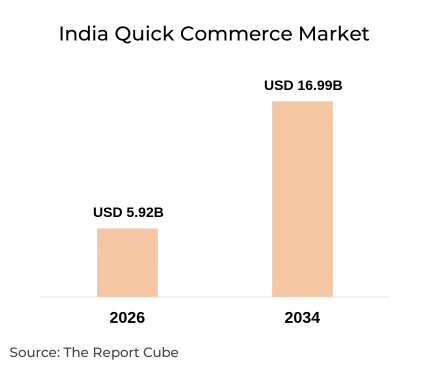
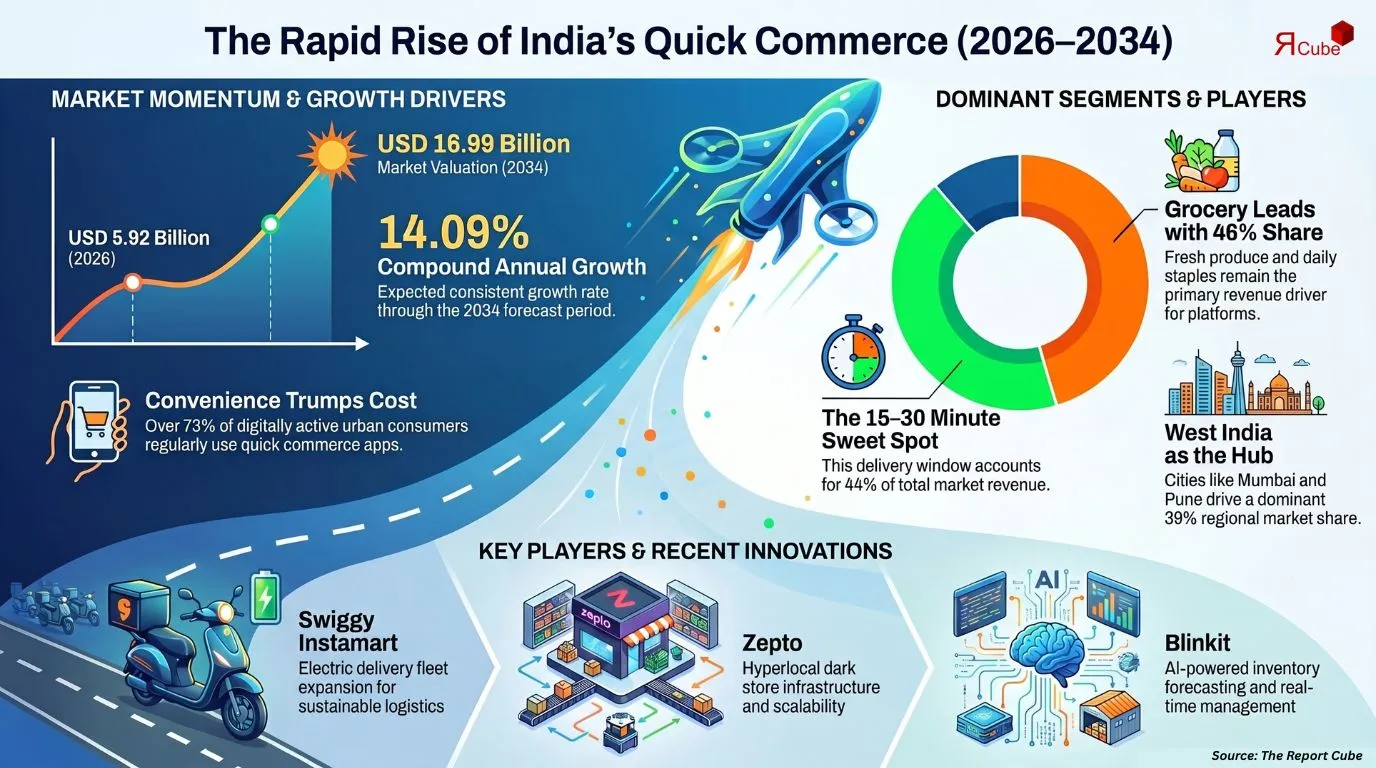
- India Quick Commerce market valuation reached USD 5.92 billion during 2026.
- India Quick Commerce industry projected reaching USD 16.99 billion by 2034.
- India Quick Commerce market expected registering strong 14.09% CAGR through forecast.
By Product Category
- Grocery segment captured approximately 46% revenue share during 2026.
Competitive Landscape
- More than 10 companies are actively engaged in producing India Quick Commerce Market.
- Top 5 companies acquired around 63% of the market share.
- Swiggy Instamart, Zepto, Blinkit, Dunzo Daily, Ola Dash, and others.
By Delivery Time
- 15–30 minutes segment accounted for nearly 44% market revenue contribution.
India Quick Commerce Market Insights & Analysis
The India Quick Commerce Market is anticipated to register a 14.09% CAGR during 2026-2034. The market size was valued at USD 5.92 billion in 2026 and is projected to reach USD 16.99 billion by 2034. India’s quick commerce industry is witnessing rapid expansion driven by increasing urbanization, rising smartphone penetration, and growing consumer preference for ultra-fast delivery services. Consumers are increasingly relying on instant delivery platforms for groceries, food products, personal care items, and household essentials because of changing lifestyle patterns and demand for convenience-oriented shopping experiences. Expanding internet accessibility and strong digital payment adoption are additionally accelerating platform penetration across metropolitan and tier-2 cities. Companies are increasingly investing in dark stores, AI-powered logistics systems, and hyperlocal fulfillment infrastructure to improve delivery efficiency and customer satisfaction.
The rapid growth of app-based retail ecosystems and evolving consumer purchasing behavior are further strengthening market competitiveness. Major quick commerce operators are integrating predictive analytics, inventory optimization technologies, and automated order management systems to enhance operational scalability and reduce delivery times. Government initiatives supporting digital commerce infrastructure and fintech innovation are also encouraging ecosystem expansion. Additionally, rising investments in electric vehicle delivery fleets, route optimization systems, and warehouse automation technologies are improving sustainability and operational performance. Increasing demand for convenience-driven shopping experiences is expected to continue supporting long-term market growth across India’s evolving quick commerce ecosystem.
India Quick Commerce Market Dynamics
Key Market Driver: Convenience-Oriented Consumption Accelerating Demand
Growing consumer preference for convenience-driven shopping experiences is significantly driving the India Quick Commerce Market. Urban consumers increasingly prefer app-based instant delivery services offering groceries, food items, and household products within minimal delivery windows. More than 73% of digitally active urban consumers in India regularly utilize quick commerce applications for daily essential purchases. Companies are rapidly expanding dark store networks and AI-enabled fulfillment systems to strengthen delivery efficiency and customer retention capabilities. Additionally, integrated digital payment solutions and subscription-based loyalty programs are improving transaction convenience and enhancing user engagement. These factors collectively continue accelerating quick commerce adoption throughout India’s expanding digital retail ecosystem.
Major Industry Challenge: Operational Costs Limiting Profitability Growth
High operational expenses and infrastructure management complexities remain major challenges within India’s quick commerce industry. Maintaining ultra-fast delivery commitments requires substantial investments in dark stores, warehouse infrastructure, delivery fleets, and real-time inventory management systems. Companies frequently encounter profitability pressures because of rising logistics costs, delivery personnel expenses, and aggressive discounting strategies aimed at customer acquisition. Additionally, inconsistent demand patterns and inventory wastage risks continue affecting operational efficiency across hyperlocal fulfillment networks. Smaller operators often face technological and financial limitations while scaling delivery infrastructure and maintaining service quality standards. These operational challenges collectively continue impacting long-term profitability and sustainable expansion across India’s quick commerce ecosystem.
Emerging Trend Shaping Outlook: AI And Hyperlocal Innovation Expanding Ecosystem
Artificial intelligence and hyperlocal logistics technologies are increasingly transforming India’s quick commerce market. Platforms are integrating AI-driven demand forecasting, route optimization systems, and predictive inventory analytics to improve operational efficiency and delivery speed. Automated warehouse systems and micro-fulfillment centers are additionally strengthening order processing capabilities and reducing delivery turnaround times. Companies are also investing in electric delivery fleets and environmentally sustainable packaging solutions to improve sustainability performance. Furthermore, expanding partnerships between quick commerce operators and local retailers are supporting broader product availability and hyperlocal market penetration. These technological advancements are expected to significantly improve scalability, customer retention, and long-term competitiveness throughout India’s rapidly evolving quick commerce ecosystem.
Need Specific Data, Let’s Customize the Report for You
Contact UsIndia Quick Commerce Market Segment-wise Analysis
India’s quick commerce industry is experiencing substantial transformation due to increasing digital retail adoption, rising demand for instant delivery services, and expanding hyperlocal fulfillment infrastructure. Companies are increasingly investing in AI-enabled logistics systems, automated inventory management technologies, and dark store expansion strategies to strengthen operational efficiency and customer engagement across urban markets.
By Product Category
- Grocery
- Food & Beverages
- Personal Care
- Household Essentials
- Others
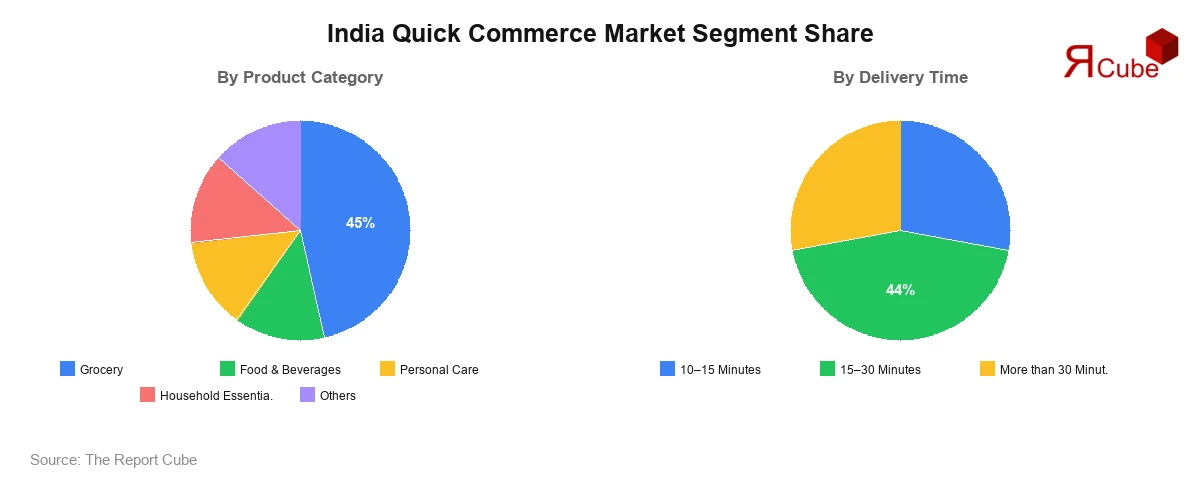
The grocery segment dominated the India Quick Commerce Market with nearly 46% market share during 2026. Increasing consumer dependence on instant grocery delivery services for daily essentials substantially contributed to segment growth. Urban consumers increasingly prefer quick commerce platforms for purchasing fresh produce, packaged foods, dairy products, and household staples because of convenience and time-saving benefits. Companies are rapidly expanding localized fulfillment centers and AI-driven inventory systems to strengthen grocery availability and delivery performance.
Food and beverages are also witnessing strong growth because consumers increasingly rely on instant delivery applications for snacks, beverages, and ready-to-eat meals. Personal care and household essentials categories continue expanding because of rising demand for urgent and convenience-oriented purchases. Additionally, subscription-based purchasing models and promotional discount strategies are strengthening repeat customer engagement across multiple product categories. Increasing digital payment adoption and hyperlocal logistics innovation are expected to further accelerate segmental growth throughout India’s quick commerce ecosystem.
By Delivery Time
- 10–15 Minutes
- 15–30 Minutes
- More than 30 Minutes
The 15–30 minutes segment accounted for approximately 44% market share during 2026 because of its operational balance between delivery speed, cost efficiency, and inventory management capabilities. Consumers increasingly prefer this delivery window because it ensures reliable service quality while maintaining product availability and delivery accuracy. Quick commerce operators are optimizing hyperlocal fulfillment infrastructure and AI-powered route management systems to improve efficiency within this delivery category.
The 10–15 minutes segment is also witnessing rapid growth because of increasing competition among operators focusing on ultra-fast delivery commitments across metropolitan regions. Companies are aggressively investing in dark store density and localized warehouse networks to strengthen rapid fulfillment capabilities. Meanwhile, delivery windows exceeding 30 minutes continue maintaining demand across low-density and semi-urban regions where operational scalability remains limited. Technological advancements in logistics optimization, inventory forecasting, and automated fulfillment systems are expected to continue strengthening delivery segment performance throughout India’s evolving quick commerce industry.
|
Segment |
Description |
|---|---|
|
10–15 Minutes |
Rapid expansion supported by dense urban fulfillment infrastructure investments |
|
15–30 Minutes |
Dominant segment balancing operational efficiency and reliable service quality |
|
More than 30 Minutes |
Stable demand across semi-urban and lower-density delivery regions |
Regional Projection of India Quick Commerce Market
- North India
- South India
- East India
- West India
- Central India
West India dominated the India Quick Commerce Market with nearly 39% market share during 2026 due to strong urbanization, high digital payment adoption, and extensive app-based retail penetration across metropolitan cities including Mumbai, Pune, and Ahmedabad. The region benefits from advanced logistics infrastructure, high smartphone usage, and increasing consumer preference for convenience-driven shopping experiences. Major quick commerce operators are aggressively expanding dark store networks and hyperlocal delivery systems throughout West India to strengthen operational scalability and customer retention. Additionally, rising disposable incomes, expanding fintech integration, and strong e-commerce participation are reinforcing regional market growth, positioning West India as the leading hub within India’s rapidly evolving quick commerce ecosystem.
India Quick Commerce Market: Recent Develpoment (2025)
- Zepto expanded hyperlocal dark store infrastructure supporting faster grocery deliveries and improved operational scalability across metropolitan cities.
- Blinkit introduced AI-powered inventory forecasting systems enhancing delivery efficiency and real-time order management capabilities significantly.
- Swiggy Instamart invested in electric delivery fleet expansion supporting sustainable logistics operations and reduced transportation emissions nationwide.
- Amazon Fresh Store strengthened quick commerce fulfillment capabilities through automated warehouse technologies and advanced route optimization systems.
India Quick Commerce Market Future Outlook (2034)
The India Quick Commerce Market is expected to witness strong long-term growth through 2034, supported by increasing digital retail adoption and rising consumer preference for instant delivery services. The market is projected to reach USD 16.99 billion by 2034 while registering a robust 14.09% CAGR during the forecast period. Rising investments in AI-powered logistics systems, dark store expansion, and automated fulfillment infrastructure are anticipated to create substantial opportunities for quick commerce operators and retail platforms.
Technological advancements in predictive analytics, hyperlocal inventory management, and electric delivery solutions will continue reshaping operational strategies across the industry. Additionally, increasing demand for convenience-oriented shopping experiences and rapid product accessibility is expected to strengthen long-term competitiveness, customer retention, and operational scalability throughout India’s evolving quick commerce ecosystem.
India Quick Commerce Market Report Coverage
|
Report Features |
Details |
|---|---|
|
Market Size (Value) |
USD 5.92 Billion (2026) |
|
Forecast Period |
2026-2034 |
|
CAGR |
14.09% |
|
Base Year |
2026 |
|
Historical Data |
2021-2025 |
|
Customization |
Available |
|
Segments Covered |
By Product Category; By Delivery Time; By Order Size; By Mode of Payment |
|
Regions Covered |
North India; West India; South India; East India |
|
Key Companies |
Blinkit, Swiggy Instamart, Zepto, Dunzo Daily, JioMart Express, Amazon Fresh Store |
|
Report Format |
PPT, PDF & Excel |
Why Choose This Report?
- Provides a comprehensive overview of the overall market analysis, encompassing key trends, consumer behavior analysis, and risk assessment to support strategic decision-making.
- Provides accurate, up-to-date insights into market size, segmentation, and emerging opportunities, helping to minimize risk & capitalizing on growth.
- Gives deep understanding of target audience preferences, investment habits, and communication channels for enhanced product development & marketing effectiveness.
- Delivers competitive analysis & benchmarking, uncovering the strengths & weaknesses of market competitors to guide strategies.
- Consolidate comprehensive market intelligence, reducing reasoning & streamlining research efforts.
- Facilitates customized market segmentation & risk mitigation strategies, fine-tuned to the business objectives.
- Aids in identifying both market challenges & untapped opportunities within the industry to drive long-term business growth.
- Provides valuable information based on actual customer data & search trends.
Table of Contents
- Introduction
- Objective of the Study
- Product Definition
- Market Segmentation
- Study Variables
- Research Methodology
- Secondary Data Points
- Companies Interviewed
- Primary Data Points
- Break Down of Primary Interviews
- Secondary Data Points
- Executive Summary
- Market Dynamics
- Drivers
- Challenges
- Opportunity Assessment
- Recent Trends and Developments
- Policy and Regulatory Landscape
- India Quick Commerce Market Overview (2021-2034)
- Market Size, By Value (USD Billion)
- Market Share, By Product Category
- Grocery
- Food & Beverages
- Personal Care
- Household Essentials
- Others
- Market Share, By Delivery Time
- 10–15 Minutes
- 15–30 Minutes
- More than 30 Minutes
- Market Share, By Order Size
- Small
- Medium
- Bulk
- Market Share, By Mode of Payment
- UPI
- Card Payment
- Cash on Delivery
- Market Share, By Region
- North India
- South India
- East India
- West India
- Central India
- India Grocery Quick Commerce Market Overview (2021-2034)
- By Value (USD Billion)
- By Product Type – Market Size & Forecast
- By Delivery Time – Market Size & Forecast
- India Personal Care Quick Commerce Market Overview (2021-2034)
- By Value (USD Billion)
- By Product Type – Market Size & Forecast
- By Delivery Time – Market Size & Forecast
- Competitive Outlook (Company Profile – Partial List)
- Blinkit
- Company Overview
- Business Segments
- Strategic Alliances/Partnerships
- Recent Developments
- Zepto
- Company Overview
- Business Segments
- Strategic Alliances/Partnerships
- Recent Developments
- Swiggy Instamart
- Company Overview
- Business Segments
- Strategic Alliances/Partnerships
- Recent Developments
- BigBasket (BB Now)
- Company Overview
- Business Segments
- Strategic Alliances/Partnerships
- Recent Developments
- Dunzo
- Company Overview
- Business Segments
- Strategic Alliances/Partnerships
- Recent Developments
- JioMart
- Company Overview
- Business Segments
- Strategic Alliances/Partnerships
- Recent Developments
- Amazon Fresh
- Company Overview
- Business Segments
- Strategic Alliances/Partnerships
- Recent Developments
- Others
- Company Overview
- Business Segments
- Strategic Alliances/Partnerships
- Recent Developments
- Blinkit
11.Contact Us & Disclaimer
Top Key Players & Market Share Outlook
- Swiggy Instamart
- Zepto
- Blinkit
- Dunzo Daily
- Ola Dash
- BB Now
- Flipkart Quick
- Amazon Fresh Store
- JioMart Express
- ZopNow
- Others
Frequently Asked Questions






