




Build Your Custom Market Intelligence Report
Customize Your ReportUK Lingerie Market Key Takeaways
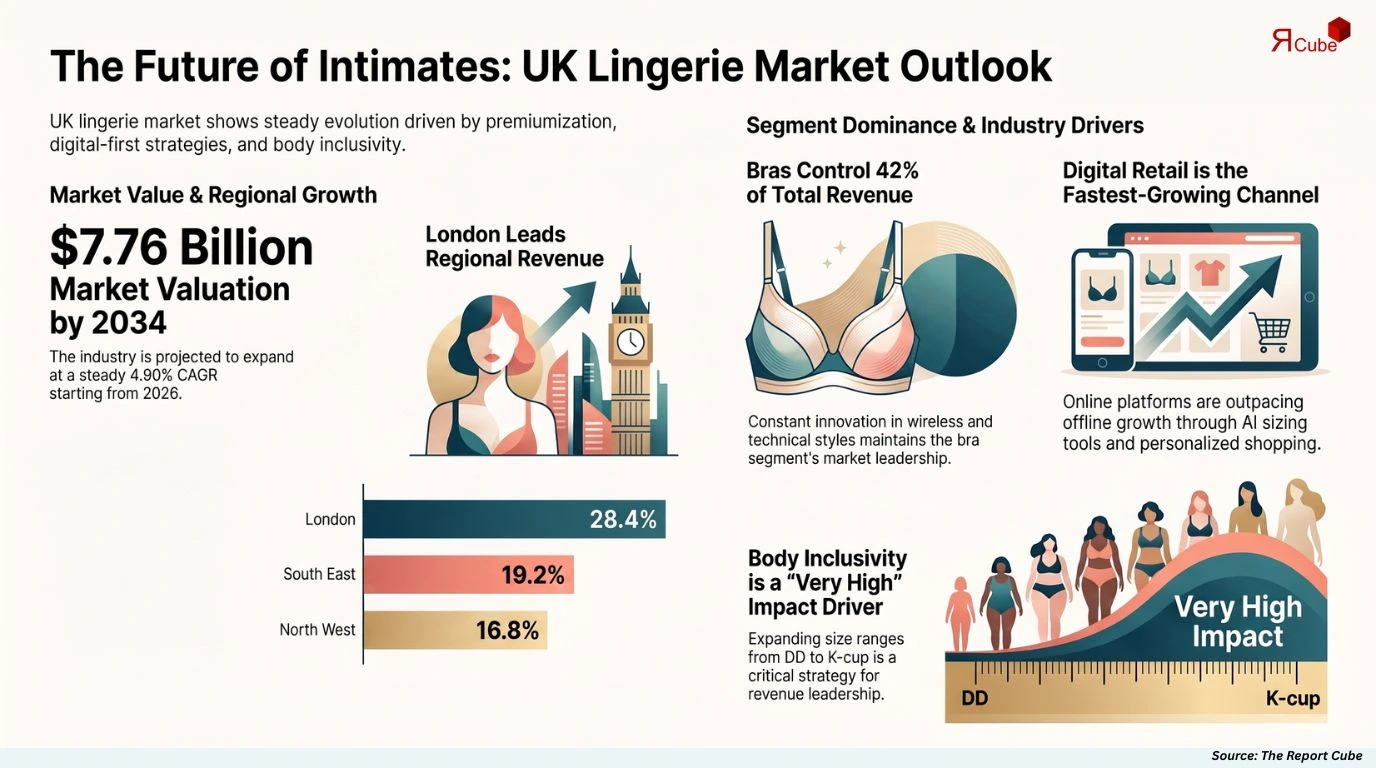
- UK Lingerie Market was valued at USD 5.29 billion in 2026.
- Market is projected to reach USD 7.76 billion by 2034.
- Industry is anticipated to expand at a 4.90% CAGR during 2026–2034.
- Bras represent the dominant product segment by revenue contribution.
- Online distribution channels are the fastest-growing sales avenue.
- London leads regional revenue owing to premium consumer spending power.
- Marks & Spencer, Triumph, Wacoal, and Ann Summers lead competitive positioning.
- Body inclusivity, sustainable fabrics, and size-range expansion reshape product strategies.
UK Lingerie Market Insights & Analysis
The UK Lingerie Market is anticipated to register a 4.90% CAGR during 2026–2034. The market size was valued at USD 5.29 billion in 2026 and is projected to reach USD 7.76 billion by 2034. Sustained growth is supported by increasing consumer preference for premium intimate apparel, expanding size-inclusive product ranges, and rising direct-to-consumer investments from established retailers and digitally native brands. Government-backed textile sustainability initiatives and growing awareness of ethical sourcing further reinforce long-term sectoral investment.
Retail modernization efforts across the UK have encouraged lingerie brands to invest in inclusive intimate apparel innovation spanning adaptive designs, recycled-fibre bra collections, and extended cup sizing. Marks & Spencer's significant supply chain investment, Boux Avenue's ongoing digital transformation, and Primark's commitment to affordable sustainable lingerie underscore the market's competitive evolution. Consumer spending on premium and everyday intimates continues to demonstrate resilience despite broader cost pressures, reflecting the category's non-discretionary positioning within UK household expenditure.
UK Lingerie Market Dynamics
The UK lingerie sector continues strengthening as consumer expectations evolve across comfort, sustainability, aesthetics, and inclusivity. Retail channel diversification, growing direct-to-consumer penetration, and expanding premium product portfolios are accelerating revenue growth for both heritage players and challenger brands. Continued investment in sustainable textile sourcing, personalized fit technology, and digitally enhanced shopping experiences is reinforcing long-term market momentum.
|
Factor |
Type |
Specific Impact on Market |
Magnitude |
|---|---|---|---|
|
Body positivity movement |
Driver |
Accelerates inclusive sizing and product line expansion |
Very High |
|
E-commerce channel growth |
Opportunity |
Increases direct-to-consumer lingerie sales penetration |
High |
|
Sustainable fabric adoption |
Trend |
Drives material innovation across bras and shapewear |
High |
|
Post-pandemic comfort preference |
Driver |
Boosts demand for wire-free and seamless intimate styles |
High |
|
Premiumization of everyday intimates |
Trend |
Raises average selling price and margin contribution |
Very High |
Key Market Driver: Body Inclusivity Reshaping Product Portfolios
The body positivity movement has structurally transformed UK lingerie product development, compelling major retailers to expand cup sizing from traditional DD ranges to K and beyond, introduce adaptive lingerie for consumers with physical disabilities, and develop marketing campaigns representing diverse body types. Brands investing in extended fit ranges have reported measurable gains in customer loyalty and basket size. Marks & Spencer's lingerie division, a consistent beneficiary of size-range investment, illustrates how inclusive product strategies directly translate into revenue leadership within the UK intimate apparel category.
Major Industry Challenge: Sustainable Supply Chain Transition Costs
Transitioning to certified organic cotton, recycled nylon, and traceable silk supply chains requires significant capital investment that disproportionately affects mid-market lingerie brands competing against volume retailers. The European sustainable textile regulation compliance landscape is accelerating mandatory due-diligence requirements for UK intimates manufacturers, creating compliance complexity in the post-Brexit regulatory environment. Smaller specialty brands face the dual burden of reformulating product lines and absorbing higher raw material costs while sustaining competitive retail price points across both online and physical channels.
Emerging Trend Shaping Outlook: Personalized Fit Technology Integration
Digital fit technology, including AI-powered sizing tools, virtual try-on applications, and bra-fit consultation algorithms embedded within retailer websites, is redefining the UK lingerie purchase journey. Boux Avenue and several premium DTC brands have deployed data-driven sizing recommendation engines that reduce return rates by an estimated 20–25%, significantly improving unit economics. Personalized fit data also enables brands to optimize inventory planning across their regional distribution networks, while generating proprietary consumer preference datasets that inform future bra and shapewear product development cycles.
Need Specific Data, Let’s Customize the Report for You
Request CustomizationUK Lingerie Market Segment-wise Analysis
The UK lingerie industry demonstrates distinct performance characteristics across product categories and distribution channels, with digital retail acceleration and premiumization trends creating differentiated growth trajectories for each segment. Both product type and distribution channel segmentation reveal meaningful revenue concentration points alongside high-velocity growth opportunities.
By Product Type
- Briefs
- Bras
- Shapewear
- Others
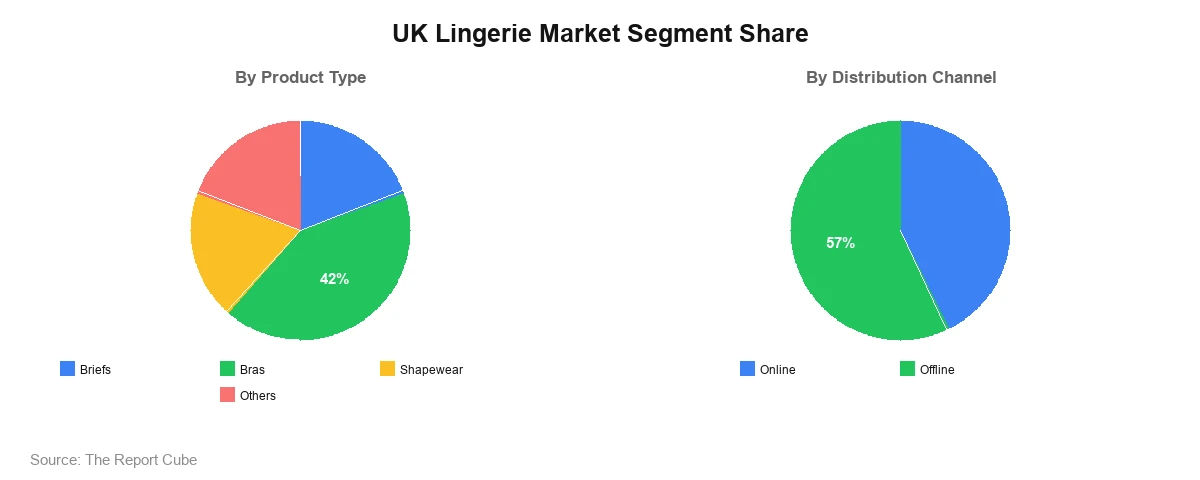
Bras represent the dominant product type segment, accounting for an estimated 42% of total UK lingerie market revenue in 2026. This leadership position reflects the category's combination of high purchase frequency, wide price-band accessibility, and continuous product innovation spanning sports bras, wireless styles, maternity bras, and fashion-forward lace constructions. Consumer willingness to invest in technically engineered, well-fitting bras continues driving average selling price growth, with premium bra collections from Triumph, Wacoal, and Marks & Spencer commanding a meaningful price premium over volume alternatives. Bra innovation pipelines across fit technology and sustainable materials further reinforce segment dominance.
Briefs represent the second-largest revenue contributor, supported by high purchase frequency and expanding design variety including seamless, bikini, high-waist, and period-care options. Shapewear is the fastest-growing sub-segment, benefiting from expanding functional use occasions beyond occasionwear into everyday comfort and activewear-adjacent styling. Growing consumer openness about shapewear usage, reinforced by celebrity endorsements and social media normalization, has accelerated Shapermint's UK penetration. The Others category includes bodysuits, suspender belts, and loungewear-adjacent intimates, which collectively capture growing demand from consumers seeking versatile, transitional pieces that blur the line between lingerie and lifestyle apparel.
By Distribution Channel
- Online
- Offline
Offline retail channels continue holding the larger revenue share at approximately 57% in 2026, anchored by the extensive UK store footprints of Marks & Spencer, Primark, and H&M Lingerie. Physical retail provides consumers with the tactile evaluation and professional fitting services that remain highly valued in the lingerie category, particularly for bra purchasing decisions where fit accuracy directly influences consumer satisfaction. Flagship lingerie departments in major UK department stores and branded boutiques like Boux Avenue continue performing strongly, supported by in-store events, consultation services, and loyalty program integrations that sustain foot traffic.
Online distribution is the fastest-growing channel, expanding at a rate meaningfully above the overall market CAGR as direct-to-consumer lingerie e-commerce platforms capture share from physical retail. Pure-play digital brands leverage data-driven personalization, subscription replenishment models, and social commerce to drive customer acquisition at lower costs than traditional retail. Shapermint's performance in the UK demonstrates the commercial viability of online-first shapewear positioning. The continued proliferation of marketplace integrations on ASOS, Next, and Very further extends the digital addressable audience for both established brands and emerging independent lingerie labels across the UK.
Regional Projection of UK Lingerie Market
The UK lingerie market exhibits clear regional variation driven by population density, household income distribution, consumer spending behavior, and retail infrastructure concentration. London and the South East dominate premium and volume sales, while the North West and other regions present growing opportunities aligned with expanding retail access and rising digital commerce penetration.
|
Region |
Estimated Market Share |
Key Growth Factors |
Consumer Trends |
|---|---|---|---|
|
London |
28.4% |
Premium retail density, high disposable income, DTC brand concentration |
High adoption of luxury and specialist lingerie brands |
|
South East |
19.2% |
Affluent suburban consumer base, proximity to London retail hubs |
Growing demand for premium and sustainable intimates |
|
North West |
16.8% |
Large urban population, strong Primark and Marks & Spencer presence |
Value-led volume purchasing alongside premium trade-up |
|
East of England |
11.5% |
Expanding retail infrastructure, increasing e-commerce adoption |
Rising online purchasing and subscription lingerie models |
|
South West |
10.3% |
Tourism-influenced seasonal spending, independent boutique activity |
Preference for artisan and sustainably produced intimates |
|
Others |
13.8% |
Nationwide e-commerce accessibility, regional retail expansion |
Growing volume from online marketplace purchasing |
- London: London leads the UK Lingerie Market with approximately 28.4% revenue share, driven by premium brand density, high consumer spending power, and active boutique lingerie retail.
- South East: The South East benefits from affluent suburban demographics and strong proximity to London retail corridors, supporting premium lingerie demand.
- North West: Manchester and Liverpool anchor North West consumption, with high-volume retailers and a growing mid-premium consumer segment driving consistent revenue.
- East of England: E-commerce penetration and improving retail access are expanding lingerie consumption across East of England's growing suburban population centers.
- South West: Independent boutiques and sustainable brand offerings characterize the South West lingerie retail environment, reflecting regional consumer values.
- Others: Remaining UK regions capture growing digital commerce volume, with online marketplaces ensuring nationwide brand accessibility beyond major urban retail clusters.
UK Lingerie Market: Recent Development (2025)
- Marks & Spencer launched an expanded sustainable bra collection using certified recycled nylon materials.
- Boux Avenue introduced an AI-powered digital fit tool enhancing online customer bra sizing accuracy.
- Triumph unveiled a new UK flagship store featuring personalized fitting suites and extended size ranges.
- Ann Summers launched an inclusive adaptive lingerie line addressing diverse consumer physical needs.
UK Lingerie Market Future Outlook (2034)
The UK Lingerie Market is projected to expand at a 4.90% CAGR, reaching approximately USD 7.76 billion by 2034. Continued premiumization of the bra and shapewear segments, accelerating online channel penetration, and deepening consumer engagement with body-positive and sustainable intimate apparel will collectively sustain long-term revenue growth. Brands investing in personalized fit technology, adaptive product ranges, and circular economy sourcing models will be best positioned to capture disproportionate share in a maturing but structurally evolving market.
Future growth will also be reinforced by the continued expansion of direct-to-consumer digital channels, subscription intimates models, and social commerce-led customer acquisition strategies. As sustainable lingerie sourcing and circular textile innovation becomes central to competitive positioning, brands that establish certified supply chains and transparent environmental credentials will command stronger price premiums and customer loyalty. Technology-enabled personalization, inclusive sizing leadership, and omnichannel retail excellence will define the competitive frontier of the UK lingerie market through 2034.
UK Lingerie Market Report Coverage
|
Report Attribute |
Details |
|---|---|
|
Market Name |
UK Lingerie Market |
|
Market Size (2026) |
USD 5.29 Billion |
|
Market Size (2034) |
USD 7.76 Billion |
|
Forecast Period |
2026–2034 |
|
CAGR |
4.90% |
|
Base Year |
2026 |
|
Historical Years |
2021–2025 |
|
Forecast Years |
2026–2034 |
|
Segments Covered |
By Product Type, By Distribution Channel, By Price Range |
|
Regions Covered |
London, South East, North West, East of England, South West, Others |
|
Key Companies |
Marks & Spencer, Boux Avenue, Ann Summers, Wacoal, Triumph, La Senza, H&M Lingerie, Primark Lingerie, Shapermint, Others |
|
Report Format |
PDF, Excel, PPT |
|
Customization |
Available as per client requirements |
Why Choose This Report?
- Comprehensive analysis of UK lingerie market drivers, trends, and challenges.
- Accurate market sizing with reliable 4.90% CAGR forecast through 2034.
- Detailed product type segmentation highlighting bra and shapewear opportunities.
- Regional insights covering London, South East, North West, and beyond.
- Distribution channel analysis spanning online and offline retail dynamics.
- Competitive profiling of Marks & Spencer, Triumph, Wacoal, and others.
- Sustainability and body inclusivity trends shaping long-term market strategy.
- Data-driven research supporting investor, retailer, and brand planning decisions.
Table of Contents
- Introduction
- Objective of the Study
- Product Definition
- Market Segmentation
- Study Variables
- Research Methodology
- Secondary Data Points
- Companies Interviewed
- Primary Data Points
- Breakdown of Primary Interviews
- Secondary Data Points
- Executive Summary
- Market Dynamics
- Drivers
- Challenges
- Opportunity Assessment
- Recent Trends and Developments
- Policy and Regulatory Landscape
- UK Lingerie Market Overview and Forecast Analysis (2021-2034)
- Market Size, By Value, By Growth Rate (CAGR/USD Billions)
- Demand – Supply Trends
- Market Share, By Product Type
- Briefs
- Bras
- Shapewear
- Others
- Market Share, By Distribution Channel
- Online
- Offline
- Market Share, By Price Range
- Economy
- Premium
- Market Share, By Region
- London
- South East
- North West
- East of England
- South West
- Others
- Market Share, By Competitors
- Competition Characteristics
- Revenue Shares
- Briefs UK Lingerie Market Overview, 2021-2034F
- By Value (USD Million)
- By Distribution Channel – Market Size & Forecast 2021-2034, USD Million
- Online
- Offline
- Bras UK Lingerie Market Overview, 2021-2034F
- By Value (USD Million)
- By Distribution Channel – Market Size & Forecast 2021-2034, USD Million
- Online
- Offline
- Shapewear UK Lingerie Market Overview, 2021-2034F
- By Value (USD Million)
- By Distribution Channel – Market Size & Forecast 2021-2034, USD Million
- Online
- Offline
- Others UK Lingerie Market Overview, 2021-2034F
- By Value (USD Million)
- By Distribution Channel – Market Size & Forecast 2021-2034, USD Million
- Online
- Offline
- Competitive Outlook (Company Profile – Partial List)
- Marks & Spencer
- Company Overview
- Business Segments
- Strategic Alliances/Partnerships
- Recent Developments
- Boux Avenue
- Company Overview
- Business Segments
- Strategic Alliances/Partnerships
- Recent Developments
- Ann Summers
- Company Overview
- Business Segments
- Strategic Alliances/Partnerships
- Recent Developments
- Wacoal
- Company Overview
- Business Segments
- Strategic Alliances/Partnerships
- Recent Developments
- Triumph
- Company Overview
- Business Segments
- Strategic Alliances/Partnerships
- Recent Developments
- La Senza
- Company Overview
- Business Segments
- Strategic Alliances/Partnerships
- Recent Developments
- H&M Lingerie
- Company Overview
- Business Segments
- Strategic Alliances/Partnerships
- Recent Developments
- Primark Lingerie
- Company Overview
- Business Segments
- Strategic Alliances/Partnerships
- Recent Developments
- Shapermint
- Company Overview
- Business Segments
- Strategic Alliances/Partnerships
- Recent Developments
- Others
- Marks & Spencer
- Contact Us & Disclaimer
Top Key Players & Market Share Outlook
- Marks & Spencer
- Boux Avenue
- Ann Summers
- Wacoal
- Triumph
- La Senza
- H&M Lingerie
- Primark Lingerie
- Shapermint
- Others
Frequently Asked Questions






