




Build Your Custom Market Intelligence Report
Customize Your ReportJapan Logistics Market Insights & Analysis
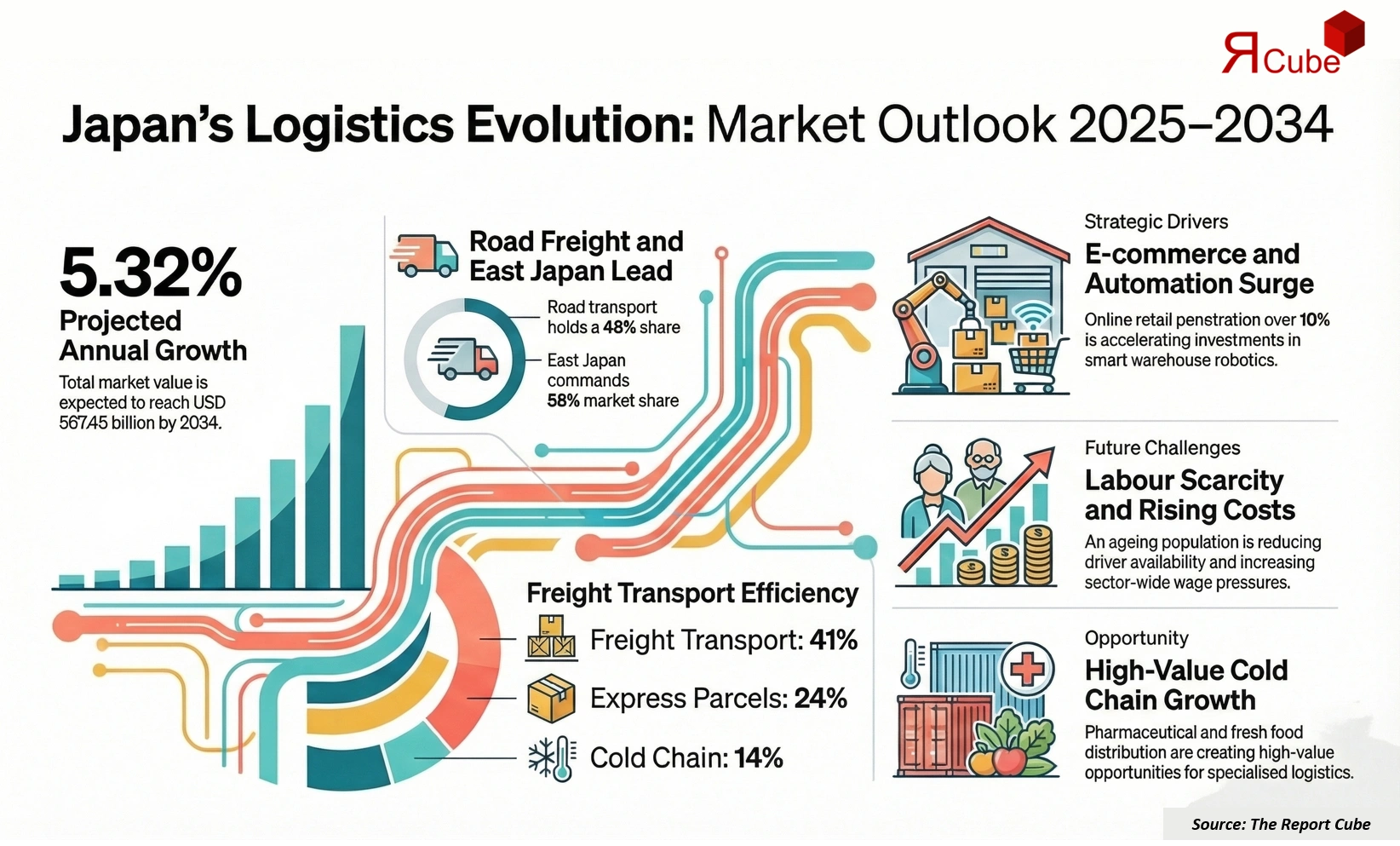
The Japan Logistics Market is anticipated to register a CAGR of 5.32% during the forecast period 2026-2034. The market size was valued at USD 355.9 billion in 2025 and is projected to reach USD 567.45 billion by 2034. This steady expansion is supported by Japan’s advanced manufacturing base, strong domestic consumption, and the rapid growth of cross-border and domestic e-commerce.
Japan’s logistics ecosystem is highly mature, characterized by dense transportation networks, advanced warehousing infrastructure, and a strong focus on operational efficiency. The market benefits from high service reliability standards and technology adoption across freight transport, express parcels, and third-party logistics services. Rising demand for same-day and next-day delivery, particularly in urban regions, continues to reshape logistics operations and investment priorities.
Furthermore, demographic changes such as an aging population and labor shortages are accelerating automation and digitalization across logistics facilities. Companies are increasingly investing in robotics, warehouse management systems, and route optimization tools to improve productivity. Together with expanding cold chain requirements driven by pharmaceuticals and fresh food distribution, these factors position the Japan Logistics Market for sustained, interconnected growth throughout the forecast period.
Japan Logistics Market Recent Developments
- 2025: Nippon Express expanded automated warehousing capacity to improve efficiency for high-volume e-commerce shipments.
- 2025: Yamato Holdings strengthened last-mile delivery networks using electric vehicles in major metropolitan areas.
Government Initiatives & Policies
- Comprehensive Logistics Policy Outline: Promotes supply chain resilience, digital logistics, and labor efficiency.
- Green Growth Strategy: Encourages low-emission transport and energy-efficient logistics operations.
Japan Logistics Market Dynamics
Key Driver: Expansion of E-commerce and Domestic Distribution
The primary driver of the Japan Logistics Market is the continued expansion of e-commerce and domestic distribution networks. Online retail penetration in Japan exceeded 10% of total retail sales in 2024, driving higher volumes of small-parcel and time-sensitive deliveries. This shift has increased demand for express parcel services, urban fulfillment centers, and advanced last-mile logistics solutions. Logistics providers are responding by expanding sorting capacity, optimizing delivery routes, and strengthening partnerships with retailers. As consumer expectations for fast and reliable delivery continue to rise, logistics services are becoming a critical competitive differentiator, directly fueling market growth.
Book your FREE 30-minute expert consultation today
Contact UsIndustry Trends: Automation and Smart Warehousing
Automation is a defining trend in the Japan Logistics Market, driven largely by labor shortages and rising operating costs. Warehouses are increasingly equipped with automated storage and retrieval systems, autonomous mobile robots, and AI-enabled inventory management tools. These technologies improve throughput, reduce error rates, and enhance space utilization. Cold chain logistics is also witnessing modernization, with temperature-controlled warehouses adopting real-time monitoring systems to meet strict quality standards. As automation becomes more accessible, even mid-sized logistics providers are adopting smart warehousing solutions, reshaping industry benchmarks for efficiency and reliability.
Major Challenge: Workforce Constraints and Rising Costs
One of the major challenges facing the market is workforce scarcity, particularly in trucking and warehouse operations. Japan’s aging population has reduced the availability of skilled drivers and logistics workers, increasing wage pressure across the sector. Rising fuel prices and maintenance costs further strain margins, especially for road freight operators. While automation helps mitigate some challenges, the high initial investment required can limit adoption among smaller players. These structural constraints may slow capacity expansion and require continued operational innovation to sustain growth.
Opportunity: Growth of Cold Chain and Pharmaceutical Logistics
The expansion of cold chain logistics presents a strong opportunity within the Japan Logistics Market. Demand for temperature-controlled transportation and storage is rising due to increased pharmaceutical production, vaccine distribution, and consumer preference for fresh and frozen foods. Cold chain services currently account for an estimated 14% of total logistics revenue and are growing faster than the overall market. Logistics providers investing in specialized facilities, monitoring technologies, and regulatory compliance capabilities are well-positioned to capture this high-value segment, strengthening long-term revenue stability.
Japan Logistics Market Segment-wise Analysis
By Service:
- Freight Transport
- Warehousing
- 3PL Services
- Express Parcels
- Cold Chain
Freight Transport remains the leading service segment, accounting for approximately 41% of the Japan Logistics Market in 2025. Its dominance is supported by strong manufacturing output and consistent domestic cargo movement. Express Parcels follow closely, driven by e-commerce growth and urban deliveries, contributing nearly 24% of market share. Warehousing and 3PL services continue to expand as companies outsource logistics to improve flexibility and reduce costs. Cold Chain services, while smaller in share, are growing rapidly due to pharmaceutical and food logistics demand, reinforcing service diversification across the market.
By Transport Mode:
- Road Freight
- Rail Freight
- Air Freight
- Sea Freight
Road Freight dominates the transport mode segment, holding around 48% market share, supported by Japan’s dense road infrastructure and short-distance distribution needs. Sea Freight plays a vital role in international trade, particularly for bulk and containerized cargo, accounting for nearly 27% of the market. Air Freight, while smaller in volume, is essential for high-value and time-sensitive shipments, especially electronics and pharmaceuticals. Rail Freight provides a cost-efficient and environmentally friendly alternative for long-distance domestic transport, complementing the overall multimodal logistics framework.
Regional Projection of Japan Logistics Industry
- East Japan
- West Japan
East Japan leads the Japan Logistics Market with an estimated 58% market share, driven by the concentration of population, industrial hubs, and major ports in the region. Tokyo and surrounding prefectures generate high logistics volumes from retail, manufacturing, and international trade activities. West Japan follows with strong performance supported by Osaka and Kobe, key gateways for domestic and international cargo. East Japan’s advanced infrastructure, higher consumption levels, and dense urban logistics networks ensure its continued leadership throughout the forecast period.
Need insights for a specific region within this market?
Request Regional DataWhy Choose This Report?
- Provides a comprehensive overview of the overall market analysis, encompassing key trends, consumer behavior analysis, and risk assessment to support strategic decision-making.
- Provides accurate, up-to-date insights into market size, segmentation, and emerging opportunities, helping to minimize risk & capitalizing on growth.
- Gives deep understanding of target audience preferences, investment habits, and communication channels for enhanced product development & marketing effectiveness.
- Delivers competitive analysis & benchmarking, uncovering the strengths & weaknesses of market competitors to guide strategies.
- Consolidate comprehensive market intelligence, reducing reasoning & streamlining research efforts.
- Facilitates customized market segmentation & risk mitigation strategies, fine-tuned to the business objectives.
- Aids in identifying both market challenges & untapped opportunities within the industry to drive long-term business growth.
- Provides valuable information based on actual customer data & search trends.
Table of Contents
- Introduction
- Objective of the Study
- Product and Category Definition
- Market Segmentation
- Study Variables
- Research Methodology
- Secondary Data Points
- Breakdown of Secondary Sources
- Primary Data Points
- Breakdown of Primary Interviews
- Secondary Data Points
- Executive Summary
- Market Dynamics
- Drivers
- Challenges
- Opportunity Assessment
- Recent Trends and Developments
- Regulatory and Policy Landscape
- Japan Logistics Market Overview (2020-2034)
- Market Size, By Value (USD Billion)
- Market Share, By Service
- Freight Transport
- Warehousing
- 3PL Services
- Express Parcels
- Cold Chain
- Market Share, By Transport Mode
- Road Freight
- Rail Freight
- Air Freight
- Sea Freight
- Market Share, By End-User
- Retail & E‑commerce
- Automotive
- Manufacturing
- Healthcare
- Others
- Market Share, By Region
- East
- West
- Market Share, By Company
- Competition Characteristics
- Revenue Shares & Analysis
- East Japan Logistics Market
- Market Size, By Value (USD Billion)
- Market Share, By Service
- Market Share, By Transport Mode
- Market Share, By End-User
- Market Share, By Key Prefecture Group
- Market Share, By Major Hubs
- Greater Tokyo
- Kanto Region
- Tohoku Region
- Hokkaido
- West Japan Logistics Market
- Market Size, By Value (USD Billion)
- Market Share, By Service
- Market Share, By Transport Mode
- Market Share, By End-User
- Market Share, By Key Prefecture Group
- Market Share, By Major Hubs
- Kansai Region
- Chubu Region
- Chugoku Region
- Kyushu-Okinawa
- Shikoku
- Competitive Outlook and Company Profiles
- Nippon Express Co., Ltd.
- Company Overview
- Service Portfolio
- Strategic Alliances/Partnerships
- Recent Developments
- Yamato Holdings Co., Ltd.
- Company Overview
- Service Portfolio
- Strategic Alliances/Partnerships
- Recent Developments
- SG Holdings (Sagawa Express)
- Company Overview
- Service Portfolio
- Strategic Alliances/Partnerships
- Recent Developments
- Kintetsu World Express, Inc.
- Company Overview
- Service Portfolio
- Strategic Alliances/Partnerships
- Recent Developments
- LOGISTEED, Ltd.
- Company Overview
- Service Portfolio
- Strategic Alliances/Partnerships
- Recent Developments
- Yusen Logistics Co., Ltd.
- Company Overview
- Service Portfolio
- Strategic Alliances/Partnerships
- Recent Developments
- Japan Post Holdings Co., Ltd.
- Company Overview
- Service Portfolio
- Strategic Alliances/Partnerships
- Recent Developments
- Schenker-Seino Co., Ltd.
- Company Overview
- Service Portfolio
- Strategic Alliances/Partnerships
- Recent Developments
- DHL Japan
- Company Overview
- Service Portfolio
- Strategic Alliances/Partnerships
- Recent Developments
- FedEx Express Japan
- Company Overview
- Service Portfolio
- Strategic Alliances/Partnerships
- Recent Developments
- Others
- Nippon Express Co., Ltd.
- Contact Us and Disclaimer
Top Key Players & Market Share Outlook
- Nippon Express Co., Ltd.
- Yamato Holdings Co., Ltd.
- SG Holdings (Sagawa Express)
- Kintetsu World Express, Inc.
- LOGISTEED, Ltd.
- Yusen Logistics Co., Ltd.
- Japan Post Holdings Co., Ltd.
- Schenker-Seino Co., Ltd.
- DHL Japan
- FedEx Express Japan
- Others
Frequently Asked Questions






