




Build Your Custom Market Intelligence Report
Customize Your ReportGCC Online Food Delivery Market Insights & Analysis
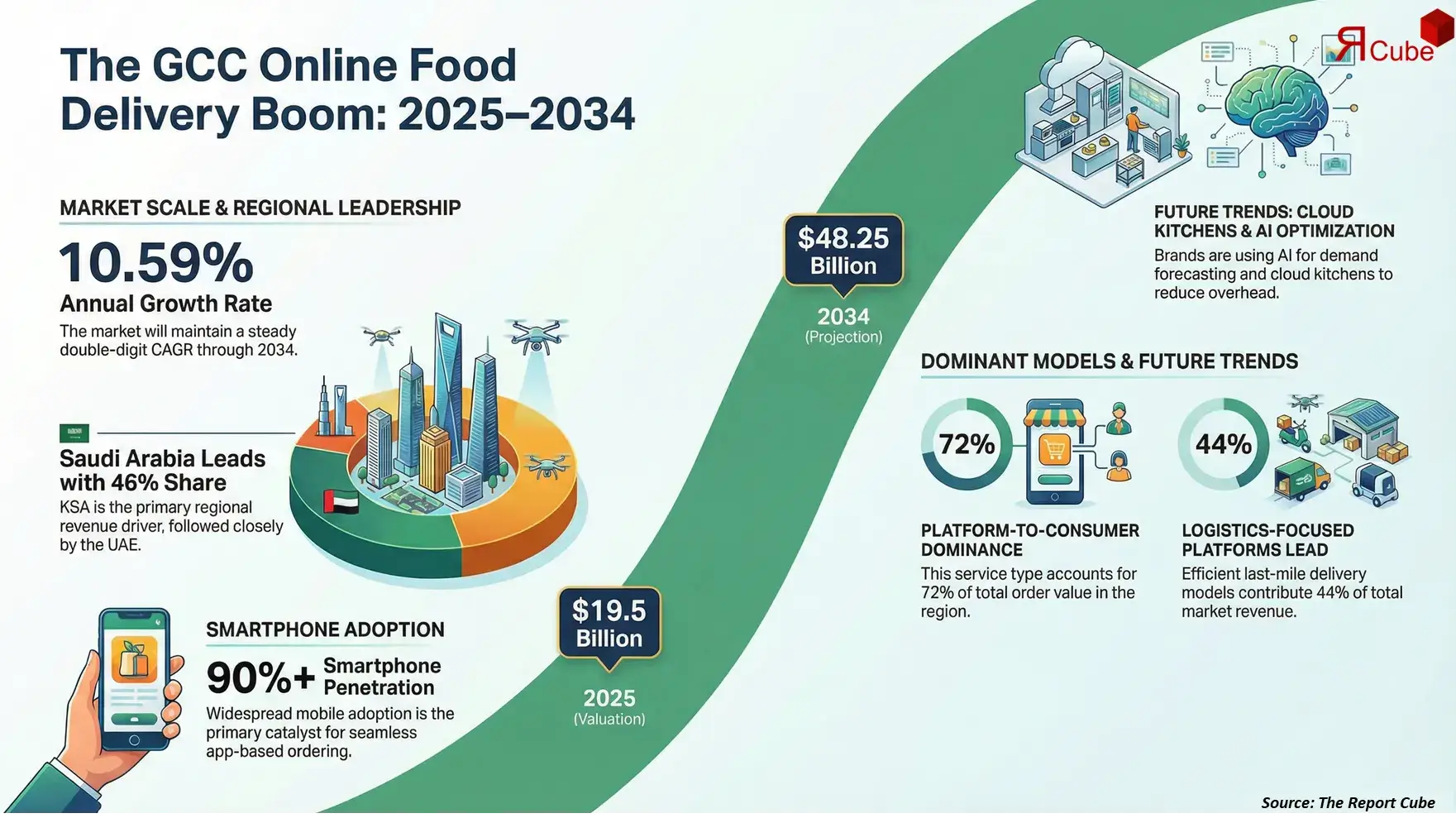
The GCC Online Food Delivery Market is anticipated to register a CAGR of 10.59% during 2026-2034. The market size was valued at USD 19.5 billion and is projected to reach USD 48.25 billion by 2034. This robust growth is driven by rapid urbanization, high smartphone penetration, and a digitally savvy population across GCC countries. Online food delivery has evolved into a mainstream consumption channel, supported by changing lifestyles, dual-income households, and strong demand for convenience among young professionals and families.
Saudi Arabia and the United Arab Emirates are at the forefront of market expansion, supported by dense urban populations, strong dining-out culture, and advanced digital payment ecosystems. The market benefits from aggressive platform expansion, extensive restaurant onboarding, and improved last-mile logistics. Additionally, the rise of cloud kitchens, subscription-based delivery programs, and AI-driven personalization has improved customer experience and order frequency. As consumer expectations shift toward faster delivery, wider cuisine choices, and competitive pricing, the GCC online food delivery market is positioned for sustained, high-growth momentum through the forecast period.
GCC Online Food Delivery Market Recent Developments
- 2025: Talabat expanded dark store and quick-commerce food delivery services across major GCC cities.
- 2025: HungerStation enhanced AI-driven demand forecasting and rider allocation in Saudi Arabia.
Government Initiatives & Policies
- Saudi Vision 2030 - Digital Economy Program: Supports e-commerce growth, digital platforms, and logistics infrastructure.
- UAE Digital Economy Strategy: Promotes digital platforms, cashless payments, and tech-enabled services.
GCC Online Food Delivery Market Dynamics
Key Driver: Convenience-led Consumption and Smartphone Penetration
The primary driver of the GCC online food delivery market is the strong consumer preference for convenience combined with widespread smartphone and internet penetration. Over 90% smartphone adoption in key GCC markets enables seamless app-based ordering and digital payments. Busy work schedules, traffic congestion, and demand for time-saving solutions have increased reliance on food delivery platforms. Promotional offers, loyalty programs, and real-time order tracking further enhance customer engagement, driving higher order frequency and basket sizes.
Major Challenge: High Operational Costs and Margin Pressure
A major challenge facing the market is rising operational costs, particularly related to last-mile delivery, rider management, and customer acquisition. Intense competition among platforms leads to high promotional spending and commission pressure. Fuel costs, labor regulations, and service quality expectations add to margin challenges. Platforms must continuously optimize logistics, pricing strategies, and restaurant partnerships to maintain profitability while sustaining growth.
Industry Trends: Growth of Cloud Kitchens and Subscription Models
An important trend shaping the market is the rapid growth of cloud kitchens and platform-led food brands. These models reduce real estate costs, enable faster scalability, and allow data-driven menu optimization. Subscription-based delivery programs offering free or discounted deliveries are also gaining traction, improving customer retention and lifetime value. Additionally, AI-driven personalization and dynamic pricing are increasingly used to optimize demand and improve operational efficiency.
Opportunity Ahead: Tier-2 City Expansion and Quick-commerce Integration
Strong opportunities exist in expanding services to tier-2 cities and integrating quick-commerce offerings. Rising urbanization beyond major metros is creating untapped demand for online food delivery. Integration of groceries, convenience foods, and meal kits within food delivery apps enhances platform stickiness and revenue diversification. Platforms investing in faster delivery times, localized cuisine offerings, and merchant enablement tools are well-positioned to capture incremental growth through 2034.
GCC Online Food Delivery Market Segment-wise Analysis
By Service Type:
- Platform-to-Consumer Delivery
- Restaurant-to-Consumer Delivery
Platform-to-consumer delivery dominates the market, accounting for approximately 72% of total order value in 2025. Aggregator platforms provide end-to-end services including ordering, payment processing, and logistics, making them highly attractive to both restaurants and consumers. Restaurant-to-consumer delivery holds a smaller share, primarily driven by large chains with in-house delivery capabilities.
By Business Model:
- Order-focused Aggregators
- Logistics-focused Platforms
- Full-stack / Cloud Kitchen-based Models
Logistics-focused platforms represent the leading business model, contributing nearly 44% of market revenue in 2025. Their ability to manage last-mile delivery efficiently and onboard a wide range of restaurant partners drives scale and coverage. Full-stack and cloud kitchen-based models are the fastest-growing segment due to higher margins and operational control.
Regional Projection of GCC Online Food Delivery Industry
- Saudi Arabia
- United Arab Emirates
- Qatar
- Kuwait
- Bahrain
- Oman
Saudi Arabia leads the GCC online food delivery market, accounting for approximately 46% of total regional revenue in 2025. The country’s large population, young demographic profile, and high app usage drive strong order volumes. The UAE follows, supported by high disposable incomes, premium dining demand, and a highly developed digital payments and logistics ecosystem.
Why Choose This Report?
- Provides a comprehensive overview of the overall market analysis, including consumer behavior, platform economics, and competitive dynamics.
- Provides accurate, up-to-date insights into market size, segmentation, and emerging growth opportunities.
- Gives deep understanding of user preferences, ordering patterns, and digital engagement drivers.
- Delivers competitive analysis & benchmarking of leading food delivery platforms.
- Consolidates comprehensive market intelligence, reducing research time & decision-making complexity.
- Facilitates customized segmentation & risk mitigation strategies aligned with platform growth objectives.
- Aids in identifying both market challenges & untapped opportunities within the digital food ecosystem.
- Provides valuable insights based on real ordering trends and platform adoption data.
Table of Contents
- Introduction
- Objective of the Study
- Product/Category Definition
- Market Segmentation
- Study Variables
- Research Methodology
- Secondary Data Points
- Breakdown of Secondary Sources
- Primary Data Points
- Breakdown of Primary Interviews
- Secondary Data Points
- Executive Summary
- Market Dynamics
- Drivers
- Challenges
- Opportunity Assessment
- Recent Trends and Developments
- Policy and Regulatory Landscape
- GCC Online Food Delivery Market Overview (2020-2034)
- Market Size, By Volume & Value (Orders / USD Million)
- Market Share, By Service Type
- Platform-to-Consumer Delivery
- Restaurant-to-Consumer Delivery
- Market Share, By Business Model
- Order-focused Aggregators
- Logistics-focused Platforms
- Full-stack / Cloud Kitchen-based Models
- Market Share, By Cuisine Type
- Arabian / Middle Eastern
- Indian & Pakistani
- Western / American & European
- Asian (Chinese, Thai, Japanese, etc.)
- Healthy / Organic / Diet Meals
- Fast Food & QSR
- Others
- Market Share, By Order Type
- Meal Delivery
- Snacks & Desserts
- Beverages & Café Orders
- Groceries & Convenience Items
- Market Share, By Platform
- Mobile Applications
- Web-based Platforms
- Market Share, By Payment Mode
- Cash on Delivery
- Cards (Credit / Debit)
- Digital Wallets & In-app Payments
- Market Share, By Consumer Age Group
- Up to 25 Years
- 26–35 Years
- 36–50 Years
- Above 50 Years
- Market Share, By Order Size
- Up to USD 30
- USD 31 to USD 50
- Above USD 50
- Market Share, By Country
- Saudi Arabia
- United Arab Emirates
- Qatar
- Kuwait
- Bahrain
- Oman
- Market Share, By Company
- Revenue Shares
- Competitive Landscape
- Saudi Arabia Online Food Delivery Market
- Market Size, By Volume & Value (USD Million)
- Market Share, By Service Type
- Market Share, By Business Model
- Market Share, By Cuisine Type
- Market Share, By Platform
- Market Share, By Payment Mode
- Market Share, By Consumer Age Group
- Market Share, By Order Size
- United Arab Emirates Online Food Delivery Market
- Market Size, By Volume & Value (USD Million)
- Market Share, By Service Type
- Market Share, By Business Model
- Market Share, By Cuisine Type
- Market Share, By Platform
- Market Share, By Payment Mode
- Market Share, By Consumer Age Group
- Market Share, By Order Size
- Qatar Online Food Delivery Market
- Market Size, By Volume & Value (USD Million)
- Market Share, By Service Type
- Market Share, By Business Model
- Market Share, By Cuisine Type
- Market Share, By Platform
- Market Share, By Payment Mode
- Market Share, By Consumer Age Group
- Market Share, By Order Size
- Kuwait Online Food Delivery Market
- Market Size, By Volume & Value (USD Million)
- Market Share, By Service Type
- Market Share, By Business Model
- Market Share, By Cuisine Type
- Market Share, By Platform
- Market Share, By Payment Mode
- Market Share, By Consumer Age Group
- Market Share, By Order Size
- Bahrain Online Food Delivery Market
- Market Size, By Volume & Value (USD Million)
- Market Share, By Service Type
- Market Share, By Business Model
- Market Share, By Cuisine Type
- Market Share, By Platform
- Market Share, By Payment Mode
- Market Share, By Consumer Age Group
- Market Share, By Order Size
- Oman Online Food Delivery Market
- Market Size, By Volume & Value (USD Million)
- Market Share, By Service Type
- Market Share, By Business Model
- Market Share, By Cuisine Type
- Market Share, By Platform
- Market Share, By Payment Mode
- Market Share, By Consumer Age Group
- Market Share, By Order Size
- Competitive Outlook & Company Profiles
- Talabat
- Company Overview
- Service & Platform Portfolio
- Geographic Presence in GCC
- Key Partnerships & Cloud Kitchens
- Recent Developments
- Jahez International
- Company Overview
- Service & Platform Portfolio
- Geographic Presence in GCC
- Key Partnerships & Cloud Kitchens
- Recent Developments
- HungerStation (Delivery Hero Group)
- Company Overview
- Service & Platform Portfolio
- Geographic Presence in GCC
- Key Partnerships & Cloud Kitchens
- Recent Developments
- Deliveroo
- Company Overview
- Service & Platform Portfolio
- Geographic Presence in GCC
- Key Partnerships & Cloud Kitchens
- Recent Developments
- Careem Food / Careem NOW
- Company Overview
- Service & Platform Portfolio
- Geographic Presence in GCC
- Key Partnerships & Cloud Kitchens
- Recent Developments
- Noon Food
- Company Overview
- Service & Platform Portfolio
- Geographic Presence in GCC
- Key Partnerships & Cloud Kitchens
- Recent Developments
- Mrsool
- Company Overview
- Service & Platform Portfolio
- Geographic Presence in GCC
- Key Partnerships
- Recent Developments
- Snoonu
- Company Overview
- Service & Platform Portfolio
- Geographic Presence in GCC
- Key Partnerships
- Recent Developments
- Zomato
- Company Overview
- Service & Platform Portfolio
- Geographic Presence in GCC
- Key Partnerships
- Recent Developments
- Carriage
- Company Overview
- Service & Platform Portfolio
- Geographic Presence in GCC
- Key Partnerships
- Recent Developments
- Others
- Talabat
- Contact Us / Disclaimer
Top Key Players & Market Share Outlook
- Talabat
- Jahez International
- HungerStation (Delivery Hero Group)
- Deliveroo
- Careem Food / Careem NOW
- Noon Food
- Mrsool
- Snoonu
- Zomato
- Carriage
- Others
Frequently Asked Questions






