



Build Your Custom Market Intelligence Report
Customize Your ReportAustralia Skincare Product Market Statistics and Insights
Market Size Statistics
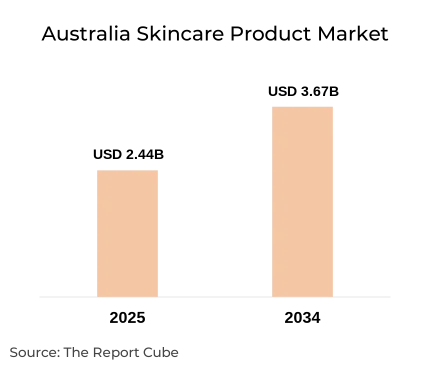
- Australia skincare product market valued at USD 2.44 billion 2025
- Market expected to reach USD 3.67 billion by 2034
- Compound annual growth rate projected at 4.64%
By Product Type
- Facial care products held around 54% market share
Competitive Landscape
- More than 10 companies are actively engaged in producing Australia Skincare Product Market
- Top 5 companies acquired around 58% of the market share.
- L’Oréal SA, KORA Organics, Procter & Gamble Company, Unilever PLC, Estée Lauder Companies Inc., and others
By Category
- Premium category accounted for nearly 52% market share
Australia Skincare Product Market Insights & Analysis
The Australia Skincare Product Market is anticipated to register a 4.64% CAGR during 2026-2034. The market size was valued at USD 2.44 billion in 2025 and is projected to reach USD 3.67 billion by 2034. The market is driven by rising consumer awareness regarding skin health and increasing demand for natural and organic skincare products. Australian consumers are highly inclined toward clean-label, cruelty-free, and environmentally sustainable skincare solutions, which is influencing product innovation and brand positioning. Government regulations supporting transparency in cosmetic ingredients are also encouraging manufacturers to adopt safer formulations.
In recent years, companies such as L’Oréal and Unilever have expanded their product portfolios with eco-friendly and dermatologically tested formulations. Additionally, the growing influence of social media and beauty influencers is shaping consumer purchasing behavior. Rising disposable income and increasing preference for premium skincare products further contribute to market growth. The expansion of e-commerce platforms and direct-to-consumer channels is also enhancing product accessibility across urban and regional areas.
Australia Skincare Product Market Dynamics
Key Market Driver: Growing Demand for Natural and Organic Skincare
The increasing preference for natural and organic skincare products is a major driver of the Australia Skincare Product Market. Consumers are becoming more conscious about the ingredients used in skincare products, favoring chemical-free and plant-based formulations. This shift is supported by rising awareness regarding skin sensitivity and long-term health benefits.
Additionally, the demand for sustainable and eco-friendly packaging solutions is gaining traction among environmentally conscious consumers. Brands are focusing on transparency and ethical sourcing to build trust and enhance brand loyalty. The growing popularity of wellness and self-care routines is further driving demand for high-quality skincare products across different age groups.
Major Industry Challenge: Regulatory Compliance and Product Transparency Requirements
Strict regulatory requirements and the need for product transparency present challenges in the Australia Skincare Product Market. Manufacturers must comply with stringent guidelines related to ingredient safety, labeling, and environmental standards.
Ensuring compliance can increase product development timelines and complexity. Additionally, consumers demand detailed ingredient disclosures, which requires companies to maintain high levels of transparency. Failure to meet regulatory standards or consumer expectations can impact brand reputation. Companies must invest in research, testing, and certification processes to maintain compliance and consumer trust.
Emerging Trend Shaping Outlook: Rise of Personalized and Premium Skincare Solutions
The rise of personalized and premium skincare solutions is a key trend shaping the Australia Skincare Product Market. Consumers are increasingly seeking customized products tailored to their skin type, concerns, and lifestyle.
Technological advancements, including AI-driven skin analysis and digital consultations, are enabling brands to offer personalized recommendations. Premium skincare products with advanced formulations and clinically proven ingredients are gaining popularity. Additionally, the influence of dermatologists and skincare professionals is driving the adoption of specialized products. This trend is expected to drive innovation and premiumization across the market.
Need Specific Data, Let’s Customize the Report for You
Request CustomizationAustralia Skincare Product Market Segment-wise Analysis
The Australia Skincare Product Market segmentation highlights strong demand across product types and categories, with facial care leading due to daily usage patterns, while premium products gain traction driven by consumer preference for high-quality and effective skincare solutions.
By Product Type
- Facial Care Products
- Body Care Products
- Lip Care Products
The product type segment is dominated by facial care products, accounting for approximately 54% of total market share. This dominance is driven by increasing consumer focus on facial skincare routines, including cleansing, moisturizing, and anti-aging treatments. Body care products also hold a significant share due to growing awareness of full-body skincare. Lip care products represent a smaller but steady segment, supported by demand for hydration and protection products. Continuous innovation in formulations and the introduction of multifunctional products are further supporting segment growth. Rising demand for anti-aging and sun protection products also contributes to the expansion of facial care products.
By Category
- Mass
- Premium
The category segment is led by premium products, holding nearly 52% of the market share. The dominance of premium skincare is driven by increasing disposable income and growing preference for high-quality, dermatologist-tested products. Consumers are willing to pay higher prices for products with proven efficacy and advanced ingredients. The mass segment continues to grow steadily, supported by affordability and widespread availability. However, premium brands are gaining a competitive edge through innovation, branding, and personalized skincare solutions. The expansion of luxury skincare lines and online retail channels further strengthens the premium segment’s growth trajectory.
Regional Projection of Australia Skincare Product Market
The regional outlook highlights strong demand in urbanized states driven by higher consumer awareness and premium product adoption, with eastern regions contributing significantly to overall skincare consumption and innovation trends.
- New South Wales
- Victoria
- Queensland
- Rest of Australia
New South Wales leads the Australia Skincare Product Market, accounting for approximately 35% of total consumption. The dominance is driven by high population density, strong retail presence, and greater awareness of skincare products. Victoria follows closely, supported by rising demand for premium and organic skincare. Queensland is experiencing steady growth due to increasing urbanization and lifestyle changes. Other regions contribute moderately, with growing adoption of skincare products in regional areas. The presence of major retail chains and e-commerce platforms further supports market expansion in leading regions.
Australia Skincare Product Market: Recent Develpoment (2025)
- L’Oréal SA launched advanced skincare range featuring sustainable ingredients targeting environmentally conscious Australian consumers
- KORA Organics expanded organic product portfolio with certified formulations enhancing premium skincare segment growth in Australia
- Unilever PLC introduced eco-friendly packaging solutions supporting sustainability initiatives across its skincare product lines
- Estée Lauder Companies Inc. invested in digital skincare personalization technologies improving customer engagement and product recommendations
Australia Skincare Product Market Future Outlook (2034)
The Australia Skincare Product Market is projected to grow at a CAGR of 4.64% and reach USD 3.67 billion by 2034. Growth opportunities are expected from increasing demand for organic products, rising premiumization, and expanding digital retail channels. Technological advancements, including AI-driven skin diagnostics and personalized skincare solutions, will enhance consumer experience. Sustainable packaging and clean-label products will remain key focus areas for manufacturers. As consumer awareness continues to grow, the market is expected to expand steadily, driven by innovation, product differentiation, and evolving beauty and wellness trends.
Why Choose This Report?
- Provides a comprehensive overview of the overall market analysis, encompassing key trends, consumer behavior analysis, and risk assessment to support strategic decision-making.
- Provides accurate, up-to-date insights into market size, segmentation, and emerging opportunities, helping to minimize risk & capitalizing on growth.
- Gives deep understanding of target audience preferences, investment habits, and communication channels for enhanced product development & marketing effectiveness.
- Delivers competitive analysis & benchmarking, uncovering the strengths & weaknesses of market competitors to guide strategies.
- Consolidate comprehensive market intelligence, reducing reasoning & streamlining research efforts.
- Facilitates customized market segmentation & risk mitigation strategies, fine-tuned to the business objectives.
- Aids in identifying both market challenges & untapped opportunities within the industry to drive long-term business growth.
- Provides valuable information based on actual customer data & search trends.
Table of Contents
- Introduction
- Objective of the study
- Product Definition
- Market Segmentation
- Study Variables
- Research Methodology
- Secondary Data Points
- Companies Interviewed
- Primary Data Points
- Breakdown of Primary Interviews
- Secondary Data Points
- Executive Summary
- Market Dynamics
- Drivers
- Challenges
- Opportunity Assessment
- Recent Trends and Developments
- Policy and Regulatory Landscape
- Australia Skincare Product Market Overview (2021-2034)
- Market Size, By Value (in USD Billions)
- Market Share, By Product Type
- Facial Care Products
- Body Care Products
- Lip Care Products
- Market Share, By Category
- Mass
- Premium
- Market Share, By Nature
- Natural/Organic
- Synthetic/Conventional
- Market Share, By End User
- Kids
- Adults
- Market Share, By Distribution Channel
- Supermarkets/Hypermarkets
- Health and Beauty Stores
- Online Retail Channels
- Other Channels
- Market Share, By Region
- New South Wales
- Victoria
- Queensland
- Rest of Australia
- Market Share, By Competitors
- Competition Characteristics
- Revenue Shares
- Australia Facial Care Products Skincare Product Market Overview, 2021-2034F
- By Value (USD Million/Billion)
- By Category- Market Size & Forecast 2021-2034, USD Million/Billion
- By Nature- Market Size & Forecast 2021-2034, USD Million/Billion
- By End User- Market Size & Forecast 2021-2034, USD Million/Billion
- By Distribution Channel- Market Size & Forecast 2021-2034, USD Million/Billion
- Australia Body Care Products Skincare Product Market Overview, 2021-2034F
- By Value (USD Million/Billion)
- By Category- Market Size & Forecast 2021-2034, USD Million/Billion
- By Nature- Market Size & Forecast 2021-2034, USD Million/Billion
- By End User- Market Size & Forecast 2021-2034, USD Million/Billion
- By Distribution Channel- Market Size & Forecast 2021-2034, USD Million/Billion
- Australia Lip Care Products Skincare Product Market Overview, 2021-2034F
- By Value (USD Million/Billion)
- By Category- Market Size & Forecast 2021-2034, USD Million/Billion
- By Nature- Market Size & Forecast 2021-2034, USD Million/Billion
- By End User- Market Size & Forecast 2021-2034, USD Million/Billion
- By Distribution Channel- Market Size & Forecast 2021-2034, USD Million/Billion
- Competitive Outlook (Company Profile - Partial List)
- L’Oréal SA
- Company Overview
- Business Segments
- Strategic Alliances/Partnerships
- Recent Developments
- KORA Organics
- Company Overview
- Business Segments
- Strategic Alliances/Partnerships
- Recent Developments
- Procter & Gamble Company
- Company Overview
- Business Segments
- Strategic Alliances/Partnerships
- Recent Developments
- Unilever PLC
- Company Overview
- Business Segments
- Strategic Alliances/Partnerships
- Recent Developments
- Estée Lauder Companies Inc.
- Company Overview
- Business Segments
- Strategic Alliances/Partnerships
- Recent Developments
- Kenvue Inc.
- Company Overview
- Business Segments
- Strategic Alliances/Partnerships
- Recent Developments
- Beiersdorf AG
- Company Overview
- Business Segments
- Strategic Alliances/Partnerships
- Recent Developments
- Shiseido Company Limited
- Company Overview
- Business Segments
- Strategic Alliances/Partnerships
- Recent Developments
- L’Occitane Group
- Company Overview
- Business Segments
- Strategic Alliances/Partnerships
- Recent Developments
- Others
- L’Oréal SA
- Contact Us & Disclaimer
Top Key Players & Market Share Outlook
- L’Oréal SA
- KORA Organics
- Procter & Gamble Company
- Unilever PLC
- Estée Lauder Companies Inc.
- Kenvue Inc.
- Beiersdorf AG
- Shiseido Company Limited
- L’Occitane Group
- Others
Frequently Asked Questions






