



Build Your Custom Market Intelligence Report
Customize Your ReportEgypt Access Control Market Insights & Analysis
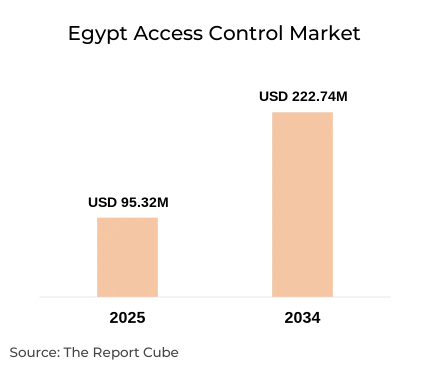
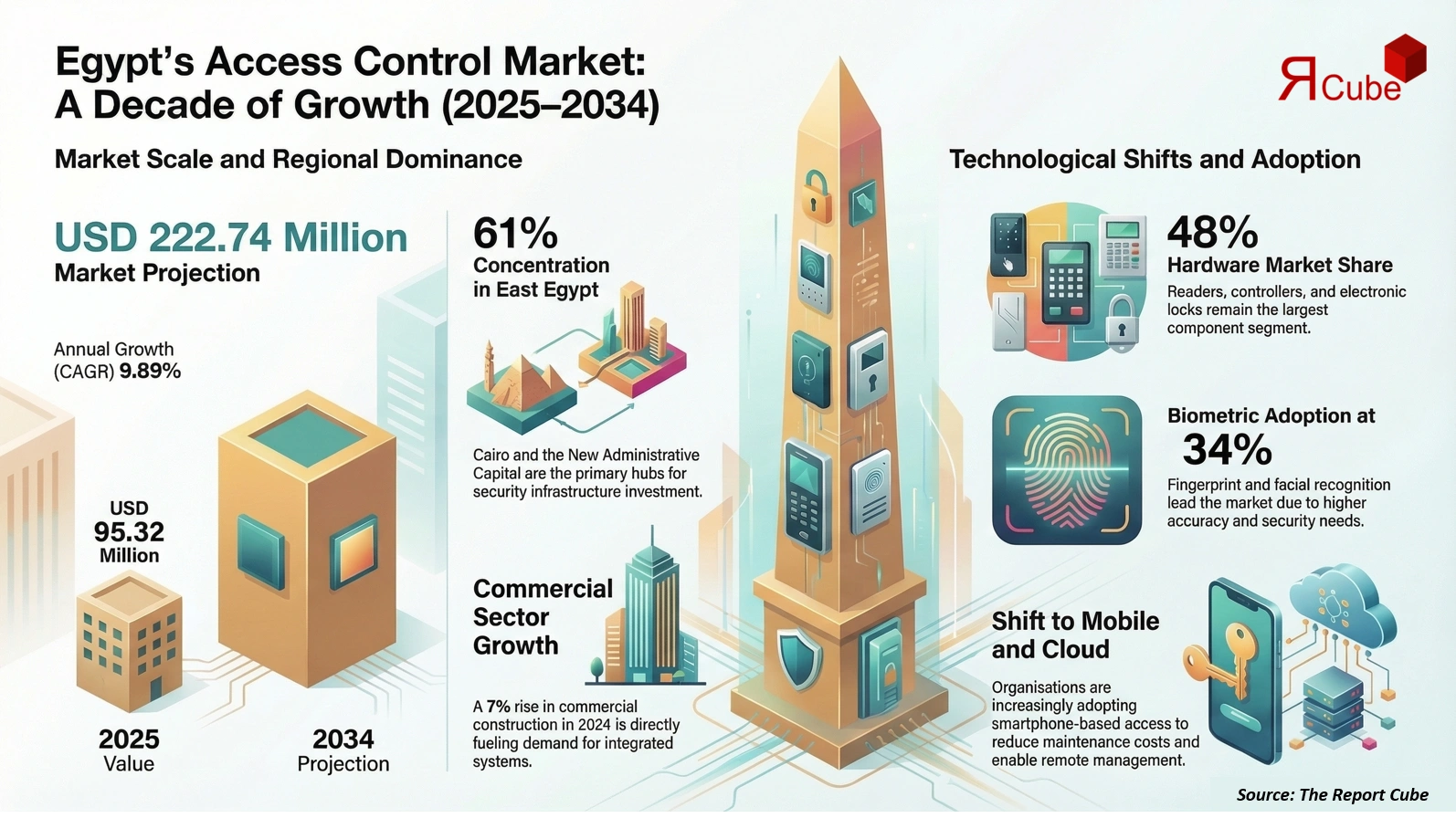
The Egypt Access Control Market is anticipated to register a CAGR of 9.89% during the forecast period 2026-2034. The market size was valued at USD 95.32 million in 2025 and is projected to reach USD 222.74 million by 2034. This strong growth trajectory reflects Egypt’s accelerating investments in smart infrastructure, commercial real estate, transportation hubs, and government-led digital security initiatives.
Rising urbanization, increased construction of mixed-use developments, and heightened awareness around physical security are directly influencing the adoption of access control systems across Egypt. Both public and private sectors are prioritizing advanced security solutions to safeguard critical infrastructure, offices, healthcare facilities, and residential complexes. As security threats evolve, organizations are transitioning from traditional lock-and-key mechanisms to integrated digital access control platforms.
Furthermore, Egypt’s push toward smart cities and digital transformation is strengthening demand for biometric, mobile-based, and multi-factor authentication systems. Integration of access control with video surveillance and building management systems is becoming standard practice, particularly in large-scale commercial and industrial projects. These interconnected trends collectively position the Egypt Access Control Market for sustained expansion over the coming decade.
Egypt Access Control Market Recent Developments
- 2025: Honeywell expanded its intelligent access control portfolio for commercial buildings across major Egyptian cities.
- 2025: ZKTeco introduced localized biometric access solutions tailored for government and enterprise applications.
Government Initiatives & Policies
- Digital Egypt Strategy: National initiative promoting smart infrastructure and digital security adoption.
- New Administrative Capital Program: Government-led smart city development integrating advanced security systems.
Egypt Access Control Market Dynamics
Key Driver: Growing Demand for Enhanced Physical Security Across Sectors
The primary driver of the Egypt Access Control Market is the rising demand for enhanced physical security across commercial, government, and residential sectors. Increasing foot traffic in office complexes, airports, hospitals, and educational institutions has elevated the need for controlled and monitored access. Organizations are investing in access control systems to prevent unauthorized entry, protect assets, and ensure personnel safety. In 2024, commercial construction activity in Egypt grew by over 7%, directly supporting demand for integrated security solutions. Additionally, regulatory emphasis on data protection and facility security is encouraging enterprises to deploy centralized access management systems. These factors, combined with rising security awareness, are consistently driving market adoption.
Book your FREE 30-minute expert consultation today
Contact UsIndustry Trends: Rapid Shift Toward Biometric and Mobile-Based Access
A key trend shaping the Egypt Access Control Market is the rapid shift toward biometric and mobile-based access technologies. Fingerprint, facial recognition, and iris scanning systems are increasingly preferred due to their higher accuracy and reduced risk of credential theft. Mobile access solutions, leveraging smartphones and cloud platforms, are gaining traction among corporate offices and co-working spaces. These systems offer flexibility, remote management, and lower maintenance costs compared to traditional card-based solutions. Moreover, the integration of artificial intelligence with biometric systems is improving authentication speed and reliability. This trend reflects a broader move toward contactless and user-friendly security solutions across Egypt.
Major Challenge: High Initial Costs and Integration Complexity
Despite strong growth prospects, high initial costs and system integration complexity remain major challenges for the Egypt Access Control Market. Advanced access control solutions, particularly biometric and multi-factor systems, require significant upfront investment in hardware, software, and network infrastructure. Small and medium-sized enterprises often face budget constraints, limiting adoption. Additionally, integrating new access control systems with legacy infrastructure can be technically complex and time-consuming. The need for skilled technicians and ongoing maintenance further adds to operational costs. These challenges may slow adoption in cost-sensitive segments, particularly in smaller cities and older buildings.
Opportunity: Expansion of Smart Cities and Commercial Infrastructure
The expansion of smart cities and large-scale commercial infrastructure projects presents a significant opportunity for the Egypt Access Control Market. Developments such as the New Administrative Capital are designed with advanced security frameworks from the outset, creating strong demand for modern access control systems. Hotels, shopping malls, logistics hubs, and industrial zones are increasingly incorporating integrated security solutions to enhance operational efficiency and safety. As foreign direct investment in real estate and industrial projects continues to rise, demand for scalable and intelligent access control platforms is expected to grow. This environment creates long-term opportunities for technology providers and system integrators.
Egypt Access Control Market Segment-wise Analysis
By Component:
- Hardware
- Software
- Services
Hardware dominates the Egypt Access Control Market, accounting for approximately 48% of total market share in 2025. This leadership is driven by strong demand for readers, controllers, biometric devices, and electronic locks across commercial and government facilities. However, the Software segment is growing at a faster pace as organizations seek centralized management, analytics, and cloud-based control platforms. Services, including installation, maintenance, and system integration, are gaining importance as system complexity increases. The balanced growth across components highlights the market’s transition from standalone hardware to integrated access control ecosystems.
By Type:
- Card-Based
- Biometric
- Mobile Access
- Keypad/PIN
- Multi-Factor
Biometric access control leads this segment, holding nearly 34% market share, due to its enhanced security and growing acceptance across government and enterprise sectors. Card-based systems remain widely used, particularly in educational institutions and offices, while Mobile Access is emerging rapidly in modern workplaces. Multi-Factor authentication is gaining adoption in high-security environments such as data centers and financial institutions. This segmental evolution reflects Egypt’s gradual shift toward advanced and layered security approaches.
Regional Projection of Egypt Access Control Industry
- East Egypt
- West Egypt
East Egypt leads the Egypt Access Control Market, accounting for approximately 61% of total demand. The region includes major urban centers such as Cairo and the New Administrative Capital, where large-scale commercial, governmental, and residential projects are concentrated. High population density, infrastructure investments, and smart city initiatives are driving robust adoption of access control systems. West Egypt follows, supported by industrial zones, tourism-related infrastructure, and gradual urban expansion. East Egypt is expected to maintain its leadership throughout the forecast period due to sustained construction activity and technology adoption.
Need insights for a specific region within this market?
Request Regional DataWhy Choose This Report?
- Provides a comprehensive overview of the overall market analysis, encompassing key trends, consumer behavior analysis, and risk assessment to support strategic decision-making.
- Provides accurate, up-to-date insights into market size, segmentation, and emerging opportunities, helping to minimize risk & capitalizing on growth.
- Gives deep understanding of target audience preferences, investment habits, and communication channels for enhanced product development & marketing effectiveness.
- Delivers competitive analysis & benchmarking, uncovering the strengths & weaknesses of market competitors to guide strategies.
- Consolidate comprehensive market intelligence, reducing reasoning & streamlining research efforts.
- Facilitates customized market segmentation & risk mitigation strategies, fine-tuned to the business objectives.
- Aids in identifying both market challenges & untapped opportunities within the industry to drive long-term business growth.
- Provides valuable information based on actual customer data & search trends.
Table of Contents
- Introduction
- Objective of the Study
- Product and Category Definition
- Market Segmentation
- Study Variables
- Research Methodology
- Secondary Data Points
- Breakdown of Secondary Sources
- Primary Data Points
- Breakdown of Primary Interviews
- Secondary Data Points
- Executive Summary
- Market Dynamics
- Drivers
- Challenges
- Opportunity Assessment
- Recent Trends and Developments
- Regulatory and Policy Landscape
- Egypt Access Control Market Overview (2020-2034)
- Market Size, By Value (USD Million)
- Market Share, By Component
- Hardware
- Software
- Services
- Market Share, By Type
- Card-Based
- Biometric
- Mobile Access
- Keypad/Pin
- Multi-Factor
- Market Share, By End User
- Commercial
- Residential
- Industrial
- Government
- Critical Infrastructure
- Market Share, By Channel Type
- Direct Sales
- System Integrators
- Distributors
- Market Share, By Region
- East
- West
- Market Share, By Company
- Revenue Shares & Analysis
- Competitive Landscape
- East Egypt Access Control Market
- Market Size, By Value (USD Million)
- Market Share, By Component
- Market Share, By Type
- Market Share, By End User
- Market Share, By Channel Type
- West Egypt Access Control Market
- Market Size, By Value (USD Million)
- Market Share, By Component
- Market Share, By Type
- Market Share, By End User
- Market Share, By Channel Type
- Competitive Outlook and Company Profiles
- Siemens
- Company Overview
- Product Portfolio
- Strategic Alliances/Partnerships
- Recent Developments
- Schneider Electric
- Company Overview
- Product Portfolio
- Strategic Alliances/Partnerships
- Recent Developments
- Honeywell
- Company Overview
- Product Portfolio
- Strategic Alliances/Partnerships
- Recent Developments
- Johnson Controls
- Company Overview
- Product Portfolio
- Strategic Alliances/Partnerships
- Recent Developments
- Bosch Security
- Company Overview
- Product Portfolio
- Strategic Alliances/Partnerships
- Recent Developments
- ASSA ABLOY
- Company Overview
- Product Portfolio
- Strategic Alliances/Partnerships
- Recent Developments
- HID Global
- Company Overview
- Product Portfolio
- Strategic Alliances/Partnerships
- Recent Developments
- Dormakaba
- Company Overview
- Product Portfolio
- Strategic Alliances/Partnerships
- Recent Developments
- Axis Communications
- Company Overview
- Product Portfolio
- Strategic Alliances/Partnerships
- Recent Developments
- ZKTeco
- Company Overview
- Product Portfolio
- Strategic Alliances/Partnerships
- Recent Developments
- Others
- Siemens
- Contact Us and Disclaimer
Top Key Players & Market Share Outlook
- Siemens
- Schneider Electric
- Honeywell
- Johnson Controls
- Bosch Security
- ASSA ABLOY
- HID Global
- Dormakaba
- Axis Communications
- ZKTeco
- Others
Frequently Asked Questions






