



Build Your Custom Market Intelligence Report
Customize Your ReportVietnam Agricultural Drone Market Key Highlights
By Drone Type:
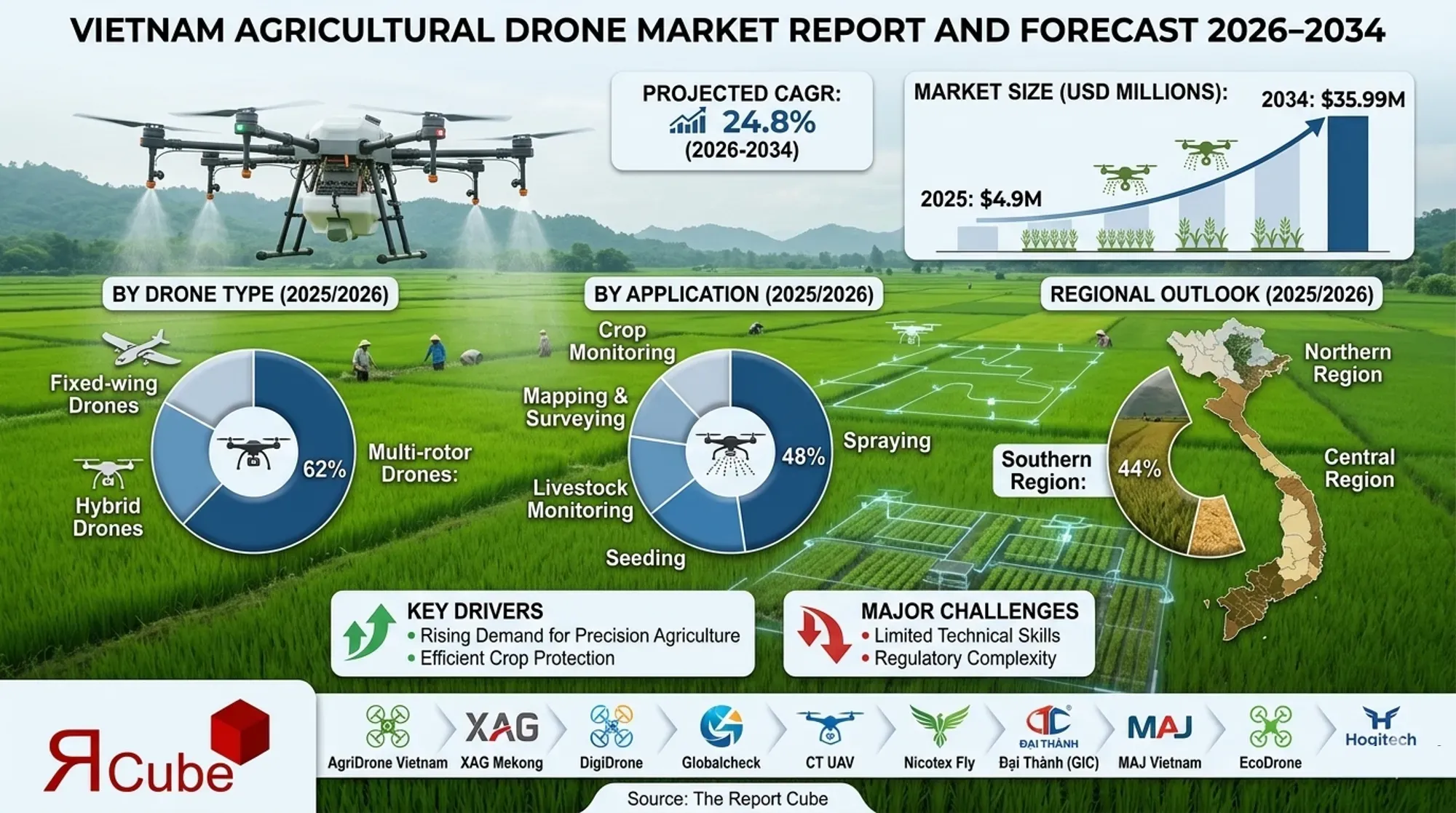
Multi-rotor drones segment lead the market, with around 62% share.
By Application:
Spraying (pesticides, herbicides, fertilizers) segment dominate the market, accounting for nearly 48% of total revenue.
Regional Outlook:
Southern region dominates the Vietnam agricultural drone market, with around 44% share.
Government Initiatives & Policies
- Vietnam National Digital Agriculture Strategy: The Vietnamese government launched initiatives promoting precision agriculture, including drone-based crop monitoring, digital farm management systems, and smart farming pilot projects to increase productivity and sustainability.
- Vietnam National Digital Transformation Program 2025-2030: This government program encourages the adoption of advanced technologies such as drones, AI analytics, and smart sensors in agriculture to improve yield forecasting, farm management efficiency, and export competitiveness.
Vietnam Agricultural Drone Market Insights & Analysis
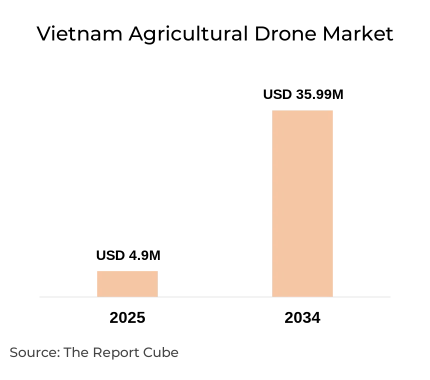
The Vietnam Agricultural Drone Market is anticipated to register a 24.8% during 2026-2034. the market size was valued at USD 4.9 million in 2025 and is projected to reach USD 35.99 million by 2034. Vietnam’s agriculture sector is undergoing rapid digital modernization as farms integrate automation, data analytics, and precision equipment to improve productivity and reduce labor intensity. Agricultural drones have emerged as one of the most transformative technologies in this transition. Vietnam’s agricultural sector contributes roughly 12% to national GDP and employs nearly one-third of the workforce, creating strong incentives for the adoption of technologies that enhance efficiency and crop protection. Drone technology enables farmers to conduct aerial spraying, crop monitoring, and field mapping with greater speed and precision compared with manual techniques.
Investments from both domestic startups and international technology companies are accelerating the adoption of drone-enabled farming solutions. Vietnamese agricultural technology providers such as AgriDrone Vietnam, DigiDrone, and EcoDrone are expanding service networks that deliver drone-as-a-service models for farmers who cannot afford direct equipment purchases. These services are increasingly used in rice cultivation, coffee plantations, and fruit orchards in the Mekong Delta and Central Highlands. Precision spraying using drones can reduce pesticide usage by up to 30% while improving crop coverage, making the technology attractive for farmers facing rising input costs.
Government policy also plays a central role in shaping market development. National strategies focused on digital agriculture and rural modernization encourage the deployment of automation technologies across farming communities. Agricultural cooperatives increasingly partner with drone service providers to deliver large-scale crop spraying and monitoring operations. At the same time, technology leaders such as DJI Agriculture and XAG Mekong are investing in localized training centers to build drone operator skills among farmers. With export demand for high-value crops such as durian, rice, and coffee continuing to grow, the integration of drone technology into Vietnamese agriculture is expected to accelerate rapidly during the forecast period.
Vietnam Agricultural Drone Market Dynamics
Key Driver: Rising Demand for Precision Agriculture and Efficient Crop Protection
The strongest growth driver for the Vietnam agricultural drone market is the expanding adoption of precision agriculture technologies. Vietnamese farmers increasingly rely on digital tools to manage crop health, improve irrigation planning, and reduce chemical usage. Agricultural drones allow farmers to spray pesticides and fertilizers quickly across large areas while maintaining consistent coverage. Studies in Vietnam show that drone-based spraying can cover up to 30 hectares per day compared with approximately 2 hectares using manual spraying equipment.
Labor shortages in rural regions are another factor driving demand for drone technology. Many young workers are shifting to urban employment, leaving farms with fewer labor resources for tasks such as crop spraying and monitoring. Drones provide an automated alternative that reduces labor dependency while improving productivity. Precision spraying also lowers chemical exposure for farmers, addressing health and environmental concerns associated with traditional spraying methods.
Rice farming represents a particularly strong application area for agricultural drones. Vietnam ranks among the world’s largest rice exporters, producing more than 40 million tons annually. Drone spraying enables farmers to apply pesticides efficiently across large rice fields, reducing time and input costs while increasing yield stability. As farmers increasingly recognize these operational benefits, drone adoption is expected to expand rapidly across multiple crop categories.
Book your FREE 30-minute expert consultation today
Contact UsIndustry Trends: Integration of AI-Driven Analytics and Smart Farming Platforms
A major industry trend shaping the Vietnam agricultural drone market is the integration of advanced analytics, artificial intelligence, and cloud-based farm management platforms. Modern agricultural drones are equipped with multispectral cameras and high-resolution imaging sensors that generate detailed data about crop health, soil moisture, and pest activity. These data sets allow farmers to make informed decisions about irrigation, fertilization, and disease control.
Technology providers are increasingly integrating drone systems with digital farm platforms that analyze aerial imagery and convert it into actionable insights. These platforms provide farmers with visual maps highlighting stressed crops or nutrient deficiencies. The integration of analytics tools allows farmers to apply fertilizers and pesticides only where needed, reducing operational costs and environmental impact.
Another trend involves the expansion of drone-as-a-service models. Instead of purchasing drones directly, many farmers hire specialized service providers that manage flight operations, data analysis, and equipment maintenance. This model lowers the entry barrier for smallholder farms, which dominate Vietnam’s agricultural landscape. With service providers handling operations, farmers gain access to precision technology without large capital investments.
Major Challenge: Limited Technical Skills and Regulatory Complexity
Although agricultural drone adoption is expanding rapidly in Vietnam, several challenges still affect market development. One major obstacle involves limited technical knowledge among farmers regarding drone operation and data interpretation. Operating agricultural drones requires specialized training, particularly for complex applications such as multispectral crop analysis and automated spraying programs. Without proper training, farmers may struggle to fully utilize the capabilities of drone technology.
Regulatory requirements also present challenges for drone deployment. Vietnam maintains aviation regulations governing drone flight permissions, altitude limits, and operational safety standards. Farmers and service providers must obtain appropriate approvals to operate drones in agricultural areas. Navigating these regulations can create delays and administrative complexity for companies entering the market.
Infrastructure limitations in rural regions also influence adoption rates. Some remote farming areas lack reliable internet connectivity, which can affect data transmission and cloud-based analytics systems. While improvements in rural digital infrastructure are ongoing, these limitations still restrict the full integration of advanced agricultural technologies in certain regions.
Opportunity: Expansion of Drone Services for High-Value Crop Production
Vietnam’s rapidly growing export-oriented agriculture sector presents major opportunities for agricultural drone technology. High-value crops such as durian, coffee, pepper, and dragon fruit require precise monitoring and pest management to maintain export quality standards. Agricultural drones enable farmers to monitor large orchards quickly and identify disease outbreaks at an early stage.
The durian sector illustrates the potential of drone-enabled farming. Vietnam has experienced significant growth in durian exports, particularly to China, leading farmers to expand orchard cultivation in the Mekong Delta. Drone spraying allows orchard operators to manage pests and fertilization efficiently across large plantations. This capability is especially valuable in areas with dense tree coverage where manual spraying is difficult.
Government programs promoting agricultural digitalization also create opportunities for technology providers. Training initiatives, technology demonstration farms, and cooperative partnerships are encouraging farmers to adopt drone services. As these programs expand across rural regions, the demand for drone-based crop management services is expected to grow significantly during the forecast period.
Vietnam Agricultural Drone Market Segment-wise Analysis
By Drone Type:
- Multi-rotor Drones
- Fixed-wing Drones
- Hybrid VTOL Drones
- Others
Multi-rotor drones dominate the Vietnam agricultural drone market, accounting for approximately 62% of total market share in 2025. These drones are widely preferred due to their stability, precision control, and ability to perform vertical takeoff and landing in compact farm environments. Vietnamese farms often consist of fragmented land parcels rather than large open fields, making multi-rotor drones particularly suitable for targeted crop spraying and monitoring operations.
Multi-rotor agricultural drones can hover above specific areas and apply pesticides with high accuracy, which is essential for crops such as rice, coffee, and fruit orchards. Most commercial agricultural drone models used in Vietnam can carry payloads ranging from 10 to 30 liters of spraying solution. This capacity allows them to cover approximately 15 to 25 hectares per day depending on terrain conditions and crop type.
The affordability of multi-rotor drone systems compared with fixed-wing platforms also contributes to their popularity. Many Vietnamese drone service providers rely on these systems to deliver spraying services for smallholder farms. The flexibility of multi-rotor drones for spraying, monitoring, and mapping tasks ensures that they remain the leading drone type in Vietnam’s agricultural drone market.
By Application:
- Spraying
- Pesticides
- Herbicides
- Fertilizers
- Crop Monitoring and Health Assessment
- Soil and Field Mapping
- Seeding and Planting
- Livestock and Farm Infrastructure Monitoring
- Others
The spraying application segment holds the largest share of the Vietnam agricultural drone market, accounting for nearly 48% of total revenue in 2025. Drone-based spraying allows farmers to apply pesticides, herbicides, and fertilizers with exceptional efficiency compared with manual spraying methods. Agricultural drones use precision nozzles and automated flight paths to distribute chemicals evenly across crop surfaces, improving pest control while minimizing chemical waste.
Drone spraying technology can reduce pesticide usage by 20-30% compared with traditional spraying techniques. This efficiency not only lowers operational costs for farmers but also supports sustainable agriculture by reducing environmental contamination. The ability to spray crops quickly during narrow weather windows also helps farmers respond rapidly to pest outbreaks.
Large rice-growing regions in southern Vietnam have seen strong adoption of drone spraying services due to their ability to cover extensive fields in a short period. Service providers often deploy fleets of drones to complete large spraying operations within a few hours. This capability improves crop protection efficiency and ensures consistent chemical application across fields.
Regional Projection of Vietnam Agricultural Drone Industry
- Northern
- Central
- Southern
- Others
The Southern region dominates the Vietnam agricultural drone market, accounting for roughly 44% of total market share in 2025. This dominance is largely driven by the Mekong Delta, which serves as Vietnam’s primary agricultural production hub. The region produces more than half of the country’s rice output and supports large areas of fruit cultivation, including durian, mango, and dragon fruit.
Large farming areas and intensive crop production in the Mekong Delta create strong demand for efficient crop management technologies. Agricultural drones are widely used for spraying pesticides and monitoring crop health across rice paddies and fruit orchards. The region’s extensive irrigation systems and flat terrain also provide ideal conditions for drone-based agricultural operations.
Several technology providers have established operational centers in southern Vietnam to serve the region’s farming communities. Companies such as XAG Mekong and DJI Agriculture partners provide drone training programs and service networks that support farmers adopting precision agriculture technologies. As export-oriented crop production continues to expand in southern Vietnam, the region is expected to remain the leading market for agricultural drone deployment.
Vietnam Agricultural Drone Market Recent Developments
- 2025: XAG Mekong announced expanded deployment of agricultural drones across Vietnam, highlighting strong adoption among young farmers and positioning its services as a key driver for digital crop spraying and seeding across rice farms and specialty crops.
- 2025: XAG Mekong scaled drone-based spraying operations for Vietnam’s rapidly growing durian sector in the Mekong Delta, helping farmers improve yield efficiency and meet rising export demand for premium fruit production.
- 2025: DJI Agriculture (VN) launched an advanced crop monitoring drone platform equipped with multispectral imaging and AI analytics to support irrigation optimization, early disease detection, and improved yield forecasting.
Why Choose This Report?
- Provides a comprehensive overview of the overall market analysis, encompassing key trends, consumer behavior analysis, and risk assessment to support strategic decision-making.
- Provides accurate, up-to-date insights into market size, segmentation, and emerging opportunities, helping to minimize risk & capitalizing on growth.
- Gives deep understanding of target audience preferences, investment habits, and communication channels for enhanced product development & marketing effectiveness.
- Delivers competitive analysis & benchmarking, uncovering the strengths & weaknesses of market competitors to guide strategies.
- Consolidate comprehensive market intelligence, reducing reasoning & streamlining research efforts.
- Facilitates customized market segmentation & risk mitigation strategies, fine-tuned to the business objectives.
- Aids in identifying both market challenges & untapped opportunities within the industry to drive long-term business growth.
- Provides valuable information based on actual customer data & search trends.
Table of Contents
- Introduction
- Objective of the Study
- Product and Category Definition
- Market Segmentation
- Study Variables
- Research Methodology
- Secondary Data Points
- Breakdown of Secondary Sources
- Primary Data Points
- Breakdown of Primary Interviews
- Secondary Data Points
- Executive Summary
- Market Dynamics
- Drivers
- Challenges
- Opportunity Assessment
- Recent Trends and Developments
- Regulatory and Policy Landscape
- Vietnam Agricultural Drone Market Overview (2021-2034)
- Market Size, By Value (USD Million)
- Market Share, By Drone Type
- Multi-rotor Drones
- Fixed-wing Drones
- Hybrid VTOL Drones
- Others
- Market Share, By Application
- Spraying (Pesticides, Herbicides, Fertilizers)
- Crop Monitoring and Health Assessment
- Soil and Field Mapping
- Seeding and Planting
- Livestock and Farm Infrastructure Monitoring
- Others
- Market Share, By Offering
- Hardware
- Drone Airframes
- Propulsion Systems
- Batteries and Power Systems
- Spraying Systems
- Sensors and Imaging Payloads
- Others
- Software and Analytics Platforms
- Drone-as-a-Service
- Training and After-sales Services
- Hardware
- Market Share, By Farm Size
- Smallholder Farms
- Medium Farms
- Large Farms
- Agribusiness and Plantation Operations
- Market Share, By Region
- Northern
- Central
- Southern
- Others
- Market Share, By Company
- Revenue Shares and Analysis
- Competitive Landscape
- Northern Vietnam Agricultural Drone Market
- Market Size, By Value (USD Million)
- Market Share, By Drone Type
- Market Share, By Application
- Market Share, By Offering
- Market Share, By Farm Size
- Central Vietnam Agricultural Drone Market
- Market Size, By Value (USD Million)
- Market Share, By Drone Type
- Market Share, By Application
- Market Share, By Offering
- Market Share, By Farm Size
- Southern Vietnam Agricultural Drone Market
- Market Size, By Value (USD Million)
- Market Share, By Drone Type
- Market Share, By Application
- Market Share, By Offering
- Market Share, By Farm Size
- Competitive Outlook and Company Profiles
- AgriDrone Vietnam
- Company Overview
- Product Portfolio
- Strategic Alliances/Partnerships
- Recent Developments
- XAG Mekong
- Company Overview
- Product Portfolio
- Strategic Alliances/Partnerships
- Recent Developments
- DigiDrone
- Company Overview
- Product Portfolio
- Strategic Alliances/Partnerships
- Recent Developments
- Globalcheck
- Company Overview
- Product Portfolio
- Strategic Alliances/Partnerships
- Recent Developments
- CT UAV (CT Group)
- Company Overview
- Product Portfolio
- Strategic Alliances/Partnerships
- Recent Developments
- Nicotex Fly
- Company Overview
- Product Portfolio
- Strategic Alliances/Partnerships
- Recent Developments
- Đại Thành (GIC)
- Company Overview
- Product Portfolio
- Strategic Alliances/Partnerships
- Recent Developments
- MAJ Vietnam
- Company Overview
- Product Portfolio
- Strategic Alliances/Partnerships
- Recent Developments
- EcoDrone
- Company Overview
- Product Portfolio
- Strategic Alliances/Partnerships
- Recent Developments
- Hogitech
- Company Overview
- Product Portfolio
- Strategic Alliances/Partnerships
- Recent Developments
- GreenSmart
- Company Overview
- Product Portfolio
- Strategic Alliances/Partnerships
- Recent Developments
- Hợp Lực (HopLuc Tech)
- Company Overview
- Product Portfolio
- Strategic Alliances/Partnerships
- Recent Developments
- Viettel High Tech
- Company Overview
- Product Portfolio
- Strategic Alliances/Partnerships
- Recent Developments
- The Le Company
- Company Overview
- Product Portfolio
- Strategic Alliances/Partnerships
- Recent Developments
- AgrHub
- Company Overview
- Product Portfolio
- Strategic Alliances/Partnerships
- Recent Developments
- IQ-UAV
- Company Overview
- Product Portfolio
- Strategic Alliances/Partnerships
- Recent Developments
- DJI Agriculture (VN)
- Company Overview
- Product Portfolio
- Strategic Alliances/Partnerships
- Recent Developments
- Others
- AgriDrone Vietnam
- Contact Us and Disclaimer
Top Key Players & Market Share Outlook
- AgriDrone Vietnam
- XAG Mekong
- DigiDrone
- Globalcheck
- CT UAV (CT Group)
- Nicotex Fly
- Đại Thành (GIC)
- MAJ Vietnam
- EcoDrone
- Hogitech
- GreenSmart
- Hợp Lực (HopLuc Tech)
- Viettel High Tech
- The Le Company
- AgrHub
- IQ-UAV
- DJI Agriculture (VN)
Frequently Asked Questions






