



Build Your Custom Market Intelligence Report
Customize Your ReportAustralia Commercial Insurance Market Insights & Analysis
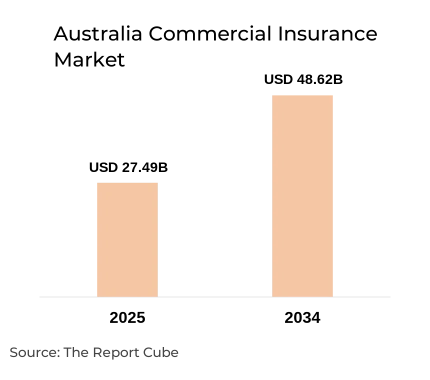
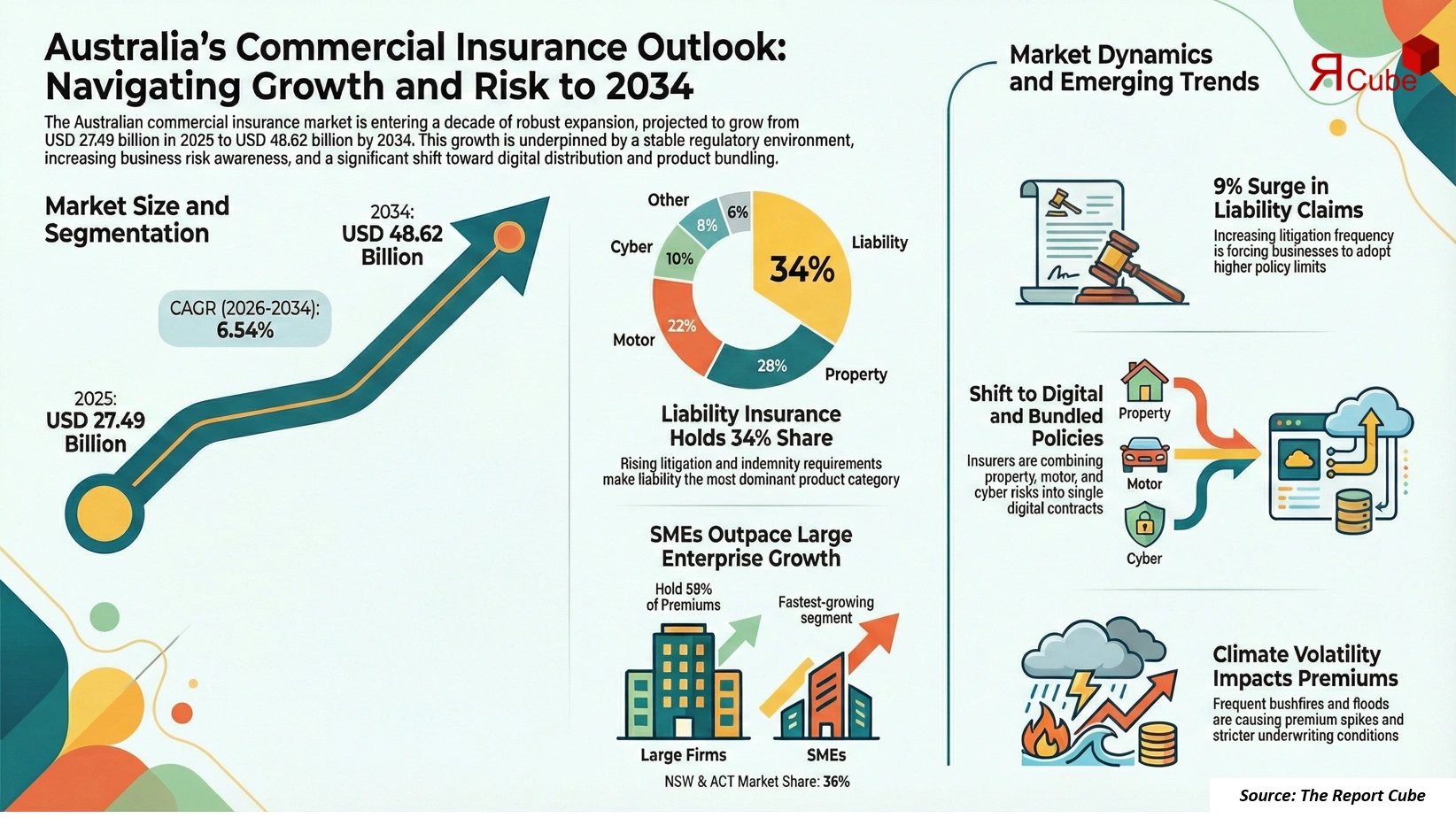
The Australia Commercial Insurance Market is anticipated to register a CAGR of 6.54% during the forecast period. The market size was valued at USD 27.49 billion in 2025 and is projected to reach USD 48.62 billion by 2034. This growth trajectory reflects rising business activity, increasing asset protection needs, and heightened awareness of risk management across Australian enterprises.
The market is structurally supported by Australia’s stable regulatory environment, high insurance penetration, and a diversified commercial base spanning construction, mining, manufacturing, retail, healthcare, and professional services. As businesses expand operations and face more complex risk exposures, demand for tailored commercial insurance solutions continues to strengthen. Liability risks, climate-related property losses, cyber incidents, and supply chain disruptions have collectively pushed enterprises to reassess coverage adequacy and policy scope.
Moreover, insurers are responding by enhancing underwriting models, leveraging data analytics, and offering bundled products that combine property, liability, and specialty coverage. The growing role of brokers and risk advisory firms has further improved policy customization and claims efficiency. Together, these factors position the Australia Commercial Insurance Market for sustained expansion, supported by premium growth, product innovation, and rising enterprise risk awareness through 2034.
Australia Commercial Insurance Market Recent Developments
- 2025: QBE Insurance expanded SME-focused liability and property insurance packages with enhanced climate-risk coverage.
- 2025: Allianz Australia launched digital underwriting tools to accelerate commercial policy issuance and renewals.
Government Initiatives & Policies
- Australian Reinsurance Pool Corporation (Cyclone Re): Government-backed scheme improving affordability of commercial property insurance.
- National Disaster Risk Reduction Framework: Program supporting resilience planning and risk mitigation for businesses.
Australia Commercial Insurance Market Dynamics
Key Driver: Rising Business Risk Exposure and Regulatory Compliance
The primary driver of the Australia Commercial Insurance Market is the steady increase in business risk exposure combined with stricter regulatory compliance requirements. Australian enterprises are facing a broader range of risks, including professional liability claims, workplace safety obligations, environmental liabilities, and cyber threats. Regulatory bodies enforce stringent compliance standards, particularly in construction, financial services, and healthcare sectors, making insurance coverage essential rather than optional. In 2024, commercial liability claims frequency rose by over 9%, highlighting the growing financial impact of litigation and compensation risks. As a result, businesses are increasing policy limits and adopting multi-line insurance programs. This trend directly supports premium growth and strengthens demand across liability, property, and specialty insurance segments.
Book your FREE 30-minute expert consultation today
Contact UsIndustry Trends: Product Bundling and Digital Distribution
A key industry trend shaping the market is the shift toward bundled commercial insurance products and digital distribution channels. Insurers are increasingly offering integrated policies that combine commercial property, liability, motor, and cyber coverage under single contracts, simplifying risk management for businesses. Digital platforms now enable faster quotations, policy issuance, and renewals, particularly benefiting SMEs. Broker-assisted digital distribution is also gaining traction, blending advisory expertise with efficiency. Additionally, insurers are using data-driven pricing models to improve underwriting accuracy and loss ratio performance. These trends enhance customer experience while enabling insurers to manage risk more effectively, supporting long-term market growth.
Major Challenge: Climate-Related Losses and Premium Volatility
Climate-related losses remain a significant challenge for the Australia Commercial Insurance Market. Increasing frequency and severity of floods, bushfires, and cyclones have led to higher claims payouts, particularly in property and marine insurance segments. These losses contribute to premium volatility and stricter underwriting conditions, especially in high-risk regions. Businesses in exposed areas often face rising premiums or coverage limitations, creating affordability concerns. Insurers must balance risk pricing with market competitiveness while maintaining solvency. Although government-backed reinsurance schemes provide partial relief, climate risk continues to pressure profitability and complicate long-term pricing strategies.
Opportunity: Expanding SME Insurance Adoption
The growing number of small and medium-sized enterprises presents a major opportunity for market expansion. SMEs account for over 98% of Australian businesses, many of which remain underinsured. Increasing awareness of liability exposure, business interruption risks, and cyber threats is driving higher insurance adoption among this segment. Insurers are developing simplified, modular products tailored to SME needs, supported by competitive pricing and flexible coverage options. As digital onboarding reduces acquisition costs, insurers can scale SME portfolios efficiently. This expanding customer base offers a stable and diversified revenue stream, strengthening the market outlook through 2034.
Australia Commercial Insurance Market Segment-wise Analysis
By Product Category:
- Liability Insurance
- Commercial Property
- Commercial Motor
- Marine Insurance
- Other Commercial
Liability Insurance leads the product category segment, accounting for approximately 34% of total market share in 2025. This dominance is driven by rising litigation risks, professional indemnity requirements, and employer liability obligations. Commercial Property Insurance follows closely, supported by asset protection needs across construction, retail, and manufacturing sectors. Commercial Motor insurance remains essential for logistics and service-based businesses, while Marine Insurance benefits from Australia’s strong trade and port activity. Other commercial policies, including cyber and business interruption coverage, are expanding rapidly, reflecting evolving enterprise risk profiles.
By Enterprise Size:
- Large Enterprises
- SMEs
Large Enterprises currently dominate the market, holding nearly 58% of total premium share due to higher asset values, complex operations, and mandatory insurance requirements. These organizations typically maintain multi-line coverage with higher policy limits. However, SMEs represent the fastest-growing segment, driven by increasing insurance awareness and tailored product offerings. SME-focused policies emphasize affordability, flexibility, and simplified claims processes. As digital distribution improves accessibility, SME adoption is expected to accelerate, gradually narrowing the gap with large enterprises over the forecast period.
Regional Projection of Australia Commercial Insurance Industry
- New South Wales & ACT
- Victoria & Tasmania
- Queensland
- Northern Territory & South Australia
- Western Australia
New South Wales & ACT lead the Australia Commercial Insurance Market, accounting for approximately 36% of total premiums. The region benefits from high business density, strong financial services activity, and extensive infrastructure assets. Victoria & Tasmania follow, supported by manufacturing and professional services sectors. Queensland’s exposure to climate risks drives higher property insurance demand, while Western Australia benefits from mining and energy-related commercial coverage. Regional diversification ensures balanced growth, with NSW & ACT expected to maintain leadership through 2034.
Need insights for a specific region within this market?
Request Regional DataWhy Choose This Report?
- Provides a comprehensive overview of the overall market analysis, encompassing key trends, consumer behavior analysis, and risk assessment to support strategic decision-making.
- Provides accurate, up-to-date insights into market size, segmentation, and emerging opportunities, helping to minimize risk & capitalizing on growth.
- Gives deep understanding of target audience preferences, investment habits, and communication channels for enhanced product development & marketing effectiveness.
- Delivers competitive analysis & benchmarking, uncovering the strengths & weaknesses of market competitors to guide strategies.
- Consolidate comprehensive market intelligence, reducing reasoning & streamlining research efforts.
- Facilitates customized market segmentation & risk mitigation strategies, fine-tuned to the business objectives.
- Aids in identifying both market challenges & untapped opportunities within the industry to drive long-term business growth.
- Provides valuable information based on actual customer data & search trends.
Table of Contents
- Introduction
- Objective of the Study
- Product and Category Definition
- Market Segmentation
- Study Variables
- Research Methodology
- Secondary Data Points
- Breakdown of Secondary Sources
- Primary Data Points
- Breakdown of Primary Interviews
- Secondary Data Points
- Executive Summary
- Market Dynamics
- Drivers
- Challenges
- Opportunity Assessment
- Recent Trends and Developments
- Regulatory and Policy Landscape
- Australia Commercial Insurance Market Overview (2020-2034)
- Market Size, By Value (USD Billion)
- Market Share, By Product Category
- Liability Insurance
- Commercial Property
- Commercial Motor
- Marine Insurance
- Other Commercial
- Market Share, By Enterprise Size
- Large Enterprises
- SMEs
- Market Share, By Distribution Channel
- Agents and Brokers
- Direct Response
- Other Channels
- Market Share, By Industry Vertical
- Transportation & Logistics
- Construction
- Manufacturing
- Healthcare
- Energy & Utilities
- Other Sectors
- Market Share, By Region
- New South Wales & ACT
- Victoria & Tasmania
- Queensland
- Northern Territory & SA
- Western Australia
- Market Share, By Company
- Competition Characteristics
- Revenue Shares & Analysis
- New South Wales & ACT Commercial Insurance Market
- Market Size, By Value (USD Billion)
- Market Share, By Product Category
- Market Share, By Enterprise Size
- Market Share, By Distribution Channel
- Market Share, By Industry Vertical
- Victoria & Tasmania Commercial Insurance Market
- Market Size, By Value (USD Billion)
- Market Share, By Product Category
- Market Share, By Enterprise Size
- Market Share, By Distribution Channel
- Market Share, By Industry Vertical
- Queensland Commercial Insurance Market
- Market Size, By Value (USD Billion)
- Market Share, By Product Category
- Market Share, By Enterprise Size
- Market Share, By Distribution Channel
- Market Share, By Industry Vertical
- Northern Territory & South Australia Commercial Insurance Market
- Market Size, By Value (USD Billion)
- Market Share, By Product Category
- Market Share, By Enterprise Size
- Market Share, By Distribution Channel
- Market Share, By Industry Vertical
- Western Australia Commercial Insurance Market
- Market Size, By Value (USD Billion)
- Market Share, By Product Category
- Market Share, By Enterprise Size
- Market Share, By Distribution Channel
- Market Share, By Industry Vertical
- Competitive Outlook and Company Profiles
- Suncorp Group
- Company Overview
- Product Portfolio
- Strategic Alliances/Partnerships
- Recent Developments
- Insurance Australia Group
- Company Overview
- Product Portfolio
- Strategic Alliances/Partnerships
- Recent Developments
- QBE Insurance Group
- Company Overview
- Product Portfolio
- Strategic Alliances/Partnerships
- Recent Developments
- Allianz Australia
- Company Overview
- Product Portfolio
- Strategic Alliances/Partnerships
- Recent Developments
- Zurich Australia
- Company Overview
- Product Portfolio
- Strategic Alliances/Partnerships
- Recent Developments
- Chubb Insurance
- Company Overview
- Product Portfolio
- Strategic Alliances/Partnerships
- Recent Developments
- CGU Insurance
- Company Overview
- Product Portfolio
- Strategic Alliances/Partnerships
- Recent Developments
- Vero Insurance
- Company Overview
- Product Portfolio
- Strategic Alliances/Partnerships
- Recent Developments
- AAMI Commercial
- Company Overview
- Product Portfolio
- Strategic Alliances/Partnerships
- Recent Developments
- Marsh McLennan
- Company Overview
- Product Portfolio
- Strategic Alliances/Partnerships
- Recent Developments
- Others
- Suncorp Group
- Contact Us and Disclaimer
Top Key Players & Market Share Outlook
- Suncorp Group
- Insurance Australia Group
- QBE Insurance Group
- Allianz Australia
- Zurich Australia
- Chubb Insurance
- CGU Insurance
- Vero Insurance
- AAMI Commercial
- Marsh McLennan
- Others
Frequently Asked Questions






