



Build Your Custom Market Intelligence Report
Customize Your ReportJapan Adhesives And Sealants Market Insights & Analysis
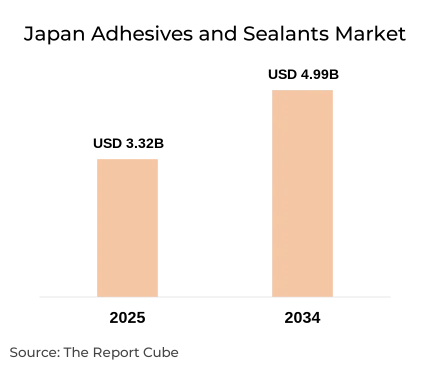
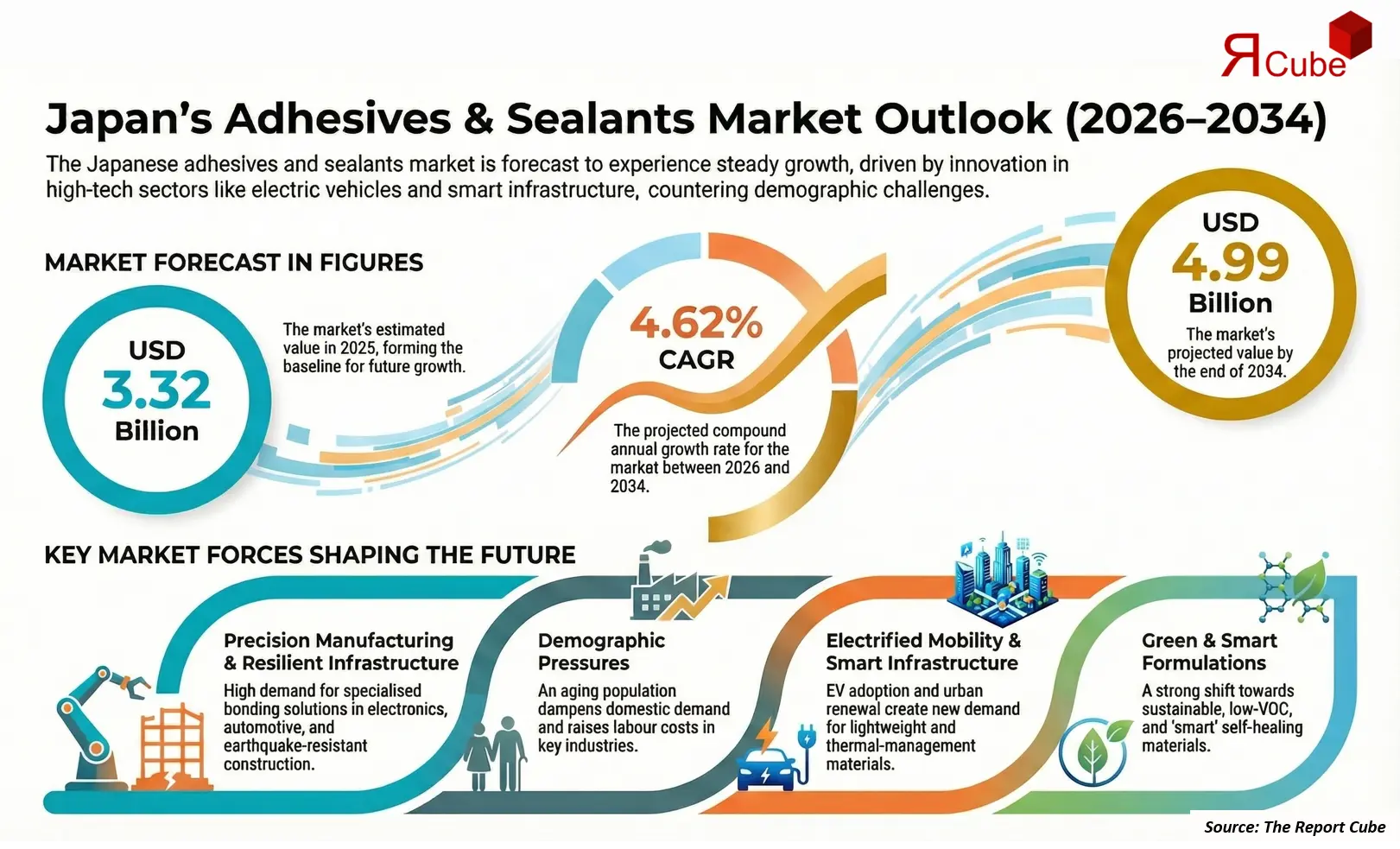
The Japan Adhesives And Sealants Market is anticipated to register a CAGR of 4.62% during 2026-2034. The market size was valued at USD 3.32 billion in 2025 and is projected to reach USD 4.99 billion by 2034. The market is expanding steadily, supported by Japan’s strong manufacturing base, advanced construction standards, and continuous innovation across automotive, electronics, and packaging industries. Adhesives and sealants have become essential materials as manufacturers seek lightweight, durable, and cost-efficient bonding solutions that outperform conventional mechanical fasteners.
Japan’s emphasis on precision engineering and high-performance materials is accelerating the adoption of advanced adhesive technologies. Sectors such as electric vehicles, semiconductor packaging, and renewable energy systems increasingly rely on specialty adhesives for thermal management, vibration resistance, and long-term durability. Additionally, infrastructure refurbishment and earthquake-resistant construction practices are increasing the demand for sealants that enhance structural integrity and flexibility.
Moreover, sustainability considerations are reshaping product portfolios, with manufacturers investing in low-VOC, water-based, and bio-based adhesive formulations. These innovations align with Japan’s environmental regulations and corporate sustainability commitments, positioning the market for stable, innovation-led growth through 2034.
Japan Adhesives And Sealants Market Recent Developments
- 2025: Shin-Etsu Chemical introduced high-performance silicone sealants for next-generation electronics and semiconductor packaging.
- 2025: Mitsubishi Chemical Group expanded its eco-friendly adhesive product line targeting automotive lightweight applications.
Government Initiatives & Policies
- Green Growth Strategy Through Achieving Carbon Neutrality: Promotes low-emission materials and sustainable industrial chemicals.
- Construction Technology Innovation Program: Supports advanced materials improving building resilience and energy efficiency.
Japan Adhesives And Sealants Market Dynamics
Key Driver: Strong Demand from Automotive and Electronics Manufacturing
The robust demand from Japan’s automotive and electronics industries is a primary driver of the adhesives and sealants market. Automotive manufacturers increasingly replace traditional welding and mechanical fasteners with structural adhesives to reduce vehicle weight, improve fuel efficiency, and enhance design flexibility. Adhesives now account for nearly 20% of bonding solutions used in electric vehicle assembly, particularly in battery modules and lightweight composite structures. Similarly, the electronics sector relies heavily on precision adhesives for miniaturized components, circuit protection, and thermal management. Japan’s leadership in advanced electronics manufacturing ensures consistent demand for high-performance adhesive technologies.
Book your FREE 30-minute expert consultation today
Contact UsIndustry Trends: Shift Toward Sustainable and High-Performance Formulations
A major trend shaping the market is the transition toward environmentally friendly and high-performance adhesive systems. Water-based and reactive adhesives are gaining market share as industries aim to reduce volatile organic compound emissions without compromising performance. In 2025, water-based technologies accounted for approximately 34% of total adhesive consumption in Japan. At the same time, manufacturers are developing multifunctional sealants offering heat resistance, chemical stability, and long service life. This trend aligns with Japan’s strict environmental standards and customer expectations for quality and sustainability.
Major Challenge: High Raw Material Costs and Technical Complexity
Volatility in raw material prices presents a significant challenge for the Japan Adhesives And Sealants Market. Key inputs such as resins, specialty chemicals, and silicone derivatives are subject to global supply fluctuations, impacting production costs. Additionally, developing advanced formulations tailored to specific industrial applications requires significant research investment and technical expertise. Smaller manufacturers often struggle to balance innovation costs with competitive pricing, limiting their ability to scale in a highly quality-driven market.
Opportunity: Infrastructure Renewal and Advanced Construction Practices
Japan’s aging infrastructure and focus on disaster-resilient construction create substantial opportunities for adhesive and sealant manufacturers. Sealants used in seismic joints, waterproofing, and structural reinforcement are experiencing rising demand as public and private sectors invest in refurbishment projects. Advanced construction adhesives improve durability and reduce maintenance costs, making them attractive solutions for long-term infrastructure planning. This opportunity is expected to support steady demand growth across multiple regions.
Japan Adhesives And Sealants Market Segment-wise Analysis
By Product Type:
- Water-based
- Solvent-based
- Hot-melt
- Reactive
Water-based adhesives lead the product type segment, holding nearly 34% market share in 2025. Their dominance is driven by low environmental impact, regulatory compliance, and suitability for packaging, woodworking, and construction applications. Reactive adhesives follow closely, supported by their superior bonding strength and resistance properties, particularly in automotive and electronics manufacturing. Solvent-based products are gradually declining due to environmental concerns, while hot-melt adhesives maintain stable demand in packaging and hygiene applications.
By Resin Type:
- Acrylic
- Epoxy
- Polyurethane
- Silicone
Silicone resins dominate the resin type segment, accounting for approximately 31% of total market revenue. Their excellent thermal stability, flexibility, and durability make them indispensable in electronics, construction, and automotive applications. Epoxy adhesives are widely used for structural bonding due to high strength and chemical resistance, while polyurethane resins gain traction for flexible bonding solutions. Acrylics remain popular for general-purpose applications requiring fast curing and strong adhesion.
Regional Projection of Japan Adhesives And Sealants Industry
- Kanto
- Kansai
- Chubu
- Kyushu-Okinawa
The Kanto region leads the Japan Adhesives And Sealants Market, contributing nearly 38% of total revenue in 2025. The region’s dominance is attributed to its concentration of automotive manufacturers, electronics producers, and large-scale construction projects. Tokyo and surrounding prefectures serve as innovation hubs, fostering collaboration between material suppliers and end-use industries. Kansai and Chubu regions also show strong demand, supported by industrial clusters and export-oriented manufacturing activities.
Need insights for a specific region within this market?
Request Regional DataWhy Choose This Report?
- Provides a comprehensive overview of the overall market analysis, encompassing key trends, consumer behavior analysis, and risk assessment to support strategic decision-making.
- Provides accurate, up-to-date insights into market size, segmentation, and emerging opportunities, helping to minimize risk & capitalizing on growth.
- Gives deep understanding of target audience preferences, investment habits, and communication channels for enhanced product development & marketing effectiveness.
- Delivers competitive analysis & benchmarking, uncovering the strengths & weaknesses of market competitors to guide strategies.
- Consolidate comprehensive market intelligence, reducing reasoning & streamlining research efforts.
- Facilitates customized market segmentation & risk mitigation strategies, fine-tuned to the business objectives.
- Aids in identifying both market challenges & untapped opportunities within the industry to drive long-term business growth.
- Provides valuable information based on actual customer data & search trends.
Table of Contents
- Introduction
- Objective of the Study
- Product and Category Definition
- Market Segmentation
- Study Variables
- Research Methodology
- Secondary Data Points
- Breakdown of Secondary Sources
- Primary Data Points
- Breakdown of Primary Interviews
- Secondary Data Points
- Executive Summary
- Market Dynamics
- Drivers
- Challenges
- Opportunity Assessment
- Recent Trends and Developments
- Regulatory and Policy Landscape
- Japan Adhesives and Sealants Market Overview (2020-2034)
- Market Size, By Value (USD Billion)
- Market Share, By Product Type
- Water-based
- Solvent-based
- Hot-melt
- Reactive
- Other Technologies
- Market Share, By Resin Type
- Acrylic
- Epoxy
- Polyurethane
- Silicone
- Other Resins
- Market Share, By End-use
- Automotive
- Electronics
- Building Construction
- Packaging
- Other Industries
- Market Share, By Region
- Kanto
- Kansai
- Chubu
- Tohoku
- Hokkaido
- Chugoku
- Shikoku
- Kyushu-Okinawa Region
- Market Share, By Company
- Market Share, By Company
- Competition Characteristics
- Revenue Shares & Analysis
- Kanto Region Market
- Market Size, By Value (USD Billion)
- Market Share, By Product Type
- Market Share, By Resin Type
- Market Share, By End-use
- Kansai Region Market
- Market Size, By Value (USD Billion)
- Market Share, By Product Type
- Market Share, By Resin Type
- Market Share, By End-use
- Chubu Region Market
- Market Size, By Value (USD Billion)
- Market Share, By Product Type
- Market Share, By Resin Type
- Market Share, By End-use
- Tohoku Region Market
- Market Size, By Value (USD Billion)
- Market Share, By Product Type
- Market Share, By Resin Type
- Market Share, By End-use
- Hokkaido Region Market
- Market Size, By Value (USD Billion)
- Market Share, By Product Type
- Market Share, By Resin Type
- Market Share, By End-use
- Chugoku Region Market
- Market Size, By Value (USD Billion)
- Market Share, By Product Type
- Market Share, By Resin Type
- Market Share, By End-use
- Shikoku Region Market
- Market Size, By Value (USD Billion)
- Market Share, By Product Type
- Market Share, By Resin Type
- Market Share, By End-use
- Kyushu-Okinawa Region Market
- Market Size, By Value (USD Billion)
- Market Share, By Product Type
- Market Share, By Resin Type
- Market Share, By End-use
- Competitive Outlook and Company Profiles
- Henkel AG & Co. KGaA
- Company Overview
- Product Portfolio
- Strategic Alliances/Partnerships
- Recent Developments
- 3M Company
- Company Overview
- Product Portfolio
- Strategic Alliances/Partnerships
- Recent Developments
- Sika AG
- Company Overview
- Product Portfolio
- Strategic Alliances/Partnerships
- Recent Developments
- H.B. Fuller Company
- Company Overview
- Product Portfolio
- Strategic Alliances/Partnerships
- Recent Developments
- Bostik (Arkema Group)
- Company Overview
- Product Portfolio
- Strategic Alliances/Partnerships
- Recent Developments
- Dow Inc.
- Company Overview
- Product Portfolio
- Strategic Alliances/Partnerships
- Recent Developments
- Mitsubishi Chemical Group
- Company Overview
- Product Portfolio
- Strategic Alliances/Partnerships
- Recent Developments
- Toyochem Co., Ltd.
- Company Overview
- Product Portfolio
- Strategic Alliances/Partnerships
- Recent Developments
- Shin-Etsu Chemical Co.
- Company Overview
- Product Portfolio
- Strategic Alliances/Partnerships
- Recent Developments
- ThreeBond Holdings Co.
- Company Overview
- Product Portfolio
- Strategic Alliances/Partnerships
- Recent Developments
- Others
- Henkel AG & Co. KGaA
- Contact Us and Disclaimer
Top Key Players & Market Share Outlook
- Henkel AG & Co. KGaA
- 3M Company
- Sika AG
- H.B. Fuller Company
- Bostik (Arkema Group)
- Dow Inc.
- Mitsubishi Chemical Group
- Toyochem Co., Ltd.
- Shin-Etsu Chemical Co.
- ThreeBond Holdings Co.
- Others
Frequently Asked Questions






