



Build Your Custom Market Intelligence Report
Customize Your ReportIran Agribusiness Market Insights & Analysis
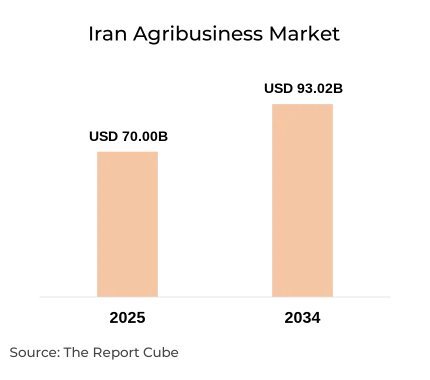
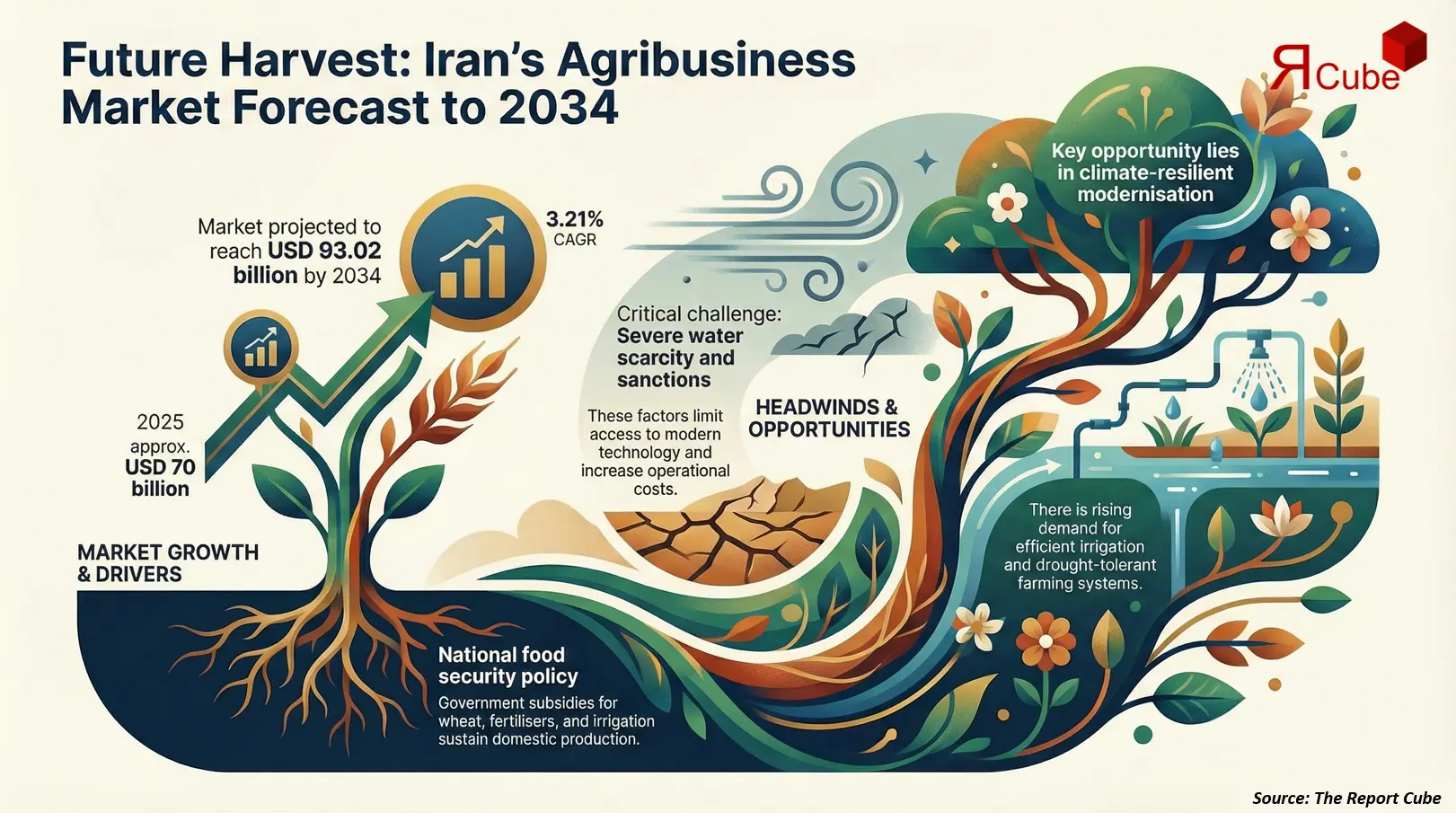
The Iran Agribusiness Market is anticipated to register a CAGR of 3.21% during 2026-2034. The market size was valued at USD 70 billion in 2025 and is projected to reach USD 93.02 billion by 2034. Agribusiness remains one of Iran’s most strategically important economic sectors, supported by diverse climatic zones, a large rural workforce, and strong domestic food demand. The sector plays a critical role in national food security, employment generation, and non-oil economic diversification.
Market growth is being shaped by rising population demand, increasing urbanization, and gradual modernization of agricultural practices. Crop production, livestock, and food processing collectively form the backbone of Iran’s agribusiness ecosystem, with strong linkages across upstream inputs and downstream distribution. Despite macroeconomic constraints, domestic production continues to expand to reduce import dependency, particularly for staple foods, dairy, and horticulture produce.
In parallel, government-backed self-sufficiency programs and investments in irrigation, mechanization, and agro-processing infrastructure are strengthening value chain integration. As consumer preferences shift toward packaged, branded, and higher-quality food products, agribusiness companies are focusing on efficiency, scale, and product diversification. These interconnected drivers are expected to sustain stable long-term growth for Iran’s agribusiness industry through 2034.
Iran Agribusiness Market Recent Developments
- 2025: Kalleh Dairy expanded its domestic processing capacity to support rising demand for packaged dairy products.
- 2025: Golestan Company introduced new value-added grain and rice product lines targeting urban consumers.
Government Initiatives & Policies
- National Food Security Plan: Focuses on increasing domestic crop yields and livestock productivity.
- Agricultural Mechanization Development Program: Promotes adoption of modern machinery and irrigation systems.
Iran Agribusiness Market Dynamics
Key Driver: Strong Domestic Food Demand and Population Growth
Rising domestic food consumption driven by population growth and urban expansion is a primary driver of the Iran Agribusiness Market. Iran’s population exceeds 88 million, with food demand increasing steadily across grains, dairy, meat, and processed products. Urban households are consuming more packaged and branded foods, encouraging agribusiness firms to expand production and improve quality standards. Additionally, dietary diversification and rising protein intake are boosting livestock, poultry, and dairy segments. These demand-side fundamentals provide long-term stability for agribusiness producers, even amid external economic pressures.
Book your FREE 30-minute expert consultation today
Contact UsIndustry Trends: Vertical Integration and Expansion of Food Processing
A major trend shaping the market is the increasing vertical integration across the agribusiness value chain. Large players are investing simultaneously in farming, processing, packaging, and distribution to control costs and ensure supply continuity. Food processing is gaining prominence, accounting for a growing share of agribusiness revenues as consumers favor ready-to-eat and longer-shelf-life products. Advances in cold storage, milling, and dairy processing are improving efficiency and reducing post-harvest losses. This trend is gradually transforming Iran’s agribusiness from volume-driven production to value-driven growth.
Major Challenge: Water Scarcity and Resource Constraints
Water scarcity remains one of the most significant challenges facing Iran’s agribusiness sector. Irregular rainfall patterns, declining groundwater levels, and inefficient irrigation systems limit productivity, particularly in crop and horticulture segments. Rising input costs, including fertilizers and animal feed, further pressure farm-level profitability. These constraints disproportionately affect small and medium farmers, creating productivity gaps across regions. Addressing resource efficiency is essential for sustaining long-term growth and ensuring resilience within the agribusiness ecosystem.
Opportunity: Modernization of Agricultural Inputs and Machinery
The gradual modernization of agricultural inputs and machinery presents a strong opportunity for the Iran Agribusiness Market. Adoption of improved seeds, precision irrigation, and mechanized harvesting can significantly enhance yields and reduce labor dependency. Government-backed financing programs and domestic manufacturing of agri-machinery are improving accessibility for farmers. As productivity improves, downstream segments such as food processing and distribution benefit from more consistent raw material supply, creating a positive ripple effect across the value chain.
Iran Agribusiness Market Segment-wise Analysis
By Type:
- Crop Production
- Livestock & Poultry
- Dairy Products
- Food Processing
Crop production remains the leading segment, accounting for approximately 34% of the Iran Agribusiness Market in 2025. Staple crops such as wheat, barley, and rice dominate agricultural output due to their strategic importance in food security policies. Government procurement programs and guaranteed pricing mechanisms continue to support farmers. Livestock and dairy products follow closely, driven by rising protein consumption and strong domestic brands. Food processing is emerging as a high-growth segment, benefiting from urbanization and evolving consumer lifestyles.
By Value Chain:
- Upstream Inputs
- On-Farm Production
- Processing & Milling
- Distribution & Trade
On-farm production represents the largest share of the value chain, contributing nearly 40% of total market value. This dominance reflects Iran’s extensive agricultural land use and labor-intensive farming practices. However, processing and milling are gaining share as investments in domestic food manufacturing increase. Improved logistics and regional distribution networks are enhancing market reach, while retail and foodservice channels are gradually expanding demand for branded agricultural products.
Regional Projection of Iran Agribusiness Industry
- North
- West
- Central Belt
- South
- East
The Central Belt leads the Iran Agribusiness Market, accounting for approximately 37% of total market value in 2025. This region benefits from concentrated farming activity, better infrastructure, and proximity to major consumption centers. Large-scale crop cultivation, food processing facilities, and distribution hubs are primarily located here, supporting efficient supply chains. While the Central Belt dominates, the North region is witnessing faster growth due to favorable climate conditions for horticulture and high-value crops.
Need insights for a specific region within this market?
Request Regional DataWhy Choose This Report?
- Provides a comprehensive overview of the overall market analysis, encompassing key trends, consumer behavior analysis, and risk assessment to support strategic decision-making.
- Provides accurate, up-to-date insights into market size, segmentation, and emerging opportunities, helping to minimize risk & capitalizing on growth.
- Gives deep understanding of target audience preferences, investment habits, and communication channels for enhanced product development & marketing effectiveness.
- Delivers competitive analysis & benchmarking, uncovering the strengths & weaknesses of market competitors to guide strategies.
- Consolidate comprehensive market intelligence, reducing reasoning & streamlining research efforts.
- Facilitates customized market segmentation & risk mitigation strategies, fine-tuned to the business objectives.
- Aids in identifying both market challenges & untapped opportunities within the industry to drive long-term business growth.
- Provides valuable information based on actual customer data & search trends.
Table of Contents
- Introduction
- Objective of the Study
- Market and Category Definition
- Market Segmentation
- Study Variables and Assumptions
- Research Methodology
- Secondary Data Points
- Breakdown of Secondary Sources
- Primary Data Points
- Breakdown of Primary Interviews
- Secondary Data Points
- Executive Summary
- Market Dynamics
- Drivers
- Challenges
- Opportunity Assessment
- Recent Trends and Developments
- Regulatory and Policy Landscape
- Iran Agribusiness Market Overview (2020-2034)
- Market Size, By Value (USD Billion)
- Market Share, By Type
- Crop Production
- Livestock & Poultry
- Dairy Products
- Horticulture Produce
- Agricultural Inputs
- Agri Machinery
- Food Processing
- Market Share, By Value Chain
- Upstream Inputs
- On‑Farm Production
- Processing & Milling
- Distribution & Trade
- Retail & Foodservice
- Market Share, By Farm Type
- Smallholder Farms
- Medium Farms
- Large Agribusinesses
- Market Share, By Region
- North
- West
- Central Belt
- South
- East
- Market Share, By Company
- Competition Characteristics
- Revenue Shares & Analysis
- Regional Analysis - Iran Agribusiness (Geography Only)
- North Provinces Agribusiness
- Market Size, By Value (USD Billion)
- Key Crop and Livestock Mix
- Irrigation and Water Resources
- West Provinces Agribusiness
- Market Size, By Value (USD Billion)
- Key Crop and Livestock Mix
- Cross‑Border Trade Links
- Central Belt Agribusiness
- Market Size, By Value (USD Billion)
- Grain and Industrial Crops
- Greenhouse and High‑Tech Farms
- South Provinces Agribusiness
- Market Size, By Value (USD Billion)
- Horticulture and Export Crops
- Port‑Led Export Logistics
- East Provinces Agribusiness
- Market Size, By Value (USD Billion)
- Dryland and Rangeland Systems
- Water‑Saving Technologies
- North Provinces Agribusiness
- Segment Deep‑Dive - Iran Agribusiness
- Crop Production
- Area and Yield Trends
- Key Cereals and Oilseeds
- Import Substitution Dynamics
- Livestock & Poultry
- Herd and Flock Structure
- Meat and Egg Output
- Feed and Input Dependencies
- Dairy Products
- Milk Production Trends
- Processing Capacity
- Domestic Demand Outlook
- Horticulture Produce
- Fruit and Vegetable Output
- Export Market Access
- Post‑Harvest Infrastructure
- Agricultural Inputs
- Seeds and Planting Material
- Fertilizers and Crop Protection
- On‑Farm Services
- Agri Machinery
- Mechanization Levels
- Domestic vs Imported Equipment
- Financing and Leasing Models
- Food Processing
- Grain and Oilseed Processing
- Fruit and Vegetable Processing
- Cold Chain and Logistics
- Crop Production
- Competitive Outlook and Company Profiles
- Sinagen Agro
- Company Overview
- Business Segments
- Strategic Initiatives
- Recent Developments
- Golestan Company
- Company Overview
- Business Segments
- Strategic Initiatives
- Recent Developments
- Kalleh Dairy
- Company Overview
- Business Segments
- Strategic Initiatives
- Recent Developments
- Mihan Dairy
- Company Overview
- Business Segments
- Strategic Initiatives
- Recent Developments
- Zarin Group
- Company Overview
- Business Segments
- Strategic Initiatives
- Recent Developments
- Behshahr Agro
- Company Overview
- Business Segments
- Strategic Initiatives
- Recent Developments
- Rojin Food
- Company Overview
- Business Segments
- Strategic Initiatives
- Recent Developments
- Sabzvaran Agro
- Company Overview
- Business Segments
- Strategic Initiatives
- Recent Developments
- Ghadir Agriculture
- Company Overview
- Business Segments
- Strategic Initiatives
- Recent Developments
- Iran Pegah
- Company Overview
- Business Segments
- Strategic Initiatives
- Recent Developments
- Others
- Sinagen Agro
- Contact Us and Disclaimer
Top Key Players & Market Share Outlook
- Sinagen Agro
- Golestan Company
- Kalleh Dairy
- Mihan Dairy
- Zarin Group
- Behshahr Agro
- Rojin Food
- Sabzvaran Agro
- Ghadir Agriculture
- Iran Pegah
- Others
Frequently Asked Questions






