




Build Your Custom Market Intelligence Report
Customize Your ReportGermany Greenhouse Horticulture Market Insights & Analysis
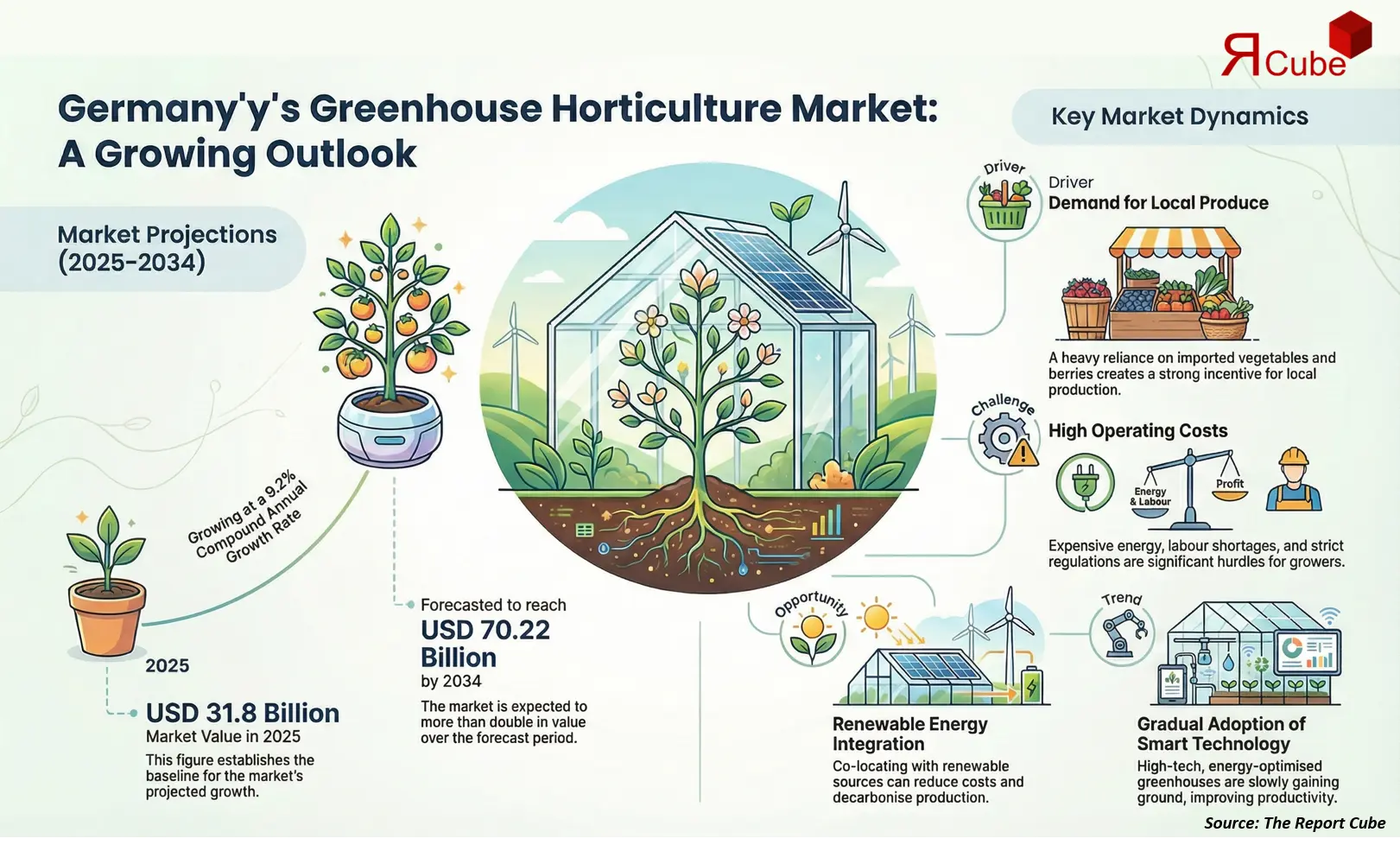
The Germany Greenhouse Horticulture Market is anticipated to register a CAGR of 9.20% during 2026-2034. The market size was valued at USD 31.8 billion in 2025 and is projected to reach USD 70.22 billion by 2034. Germany represents one of Europe’s most technologically advanced greenhouse horticulture ecosystems, supported by strong demand for year-round fresh produce, high food quality standards, and a growing focus on climate-resilient agriculture. Greenhouse cultivation has transitioned from a supplementary farming method into a core pillar of domestic food production, particularly for vegetables, ornamentals, and high-value specialty crops.
This market expansion is closely linked with Germany’s push toward sustainable agriculture and reduced reliance on imports. Controlled-environment agriculture allows growers to optimize yields while minimizing water usage, pesticide dependency, and land constraints. Advanced climate control systems, precision irrigation, and automated monitoring are becoming standard across new greenhouse installations. These developments are improving productivity per square meter, enabling growers to offset rising energy and labor costs while meeting stringent environmental regulations.
Furthermore, the increasing adoption of renewable energy integration, including biomass heating and solar-assisted greenhouse systems, is strengthening long-term market viability. As consumer preferences shift toward locally produced, traceable, and pesticide-residue-free food, greenhouse horticulture is emerging as a strategic solution. Collectively, these factors underpin strong investment momentum and position Germany as a key innovation hub within the European greenhouse horticulture landscape through 2034.
Germany Greenhouse Horticulture Market Recent Developments
- 2025: AgriTech Solutions deployed AI-driven climate optimization systems in multiple German commercial greenhouses.
- 2025: GreenGlass Innovations expanded high-efficiency glasshouse projects across southern Germany.
Government Initiatives & Policies
- Federal Climate-Smart Agriculture Program: Supports energy-efficient greenhouse investments and renewable heating adoption.
- Germany National Sustainability Strategy: Promotes resource-efficient food production and reduced agricultural emissions.
Germany Greenhouse Horticulture Market Dynamics
Key Driver: Rising Demand for Year-Round Local Produce
The growing consumer preference for year-round availability of locally produced fruits and vegetables is a major driver of the Germany Greenhouse Horticulture Market. German consumers increasingly value freshness, food safety, and reduced carbon footprints, prompting retailers to source produce domestically rather than rely on imports. Greenhouse horticulture enables consistent production regardless of seasonal limitations, ensuring stable supply chains for tomatoes, cucumbers, peppers, and leafy greens. Nearly 65% of fresh vegetables sold in major German supermarkets are now sourced from domestic or neighboring greenhouse producers, reflecting this structural shift. This demand stability provides growers with predictable revenues, encouraging continued capital investment in modern greenhouse infrastructure.
Book your FREE 30-minute expert consultation today
Contact UsIndustry Trends: Automation and Digital Greenhouse Management
Automation and digitalization are transforming operational efficiency across Germany’s greenhouse horticulture sector. Growers are increasingly deploying sensor-based climate monitoring, automated irrigation, and data-driven crop management platforms to optimize yields. Smart greenhouse systems can reduce water usage by up to 30% while improving crop uniformity and reducing labor dependency. Integration of artificial intelligence for predictive climate adjustments and disease detection is becoming more common, particularly among large-scale commercial operators. This trend aligns with Germany’s broader Industry 4.0 framework, positioning greenhouse horticulture as a technologically advanced and scalable agricultural model.
Major Challenge: High Energy and Capital Investment Costs
Despite strong growth prospects, high energy prices and significant upfront capital requirements present a major challenge for market participants. Greenhouses, particularly glass structures with advanced climate control, require substantial investment and ongoing energy inputs for heating and lighting. Energy costs can account for over 35% of total operational expenses in northern regions during winter months. Although renewable energy integration is increasing, initial installation costs remain a barrier for small and mid-sized growers. These financial pressures can slow expansion and limit market entry for new participants.
Opportunity: Expansion of Sustainable and Low-Carbon Greenhouse Solutions
The transition toward low-carbon and sustainable greenhouse solutions represents a significant opportunity within the Germany Greenhouse Horticulture Market. Government incentives and retailer sustainability commitments are encouraging adoption of energy-efficient materials, closed-loop water systems, and renewable heating technologies. Greenhouses utilizing combined heat and power systems or geothermal energy can reduce emissions by up to 40% compared to conventional models. As sustainability becomes a key procurement criterion for retailers, growers investing in green technologies are well-positioned to secure long-term supply contracts and premium pricing.
Germany Greenhouse Horticulture Market Segment-wise Analysis
By Material Type:
- Glass Structures
- Plastic Structures
- Polycarbonate Panels
- Other Materials
Glass structures dominate the Germany Greenhouse Horticulture Market by material type, accounting for approximately 48% of total installations in 2025. Their superior light transmission, durability, and compatibility with advanced climate systems make them the preferred choice for high-value crops. Glass greenhouses are particularly prevalent in large-scale vegetable production clusters in western and southern Germany. While plastic and polycarbonate structures offer cost advantages, glass remains the leading segment due to its long-term productivity and suitability for automation-intensive operations.
By Crop Type:
- Fruits & Vegetables
- Flowers & Ornamentals
- Nursery Crops
- Other Crops
Fruits and vegetables represent the leading crop segment, contributing nearly 55% of total greenhouse horticulture revenue in Germany. Tomatoes, cucumbers, and peppers account for the largest share due to strong domestic consumption and retail demand. This segment benefits from continuous production cycles and premium pricing for locally grown produce. Flowers and ornamentals remain significant, particularly in southern regions, but food crops are increasingly prioritized as part of Germany’s food security and sustainability objectives.
Regional Projection of Germany Greenhouse Horticulture Industry
- North
- South
- East
- West
The western region leads the Germany Greenhouse Horticulture Market, holding approximately 36% of total market share in 2025. This dominance is driven by favorable logistics, proximity to major retail distribution centers, and a high concentration of technologically advanced greenhouse facilities. Regions such as North Rhine-Westphalia benefit from established horticultural expertise and strong infrastructure. While the west remains the market leader, southern Germany is witnessing faster growth due to increasing investments in energy-efficient greenhouse projects and specialty crop production.
Need insights for a specific region within this market?
Request Regional DataWhy Choose This Report?
- Provides a comprehensive overview of the overall market analysis, encompassing key trends, consumer behavior analysis, and risk assessment to support strategic decision-making.
- Provides accurate, up-to-date insights into market size, segmentation, and emerging opportunities, helping to minimize risk & capitalizing on growth.
- Gives deep understanding of target audience preferences, investment habits, and communication channels for enhanced product development & marketing effectiveness.
- Delivers competitive analysis & benchmarking, uncovering the strengths & weaknesses of market competitors to guide strategies.
- Consolidate comprehensive market intelligence, reducing reasoning & streamlining research efforts.
- Facilitates customized market segmentation & risk mitigation strategies, fine-tuned to the business objectives.
- Aids in identifying both market challenges & untapped opportunities within the industry to drive long-term business growth.
- Provides valuable information based on actual customer data & search trends.
Table of Contents
- Introduction
- Objective of the Study
- Product and Category Definition
- Market Segmentation
- Study Variables
- Research Methodology
- Secondary Data Points
- Breakdown of Secondary Sources
- Primary Data Points
- Breakdown of Primary Interviews
- Secondary Data Points
- Executive Summary
- Market Dynamics
- Drivers
- Challenges
- Opportunity Assessment
- Recent Trends and Developments
- Regulatory and Policy Landscape
- Germany Greenhouse Horticulture Market Overview (2020-2034)
- Market Size, By Value (USD Million)
- Market Share, By Material Type
- Glass Structures
- Plastic Structures
- Polycarbonate Panels
- Other Materials
- Market Share, By Crop Type
- Fruits & Vegetables
- Flowers & Ornamentals
- Nursery Crops
- Other Crops
- Market Share, By Technology
- Low-Tech Systems
- Medium-Tech Systems
- High-Tech Systems
- Market Share, By Application
- Commercial Production
- Research & Trials
- Urban Farming
- Hobby & Smallholders
- Market Share, By Region
- North
- South
- East
- West
- Market Share, By Company
- Competition Characteristics
- Revenue Shares & Analysis
- East Germany Greenhouse Horticulture Market
- Market Size, By Value (USD Million)
- Market Share, By Material Type
- Market Share, By Crop Type
- Market Share, By Technology
- Market Share, By Application
- West Germany Greenhouse Horticulture Market
- Market Size, By Value (USD Million)
- Market Share, By Material Type
- Market Share, By Crop Type
- Market Share, By Technology
- Market Share, By Application
- North Germany Greenhouse Horticulture Market
- Market Size, By Value (USD Million)
- Market Share, By Material Type
- Market Share, By Crop Type
- Market Share, By Technology
- Market Share, By Application
- South Germany Greenhouse Horticulture Market
- Market Size, By Value (USD Million)
- Market Share, By Material Type
- Market Share, By Crop Type
- Market Share, By Technology
- Market Share, By Application
- Competitive Outlook and Company Profiles
- Certhon B.V.
- Company Overview
- Product Portfolio
- Strategic Alliances/Partnerships
- Recent Developments
- Dalsem B.V.
- Company Overview
- Product Portfolio
- Strategic Alliances/Partnerships
- Recent Developments
- Hoogendoorn Growth Management
- Company Overview
- Product Portfolio
- Strategic Alliances/Partnerships
- Recent Developments
- Priva Group
- Company Overview
- Product Portfolio
- Strategic Alliances/Partnerships
- Recent Developments
- Richel Group
- Company Overview
- Product Portfolio
- Strategic Alliances/Partnerships
- Recent Developments
- Van der Hoeven
- Company Overview
- Product Portfolio
- Strategic Alliances/Partnerships
- Recent Developments
- Logiqs B.V.
- Company Overview
- Product Portfolio
- Strategic Alliances/Partnerships
- Recent Developments
- Netafim (Orbia)
- Company Overview
- Product Portfolio
- Strategic Alliances/Partnerships
- Recent Developments
- Gakon Horticultural Projects
- Company Overview
- Product Portfolio
- Strategic Alliances/Partnerships
- Recent Developments
- Hoogsteder Horticulture
- Company Overview
- Product Portfolio
- Strategic Alliances/Partnerships
- Recent Developments
- Others
- Certhon B.V.
- Contact Us and Disclaimer
Top Key Players & Market Share Outlook
- Certhon B.V.
- Dalsem B.V.
- Hoogendoorn Growth Management
- Priva Group
- Richel Group
- Van der Hoeven
- Logiqs B.V.
- Netafim (Orbia)
- Gakon Horticultural Projects
- Hoogsteder Horticulture
- Others
Frequently Asked Questions