



Build Your Custom Market Intelligence Report
Customize Your ReportGermany Smart Grid Systems Market Key Highlights
By Solution:
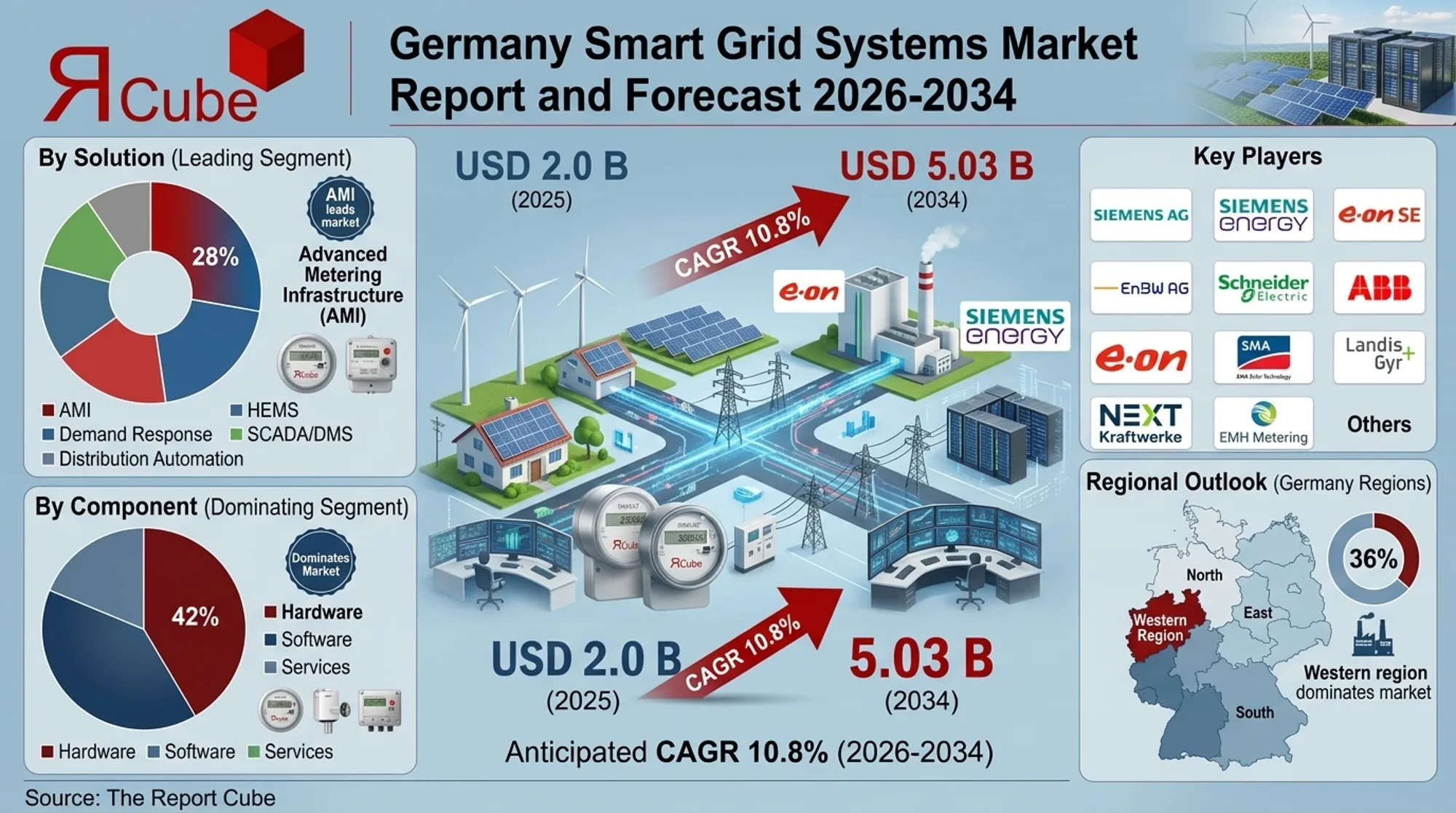
Advanced Metering Infrastructure (AMI) segment leads the market, with around 28% share.
By Component:
Hardware segment dominates the market, accounting for nearly 42% of total revenue.
Regional Outlook:
Western region dominates the Germany smart grid systems market, with around 36% share.
Germany Smart Grid Systems Market Insights & Analysis
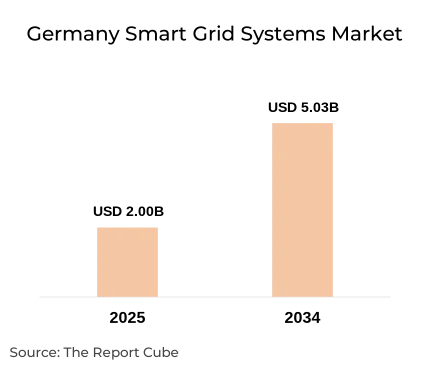
The Germany Smart Grid Systems Market is anticipated to register a CAGR of around CAGR of 10.8% during the forecast period 2026-2034. The market size was valued at USD 2.0 billion in 2025 and is projected to reach USD 5.03 billion by 2034. Germany continues to lead Europe’s energy transition, with smart grids becoming the backbone of its decentralized energy model. Rising renewable penetration, accounting for over 52% of electricity generation in 2025, has intensified the need for intelligent grid balancing and digital infrastructure.
Investment momentum remains strong, with grid operators allocating over €12 billion between 2024 and 2026 toward smart grid modernization and automation. Programs like “Energiewende” have accelerated digital substations and advanced metering deployments, especially across urban-industrial hubs. The integration of EV charging infrastructure and distributed energy resources is further pushing demand, as over 2.5 million EVs were registered in Germany by early 2025, requiring dynamic load balancing and real-time grid communication.
Germany Smart Grid Systems Market Dynamics
Key Driver: Rapid Renewable Energy Integration Creating Grid Complexity
Germany’s aggressive renewable expansion, wind and solar alone contributing nearly 45% of total electricity, has transformed grid operations into a dynamic, multi-directional system. Traditional grids were designed for centralized generation, but today’s decentralized energy ecosystem requires real-time monitoring, predictive analytics, and automation. This shift is driving widespread adoption of smart grid systems, particularly DERMS and advanced metering solutions.
Additionally, the variability of renewable energy introduces frequent imbalances in supply and demand. Smart grids enable automated load management and energy forecasting, helping utilities maintain stability. For instance, utilities using AI-driven grid solutions have reported up to 18% improvement in load balancing efficiency, making smart infrastructure essential rather than optional.
Book your FREE 30-minute expert consultation today
Contact UsIndustry Trends: Integration of AI, IoT, and EV Infrastructure Reshaping Grid Intelligence
The convergence of AI and IoT technologies is redefining smart grid capabilities in Germany. Utilities are deploying intelligent sensors and predictive analytics platforms to monitor grid health and anticipate outages. These systems can detect anomalies within milliseconds, reducing downtime and improving operational efficiency.
Simultaneously, EV charging infrastructure is becoming deeply integrated with grid systems. Smart charging solutions, which adjust charging times based on grid load, are gaining traction. By 2025, over 35% of public charging stations in Germany were connected to smart grid platforms, allowing utilities to optimize energy distribution while reducing peak load stress.
Major Challenge: High Infrastructure Upgrade Costs and Legacy Grid Integration
One of the most pressing challenges in the Germany smart grid systems market is the significant capital required for upgrading legacy infrastructure. Many parts of Germany’s grid were built decades ago and lack compatibility with modern digital technologies. Retrofitting these systems involves high costs, complex engineering, and extended deployment timelines.
Moreover, integrating new technologies with existing grid frameworks can create interoperability issues. Utilities often face delays due to regulatory approvals and technical constraints. Reports suggest that nearly 30% of planned smart grid projects in Germany experienced timeline extensions due to integration complexities, impacting overall market growth.
Opportunity: Expansion of Distributed Energy Resources and Digital Energy Platforms
The rapid rise of distributed energy resources such as rooftop solar, battery storage, and microgrids presents a significant opportunity for smart grid adoption. These decentralized systems require advanced coordination, which smart grids are uniquely positioned to provide.
Furthermore, digital energy platforms are emerging as a new growth avenue. Platforms enabling peer-to-peer energy trading and real-time consumption insights are gaining popularity among residential and commercial users. With over 1.7 million residential solar installations in Germany by 2025, the demand for intelligent energy management systems is expected to surge.
Germany Smart Grid Systems Market Segment-wise Analysis
By Solution:
- Advanced Metering Infrastructure (AMI)
- Substation Automation Systems
- Distribution Management Systems
- Demand Response Systems
- Outage Management Systems
- Energy Storage Integration
- Distributed Energy Resource Management Systems (DERMS)
- Electric Vehicle Charging Infrastructure
- Others
Advanced Metering Infrastructure (AMI) holds the leading position with approximately 28% market share in 2025, driven by Germany’s nationwide smart meter rollout initiatives. AMI enables real-time data collection, enhancing billing accuracy and energy efficiency. By 2025, over 35 million smart meters were planned for deployment under regulatory mandates, significantly boosting this segment.
Utilities benefit from AMI through improved demand response capabilities and reduced operational costs. Consumers, on the other hand, gain better visibility into energy consumption patterns. Studies indicate that households using smart meters reduced electricity usage by up to 12%, reinforcing the segment’s dominance and long-term growth potential.
By Component:
- Hardware
- Software
- Services
The hardware segment dominates with around 42% share, supported by extensive investments in physical infrastructure such as smart meters, sensors, and communication devices. Grid modernization projects across Germany require large-scale hardware deployment, making this segment a primary revenue contributor.
At the same time, hardware advancements like edge computing-enabled devices are improving data processing at the source. This reduces latency and enhances grid responsiveness. With increasing demand for resilient and adaptive grid systems, hardware remains the foundation of smart grid expansion in Germany.
Regional Projection of Germany Smart Grid Systems Industry
- Western
- Northern
- Eastern
- Southern
- Others
The Western region leads the Germany smart grid systems market with nearly 36% share, driven by high industrial density and advanced infrastructure. Cities like North Rhine-Westphalia serve as energy consumption hubs, requiring sophisticated grid management systems to balance demand and supply efficiently.
Additionally, the presence of major utilities and technology providers accelerates innovation and deployment in this region. Investments in smart substations and EV infrastructure are particularly strong, with over 40% of Germany’s pilot smart grid projects concentrated in Western areas, making it a key growth engine for the market.
Government Initiatives & Policies
- Germany Digitalization of the Energy Transition Act (Updated 2025): Focuses on nationwide rollout of smart meters and grid digitalization to enhance energy efficiency and real-time monitoring.
- EU Green Deal & REPowerEU Plan (2025 Update): Strengthens smart grid investments, renewable integration, and cross-border electricity infrastructure in Germany.
Germany Smart Grid Systems Market Recent Developments
- 2025: Siemens AG partnered with DB Energie to deploy Spectrum Power 7 grid control software across 16,000 km of traction power network, significantly enhancing real-time monitoring, operational efficiency, and smart grid reliability.
- 2025: SMA Solar Technology introduced advanced energy management solutions at Intersolar Europe, enabling intelligent battery scheduling and dynamic tariff optimization for renewable energy users across Germany.
Need insights for a specific region within this market?
Request Regional DataWhy Choose This Report?
- Provides a comprehensive overview of the overall market analysis, encompassing key trends, consumer behavior analysis, and risk assessment to support strategic decision-making.
- Provides accurate, up-to-date insights into market size, segmentation, and emerging opportunities, helping to minimize risk & capitalizing on growth.
- Gives deep understanding of target audience preferences, investment habits, and communication channels for enhanced product development & marketing effectiveness.
- Delivers competitive analysis & benchmarking, uncovering the strengths & weaknesses of market competitors to guide strategies.
- Consolidate comprehensive market intelligence, reducing reasoning & streamlining research efforts.
- Facilitates customized market segmentation & risk mitigation strategies, fine-tuned to the business objectives.
- Aids in identifying both market challenges & untapped opportunities within the industry to drive long-term business growth.
- Provides valuable information based on actual customer data & search trends.
Table of Contents
- Introduction
- Objective of the Study
- Product and Category Definition
- Market Segmentation
- Study Variables
- Research Methodology
- Secondary Data Points
- Breakdown of Secondary Sources
- Primary Data Points
- Breakdown of Primary Interviews
- Secondary Data Points
- Executive Summary
- Market Dynamics
- Drivers
- Challenges
- Opportunity Assessment
- Recent Trends and Developments
- Regulatory and Policy Landscape
- Germany Smart Grid Systems Market Overview (2021-2034)
- Market Size, By Value (USD Billion)
- Market Share, By Solution
- Advanced Metering Infrastructure (AMI)
- Substation Automation Systems
- Distribution Management Systems
- Demand Response Systems
- Outage Management Systems
- Energy Storage Integration
- Distributed Energy Resource Management Systems (DERMS)
- Electric Vehicle Charging Infrastructure
- Others
- Market Share, By Component
- Hardware
- Software
- Services
- Market Share, By Communication Technology
- Power Line Communication
- Fiber Optic Communication
- Wireless Communication
- Others
- Market Share, By End User
- Residential
- Commercial
- Industrial
- Utility
- Others
- Market Share, By Region
- Northern
- Western
- Eastern
- Southern
- Others
- Market Share, By Company
- Revenue Shares & Analysis
- Competitive Landscape
- Northern Germany Smart Grid Systems Market
- Market Size, By Value (USD Billion/Million)
- Market Share, By Solution
- Market Share, By Component
- Market Share, By Communication Technology
- Market Share, By End User
- Western Germany Smart Grid Systems Market
- Market Size, By Value (USD Billion/Million)
- Market Share, By Solution
- Market Share, By Component
- Market Share, By Communication Technology
- Market Share, By End User
- Eastern Germany Smart Grid Systems Market
- Market Size, By Value (USD Billion/Million)
- Market Share, By Solution
- Market Share, By Component
- Market Share, By Communication Technology
- Market Share, By End User
- Southern Germany Smart Grid Systems Market
- Market Size, By Value (USD Billion/Million)
- Market Share, By Solution
- Market Share, By Component
- Market Share, By Communication Technology
- Market Share, By End User
- Competitive Outlook and Company Profiles
- Siemens AG
- Company Overview
- Product Portfolio
- Strategic Alliances/Partnerships
- Recent Developments
- Siemens Energy
- Company Overview
- Product Portfolio
- Strategic Alliances/Partnerships
- Recent Developments
- E.ON SE
- Company Overview
- Product Portfolio
- Strategic Alliances/Partnerships
- Recent Developments
- EnBW AG
- Company Overview
- Product Portfolio
- Strategic Alliances/Partnerships
- Recent Developments
- Schneider Electric
- Company Overview
- Product Portfolio
- Strategic Alliances/Partnerships
- Recent Developments
- ABB AG
- Company Overview
- Product Portfolio
- Strategic Alliances/Partnerships
- Recent Developments
- SMA Solar Technology
- Company Overview
- Product Portfolio
- Strategic Alliances/Partnerships
- Recent Developments
- Landis+Gyr GmbH
- Company Overview
- Product Portfolio
- Strategic Alliances/Partnerships
- Recent Developments
- Next Kraftwerke
- Company Overview
- Product Portfolio
- Strategic Alliances/Partnerships
- Recent Developments
- EMH Metering
- Company Overview
- Product Portfolio
- Strategic Alliances/Partnerships
- Recent Developments
- Kiwigrid GmbH
- Company Overview
- Product Portfolio
- Strategic Alliances/Partnerships
- Recent Developments
- envelio GmbH
- Company Overview
- Product Portfolio
- Strategic Alliances/Partnerships
- Recent Developments
- Power Plus Communications (PPC)
- Company Overview
- Product Portfolio
- Strategic Alliances/Partnerships
- Recent Developments
- sonnen GmbH
- Company Overview
- Product Portfolio
- Strategic Alliances/Partnerships
- Recent Developments
- The Mobility House
- Company Overview
- Product Portfolio
- Strategic Alliances/Partnerships
- Recent Developments
- emsys grid services
- Company Overview
- Product Portfolio
- Strategic Alliances/Partnerships
- Recent Developments
- GreenCom Networks
- Company Overview
- Product Portfolio
- Strategic Alliances/Partnerships
- Recent Developments
- Others
- Siemens AG
- Contact Us and Disclaimer
Top Key Players & Market Share Outlook
- Siemens AG
- Siemens Energy
- E.ON SE
- EnBW AG
- Schneider Electric
- ABB AG
- SMA Solar Technology
- Landis+Gyr GmbH
- Next Kraftwerke
- EMH Metering
- Kiwigrid GmbH
- envelio GmbH
- Power Plus Communications (PPC)
- sonnen GmbH
- The Mobility House
- emsys grid services
- GreenCom Networks
Frequently Asked Questions






