




Build Your Custom Market Intelligence Report
Customize Your ReportJapan AI Data Center Market Key Highlights
By Infrastructure Layer:
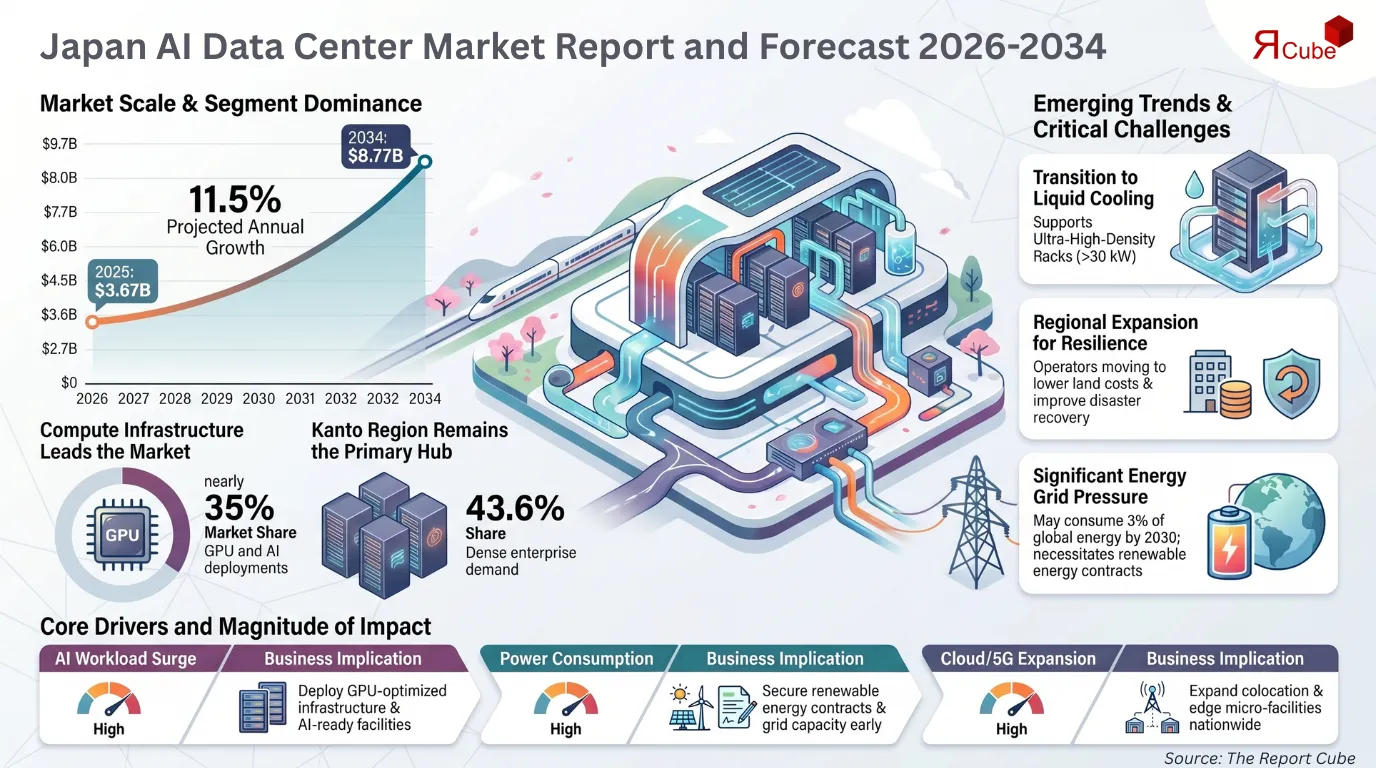
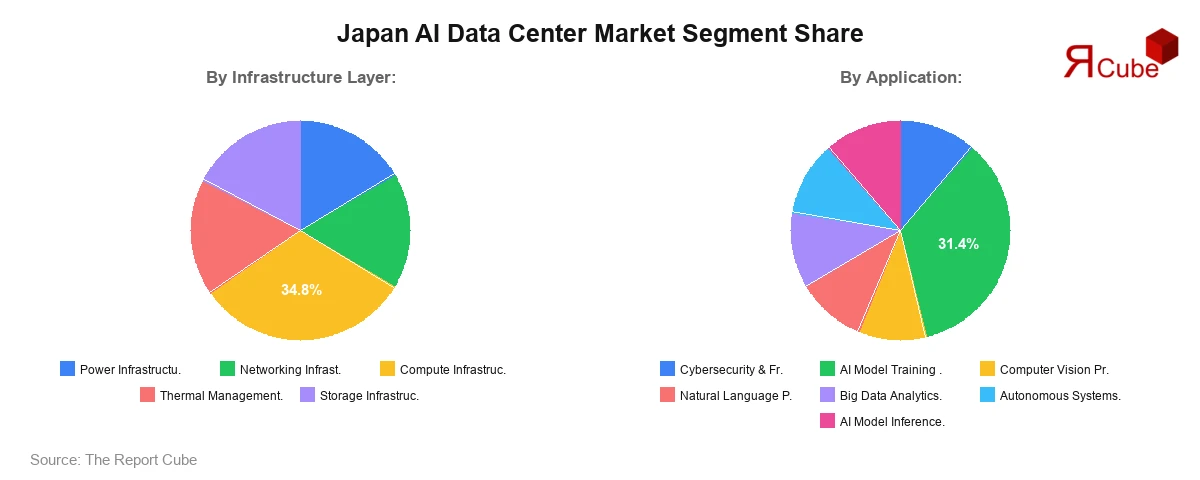
Compute Infrastructure segment leads the market with nearly 34.8% share.
By Deployment Model:
Cloud-Based segment dominates the market with around 47.2% of revenue.
Regional Outlook:
Kanto region dominates the Japan AI Data Center market with approximately 43.6% share.
Japan AI Data Center Market Insights & Analysis
The Japan AI Data Center Market is witnessing substantial expansion as enterprises increase investments in high-performance computing infrastructure to support generative AI, cloud-native applications, and advanced analytics. The market size is valued at USD 3.67 billion in 2026 and is forecast to reach USD 8.77 billion by 2034, growing at a CAGR of 11.5% during 2026-2034. Japan’s strong industrial ecosystem, advanced telecommunications infrastructure, and increasing focus on sovereign digital capabilities are accelerating the deployment of AI-ready facilities across major metropolitan and regional areas. Companies are prioritizing scalable compute environments equipped with GPU clusters, high-speed interconnects, and energy-efficient cooling systems to manage growing AI workloads.
Infrastructure operators are also expanding beyond conventional colocation models to develop hyperscale and distributed AI facilities tailored for enterprise training and inference applications. Tokyo and Osaka continue attracting large-scale investments due to strong connectivity and enterprise demand, while regional expansion in Kyoto and other prefectures is improving disaster resilience and network distribution. Strategic collaborations between cloud providers, telecom operators, and semiconductor technology companies are strengthening Japan’s position as a key AI infrastructure hub in Asia-Pacific. Increasing adoption of liquid cooling, immersion cooling, and ultra-high-density rack environments further reflects the market’s transition toward next-generation AI computing architecture.
Japan AI Data Center Market Impact Analysis
| Factor | Type | Specific Impact on Market | Magnitude | Business Implication |
|---|---|---|---|---|
| AI Workload Surge | Technological | AI contributes 25% of new capacity with high-density GPU demand | High | Deploy GPU-optimized infrastructure and AI-ready facilities |
| Power Consumption Challenges | Environmental | Data centers may consume 3% global energy by 2030, straining grids | High | Secure renewable energy contracts and grid capacity early |
| Government Cloud Provider Selection | Regulatory | Oracle, Google, Microsoft selected; $28B investment planned | High | Align with official providers for public-sector contracts |
| Advanced Cooling Demand | Technological | Cooling uses 38% electricity; liquid systems replacing air-cooling | High | Adopt Cooling-as-a-Service and hybrid liquid-cooling solutions |
| Cloud Migration and 5G Expansion | Market | Cloud workloads drive 60% new capacity; 5G boosts edge demand | High | Expand colocation services and edge micro-facilities nationwide |
| Localized Supply Chain Development | Market | Local assembly of AI servers reduces delays and import hurdles | Medium | Source components locally to reduce lead times and costs |
| Energy Sustainability Requirements | Regulatory | Watt-Bit policy mandates renewable co-location by 2030 | High | Integrate renewable energy sources and green certifications |
| Regional Capacity Concentration | Market | Tokyo and Osaka dominate; Saitama emerging as hyperscale hub | Medium | Diversify geographically to access cheaper land and power |
| Industry 4.0 and IoT Growth | Market | Manufacturing, fintech, healthcare drive secure data hosting | Medium | Offer industry-specific compliance and low-latency solutions |
| AI Regulation and Compliance | Regulatory | AI Act-style frameworks impose risk assessments and reporting | Medium | Establish compliance frameworks for AI workload transparency |
Japan AI Data Center Market Dynamics
Key Driver: Expansion of Enterprise AI Computing and Digital Transformation Programs
Japan’s enterprise sector is rapidly integrating AI-driven technologies across manufacturing, automotive, financial services, and healthcare operations, creating strong demand for advanced AI data center infrastructure. Businesses are deploying large-scale AI models for predictive analytics, industrial automation, fraud detection, and intelligent customer engagement platforms, increasing the requirement for scalable compute capacity and high-speed networking systems. As a result, demand for GPU-powered infrastructure, AI accelerators, and low-latency processing environments continues to rise across the country.
Large technology providers and telecom companies are responding with significant infrastructure investments focused on hyperscale AI clusters and distributed computing environments. Organizations are also prioritizing domestic AI processing capabilities to improve data governance and cybersecurity resilience. This shift is encouraging the development of AI-ready colocation facilities with advanced thermal management systems capable of supporting high-density workloads. Growing adoption of cloud-based AI services among mid-sized enterprises is further contributing to sustained infrastructure demand throughout the forecast period.
Book your FREE 30-minute expert consultation today
Contact UsIndustry Trends: Adoption of High-Density Infrastructure and Advanced Cooling Technologies
AI-focused workloads are reshaping data center architecture standards across Japan as operators transition toward ultra-high-density rack environments. Traditional air-cooling systems are increasingly being replaced with liquid cooling and immersion cooling technologies to support GPU-intensive AI model training operations. Facilities designed for rack densities exceeding 30 kW are becoming more common, particularly within hyperscale deployments supporting generative AI applications and real-time analytics.
Another major trend involves the rise of regional AI infrastructure development beyond Tokyo. Operators are establishing facilities in Osaka, Kyoto, and secondary markets to improve latency performance, reduce concentration risks, and support industrial AI adoption. Edge AI deployments linked to robotics, smart manufacturing, and autonomous systems are also contributing to market expansion. This broader geographic distribution is strengthening Japan’s national AI infrastructure resilience while enabling localized computing for enterprise and public-sector applications.
Major Challenge: Power Constraints and Rising Operational Costs
The rapid growth of AI computing infrastructure is placing considerable pressure on Japan’s energy resources and operational planning capabilities. AI training clusters equipped with thousands of GPUs consume significantly more electricity compared to conventional cloud environments, increasing energy expenditure for operators. Urban regions with high infrastructure demand are facing growing pressure on grid capacity, creating limitations for future hyperscale expansion projects.
Cooling requirements for AI workloads are also raising operational complexity and capital investment needs. High-density AI environments require advanced thermal management systems and continuous infrastructure optimization to maintain operational efficiency. Alongside these challenges, land availability and construction costs remain elevated in major metropolitan areas such as Tokyo and Yokohama. To address these concerns, operators are exploring renewable energy partnerships, modular infrastructure strategies, and regional facility expansion to improve long-term sustainability and cost efficiency.
Opportunity: Growth of Sovereign AI Infrastructure and Industrial Automation Applications
Japan’s emphasis on sovereign AI development is creating new opportunities for domestic AI data center operators and infrastructure providers. Enterprises and government organizations are increasingly prioritizing localized computing environments to strengthen data control, cybersecurity protection, and regulatory compliance. This trend is accelerating investments in domestic hyperscale facilities, AI colocation infrastructure, and hybrid cloud environments optimized for enterprise AI workloads.
Industrial AI adoption is also creating long-term growth opportunities across automotive manufacturing, robotics, semiconductor production, and healthcare technology sectors. These industries require low-latency inference systems, advanced computer vision processing, and scalable data analytics capabilities to support real-time operational decision-making. The expansion of autonomous systems and smart factory initiatives is expected to further increase demand for edge AI infrastructure and distributed computing facilities throughout Japan during the forecast period.
Japan AI Data Center Market Segment-wise Analysis
By Infrastructure Layer:
- Power Infrastructure
- Networking Infrastructure
- Compute Infrastructure
- Thermal Management Systems
- Storage Infrastructure
Compute Infrastructure represents the leading segment in the Japan AI Data Center market due to increasing deployment of AI accelerators, GPUs, TPUs, and high-performance CPUs required for large-scale AI processing. The segment accounted for approximately 34.8% of the market share in 2026 as hyperscale operators and enterprise organizations accelerated investments in AI training clusters and advanced analytics infrastructure. Demand for generative AI applications, natural language processing systems, and autonomous technologies is driving the adoption of scalable compute platforms capable of handling intensive parallel processing workloads.
Cloud service providers and telecom operators are expanding GPU-based infrastructure to support enterprise AI adoption across manufacturing, healthcare, BFSI, and media sectors. The growing integration of NVIDIA Blackwell systems and high-speed interconnect technologies is further enhancing computational efficiency and workload optimization. Rising investment in sovereign AI capabilities and domestic computing resources is also strengthening demand for high-density compute architecture throughout Japan’s evolving AI infrastructure landscape.
By Application:
- Cybersecurity & Fraud Detection
- AI Model Training Platforms
- Computer Vision Processing
- Natural Language Processing (NLP)
- Big Data Analytics
- Autonomous Systems & Robotics
- AI Model Inference Systems
AI Model Training Platforms hold the largest revenue share within the application segment as enterprises and technology providers expand investments in large language models and advanced deep-learning systems. The segment captured nearly 31.4% of market revenue in 2026, supported by increasing demand for high-capacity computing environments capable of processing large-scale datasets and complex AI algorithms. Organizations across automotive, healthcare, and financial services sectors are rapidly adopting AI training infrastructure to improve operational intelligence and accelerate innovation cycles.
The deployment of hyperscale GPU clusters and advanced networking systems is strengthening the ability of enterprises to train increasingly sophisticated AI models within domestic infrastructure environments. Rising investments in enterprise-specific generative AI applications and multimodal AI systems are also supporting long-term growth. In addition, government-backed digital transformation initiatives and domestic AI research programs continue encouraging infrastructure expansion for advanced AI development across Japan.
Regional Projection of Japan AI Data Center Industry
- Hokkaido
- Tohoku
- Kanto
- Shikoku
- Others
Kanto remains the dominant regional market within Japan AI data center industry, accounting for approximately 43.6% of total market revenue due to the concentration of hyperscale cloud providers, enterprise headquarters, and advanced network infrastructure across Tokyo and surrounding prefectures. The region continues attracting large-scale investments from domestic and international operators seeking proximity to major financial institutions, telecom networks, and enterprise customers requiring low-latency AI computing services.
Strong demand for cloud-based AI platforms, enterprise digital transformation projects, and advanced analytics applications is supporting continued infrastructure expansion across the region. Operators are increasingly deploying high-density facilities equipped with advanced cooling technologies and scalable compute environments to meet growing AI workload requirements. Kanto also benefits from strong connectivity to submarine cable systems and regional internet exchange infrastructure, strengthening its role as Japan’s primary hub for hyperscale AI data center development and cloud computing operations.
Need insights for a specific region within this market?
Request Regional DataJapan AI Data Center Industry Regional Analysis
The Japan AI data center industry varies significantly across regions due to power availability, climate conditions, land costs, and government incentives.
| Region | Demand Level | Key Areas | System Dominance | Core Demand Logic | Growth Nature |
|---|---|---|---|---|---|
| Hokkaido | High | Tomakomai, Sapporo, Ishikari | Hyperscale & AI-optimized | Cool climate & renewable energy resources | Fastest emerging segment |
| Tohoku | Medium | Fukushima, Okuma | GPU-equipped AI centers | Low electricity costs & government subsidies | Subsidy-driven expansion |
| Kanto (Greater Tokyo) | Extremely High | Tokyo, Chiba, Inzai, Yokohama | Hyperscale & Cloud regions | Dense enterprise demand & carrier connectivity | Mature market saturation |
| Shikoku | Low | Limited development | Edge data centers | Minimal industrial & tech concentration | Underdeveloped potential |
| Others (Kyushu, Kinki, Chubu) | Very High | Fukuoka, Osaka, Nagoya | AI conversion & VRF systems | Asian proximity & lower land costs | High-priority government hubs |
Government Initiatives & Policies
- Japan Digital Garden City Nation Initiative: Japan’s government continues investing in regional digital infrastructure expansion during 2025-2026 to support AI computing, edge processing, and cloud connectivity across regional economic zones through advanced digital transformation policies.
- METI Semiconductor and AI Infrastructure Support Program: The Ministry of Economy, Trade and Industry expanded support for domestic semiconductor and AI infrastructure investments in 2026, encouraging hyperscale data center expansion and sovereign AI computing capabilities within Japan.
Japan AI Data Center Industry Recent Developments
- 2026: NTT DATA opened the Keihanna OSK11 Data Center in Kyoto with approximately 30MW capacity designed for hyperscalers and enterprise AI workloads. The facility incorporates advanced cooling technologies and scalable infrastructure systems, strengthening regional AI computing capacity and improving infrastructure distribution beyond Tokyo.
- 2026: KDDI Corporation launched the Osaka Sakai AI Data Center equipped with NVIDIA Blackwell GPUs and advanced liquid cooling infrastructure. The facility supports AI training and inference applications for manufacturing and pharmaceutical industries while accelerating high-density AI infrastructure deployment across the Kansai region.
- 2025: SoftBank Corp. deployed a large-scale NVIDIA DGX SuperPOD powered by more than 4,000 NVIDIA Blackwell GPUs. The deployment significantly increased domestic AI computing capabilities and strengthened Japan’s position in sovereign AI development and hyperscale generative AI infrastructure.
Why Choose This Report?
- Provides a comprehensive overview of the overall market analysis, encompassing key trends, consumer behavior analysis, and risk assessment to support strategic decision-making.
- Provides accurate, up-to-date insights into market size, segmentation, and emerging opportunities, helping to minimize risk & capitalizing on growth.
- Gives deep understanding of target audience preferences, investment habits, and communication channels for enhanced product development & marketing effectiveness.
- Delivers competitive analysis & benchmarking, uncovering the strengths & weaknesses of market competitors to guide strategies.
- Consolidate comprehensive market intelligence, reducing reasoning & streamlining research efforts.
- Facilitates customized market segmentation & risk mitigation strategies, fine-tuned to the business objectives.
- Aids in identifying both market challenges & untapped opportunities within the industry to drive long-term business growth.
- Provides valuable information based on actual customer data & search trends.
Table of Contents
- Introduction
- Objective of the Study
- Product and Category Definition
- Market Segmentation
- Study Variables
- Research Methodology
- Secondary Data Points
- Breakdown of Secondary Sources
- Primary Data Points
- Breakdown of Primary Interviews
- Secondary Data Points
- Executive Summary
- Market Dynamics
- Emerging Opportunities
- Adoption Trends
- Demand Drivers
- Disruption Analysis (Challenges)
- Industry Analysis & Strategic Insights
- Supply/Value Chain Analysis
- Pricing Analysis
- Go-To-Market (GTM) Strategy
- BCG Matrix
- Recent Trends and Developments
- Import and Export Analysis
- Regulatory and Policy Landscape
- Region-wise Policies
- Government Initiatives
- Japan AI Data Center Market Overview and Forecast Analysis (2021-2034)
- Market Size, By Value, By Growth Rate (CAGR/USD Billion)
- Market Share, By Infrastructure Layer
- Power Infrastructure
- Transformers
- UPS
- Networking Infrastructure
- Optical Networking
- High-speed Interconnects
- Compute Infrastructure
- TPUs
- Custom AI Accelerators
- CPUs
- GPUs
- Thermal Management Systems
- Immersion Cooling
- Liquid Cooling
- Storage Infrastructure
- Object & Distributed Storage
- High-performance SSD
- Power Infrastructure
- Market Share, By Data Center Architecture Type
- AI Enterprise Data Centers
- AI Edge / Distributed AI Facilities
- AI Hyperscale Data Centers
- AI Colocation Data Centers
- Market Share, By Rack Power Density
- Standard Density (<15 kW/rack)
- High Density (15-30 kW/rack)
- Ultra-High Density (>30 kW/rack, AI factories)
- Market Share, By Deployment Model
- Hybrid
- Cloud-Based
- On-Premises
- Market Share, By Application
- Cybersecurity & Fraud Detection
- AI Model Training Platforms
- Computer Vision Processing
- Natural Language Processing (NLP)
- Big Data Analytics
- Autonomous Systems & Robotics
- AI Model Inference Systems
- Market Share, By End User
- Government
- Healthcare
- Automotive
- IT & Telecom
- Media & Entertainment
- BFSI
- Others
- Market Share, By Region
- Hokkaido
- Tohoku
- Kanto
- Shikoku
- Others
- Market Share, By Company
- Revenue Shares & Analysis
- Competitive Landscape
- Hokkaido AI Data Center Market Overview and Forecast Analysis (2021-2034)
- Market Size, By Value, By Growth Rate (CAGR/USD Billion/Million)
- Market Share, By Infrastructure Layer
- Market Share, By Data Center Architecture Type
- Market Share, By Rack Power Density
- Market Share, By Deployment Model
- Market Share, By Application
- Market Share, By End User
- Tohoku AI Data Center Market Overview and Forecast Analysis (2021-2034)
- Market Size, By Value, By Growth Rate (CAGR/USD Billion/Million)
- Market Share, By Infrastructure Layer
- Market Share, By Data Center Architecture Type
- Market Share, By Rack Power Density
- Market Share, By Deployment Model
- Market Share, By Application
- Market Share, By End User
- Kanto AI Data Center Market Overview and Forecast Analysis (2021-2034)
- Market Size, By Value, By Growth Rate (CAGR/USD Billion/Million)
- Market Share, By Infrastructure Layer
- Market Share, By Data Center Architecture Type
- Market Share, By Rack Power Density
- Market Share, By Deployment Model
- Market Share, By Application
- Market Share, By End User
- Shikoku AI Data Center Market Overview and Forecast Analysis (2021-2034)
- Market Size, By Value, By Growth Rate (CAGR/USD Billion/Million)
- Market Share, By Infrastructure Layer
- Market Share, By Data Center Architecture Type
- Market Share, By Rack Power Density
- Market Share, By Deployment Model
- Market Share, By Application
- Market Share, By End User
- Competitive Analysis, 2026
- Market Share of Key Players
- Competitive Mapping for Each Segment and Companies Operating Regionally
- Hokkaido AI Data Center Companies Share & Competitive Analysis, 2026
- Tohoku AI Data Center Companies Share & Competitive Analysis, 2026
- Kanto AI Data Center Companies Share & Competitive Analysis, 2026
- Shikoku AI Data Center Companies Share & Competitive Analysis, 2026
- Company Profile (Partial List)
- KDDI Corporation
- Company Overview
- Product Portfolio
- Strategic Alliances/Partnerships
- Recent Developments
- IDC Frontier Inc.
- Company Overview
- Product Portfolio
- Strategic Alliances/Partnerships
- Recent Developments
- Amazon Web Services, Inc.
- Company Overview
- Product Portfolio
- Strategic Alliances/Partnerships
- Recent Developments
- MC Digital Realty, Inc.
- Company Overview
- Product Portfolio
- Strategic Alliances/Partnerships
- Recent Developments
- AirTrunk Operating Pty Ltd
- Company Overview
- Product Portfolio
- Strategic Alliances/Partnerships
- Recent Developments
- NTT Global Data Centers Corporation
- Company Overview
- Product Portfolio
- Strategic Alliances/Partnerships
- Recent Developments
- Colt Data Centre Services Group Limited
- Company Overview
- Product Portfolio
- Strategic Alliances/Partnerships
- Recent Developments
- Sakura Internet Inc.
- Company Overview
- Product Portfolio
- Strategic Alliances/Partnerships
- Recent Developments
- Equinix, Inc.
- Company Overview
- Product Portfolio
- Strategic Alliances/Partnerships
- Recent Developments
- Microsoft Corporation
- Company Overview
- Product Portfolio
- Strategic Alliances/Partnerships
- Recent Developments
- Others (Partial List)
- KDDI Corporation
- Contact Us and Disclaimer
Top Key Players & Market Share Outlook
- KDDI Corporation
- IDC Frontier Inc.
- Amazon Web Services, Inc.
- MC Digital Realty, Inc.
- AirTrunk Operating Pty Ltd
- NTT Global Data Centers Corporation
- Colt Data Centre Services Group Limited
- Sakura Internet Inc.
- Equinix, Inc.
- Microsoft Corporation
- Others
Frequently Asked Questions






