



Build Your Custom Market Intelligence Report
Customize Your ReportArgentina Air Conditioners Market Key Highlights
By Product Type:
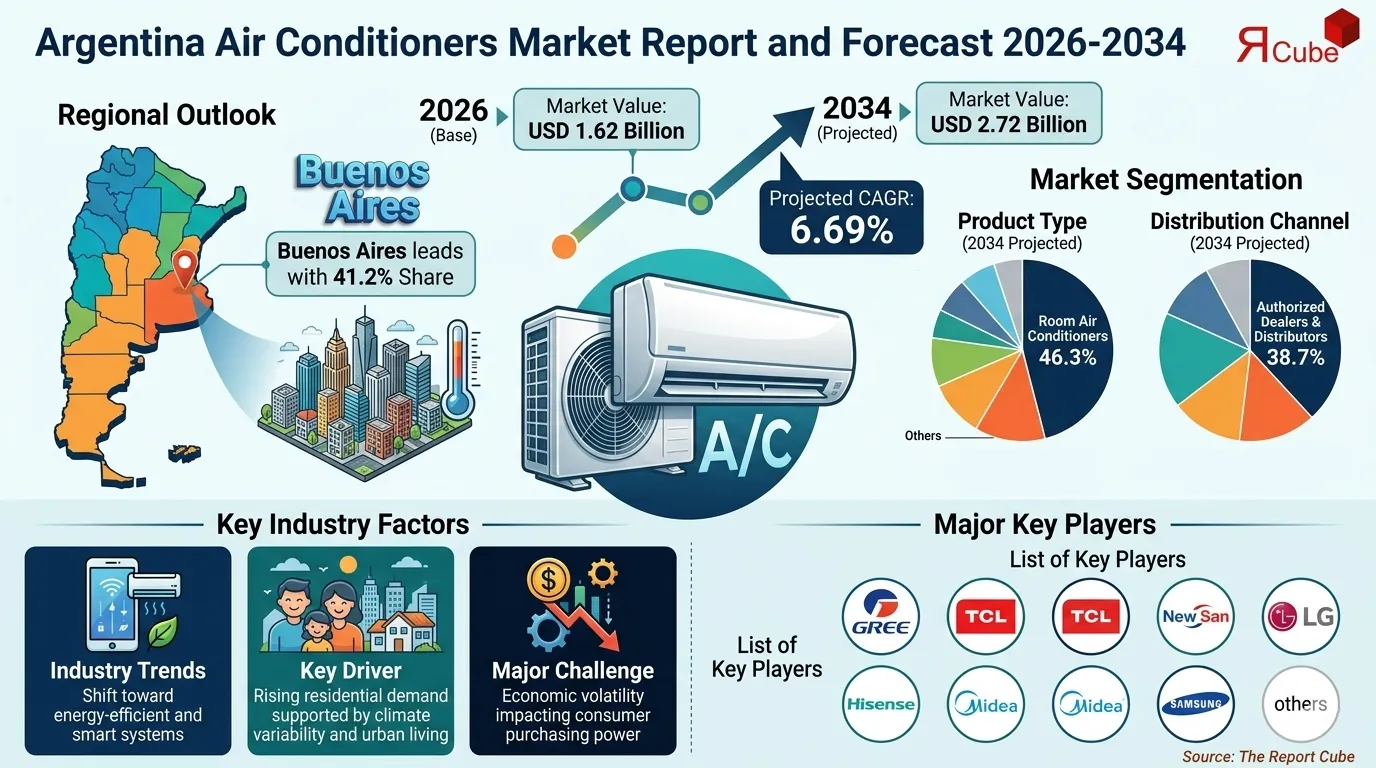
Room Air Conditioners segment leads the market with 46.3%.
By Distribution Channel:
Authorized Dealers and Distributors segment dominates the market with 38.7% of revenue.
Regional Outlook:
Buenos Aires region dominates the Argentina Air Conditioners market with 41.2% share.
Argentina Air Conditioners Market Insights & Analysis
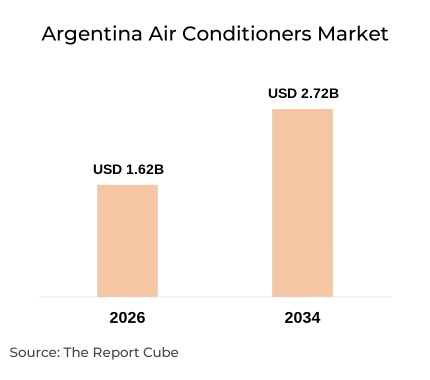
The Argentina Air Conditioners Market is anticipated to register a CAGR of around 6.69% during the forecast period 2026-2034. The market size is valued at USD 1.62 billion and is projected to reach USD 2.72 billion by 2034. Rising urban density and temperature variability are reshaping cooling demand across Argentina. In 2025, household appliance spending showed recovery in Buenos Aires and Central regions, supported by retail financing and seasonal promotions. Manufacturers are focusing on energy-efficient split AC systems, driven by consumer interest in lower electricity consumption and smart temperature control. The Argentina air conditioners market size is further supported by increased installation in residential apartments and mid-sized commercial spaces.
Industry activity has intensified with brands introducing inverter technology, R32 refrigerant systems, and AI-enabled controls. Companies such as Hisense and Midea expanded their local presence through product launches and retail partnerships, which directly improved market share visibility. Growth trends also reflect broader South American HVAC investment, where commercial infrastructure upgrades are encouraging adoption of ducted split systems and VRF systems. Demand is gradually shifting toward premium and energy-saving solutions, influenced by electricity tariffs and sustainability awareness across Argentina.
Argentina Air Conditioners Market Impact Analysis
| Factor | Type | Specific Impact on Market | Magnitude | Business Implication |
|---|---|---|---|---|
| Rising Temperatures & Heatwaves | Demand Driver | Increased need for residential cooling across urban areas | High | Sustained demand for room and split AC systems |
| High Urbanization (Buenos Aires Dominance) | Structural Driver | Demand concentrated in major cities and metro areas | High | Strong urban-centric sales and installation growth |
| Commercial Infrastructure Expansion | Demand Driver | Growth in offices, malls, and hospitality sector | Medium–High | Increase in central and VRF system demand |
| Energy Efficiency Regulations & Labeling | Regulatory Driver | Push toward inverter and efficient AC systems | High | Inverter AC adoption increases |
| High Electricity Costs | Market Constraint | Consumers prefer low-consumption systems | Medium | Shift toward energy-efficient models |
| Dominance of Split AC Systems (~85%) | Market Structure | Market heavily skewed toward split AC units | High | Limited diversification across AC types |
| Replacement Demand Cycle | Market Behavior | Mature market with repeat purchases and upgrades | Medium | Stable baseline demand even without new installations |
| Import & Global Brand Competition | Market Structure | Presence of global and regional manufacturers | Medium | Competitive pricing and product variety |
Argentina Air Conditioners Market Dynamics
Key Driver: Rising residential demand supported by climate variability and urban living
Increasing summer temperatures and longer heatwaves are influencing consumer behavior across Argentina. Urban households are investing more in room air conditioners, especially split AC units with inverter technology. This shift is closely tied to rising disposable income in metropolitan areas and improved access to financing through retail chains and authorized dealers. The Argentina air conditioners market demand is strongly linked to housing expansion and renovation activities.
Cooling appliances are no longer considered luxury items but essential household equipment. This transition is accelerating adoption in tier-2 cities and suburban areas. Demand for compact and energy-efficient systems continues to rise, particularly in apartments where space optimization matters. These trends directly impact market growth and encourage manufacturers to expand product portfolios with tailored capacity options.
Book your FREE 30-minute expert consultation today
Contact UsIndustry Trends: Shift toward energy-efficient and smart air conditioning systems
Manufacturers are rapidly introducing inverter-based air conditioners and smart connectivity features. Consumers now prefer systems that can be controlled via mobile applications and offer adaptive cooling. This trend is reshaping product innovation and influencing Argentina air conditioners market share among premium segments. Brands are differentiating through features such as air purification and humidity control.
Environmental considerations are also influencing purchasing decisions. The transition toward R32 refrigerants reflects regulatory alignment with global emission standards. Smart AC systems are gaining traction in Buenos Aires and Central regions, where energy costs are higher. These innovations are expected to drive sustained growth trends in both residential and light commercial sectors.
Major Challenge: Economic volatility impacting consumer purchasing power
Argentina's economic fluctuations continue to affect consumer spending patterns. Inflation and currency depreciation increase product costs, making air conditioners less accessible for lower-income households. This creates pricing pressure across the Argentina air conditioners market and limits expansion in price-sensitive regions.
Retailers often rely on installment plans to stimulate demand, but financing risks remain a concern. Import dependency for components also exposes manufacturers to supply chain disruptions. These factors collectively challenge market stability and require companies to adopt flexible pricing and localized sourcing strategies.
Opportunity: Expansion of commercial infrastructure and smart building adoption
Growth in commercial real estate and hospitality sectors presents strong opportunities for advanced cooling systems. Offices, malls, and hotels are increasingly adopting ducted split systems and VRF solutions to improve energy efficiency. This trend supports higher-value installations within the Argentina air conditioners market growth outlook.
Smart building initiatives are encouraging integration of HVAC systems with building management platforms. This creates demand for centralized cooling solutions and automated energy optimization. Manufacturers focusing on commercial-grade products can capitalize on these opportunities while strengthening their presence in large-scale projects.
Argentina Air Conditioners Market Segment-wise Analysis
By Product Type:
- Chillers
- Room Air Conditioners
- Cassette Air Conditioners
- Packaged Air Conditioners
- Ducted Split Systems
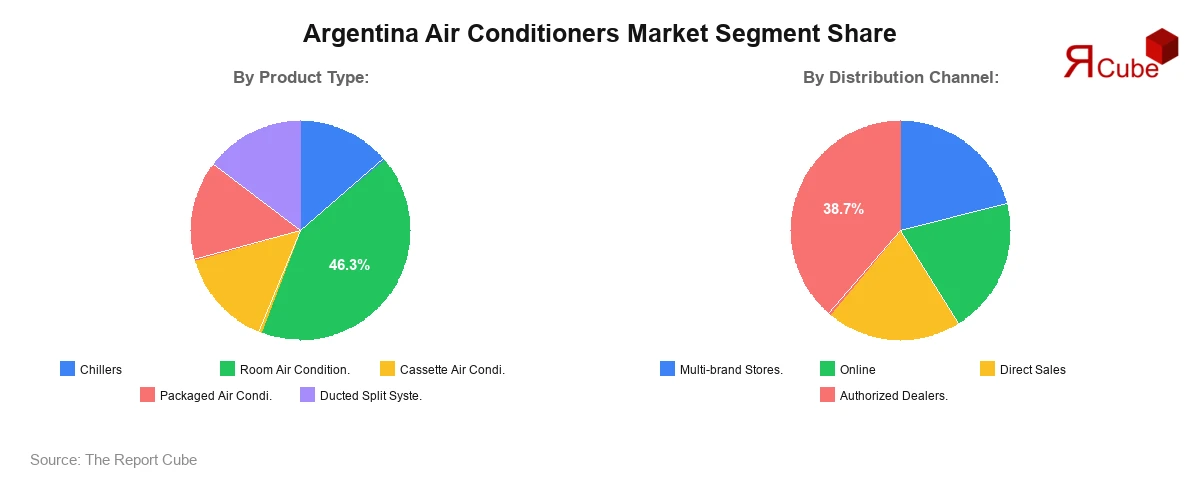
Room Air Conditioners hold a dominant share of 46.3% in the Argentina air conditioners market, largely driven by strong residential demand. Split AC systems account for the majority within this segment due to their energy efficiency and flexibility in installation. Units between 1 ton to 1.5 ton are widely preferred in urban apartments, aligning with average room sizes.
Increasing adoption of inverter technology has improved efficiency by 28%, which directly appeals to cost-conscious consumers. Growth is further supported by retail promotions and availability through multi-brand stores and authorized dealers. Demand for window AC units remains stable in older buildings, but split systems continue to gain higher market share due to aesthetics and performance advantages.
By Distribution Channel:
- Multi-brand Stores
- Online
- Direct Sales
- Authorized Dealers and Distributors
Authorized Dealers and Distributors dominate with 38.7% revenue share, reflecting consumer preference for trusted installation and after-sales services. Buyers in Argentina prioritize warranty support and professional installation, which strengthens this channel's position. Dealers often collaborate with brands to offer financing plans, making high-value air conditioners more accessible.
The Argentina air conditioners market trends show that offline retail continues to outperform online channels, particularly for large appliances requiring technical setup. However, online sales are gradually increasing, driven by digital adoption and competitive pricing. Multi-brand stores remain relevant in urban areas where consumers compare multiple brands before purchase.
Regional Projection of Argentina Air Conditioners Industry
- Buenos Aires
- Central
- Cuyo
- Patagonia
- Litoral
- North
Buenos Aires leads the Argentina air conditioners market with 41.2% share, supported by high population density and strong purchasing power. The region experiences significant seasonal temperature variations, which drives consistent demand for cooling systems. Residential installations dominate, particularly in high-rise apartments and newly developed housing complexes.
Commercial adoption is also strong, with offices and retail spaces investing in advanced HVAC systems. Availability of major retailers and distribution networks further supports market penetration. Energy-efficient models are increasingly popular due to higher electricity tariffs, encouraging consumers to upgrade existing systems. This regional dominance is expected to continue as urbanization and infrastructure development remain concentrated in Buenos Aires.
Argentina Air Conditioners Market Regional Analysis
The Argentina air conditioners market varies significantly across regions due to diverse climatic conditions, urban concentration, and economic activity.
| Cluster | Demand Level | Key Areas | System Dominance | Core Demand Logic | Growth Nature |
|---|---|---|---|---|---|
| Buenos Aires | Very High | CABA, GBA urban belt | Split & Multi-split AC | Dense housing and service economy | Replacement plus new installs |
| Central | High | Córdoba, Santa Fe corridor | Split & Light commercial | Warm summers, mid–high incomes | Steady urban expansion |
| Cuyo | Medium | Mendoza, San Juan, San Luis | Split & Heat‑pump AC | Hot dry climate, wine industry | Climate and tourism led |
| Patagonia | Low | Neuquén, Río Negro, Chubut | Heat‑pump and reversible units | Cooling secondary to heating | Niche, selective adoption |
| Litoral | Very High | Rosario, Paraná, Corrientes belt | Split AC with inverter | Hot humid climate, river cities | Fast penetration growth |
| North | High | Salta, Tucumán, Chaco, Formosa | Split & Room AC | Extreme heat and humidity | New users and upgrades |
Need insights for a specific region within this market?
Request Regional DataGovernment Initiatives & Policies
- Energy Efficiency Labeling Program: Argentina strengthened appliance labeling standards in 2025 to promote energy-efficient air conditioners, helping consumers compare efficiency ratings and reduce electricity consumption.
- National Energy Saving Plan 2026: The government introduced incentives for efficient home appliances, encouraging adoption of inverter AC systems and reducing national energy demand through subsidy-linked programs.
Argentina Air Conditioners Industry Recent Developments
- 2025: Hisense Group launched its “Fresh Master” room air conditioner in Argentina, featuring AI control, fresh-air intake, and R32 refrigerant. This premium product enhances its portfolio and strengthens presence in the residential segment.
- 2025: Midea Group Co Ltd organized a major product launch event in Argentina, introducing new room AC lines and expanding retail partnerships, which supports brand visibility and drives sales growth.
- 2025: Regional HVAC Expansion South America’s commercial HVAC investment increased significantly, with global players expanding operations, indirectly boosting demand for advanced air conditioning systems in Argentina.
Why Choose This Report?
- Provides a comprehensive overview of the overall market analysis, encompassing key trends, consumer behavior analysis, and risk assessment to support strategic decision-making.
- Provides accurate, up-to-date insights into market size, segmentation, and emerging opportunities, helping to minimize risk & capitalizing on growth.
- Gives deep understanding of target audience preferences, investment habits, and communication channels for enhanced product development & marketing effectiveness.
- Delivers competitive analysis & benchmarking, uncovering the strengths & weaknesses of market competitors to guide strategies.
- Consolidate comprehensive market intelligence, reducing reasoning & streamlining research efforts.
- Facilitates customized market segmentation & risk mitigation strategies, fine-tuned to the business objectives.
- Aids in identifying both market challenges & untapped opportunities within the industry to drive long-term business growth.
- Provides valuable information based on actual customer data & search trends.
Table of Contents
- Introduction
- Objective of the Study
- Product and Category Definition
- Market Segmentation
- Study Variables
- Research Methodology
- Secondary Data Points
- Breakdown of Secondary Sources
- Primary Data Points
- Breakdown of Primary Interviews
- Secondary Data Points
- Executive Summary
- Market Dynamics
- Emerging Opportunities
- Adoption Trends
- Demand Drivers
- Disruption Analysis (Challenges)
- Industry Analysis and Strategic Insights
- Supply and Value Chain Analysis
- Pricing Analysis
- Go-To-Market Strategy
- BCG Matrix
- Recent Trends and Developments
- Import and Export Analysis
- Regulatory and Policy Landscape
- Region-wise Policies
- Government Initiatives
- Argentina Air Conditioners Market Overview and Forecast Analysis (2021-2034)
- Market Size, By Value, By Growth Rate (CAGR/USD Billion)
- Market Share, By Product Type
- Chillers
- Water-cooled Chillers
- Air-cooled Chillers
- Other Chillers
- Room Air Conditioners
- Split AC
- Up to 1 Ton
- 1 Ton to 1.5 Ton
- Above 1.6 to 2 Ton
- Above 2 Ton
- Window AC
- Up to 1 Ton
- 1 Ton to 2 Ton
- Above 2 Ton
- Split AC
- Cassette Air Conditioners
- Up to 2 Tons
- 2.1 to 4 Tons
- 4.1 to 5 Tons
- Above 5 Tons
- Packaged Air Conditioners
- Up to 5 Tons
- 6 to 10 Tons
- 11 to 20 Tons
- Above 20 Tons
- Ducted Split Systems
- VRF Systems
- Up to 5 Tons
- 6 to 10 Tons
- 11 to 20 Tons
- Above 20 Tons
- Others (Air Handling Units / Fan Coil Units, etc.)
- Chillers
- Market Share, By Refrigerant Type
- R290
- R410A
- R32
- R1234ze / R1234yf
- R134a
- Other Refrigerants
- Market Share, By Distribution Channel
- Multi-brand Stores
- Online
- Direct Sales
- Authorized Dealers and Distributors
- Market Share, By End User
- Retail and Malls
- Pharmaceuticals
- Food and Beverage
- Hotels and Hospitality
- Data Centers
- Offices
- Manufacturing
- Residential
- Educational Institutions
- Hospitals and Healthcare
- Other End Users
- Market Share, By Region
- Buenos Aires
- Central
- Cuyo
- Patagonia
- Litoral
- North
- Market Share, By Company
- Revenue Shares and Analysis
- Competitive Landscape
- Buenos Aires Air Conditioners Market Overview and Forecast Analysis (2021-2034)
- Market Size, By Value, By Growth Rate (CAGR/USD Billion/Million)
- Market Share, By Product Type
- Market Share, By Refrigerant Type
- Market Share, By Distribution Channel
- Market Share, By End User
- Central Air Conditioners Market Overview and Forecast Analysis (2021-2034)
- Market Size, By Value, By Growth Rate (CAGR/USD Billion/Million)
- Market Share, By Product Type
- Market Share, By Refrigerant Type
- Market Share, By Distribution Channel
- Market Share, By End User
- Cuyo Air Conditioners Market Overview and Forecast Analysis (2021-2034)
- Market Size, By Value, By Growth Rate (CAGR/USD Billion/Million)
- Market Share, By Product Type
- Market Share, By Refrigerant Type
- Market Share, By Distribution Channel
- Market Share, By End User
- Patagonia Air Conditioners Market Overview and Forecast Analysis (2021-2034)
- Market Size, By Value, By Growth Rate (CAGR/USD Billion/Million)
- Market Share, By Product Type
- Market Share, By Refrigerant Type
- Market Share, By Distribution Channel
- Market Share, By End User
- Litoral Air Conditioners Market Overview and Forecast Analysis (2021-2034)
- Market Size, By Value, By Growth Rate (CAGR/USD Billion/Million)
- Market Share, By Product Type
- Market Share, By Refrigerant Type
- Market Share, By Distribution Channel
- Market Share, By End User
- North Air Conditioners Market Overview and Forecast Analysis (2021-2034)
- Market Size, By Value, By Growth Rate (CAGR/USD Billion/Million)
- Market Share, By Product Type
- Market Share, By Refrigerant Type
- Market Share, By Distribution Channel
- Market Share, By End User
- Competitive Analysis, 2026
- Market Share of Key Players
- Competitive Mapping for Each Segment and Companies Operating By Region
- Buenos Aires Air Conditioners Companies Share and Competitive Analysis, 2026
- Central Air Conditioners Companies Share and Competitive Analysis, 2026
- Cuyo Air Conditioners Companies Share and Competitive Analysis, 2026
- Patagonia Air Conditioners Companies Share and Competitive Analysis, 2026
- Litoral Air Conditioners Companies Share and Competitive Analysis, 2026
- North Air Conditioners Companies Share and Competitive Analysis, 2026
- Company Profile (Partial List)
- Gree Electric Appliances Inc of Zhuhai
- Company Overview
- Product Portfolio
- Strategic Alliances/Partnerships
- Recent Developments
- TCL Corp
- Company Overview
- Product Portfolio
- Strategic Alliances/Partnerships
- Recent Developments
- New San SA
- Company Overview
- Product Portfolio
- Strategic Alliances/Partnerships
- Recent Developments
- LG Corp
- Company Overview
- Product Portfolio
- Strategic Alliances/Partnerships
- Recent Developments
- Hisense Group
- Company Overview
- Product Portfolio
- Strategic Alliances/Partnerships
- Recent Developments
- Midea Group Co Ltd
- Company Overview
- Product Portfolio
- Strategic Alliances/Partnerships
- Recent Developments
- Samsung Corp
- Company Overview
- Product Portfolio
- Strategic Alliances/Partnerships
- Recent Developments
- BGH SA
- Company Overview
- Product Portfolio
- Strategic Alliances/Partnerships
- Recent Developments
- Aires del Sur SA
- Company Overview
- Product Portfolio
- Strategic Alliances/Partnerships
- Recent Developments
- Robert Bosch GmbH
- Company Overview
- Product Portfolio
- Strategic Alliances/Partnerships
- Recent Developments
- Others (Partial List)
- Gree Electric Appliances Inc of Zhuhai
- Contact Us and Disclaimer
Top Key Players & Market Share Outlook
- Gree Electric Appliances Inc of Zhuhai
- TCL Corp
- New San SA
- LG Corp
- Hisense Group
- Midea Group Co Ltd
- Samsung Corp
- BGH SA
- Aires del Sur SA
- Robert Bosch GmbH
Frequently Asked Questions