



Build Your Custom Market Intelligence Report
Customize Your ReportBrazil Air Conditioners Market Key Highlights
By Refrigerant Type:
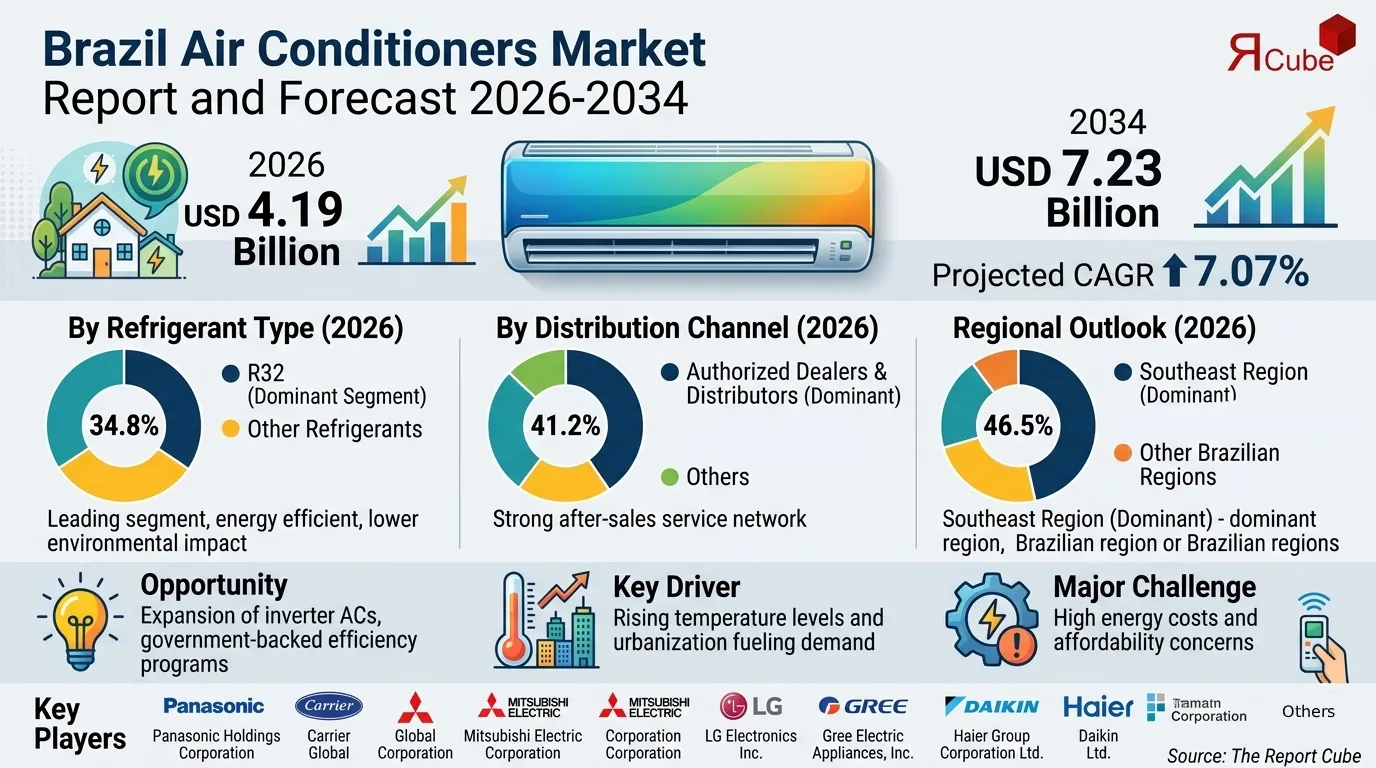
R32 segment leads the market with nearly 34.8% share, driven by its energy efficiency and lower environmental impact.
By Distribution Channel:
Authorized Dealers and Distributors segment dominates the market with around 41.2% of revenue due to strong after-sales service networks.
Regional Outlook:
Southeast region dominates the Brazil Air Conditioners market with approximately 46.5% share.
Brazil Air Conditioners Market Insights & Analysis
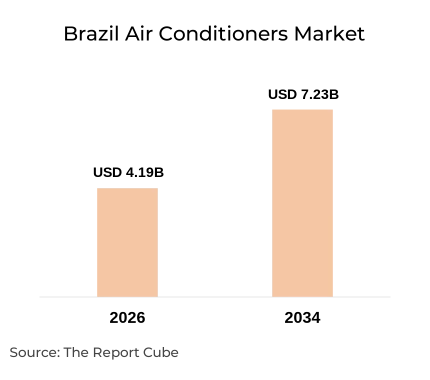
The Brazil Air Conditioners Market is anticipated to register a CAGR of around 7.07% during the forecast period 2026-2034. The market size is valued at USD 4.19 billion in 2026 and is projected to reach USD 7.23 billion by 2034. Growing urban heat intensity, rising disposable income, and expansion in middle-class households are accelerating Brazil air conditioners market growth, while increased construction activities are boosting demand across residential and commercial sectors. Market size and share trends indicate strong adoption of split air conditioning systems, especially inverter-based units that deliver improved energy savings.
Recent industry data highlights that Brazil has emerged as the world’s second-largest air-conditioning manufacturing hub in 2024, strengthening domestic supply chains and export capabilities. Production of split AC units crossed 6 million units in 2025, reflecting steady growth in demand. Policy-driven efficiency standards introduced in 2025-2026 are encouraging the adoption of eco-friendly refrigerants and advanced cooling technologies. Market trends also show rising online sales channels and growing consumer awareness regarding energy-efficient appliances, contributing to long-term Brazil air conditioners market expansion.
Brazil Air Conditioners Market Impact Analysis
| Factor | Type | Specific Impact on Market | Magnitude | Business Implication |
|---|---|---|---|---|
| Rising Temperatures and More Intense Heatwaves | Environmental | Boosts seasonal and peak air conditioner usage levels | High | Plan capacity, stock and marketing around hot spells |
| Urbanisation in Coastal and Northern Metro Areas | Market | Concentrates demand in dense, high-humidity regions | High | Prioritise distribution and service in urban corridors |
| Growth of Residential and Commercial Construction | Market | Creates steady demand for room, split and light VRF | Medium–High | Target builders, malls, hotels and office projects |
| Stricter Energy Efficiency and MEPS Regulations | Regulatory | Eliminates low-efficiency units and raises standards | High | Accelerate inverter shift and upgrade product lines |
| High Electricity Tariffs and Bill Sensitivity | Consumer | Pushes buyers toward efficient and inverter models | Medium | Highlight lifetime energy savings in brand messaging |
| Import Dependence for Components and Compressors | Environmental | Exposes market to currency and logistics volatility | Medium | Diversify sourcing and explore localised assembly |
| Dominance of Split and Inverter Room AC Segment | Market | Shifts volume strongly toward efficient split systems | High | Prioritise split portfolio and channel level focus |
| Competition from Global and Regional AC Brands | Competitive | Intensifies price pressure and limits quick share gain | Medium | Compete via service, localisation and niche offerings |
| Growing Policy Push for Low-GWP Refrigerants | Regulatory | Encourages transition to climate-friendly refrigerants | Medium | Invest in compliant designs and green positioning |
| Rising Importance of After-Sales and Maintenance | Competitive | Service quality shapes retention and brand advocacy | Medium | Build dense authorised networks and AMC programs |
Brazil Air Conditioners Market Dynamics
Key Driver: Rising temperature levels and urbanization fueling cooling demand
Rapid urban expansion across major Brazilian cities is significantly increasing the need for efficient cooling systems. Higher average temperatures and extended summer seasons are pushing residential users to invest in modern air conditioners, boosting Brazil air conditioners market demand. Increasing penetration of smart homes and rising electricity access in semi-urban regions further strengthen market growth and size.
Construction growth in residential complexes, shopping centers, and commercial buildings continues to support strong demand for HVAC systems. The growing middle-income population is prioritizing comfort appliances, contributing to higher air conditioner ownership rates. This shift is directly influencing Brazil air conditioners market share expansion, particularly in the split AC and inverter segments.
Book your FREE 30-minute expert consultation today
Contact UsIndustry Trends: Shift toward energy-efficient and eco-friendly refrigerants
Market trends clearly indicate a transition from traditional refrigerants like R410A toward low-GWP alternatives such as R32 and R290. Manufacturers are investing in sustainable product lines to comply with environmental regulations and improve brand positioning. This trend is reshaping Brazil air conditioners market growth by aligning with global climate goals and local efficiency standards.
Another key trend includes the rise of inverter technology and IoT-enabled air conditioners. Consumers are increasingly opting for smart AC systems with remote monitoring and automated temperature control. Online distribution channels are also gaining traction, supported by digital transformation and e-commerce growth, enhancing accessibility and boosting overall market demand.
Major Challenge: High energy costs and affordability concerns
Electricity pricing remains a major concern for Brazilian households, limiting the adoption of air conditioning systems in low-income segments. High upfront costs of energy-efficient models create affordability barriers, affecting Brazil air conditioners market penetration in rural and economically weaker regions.
Additionally, fluctuating raw material prices and import dependencies for certain components increase production costs for manufacturers. These factors can impact pricing strategies and profit margins, creating challenges for sustained market growth and expansion.
Opportunity: Expansion of inverter ACs and government-backed efficiency programs
Government initiatives promoting energy efficiency and emission reduction are creating strong growth opportunities for advanced air conditioning systems. Incentives for adopting energy-saving appliances are encouraging consumers to upgrade older systems, driving Brazil air conditioners market trends toward sustainable solutions.
Furthermore, increasing electrification and rising awareness about climate comfort are opening new avenues in untapped regions such as North and Northeast Brazil. The expected surge in household AC penetration to nearly 80% by 2035 presents a significant long-term opportunity for manufacturers and distributors.
Brazil Air Conditioners Market Segment-wise Analysis
By Refrigerant Type:
- R290
- R410A
- R32
- R1234ze / R1234yf
- R134a
- Other Refrigerants
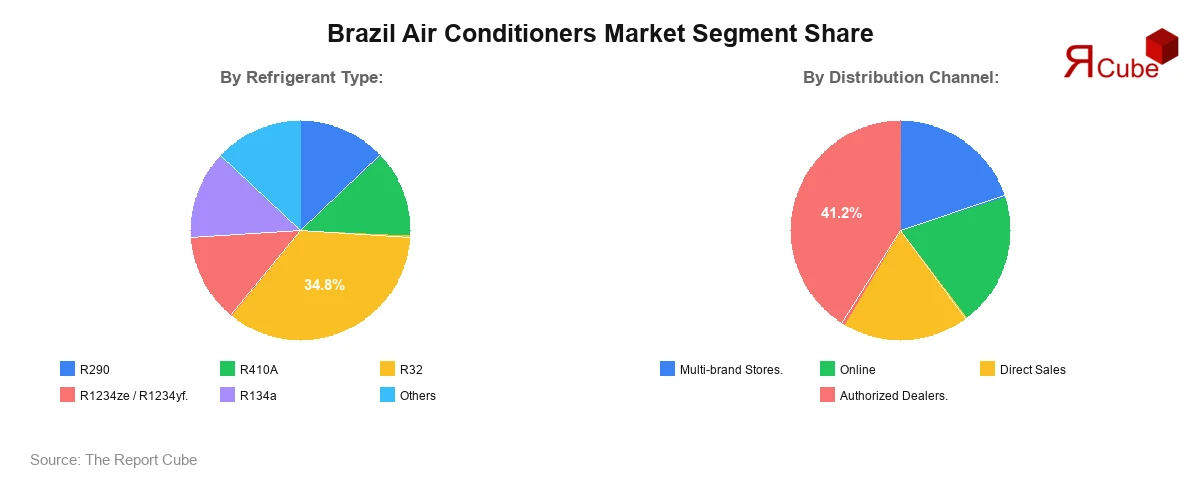
R32 refrigerant segment leads the Brazil air conditioners market with an estimated share of around 34.8%. The segment growth is supported by its superior thermodynamic efficiency and lower global warming potential compared to R410A. Manufacturers are increasingly transitioning toward R32-based systems due to regulatory pressure and consumer demand for energy-efficient appliances.
Market size expansion in this segment is also driven by rising installation of inverter AC systems, where R32 performs efficiently. Growing awareness of environmental sustainability and cost savings in energy bills continues to boost adoption, strengthening overall Brazil air conditioners market growth.
By Distribution Channel:
- Multi-brand Stores
- Online
- Direct Sales
- Authorized Dealers and Distributors
Authorized dealers and distributors dominate the Brazil air conditioners market, accounting for approximately 41.2% of total revenue share. Strong service networks, installation support, and trusted brand partnerships make this channel highly preferred among consumers. The segment benefits from after-sales services, warranty assurance, and product authenticity, which are critical factors influencing purchase decisions.
While online sales are expanding rapidly due to digital adoption, offline dealer networks continue to lead in terms of value and customer trust, maintaining their dominance in market share.
Regional Projection of Brazil Air Conditioners Industry
- North
- Northeast
- Centerwest
- Southeast
- South
The Southeast region holds the largest share in the Brazil air conditioners market, contributing approximately 46.5% of total revenue. High urban density, strong economic activity, and rising disposable income levels in cities such as São Paulo and Rio de Janeiro drive demand. The region also has a well-established infrastructure and higher penetration of residential and commercial air conditioning systems. Increasing adoption of smart appliances and energy-efficient systems further supports market growth in this region. Additionally, large-scale commercial developments and industrial expansion continue to create consistent demand, reinforcing Southeast Brazil’s leadership in market size and share.
Brazil Air Conditioners Market Regional Analysis
The brazil air conditioners market varies significantly across regions due to diverse climatic conditions, urban concentration, and economic activity.
| Cluster | Demand Level | Key Areas | System Dominance | Core Demand Logic | Growth Nature |
|---|---|---|---|---|---|
| North | High | Manaus, Belém, river cities | Window & basic split AC | Hot, humid climate, low incomes | Volume-led, price sensitive |
| Northeast | Very High | Salvador, Recife, Fortaleza | Split AC & inverter split | Tourism, dense coastal housing | Penetration and upgrade growth |
| Centerwest | Medium | Brasília, Goiânia, agribusiness hubs | Split AC in homes, light VRF | Service sector and farm income | Emerging urban and rural demand |
| Southeast | Very High | São Paulo, Rio, Belo Horizonte | Split, VRF & central systems | Highest income, dense urban stock | Replacement and premium growth |
| South | Medium | Curitiba, Porto Alegre, Florianópolis | Heat pump split & multisplit | Mixed cooling and heating need | Steady, climate shift driven |
Need insights for a specific region within this market?
Request Regional DataGovernment Initiatives & Policies
- National Energy Efficiency Standards: Brazil introduced updated minimum energy performance standards in 2025 to promote efficient air conditioners and reduce emissions.
- Industrial Growth & Manufacturing Support: Government initiatives supporting domestic AC production strengthened Brazil’s position as the second-largest global manufacturer in 2024.
Brazil Air Conditioners Industry Recent Developments
- 2026: ABRAVA reported that Brazil’s AC market production exceeded 6 million split units in 2025, reflecting an 8% annual increase, driven by rising residential demand, improved economic conditions, and growing adoption of energy-efficient cooling systems.
Why Choose This Report?
- Provides a comprehensive overview of the overall market analysis, encompassing key trends, consumer behavior analysis, and risk assessment to support strategic decision-making.
- Provides accurate, up-to-date insights into market size, segmentation, and emerging opportunities, helping to minimize risk & capitalizing on growth.
- Gives deep understanding of target audience preferences, investment habits, and communication channels for enhanced product development & marketing effectiveness.
- Delivers competitive analysis & benchmarking, uncovering the strengths & weaknesses of market competitors to guide strategies.
- Consolidate comprehensive market intelligence, reducing reasoning & streamlining research efforts.
- Facilitates customized market segmentation & risk mitigation strategies, fine-tuned to the business objectives.
- Aids in identifying both market challenges & untapped opportunities within the industry to drive long-term business growth.
- Provides valuable information based on actual customer data & search trends.
Table of Contents
- Introduction
- Objective of the Study
- Product and Category Definition
- Market Segmentation
- Study Variables
- Research Methodology
- Secondary Data Points
- Breakdown of Secondary Sources
- Primary Data Points
- Breakdown of Primary Interviews
- Secondary Data Points
- Executive Summary
- Market Dynamics
- Emerging Opportunities
- Adoption Trends
- Demand Drivers
- Disruption Analysis (Challenges)
- Industry Analysis and Strategic Insights
- Supply and Value Chain Analysis
- Pricing Analysis
- Go-To-Market Strategy
- BCG Matrix
- Recent Trends and Developments
- Import and Export Analysis
- Regulatory and Policy Landscape
- Region-wise Policies
- Government Initiatives
- Brazil Air Conditioners Market Overview and Forecast Analysis (2021-2034)
- Market Size, By Value, By Growth Rate (CAGR/USD Billion)
- Market Share, By Product Type
- Chillers
- Water-cooled Chillers
- Air-cooled Chillers
- Other Chillers
- Room Air Conditioners
- Split AC
- Up to 1 Ton
- 1 Ton to 1.5 Ton
- Above 1.6 to 2 Ton
- Above 2 Ton
- Window AC
- Up to 1 Ton
- 1 Ton to 2 Ton
- Above 2 Ton
- Split AC
- Cassette Air Conditioners
- Up to 2 Tons
- 2.1 to 4 Tons
- 4.1 to 5 Tons
- Above 5 Tons
- Packaged Air Conditioners
- Up to 5 Tons
- 6 to 10 Tons
- 11 to 20 Tons
- Above 20 Tons
- Ducted Split Systems
- VRF Systems
- Up to 5 Tons
- 6 to 10 Tons
- 11 to 20 Tons
- Above 20 Tons
- Others (Air Handling Units / Fan Coil Units, etc.)
- Chillers
- Market Share, By Refrigerant Type
- R290
- R410A
- R32
- R1234ze / R1234yf
- R134a
- Other Refrigerants
- Market Share, By Distribution Channel
- Multi-brand Stores
- Online
- Direct Sales
- Authorized Dealers and Distributors
- Market Share, By End User
- Retail and Malls
- Pharmaceuticals
- Food and Beverage
- Hotels and Hospitality
- Data Centers
- Offices
- Manufacturing
- Residential
- Educational Institutions
- Hospitals and Healthcare
- Other
- Market Share, By Region
- North
- Northeast
- Centerwest
- Southeast
- South
- Market Share, By Company
- Revenue Shares and Analysis
- Competitive Landscape
- North Region Brazil Air Conditioners Market Overview and Forecast Analysis (2021-2034)
- Market Size, By Value, By Growth Rate (CAGR/USD Billion/Million)
- Market Share, By Product Type
- Market Share, By Refrigerant Type
- Market Share, By Distribution Channel
- Market Share, By End User
- Northeast Region Brazil Air Conditioners Market Overview and Forecast Analysis (2021-2034)
- Market Size, By Value, By Growth Rate (CAGR/USD Billion/Million)
- Market Share, By Product Type
- Market Share, By Refrigerant Type
- Market Share, By Distribution Channel
- Market Share, By End User
- Centerwest Region Brazil Air Conditioners Market Overview and Forecast Analysis (2021-2034)
- Market Size, By Value, By Growth Rate (CAGR/USD Billion/Million)
- Market Share, By Product Type
- Market Share, By Refrigerant Type
- Market Share, By Distribution Channel
- Market Share, By End User
- Southeast Region Brazil Air Conditioners Market Overview and Forecast Analysis (2021-2034)
- Market Size, By Value, By Growth Rate (CAGR/USD Billion/Million)
- Market Share, By Product Type
- Market Share, By Refrigerant Type
- Market Share, By Distribution Channel
- Market Share, By End User
- South Region Brazil Air Conditioners Market Overview and Forecast Analysis (2021-2034)
- Market Size, By Value, By Growth Rate (CAGR/USD Billion/Million)
- Market Share, By Product Type
- Market Share, By Refrigerant Type
- Market Share, By Distribution Channel
- Market Share, By End User
- Competitive Analysis, 2026
- Market Share of Key Players
- Competitive Mapping for Each Segment and Companies Operating Regionally
- North Region Brazil Air Conditioners Companies Share and Competitive Analysis, 2026
- Northeast Region Brazil Air Conditioners Companies Share and Competitive Analysis, 2026
- Centerwest Region Brazil Air Conditioners Companies Share and Competitive Analysis, 2026
- Southeast Region Brazil Air Conditioners Companies Share and Competitive Analysis, 2026
- South Region Brazil Air Conditioners Companies Share and Competitive Analysis, 2026
- Company Profile (Partial List)
- Panasonic Holdings Corporation
- Company Overview
- Product Portfolio
- Strategic Alliances/Partnerships
- Recent Developments
- Carrier Global Corporation
- Company Overview
- Product Portfolio
- Strategic Alliances/Partnerships
- Recent Developments
- Mitsubishi Electric Corporation
- Company Overview
- Product Portfolio
- Strategic Alliances/Partnerships
- Recent Developments
- LG Electronics Inc.
- Company Overview
- Product Portfolio
- Strategic Alliances/Partnerships
- Recent Developments
- Gree Electric Appliances, Inc.
- Company Overview
- Product Portfolio
- Strategic Alliances/Partnerships
- Recent Developments
- Daikin Industries, Ltd.
- Company Overview
- Product Portfolio
- Strategic Alliances/Partnerships
- Recent Developments
- Haier Group Corporation
- Company Overview
- Product Portfolio
- Strategic Alliances/Partnerships
- Recent Developments
- Samsung Eletrônica da Amazônia Ltda
- Company Overview
- Product Portfolio
- Strategic Alliances/Partnerships
- Recent Developments
- Komgroup Industrial Ltda
- Company Overview
- Product Portfolio
- Strategic Alliances/Partnerships
- Recent Developments
- Midea Carrier Brasil
- Company Overview
- Product Portfolio
- Strategic Alliances/Partnerships
- Recent Developments
- Ingersoll Rand
- Company Overview
- Product Portfolio
- Strategic Alliances/Partnerships
- Recent Developments
- Hitachi, Ltd.
- Company Overview
- Product Portfolio
- Strategic Alliances/Partnerships
- Recent Developments
- Others (Partial List)
- Panasonic Holdings Corporation
- Contact Us and Disclaimer
Top Key Players & Market Share Outlook
- Panasonic Holdings Corporation
- Carrier Global Corporation
- Mitsubishi Electric Corporation
- LG Electronics Inc.
- Gree Electric Appliances, Inc.
- Daikin Industries, Ltd.
- Haier Group Corporation
- Samsung Eletrônica da Amazônia Ltda
- Komgroup Industrial Ltda
- Midea Carrier Brasil
- Ingersoll Rand
- Hitachi, Ltd.
Frequently Asked Questions






