



Build Your Custom Market Intelligence Report
Customize Your ReportThailand Air Conditioners Market Key Highlights
By Product Type:
Room Air Conditioners segment leads the market with 46.20%.
By Refrigerant Type:
R32 segment dominates the market with 41.80% of revenue.
Regional Outlook:
Central region dominates the Thailand Air Conditioners Market with 38.60% share.
Thailand Air Conditioners Market Insights & Analysis
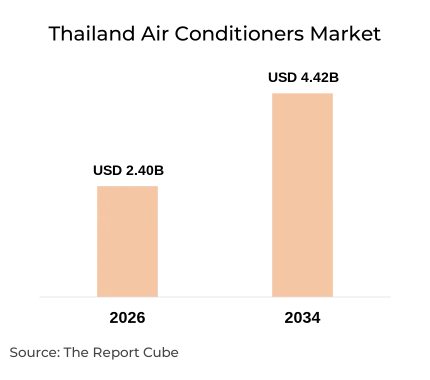
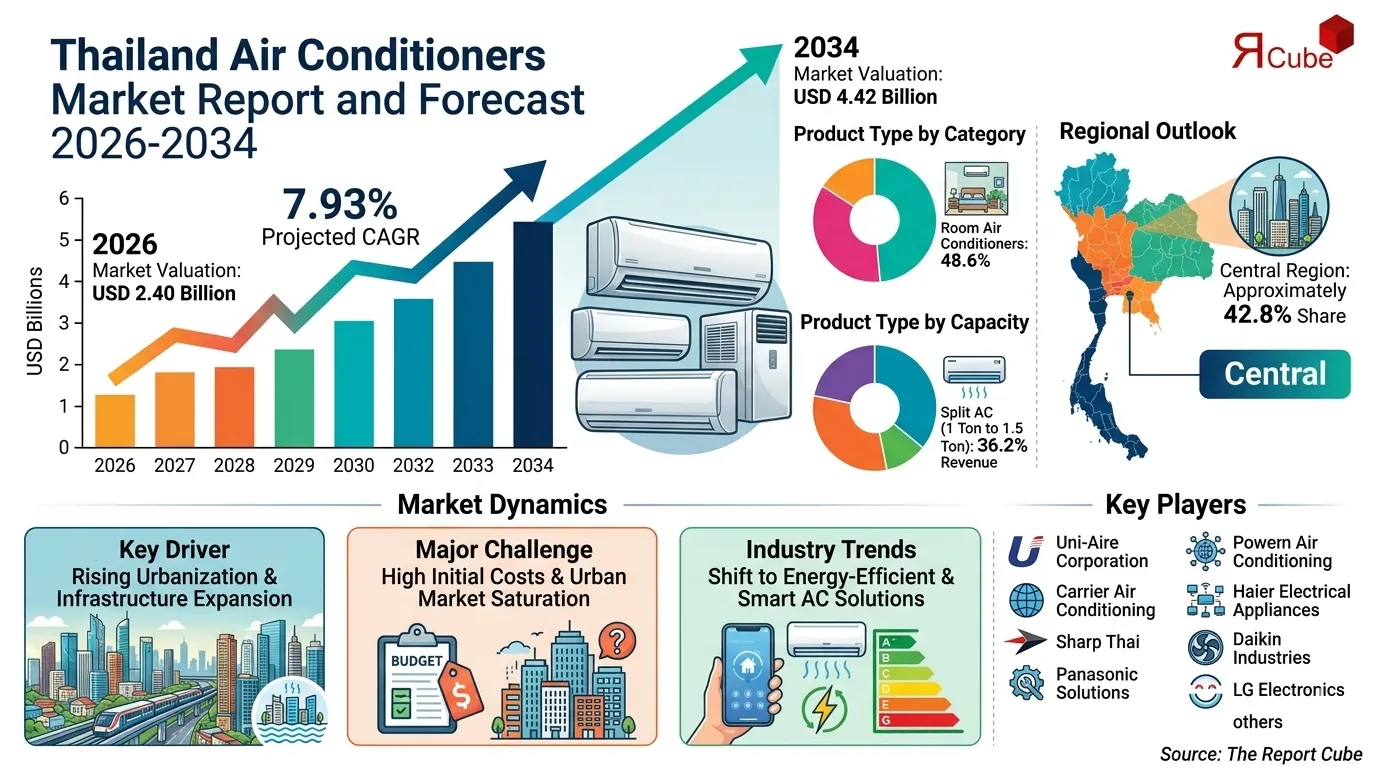
The Thailand Air Conditioners Market is anticipated to register a CAGR of around 7.93% during the forecast period 2026-2034. The market size is valued at USD 2.40 billion in 2026 and is projected to reach USD 4.42 billion by 2034. Thailand continues to see strong air conditioner demand driven by urban housing expansion, rising disposable income, and climate-driven cooling needs. In 2025, the domestic market crossed THB 30 billion, supported by increased adoption of inverter-based systems and energy-efficient cooling solutions. Manufacturers are focusing on product innovation such as smart connectivity, eco-friendly refrigerants, and compact designs suited for urban apartments. Export-oriented production has strengthened Thailand’s position as a manufacturing hub, with a significant share of output shipped to North America and Asia.
Industry activity has intensified as global and regional brands expand local presence. Entry of new players has triggered pricing competition, improving affordability while accelerating technology adoption. Government-backed energy efficiency programs and labeling initiatives are encouraging replacement demand for older systems. Investment in production facilities and supply chain localization is improving cost efficiency and ensuring stable product availability. These factors collectively support sustained market growth, while increasing focus on sustainability and refrigerant transition continues shaping long-term market trends and product development strategies.
Thailand Air Conditioners Market Impact Analysis
| Factor | Type | Specific Impact on Market | Magnitude | Business Implication |
|---|---|---|---|---|
| Rapid growth in Thailand AC demand | Market | Steady value growth with strong medium term CAGR | High | Scale capacity and secure渠道 for long run growth |
| Hot climate and severe heatwaves | Environmental | Year round cooling need, sharper summer peaks | High | Align inventory and promo to March–May peaks |
| Urbanization around Bangkok and hubs | Market | Demand clusters in central and urban corridors | High | Focus渠道, installers and服务 density in cities |
| Dominance of room and split AC units | Market | Major share from residential room air systems | High | Prioritise split and inverter room AC pipeline |
| Shift to inverter and eco friendly models | Technological | Customers replace old units with efficient tech | High | Upgrade designs and stress lifetime bill savings |
| Thailand as export manufacturing hub | Market | Large export share supports规模 and cost base | Medium | Leverage capacity for ASEAN and global exports |
| Energy efficiency rules and labelling | Regulatory | Policies push higher MEPS and better labels | Medium | Stay ahead on specs and use stars in营销 |
| Intensifying brand and price竞争 | Competitive | Global, regional and Chinese brands crowd space | High | Compete via value,品质, service not仅 price |
| Growth of smart and connected AC需求 | Technological | Urban users seek WiFi, app and智能 control | Medium | Bundle smart features on mid and高端 models |
| Consumer price and EMI sensitivity | Consumer | Upfront cost and running bills drive choice | High | Offer tiered ranges plus EMI and cashback支持 |
| Rising focus on环保 refrigerants | Environmental | Move toward low GWP gases in new产品 lines | Medium | Shift portfolio and brand as绿色 cooling partner |
| Expansion of e commerce and数字 search | Consumer | Online ratings, content and reviews sway决策 | Medium | Optimise listings,内容, SEO and omnichannel |
Thailand Air Conditioners Market Dynamics
Key Driver: Rising urban housing demand and climate-driven cooling needs
Thailand’s hot and humid climate continues to drive consistent air conditioner demand across residential and commercial sectors. Rapid urbanization in cities such as Bangkok has increased the number of condominiums and compact housing units, directly supporting the room air conditioners market expansion. Consumers are increasingly prioritizing thermal comfort, leading to higher penetration rates even in mid-income households.
Replacement demand is another strong contributor, as older non-inverter systems are gradually phased out. Energy savings of up to 28% from inverter models encourage consumers to upgrade. Retail financing options and seasonal promotions further boost sales volume, making cooling systems more accessible across wider income groups.
Book your FREE 30-minute expert consultation today
Contact UsIndustry Trends: Shift toward inverter technology and eco-friendly refrigerants
The Thailand air conditioners market trends show a strong shift toward inverter-based systems, which offer improved efficiency and lower electricity consumption. Manufacturers are introducing models with IoT integration, allowing remote control through mobile apps and smart home ecosystems. This aligns with rising consumer interest in convenience and energy monitoring.
Refrigerant transition is shaping product innovation, with R32 gaining strong traction due to lower environmental impact. Brands are phasing out high global warming potential refrigerants and investing in sustainable alternatives. This trend is supported by regulatory pressure and growing awareness among environmentally conscious buyers.
Major Challenge: Price competition and margin pressure from new entrants
Increasing competition from regional manufacturers is creating pricing pressure across the Thailand air conditioners market share. New entrants are offering feature-rich products at competitive price points, forcing established brands to adjust pricing strategies. This impacts profit margins, particularly in the mid-range segment.
Supply chain volatility and fluctuating raw material costs also add complexity. Components such as compressors and electronic parts have experienced price shifts, affecting production costs. Companies must balance affordability with profitability while maintaining product quality and innovation standards.
Opportunity: Expansion of export manufacturing and smart AC adoption
Thailand is strengthening its position as a global air conditioner manufacturing hub, creating opportunities for production expansion and export growth. Strong demand from international markets is encouraging companies to scale operations and invest in advanced manufacturing technologies.
Smart air conditioning systems present a key growth avenue. Increasing adoption of connected homes and energy management solutions is driving demand for intelligent cooling products. Integration with AI-based temperature control and predictive maintenance features is expected to attract tech-savvy consumers and support long-term market growth.
Thailand Air Conditioners Market Segment-wise Analysis
By Product Type:
- Chillers
- Room Air Conditioners
- Cassette Air Conditioners
- Packaged Air Conditioners
- Ducted Split Systems
Room Air Conditioners hold a leading share of 46.20% in the Thailand air conditioners market due to strong residential demand and increasing urban housing projects. Split AC units, especially in the 1 ton to 1.5 ton category, are widely preferred for apartments and small homes. These systems offer energy efficiency, ease of installation, and affordability, making them highly popular among middle-income consumers.
Seasonal temperature peaks further increase sales during summer months. Continuous product upgrades such as inverter compressors and air purification features are strengthening demand. Manufacturers are also focusing on compact designs and aesthetic improvements to match modern interiors, which enhances adoption across urban households and supports segment growth.
By Refrigerant Type:
- R290
- R410A
- R32
- R1234ze / R1234yf
- R134a
- Other Refrigerants
R32 dominates the market with a 41.80% share due to its lower environmental impact and higher energy efficiency compared to traditional refrigerants. The shift toward R32 is supported by government energy efficiency programs and manufacturer initiatives focused on sustainability. This refrigerant requires less charge volume and improves cooling performance, making it suitable for residential and light commercial applications.
Consumer awareness regarding eco-friendly products is also increasing, influencing purchase decisions. Major brands are actively transitioning product lines toward R32-based systems, further accelerating its adoption. As environmental regulations tighten, the demand for low global warming potential refrigerants is expected to remain strong across the Thailand air conditioners market.
Regional Projection of Thailand Air Conditioners Industry
- Northern
- Northeastern
- Central
- Eastern
- Western
- Southern
The Central region leads the Thailand air conditioners market with a 38.60% share, driven by high urban density and strong economic activity. Bangkok and surrounding provinces contribute significantly to sales due to large residential complexes, commercial buildings, and office spaces. The region’s higher income levels and infrastructure development support greater adoption of advanced air conditioning systems.
Demand in this region is further supported by retail expansion, hospitality growth, and commercial real estate projects. Replacement demand is particularly high as older systems are upgraded to energy-efficient models. The presence of distribution networks and service infrastructure also ensures easier product availability and maintenance, reinforcing regional dominance in the overall market.
Thailand Air Conditioners Market Regional Analysis
The Thailand air conditioners market shows strong regional variation driven by altitude, climate conditions, and urban development across coastal, Andean, and tropical regions.
| Region | Key Residential / Industrial Areas | Demand Drivers | Consumer Segment | Popular AC Types | Price Sensitivity | Growth Potential | Key Challenges |
|---|---|---|---|---|---|---|---|
| Northern | Chiang Mai, Chiang Rai; tourism belts | Very hot summers, rising urban tourism | Residential, hotels, small businesses | Split, inverter split and some VRF | Medium, demand tied to income bands | Medium–High, heat spikes and tourism | Lower incomes, grid strain in hot spells |
| Northeastern | Khon Kaen, Udon Thani; agro‑industrial zones | Hot, dry climate and growing townships | Mass residential, basic commercial users | Entry split ACs and select window units | High, highly value upfront affordability | Medium, low base but wide population | Price‑driven buyers, rural service gaps |
| Central | Bangkok, Nonthaburi, Pathum Thani | Dense urban heat, malls, offices, condos | Residential, offices, retail, data hubs | Split, multi‑split, VRF, central systems | Medium, TCO and brand trust matter | High, largest share and steady projects | Traffic, load peaks, space constraints |
| Eastern | Chonburi, Rayong; Eastern Economic Corridor | Industrial estates, ports, expat housing | Industrial, logistics, mid‑high income resi | VRF, rooftop, split and precision cooling | Medium, industry pays for performance | High, EEC‑led industrial expansion | Energy costs, skill need for complex kits |
| Western | Kanchanaburi, Hua Hin; resort corridors | Tourism clusters and growing suburbs | Resorts, villas, mid‑income households | Split, inverter split in rooms and suites | Medium, balance of capex and bills | Medium, tourism and second homes | Seasonality, small‑town installer depth |
| Southern | Phuket, Krabi, Hat Yai; coastal cities | Hot, humid climate and heavy tourism | Hotels, resorts, retail, dense coastal resi | Split, VRF for hotels, some central plants | Low–Medium, cooling seen as essential | High, strong tourism and condo builds | Salt‑air corrosion, storm and power risks |
Need insights for a specific region within this market?
Request Regional DataGovernment Initiatives & Policies
- Energy Efficiency Labeling Program: Thailand’s Ministry of Energy expanded the No.5 labeling scheme in 2025 to promote high-efficiency air conditioners.
- National Cooling Action Plan 2026: Introduced to reduce cooling energy consumption and encourage eco-friendly refrigerants adoption across residential and commercial sectors.
Thailand Air Conditioners Industry Recent Developments
- 2025: Xiaomi Corp entered Thailand’s air conditioner market, intensifying competition with affordable and smart-enabled models. This move reshaped pricing strategies and increased accessibility of advanced cooling technologies across mid-income consumer segments.
- 2026: BRG Building Solutions highlighted Thailand’s strong export performance, noting that 59% of AC exports were directed to the United States in 2025, reinforcing the country’s role as a global manufacturing hub and supporting economies of scale.
Why Choose This Report?
- Provides a comprehensive overview of the overall market analysis, encompassing key trends, consumer behavior analysis, and risk assessment to support strategic decision-making.
- Provides accurate, up-to-date insights into market size, segmentation, and emerging opportunities, helping to minimize risk & capitalizing on growth.
- Gives deep understanding of target audience preferences, investment habits, and communication channels for enhanced product development & marketing effectiveness.
- Delivers competitive analysis & benchmarking, uncovering the strengths & weaknesses of market competitors to guide strategies.
- Consolidate comprehensive market intelligence, reducing reasoning & streamlining research efforts.
- Facilitates customized market segmentation & risk mitigation strategies, fine-tuned to the business objectives.
- Aids in identifying both market challenges & untapped opportunities within the industry to drive long-term business growth.
- Provides valuable information based on actual customer data & search trends.
Table of Contents
- Introduction
- Objective of the Study
- Product and Category Definition
- Market Segmentation
- Study Variables
- Research Methodology
- Secondary Data Points
- Breakdown of Secondary Sources
- Primary Data Points
- Breakdown of Primary Interviews
- Secondary Data Points
- Executive Summary
- Market Dynamics
- Emerging Opportunities
- Adoption Trends
- Demand Drivers
- Disruption Analysis (Challenges)
- Industry Analysis & Strategic Insights
- Supply/Value Chain Analysis
- Pricing Analysis
- Go-To-Market (GTM) Strategy
- BCG Matrix
- Recent Trends and Developments
- Import and Export Analysis
- Regulatory and Policy Landscape
- Region-wise Policies
- Government Initiatives
- Thailand Air Conditioners Market Overview and Forecast Analysis (2021-2034)
- Market Size, By Value, By Growth Rate (CAGR/USD Billion)
- Market Share, By Product Type
- Chillers
- Water-cooled Chillers
- Air-cooled Chillers
- Other Chillers
- Room Air Conditioners
- Split AC
- Up to 1 Ton
- 1 Ton to 1.5 Ton
- Above 1.6 to 2 Ton
- Above 2 Ton
- Window AC
- Up to 1 Ton
- 1 Ton to 2 Ton
- Above 2 Ton
- Split AC
- Cassette Air Conditioners
- Up to 2 Tons
- 2.1 to 4 Tons
- 4.1 to 5 Tons
- Above 5 Tons
- Packaged Air Conditioners
- Up to 5 Tons
- 6 to 10 Tons
- 11 to 20 Tons
- Above 20 Tons
- Ducted Split Systems
- VRF Systems
- Up to 5 Tons
- 6 to 10 Tons
- 11 to 20 Tons
- Above 20 Tons
- Others (Air Handling Units (AHU) / Fan Coil Units (FCU), etc.)
- Chillers
- Market Share, By Refrigerant Type
- R290
- R410A
- R32
- R1234ze / R1234yf
- R134a
- Others
- Market Share, By Distribution Channel
- Multi-brand Stores
- Online
- Direct Sales
- Authorized Dealers and Distributors
- Market Share, By End User
- Retail and Malls
- Pharmaceuticals
- Food and Beverage
- Hotels and Hospitality
- Data Centers
- Offices
- Manufacturing
- Residential
- Educational Institutions
- Hospitals and Healthcare
- Other
- Market Share, By Region
- Northern
- Northeastern
- Central
- Eastern
- Western
- Southern
- Market Share, By Company
- Revenue Shares & Analysis
- Competitive Landscape
- Northern Thailand Air Conditioners Market Overview and Forecast Analysis (2021-2034)
- Market Size, By Value, By Growth Rate (CAGR/USD Billion/Million)
- Market Share, By Product Type
- Market Share, By Refrigerant Type
- Market Share, By Distribution Channel
- Market Share, By End User
- Northeastern Thailand Air Conditioners Market Overview and Forecast Analysis (2021-2034)
- Market Size, By Value, By Growth Rate (CAGR/USD Billion/Million)
- Market Share, By Product Type
- Market Share, By Refrigerant Type
- Market Share, By Distribution Channel
- Market Share, By End User
- Central Thailand Air Conditioners Market Overview and Forecast Analysis (2021-2034)
- Market Size, By Value, By Growth Rate (CAGR/USD Billion/Million)
- Market Share, By Product Type
- Market Share, By Refrigerant Type
- Market Share, By Distribution Channel
- Market Share, By End User
- Eastern Thailand Air Conditioners Market Overview and Forecast Analysis (2021-2034)
- Market Size, By Value, By Growth Rate (CAGR/USD Billion/Million)
- Market Share, By Product Type
- Market Share, By Refrigerant Type
- Market Share, By Distribution Channel
- Market Share, By End User
- Western Thailand Air Conditioners Market Overview and Forecast Analysis (2021-2034)
- Market Size, By Value, By Growth Rate (CAGR/USD Billion/Million)
- Market Share, By Product Type
- Market Share, By Refrigerant Type
- Market Share, By Distribution Channel
- Market Share, By End User
- Southern Thailand Air Conditioners Market Overview and Forecast Analysis (2021-2034)
- Market Size, By Value, By Growth Rate (CAGR/USD Billion/Million)
- Market Share, By Product Type
- Market Share, By Refrigerant Type
- Market Share, By Distribution Channel
- Market Share, By End User
- Competitive Analysis, 2026
- Market Share of Key Players
- Competitive Mapping for Each Segment and Companies Operating Regionally
- Northern Thailand Air Conditioners Companies Share & Competitive Analysis, 2026
- Northeastern Thailand Air Conditioners Companies Share & Competitive Analysis, 2026
- Central Thailand Air Conditioners Companies Share & Competitive Analysis, 2026
- Eastern Thailand Air Conditioners Companies Share & Competitive Analysis, 2026
- Western Thailand Air Conditioners Companies Share & Competitive Analysis, 2026
- Southern Thailand Air Conditioners Companies Share & Competitive Analysis, 2026
- Company Profile (Partial List)
- Samsung Corp
- Company Overview
- Product Portfolio
- Strategic Alliances/Partnerships
- Recent Developments
- Carrier Global Corp
- Company Overview
- Product Portfolio
- Strategic Alliances/Partnerships
- Recent Developments
- TCL Corp
- Company Overview
- Product Portfolio
- Strategic Alliances/Partnerships
- Recent Developments
- Daikin Industries Ltd
- Company Overview
- Product Portfolio
- Strategic Alliances/Partnerships
- Recent Developments
- Mitsubishi Electric Corp
- Company Overview
- Product Portfolio
- Strategic Alliances/Partnerships
- Recent Developments
- Gree Electric Appliances Inc of Zhuhai
- Company Overview
- Product Portfolio
- Strategic Alliances/Partnerships
- Recent Developments
- LG Corp
- Company Overview
- Product Portfolio
- Strategic Alliances/Partnerships
- Recent Developments
- Midea Group Co Ltd
- Company Overview
- Product Portfolio
- Strategic Alliances/Partnerships
- Recent Developments
- Hisense Group
- Company Overview
- Product Portfolio
- Strategic Alliances/Partnerships
- Recent Developments
- Haier Group
- Company Overview
- Product Portfolio
- Strategic Alliances/Partnerships
- Recent Developments
- Others (Partial List)
- Samsung Corp
- Contact Us and Disclaimer
Top Key Players & Market Share Outlook
- Samsung Corp
- Carrier Global Corp
- TCL Corp
- Daikin Industries Ltd
- Mitsubishi Electric Corp
- Gree Electric Appliances Inc of Zhuhai
- LG Corp
- Midea Group Co Ltd
- Hisense Group
- Haier Group
Frequently Asked Questions






