



Build Your Custom Market Intelligence Report
Customize Your ReportIndonesia Air Conditioners Market Key Highlights
By Product Type:
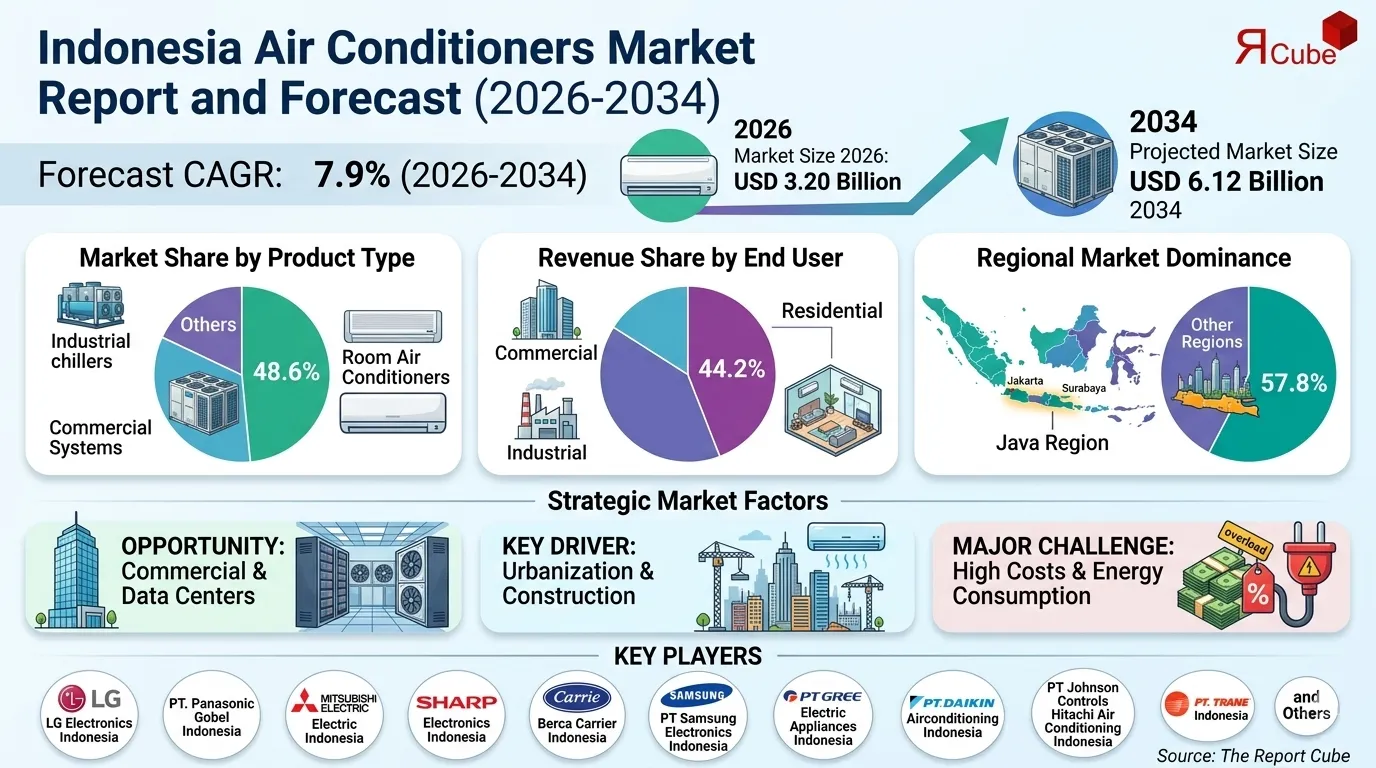
Room Air Conditioners segment leads the market with 48.6% share.
By End User:
Residential segment dominates the market with 44.2% of revenue.
Regional Outlook:
Java region dominates the Indonesia Air Conditioners market with 57.8% share.
Indonesia Air Conditioners Market Insights & Analysis
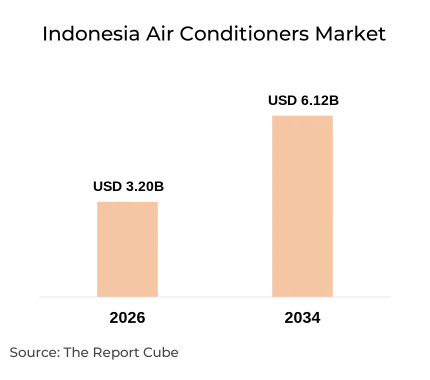
The Indonesia Air Conditioners Market is anticipated to register a CAGR of around 7.9% during the forecast period 2026-2034. The market size is valued at USD 3.20 billion in 2026 and is projected to reach USD 6.12 billion by 2034. Growth in the Indonesia air conditioners market size is being shaped by rapid urban housing expansion, rising disposable income, and a sharp increase in cooling demand across tropical urban centers. The country’s hot and humid climate continues to drive year-round demand, while electrification and residential construction have expanded access to modern HVAC systems. Data from housing development agencies suggests that over 780,000 new residential units were added in 2025 alone, creating a strong base for AC adoption.
Investment trends also reveal a shift toward localized manufacturing and energy-efficient technologies. Leading companies are increasing domestic production capacity to meet local demand and comply with domestic content requirements. At the same time, inverter-based and smart air conditioners are gaining traction, accounting for nearly 36% of total unit sales in 2025. Government energy efficiency programs and rising electricity tariffs are encouraging consumers to adopt energy-saving units, which is accelerating innovation across the Indonesia air conditioners market growth landscape.
Indonesia Air Conditioners Market Impact Analysis
| Factor | Type | Specific Impact on Market | Magnitude | Business Implication |
|---|---|---|---|---|
| Steady growth in AC demand | Market | Market expanding with strong residential uptake | High | Scale capacity and deepen reach in growth clusters |
| Tropical climate and rising heat | Environmental | Hot, humid weather lifts baseline cooling needs | High | Align inventory to peak summer and heat events |
| Urbanisation and housing projects | Market | New apartments and complexes boost installs | High | Target developers and new housing corridors |
| Rising middle class incomes | Consumer | More first time buyers enter AC category | High | Offer entry models with aspirational features |
| Preference for split AC systems | Market | Growing tilt toward split over window units | Medium | Prioritise split portfolio and indoor aesthetics |
| Shift to inverter and efficient units | Technological | Demand rising for lower power consumption ACs | High | Expand inverter line and highlight bill savings |
| Energy efficiency policies and plans | Regulatory | I‑NCAP and labelling push efficient products | Medium | Ensure compliance and use labels in branding |
| Dominance of low efficiency models | Market | Large installed base still uses inefficient units | Medium | Position efficient ranges as replacement choice |
| Presence of global and local brands | Competitive | Strong rivalry on price, features and channels | High | Differentiate on service, reliability and value |
| High upfront and installation costs | Consumer | Price and set up costs slow some purchases | Medium | Bundle EMIs, promos and value financing options |
| Growth in commercial and HVAC projects | Market | Offices and malls add steady AC demand pool | Medium | Develop project sales and key account focus |
| Environmental and refrigerant transition | Environmental | Policies push low GWP and climate friendly tech | Medium | Adopt greener gases and promote sustainability |
Indonesia Air Conditioners Market Dynamics
Key Driver: Rising Urbanization and Residential Construction Boosting Cooling Demand
One of the strongest growth drivers in the Indonesian air conditioners market is the rapid pace of urbanization, particularly in cities like Jakarta and Surabaya. Urban population growth has crossed 57% and continues to rise steadily, pushing demand for residential cooling systems. Developers are increasingly integrating air conditioning units as standard amenities in mid-range and premium housing projects. This shift is significantly increasing the penetration rate of room air conditioners across urban households.
Alongside urban growth, climate patterns have intensified the need for consistent indoor cooling. Average temperatures in major Indonesian cities have increased by nearly 1.2°C over the past decade, directly impacting consumer buying behavior. As a result, the Indonesia air conditioners market demand is witnessing strong momentum, especially in affordable split AC categories that cater to middle-income households.
Book your FREE 30-minute expert consultation today
Contact UsIndustry Trends: Shift Toward Energy-Efficient and Smart HVAC Technologies
A major trend shaping the Indonesia air conditioner market is the growing shift toward inverter-based and smart AC systems. With electricity costs steadily rising, consumers are thinking more carefully about energy use and long-term savings, which is pushing demand toward more efficient models. This change in mindset is already visible in the market, as inverter AC sales increased by over 22% year-on-year in 2025, showing a clear move away from traditional units toward smarter, energy-saving options.
In addition, smart home integration is gaining ground, particularly among urban consumers. Features such as remote control via mobile apps, AI-based cooling adjustments, and energy monitoring are becoming standard offerings. These innovations are not only enhancing user convenience but also improving operational efficiency, contributing to the overall Indonesia air conditioners market trends.
Major Challenge: High Initial Costs and Energy Consumption Concerns
While demand is increasing, high upfront costs remain a significant barrier in the Indonesia air conditioners market. Advanced systems such as VRF and inverter ACs come with higher price points, limiting their adoption among lower-income groups. Even though long-term savings are evident, initial investment concerns often delay purchase decisions.
Moreover, electricity consumption associated with air conditioners continues to be a concern for both consumers and policymakers. Cooling systems account for nearly 40% of household electricity usage in urban Indonesia. This has led to stricter regulations and efficiency standards, which, while beneficial in the long run, pose short-term challenges for manufacturers in terms of compliance costs and product redesign.
Opportunity: Expansion of Commercial Infrastructure and Data Centers
The expansion of commercial infrastructure presents a major opportunity for the Indonesia air conditioners market. Growth in shopping malls, office complexes, and hospitality sectors is driving demand for centralized and packaged air conditioning systems. The commercial HVAC segment recorded a growth rate of approximately 8.5% in 2025, reflecting strong infrastructure development.
Furthermore, the rising number of data centers across Indonesia is creating demand for precision cooling solutions. With digital transformation accelerating, the need for reliable cooling in server environments is increasing. This trend is expected to open new revenue streams for advanced HVAC solutions, boosting the Indonesia air conditioners market share in high-capacity systems.
Indonesia Air Conditioners Market Segment-wise Analysis
By Product Type:
- Chillers
- Room Air Conditioners
- Cassette Air Conditioners
- Packaged Air Conditioners
- Ducted Split Systems
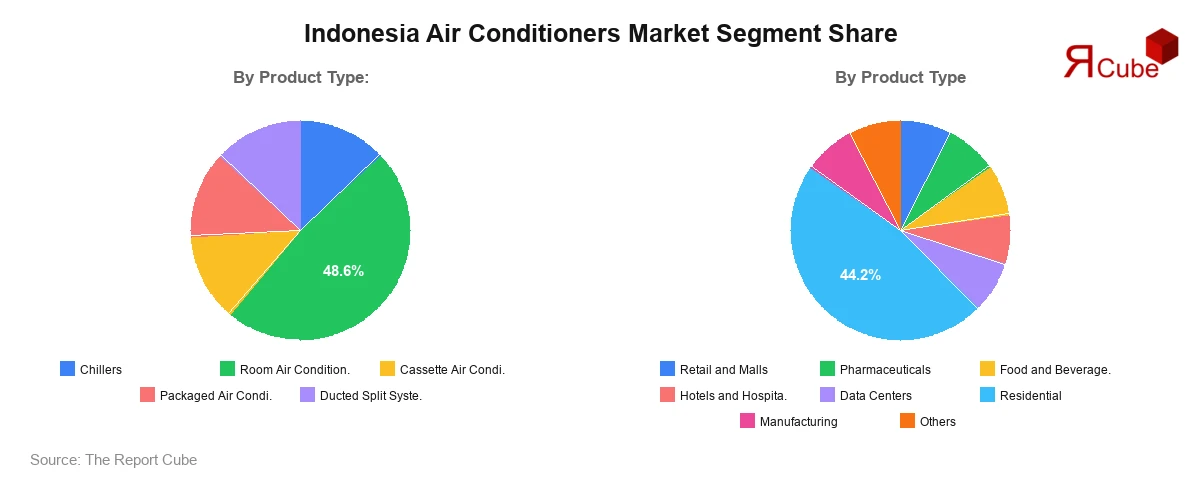
Room Air Conditioners dominate the Indonesia air conditioners market share, accounting for nearly 48.6% of total revenue in 2025. Among these, split AC units hold the majority due to their energy efficiency, ease of installation, and suitability for residential use. Units in the 1 ton to 1.5 ton category are particularly popular, contributing over 52% of split AC sales.
Increasing urban housing and rising middle-class income levels are supporting this segment’s growth. Additionally, manufacturers are offering flexible pricing and financing options, making these systems more accessible to a broader consumer base.
By End User:
- Retail and Malls
- Pharmaceuticals
- Food and Beverage
- Hotels and Hospitality
- Data Centers
- Offices
- Manufacturing
- Residential
- Educational Institutions
- Hospitals and Healthcare
The residential segment leads the Indonesia air conditioners market demand, capturing approximately 44.2% of total market revenue. Increasing home ownership rates and improved access to financing have made air conditioners more attainable for households. Urban households, in particular, are upgrading from fans to AC systems due to comfort preferences and rising temperatures.
Additionally, government-backed housing programs have contributed to higher adoption rates, especially in suburban regions. The trend toward compact and energy-efficient models is further strengthening this segment’s position.
Regional Projection of Indonesia Air Conditioners Industry
- Sumatra
- Java
- Kalimantan
- Sulawesi
- Nusa Tenggara
- Maluku
- Papua
Java holds the largest share in the Indonesia air conditioners market, contributing approximately 57.8% of the overall revenue. The region’s dominance is supported by its high population density, advanced urban infrastructure, and strong economic activity. Cities like Jakarta, Bandung, and Surabaya are key demand centers, driven by residential, commercial, and industrial expansion.
Additionally, the presence of manufacturing hubs and better electricity infrastructure supports higher AC adoption rates. Increasing investments in smart buildings and commercial complexes are expected to further strengthen Java’s leading position in the Indonesia air conditioners market growth.
Indonesia Air Conditioners Market Regional Analysis
The Indonesia air conditioners market shows strong regional variation driven by altitude, climate conditions, and urban development across coastal, Andean, and tropical regions.
| Cluster | Demand Level | Key Areas | System Dominance | Core Demand Logic | Growth Nature |
|---|---|---|---|---|---|
| Sumatra | Medium–High | Medan, Palembang, Batam belts | Residential splits, light commercial | Rising urban homes and agro industry | Steady, led by urban town expansion |
| Java | Very High | Jakarta, Bandung, Surabaya corridor | Split, multi‑split, VRF in high‑rises | Dense, higher income, service economy | Fast, core driver of national market |
| Kalimantan | Medium | Balikpapan, Samarinda, mining hubs | Splits, ducted and packaged units | Resource projects and support towns | Project‑linked, cyclical industrial led |
| Sulawesi | Medium | Makassar, Manado, coastal cities | Residential splits, small commercial | Port, trade and growing services | Gradual, in line with urban growth |
| Nusa Tenggara | Low–Medium | Lombok, Sumbawa, tourist pockets | Splits in villas, hotels, guesthouses | Seasonal tourism and villa projects | Niche, tourism and resort driven |
| Maluku | Low | Ambon and scattered island towns | Basic splits and limited portables | Small urban base, public buildings | Slow, constrained by scale and access |
| Papua | Low–Medium | Jayapura, Timika, resource enclaves | Splits, packaged for camps, offices | Mining camps and admin centres | Patchy, tied to large projects |
Government Initiatives & Policies
- Minimum Energy Performance Standards (MEPS): Indonesia strengthened its MEPS regulations in 2025 to improve energy efficiency in air conditioners. The policy mandates higher efficiency ratings and supports reduced electricity consumption.
- Domestic Component Level (TKDN) Policy: The government promotes local manufacturing by requiring minimum domestic content in HVAC products. This initiative encourages investment in local production facilities and reduces import dependency.
Indonesia Air Conditioners Industry Recent Developments
- 2025: PT. Daikin Airconditioning Indonesia launched its first residential AC manufacturing facility with an annual capacity of 1.5 million units. The plant focuses on inverter AC production to meet energy efficiency demand and supports localized manufacturing strategies.
- 2025: PT. LG Electronics Indonesia established a new production facility in Bekasi with a capacity of 700,000 units annually. The plant aligns with domestic content requirements and strengthens local supply chains.
- 2026: PT Samsung Electronics Indonesia introduced AI-powered HVAC systems with energy-saving features that reduce electricity consumption by up to 30%, targeting smart home adoption.
- 2025: PT. Mitsubishi Electric Indonesia relocated its headquarters to enhance operational efficiency and strengthen its integrated HVAC solutions business in Indonesia.
Need insights for a specific region within this market?
Request Regional DataWhy Choose This Report?
- Provides a comprehensive overview of the overall market analysis, encompassing key trends, consumer behavior analysis, and risk assessment to support strategic decision-making.
- Provides accurate, up-to-date insights into market size, segmentation, and emerging opportunities, helping to minimize risk & capitalizing on growth.
- Gives deep understanding of target audience preferences, investment habits, and communication channels for enhanced product development & marketing effectiveness.
- Delivers competitive analysis & benchmarking, uncovering the strengths & weaknesses of market competitors to guide strategies.
- Consolidate comprehensive market intelligence, reducing reasoning & streamlining research efforts.
- Facilitates customized market segmentation & risk mitigation strategies, fine-tuned to the business objectives.
- Aids in identifying both market challenges & untapped opportunities within the industry to drive long-term business growth.
- Provides valuable information based on actual customer data & search trends.
Table of Contents
- Introduction
- Objective of the Study
- Product and Category Definition
- Market Segmentation
- Study Variables
- Research Methodology
- Secondary Data Points
- Breakdown of Secondary Sources
- Primary Data Points
- Breakdown of Primary Interviews
- Secondary Data Points
- Executive Summary
- Market Dynamics
- Emerging Opportunities
- Adoption Trends
- Demand Drivers
- Disruption Analysis (Challenges)
- Industry Analysis and Strategic Insights
- Supply and Value Chain Analysis
- Pricing Analysis
- Go-to-Market Strategy
- BCG Matrix
- Recent Trends and Developments
- Import and Export Analysis
- Regulatory and Policy Landscape
- Region-wise Policies
- Government Initiatives
- Indonesia Air Conditioners Market Overview and Forecast (2021-2034)
- Market Size, By Value, By Growth Rate (CAGR / USD Billion)
- Market Share, By Product Type
- Chillers
- Water-cooled Chillers
- Air-cooled Chillers
- Other Chillers
- Room Air Conditioners
- Split AC
- Up to 1 Ton
- 1 Ton to 1.5 Ton
- Above 1.6 to 2 Ton
- Above 2 Ton
- Window AC
- Up to 1 Ton
- 1 Ton to 2 Ton
- Above 2 Ton
- Split AC
- Cassette Air Conditioners
- Up to 2 Tons
- 2.1 to 4 Tons
- 4.1 to 5 Tons
- Above 5 Tons
- Packaged Air Conditioners
- Up to 5 Tons
- 6 to 10 Tons
- 11 to 20 Tons
- Above 20 Tons
- Ducted Split Systems
- VRF Systems
- Up to 5 Tons
- 6 to 10 Tons
- 11 to 20 Tons
- Above 20 Tons
- Others (Air Handling Units (AHU) / Fan Coil Units (FCU), etc.)
- Chillers
- Market Share, By Refrigerant Type
- R290
- R410A
- R32
- R1234ze / R1234yf
- R134a
- Other Refrigerants
- Market Share, By Distribution Channel
- Multi-brand Stores
- Online
- Direct Sales
- Authorized Dealers and Distributors
- Market Share, By End User
- Retail and Malls
- Pharmaceuticals
- Food and Beverage
- Hotels and Hospitality
- Data Centers
- Offices
- Manufacturing
- Residential
- Educational Institutions
- Hospitals and Healthcare
- Other End Users
- Market Share, By Region
- Sumatra
- Java
- Kalimantan
- Sulawesi
- Nusa Tenggara
- Maluku
- Papua
- Market Share, By Company
- Revenue Shares and Analysis
- Competitive Landscape
- Sumatra Air Conditioners Market Overview and Forecast (2021-2034)
- Market Size, By Value, By Growth Rate (CAGR / USD Billion / Million)
- Market Share, By Product Type
- Market Share, By Refrigerant Type
- Market Share, By Distribution Channel
- Market Share, By End User
- Java Air Conditioners Market Overview and Forecast (2021-2034)
- Market Size, By Value, By Growth Rate (CAGR / USD Billion / Million)
- Market Share, By Product Type
- Market Share, By Refrigerant Type
- Market Share, By Distribution Channel
- Market Share, By End User
- Kalimantan Air Conditioners Market Overview and Forecast (2021-2034)
- Market Size, By Value, By Growth Rate (CAGR / USD Billion / Million)
- Market Share, By Product Type
- Market Share, By Refrigerant Type
- Market Share, By Distribution Channel
- Market Share, By End User
- Sulawesi Air Conditioners Market Overview and Forecast (2021-2034)
- Market Size, By Value, By Growth Rate (CAGR / USD Billion / Million)
- Market Share, By Product Type
- Market Share, By Refrigerant Type
- Market Share, By Distribution Channel
- Market Share, By End User
- Nusa Tenggara Air Conditioners Market Overview and Forecast (2021-2034)
- Market Size, By Value, By Growth Rate (CAGR / USD Billion / Million)
- Market Share, By Product Type
- Market Share, By Refrigerant Type
- Market Share, By Distribution Channel
- Market Share, By End User
- Maluku Air Conditioners Market Overview and Forecast (2021-2034)
- Market Size, By Value, By Growth Rate (CAGR / USD Billion / Million)
- Market Share, By Product Type
- Market Share, By Refrigerant Type
- Market Share, By Distribution Channel
- Market Share, By End User
- Papua Air Conditioners Market Overview and Forecast (2021-2034)
- Market Size, By Value, By Growth Rate (CAGR / USD Billion / Million)
- Market Share, By Product Type
- Market Share, By Refrigerant Type
- Market Share, By Distribution Channel
- Market Share, By End User
- Competitive Analysis, 2026
- Market Share of Key Players
- Competitive Mapping By Segment and Region
- Sumatra Air Conditioners Companies Share and Competitive Analysis, 2026
- Java Air Conditioners Companies Share and Competitive Analysis, 2026
- Kalimantan Air Conditioners Companies Share and Competitive Analysis, 2026
- Sulawesi Air Conditioners Companies Share and Competitive Analysis, 2026
- Nusa Tenggara Air Conditioners Companies Share and Competitive Analysis, 2026
- Maluku Air Conditioners Companies Share and Competitive Analysis, 2026
- Papua Air Conditioners Companies Share and Competitive Analysis, 2026
- Company Profiles (Partial List)
- PT. LG Electronics Indonesia
- Company Overview
- Product Portfolio
- Strategic Alliances/Partnerships
- Recent Developments
- PT. Panasonic Gobel Indonesia
- Company Overview
- Product Portfolio
- Strategic Alliances/Partnerships
- Recent Developments
- PT. Mitsubishi Electric Indonesia
- Company Overview
- Product Portfolio
- Strategic Alliances/Partnerships
- Recent Developments
- PT. Sharp Electronics Indonesia
- Company Overview
- Product Portfolio
- Strategic Alliances/Partnerships
- Recent Developments
- PT. Berca Carrier Indonesia
- Company Overview
- Product Portfolio
- Strategic Alliances/Partnerships
- Recent Developments
- PT Samsung Electronics Indonesia
- Company Overview
- Product Portfolio
- Strategic Alliances/Partnerships
- Recent Developments
- PT. Gree Electric Appliances Indonesia
- Company Overview
- Product Portfolio
- Strategic Alliances/Partnerships
- Recent Developments
- PT. Daikin Airconditioning Indonesia
- Company Overview
- Product Portfolio
- Strategic Alliances/Partnerships
- Recent Developments
- PT Johnson Controls Hitachi Air Conditioning Indonesia
- Company Overview
- Product Portfolio
- Strategic Alliances/Partnerships
- Recent Developments
- PT. Trane Indonesia
- Company Overview
- Product Portfolio
- Strategic Alliances/Partnerships
- Recent Developments
- Others (Partial List)
- PT. LG Electronics Indonesia
- Contact Us and Disclaimer
Top Key Players & Market Share Outlook
- PT. LG Electronics Indonesia
- PT. Panasonic Gobel Indonesia
- PT. Mitsubishi Electric Indonesia
- PT. Sharp Electronics Indonesia
- PT. Berca Carrier Indonesia
- PT Samsung Electronics Indonesia
- PT. Gree Electric Appliances Indonesia
- PT. Daikin Airconditioning Indonesia
- PT Johnson Controls Hitachi Air Conditioning Indonesia
- PT. Trane Indonesia
Frequently Asked Questions






