



Build Your Custom Market Intelligence Report
Customize Your ReportMalaysia Air Conditioners Market Key Highlights
By Product Type:
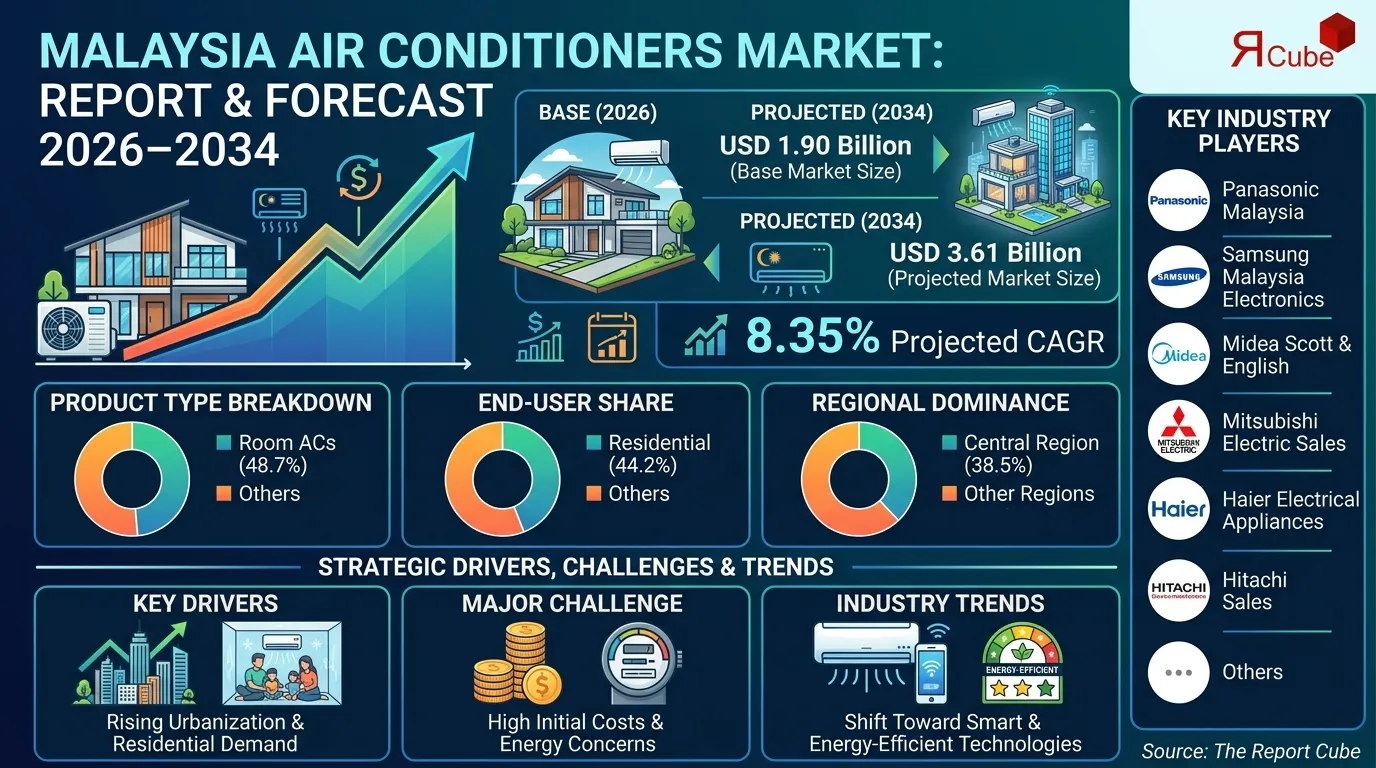
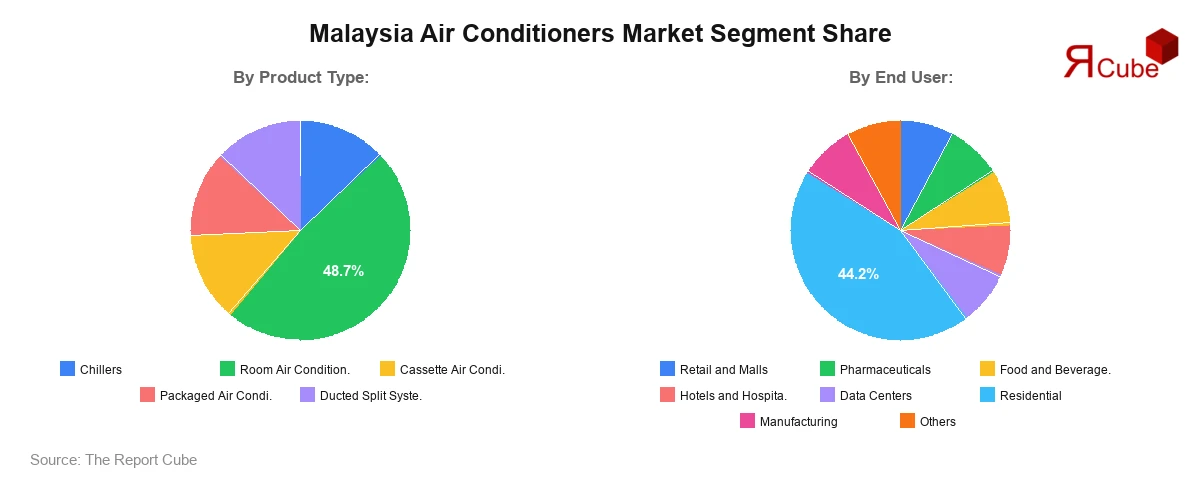
Room Air Conditioners segment leads the market with 48.7% share.
By End User:
Residential segment dominates the market with 44.2% of revenue.
Regional Outlook:
Central region dominates the Malaysia Air Conditioners Market with 38.5% share.
Malaysia Air Conditioners Market Insights & Analysis
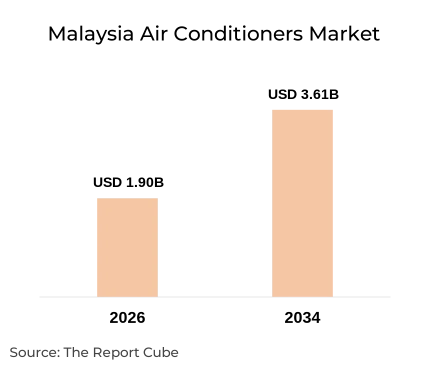
The Malaysia Air Conditioners Market is anticipated to register a CAGR of around 8.35% during the forecast period 2026-2034. The market size is valued at USD 1.90 billion in 2026 and is projected to reach USD 3.61 billion by 2034. A closer look at Malaysia air conditioners market size and growth trends shows strong momentum driven by urban housing demand and climate conditions. Malaysia records average temperatures between 27°C and 32°C, which continues to support consistent cooling demand across residential and commercial segments. In 2025, over 62% of newly launched residential units in Kuala Lumpur integrated inverter-based air conditioning systems, reflecting a shift toward energy-efficient solutions.
Investment activity and innovation are shaping the Malaysia air conditioners market share and demand outlook. Major manufacturers are strengthening local production and R&D capabilities, supported by Malaysia’s position as an ASEAN manufacturing hub. For instance, Panasonic expanded its compressor and HVAC manufacturing facilities, while companies like Samsung and Haier introduced AI-driven cooling technologies with energy optimization features. In addition, government-backed sustainability targets under Malaysia’s energy transition roadmap are accelerating adoption of eco-friendly refrigerants such as R32 and R290. These developments, combined with increasing demand from sectors like data centers and hospitality, are reinforcing long-term Malaysia air conditioners market growth.
Malaysia Air Conditioners Market Impact Analysis
| Factor | Type | Specific Impact on Market | Magnitude | Business Implication |
|---|---|---|---|---|
| Hot Humid Climate and Year-Round Cooling Need | Environmental | Sustains baseline residential and light commercial demand | High | Maintain broad AC portfolio tuned for tropical humidity |
| Rising Urbanisation in Klang Valley and Key Cities | Market | Concentrates AC installations in dense urban corridors | High | Prioritise dealers and projects in KL, Selangor, Penang |
| Growth in Residential Construction and High-Rises | Market | Boosts split AC penetration in new apartment projects | High | Forge developer tie-ups and bundle ACs with new units |
| Government Push for Energy-Efficient Technologies | Regulatory | Accelerates shift to inverter and high-star AC models | High | Align specs with MEPS rules and use labels in marketing |
| Incentives for Low-GWP and Eco-Friendly Refrigerants | Regulatory | Favours products using R32, R290 and green solutions | Medium | Reengineer lines to compliant gases and signal eco focus |
| Expansion of Data Centers and Commercial Facilities | Market | Lifts demand for VRF, precision and central AC systems | Medium | Develop project sales team targeting DCs and business |
| Consumer Shift to Inverter and Smart Connected Units | Technological | Raises expectations for comfort, control and efficiency | Medium | Add IoT features and apps on mid to premium Malaysia SKUs |
| Strong Presence of Japanese, Korean and Chinese Brands | Competitive | Intensifies price, feature and promotion competition | High | Position on reliability, service and Malaysia tailoring |
| Growth of E-Commerce and Omnichannel AC Purchases | Market | Shifts research and deal discovery to online platforms | Medium | Strengthen marketplace listings, reviews and bundling |
| Rising Focus on Indoor Air Quality and Filtration | Consumer | Stimulates interest in ACs with filters and purification | Medium | Integrate IAQ features and highlight health messaging |
Malaysia Air Conditioners Market Dynamics
Key Driver: Rising Urbanization and Residential Cooling Demand
Rapid urban development continues to influence Malaysia air conditioners market demand and size expansion. Malaysia’s urban population exceeded 78% in 2025, leading to higher construction of high-rise apartments and mixed-use developments. This shift has significantly increased the installation of split air conditioners, particularly in metropolitan areas such as Kuala Lumpur and Selangor. Consumers are prioritizing energy-efficient inverter ACs, which accounted for nearly 65% of residential sales in 2025.
Alongside housing growth, rising disposable income is enabling households to invest in advanced cooling solutions. Middle-income households are upgrading from conventional window units to smart split systems equipped with IoT connectivity. This trend is strengthening Malaysia air conditioners market growth, while also boosting demand for premium features such as air purification and humidity control.
Book your FREE 30-minute expert consultation today
Contact UsIndustry Trends: Shift Toward Smart and Energy-Efficient Technologies
Technology advancements are reshaping trends in the Malaysia air conditioners market, with smart AC systems gaining notable popularity. AI-driven climate control features that adjust based on user habits are becoming more common, particularly in urban homes. By 2026, close to 35% of newly installed air conditioners in Malaysia are expected to come with smart connectivity options, allowing control through mobile apps or voice assistants.
At the same time, there is a clear move toward refrigerants with lower global warming impact. Manufacturers are gradually replacing R410A with more environmentally friendly options such as R32 and R290. This transition supports Malaysia’s environmental goals and contributes to the long-term sustainability of the air conditioning market. In commercial spaces as well, demand is shifting toward VRF systems, as businesses look for solutions that offer higher energy efficiency and flexible cooling across large buildings.
Major Challenge: High Initial Costs and Energy Consumption Concerns
Even though demand is increasing, high upfront costs remain a barrier to Malaysia air conditioners market penetration. Advanced systems such as VRF and smart AC units can cost up to 25% more than conventional systems, limiting adoption among price-sensitive consumers. Small and medium enterprises also face budget constraints when upgrading HVAC infrastructure.
Energy consumption continues to be another concern impacting Malaysia's air conditioner market growth. Air conditioning accounts for nearly 40% of electricity usage in commercial buildings across Malaysia. This has led to increased scrutiny from regulators and consumers, pushing manufacturers to focus on energy labeling and efficiency improvements. However, achieving affordability alongside efficiency remains a key industry challenge.
Opportunity: Expansion of Commercial Infrastructure and Data Centers
The expansion of commercial infrastructure is opening new opportunities in the Malaysia air conditioners market. Malaysia is emerging as a regional hub for data centers, with investments exceeding USD 5 billion between 2024 and 2026. Data centers require high-performance cooling systems, including precision air conditioning and VRF systems, which is boosting demand across the commercial segment.
Hospitality and retail sectors are also contributing to Malaysia air conditioners market growth. The recovery of tourism has increased hotel occupancy rates, leading to renovation and installation of advanced HVAC systems. Moreover, green building certifications are encouraging developers to adopt energy-efficient cooling solutions, further strengthening market demand and innovation.
Malaysia Air Conditioners Market Segment-wise Analysis
By Product Type:
- Chillers
- Room Air Conditioners
- Cassette Air Conditioners
- Packaged Air Conditioners
- Ducted Split Systems
The room air conditioners segment holds the leading position in the Malaysia air conditioners market, accounting for around 48.7% share in 2026. This dominance largely comes from strong residential demand, especially in urban housing where split AC units make up nearly 80% of installations within the segment. Within this category, the 1 ton to 1.5 ton capacity range is the most widely preferred, contributing close to 52% of total unit sales, as it fits well with typical apartment and small home cooling needs.
Growing interest in inverter-based models and smart connectivity features is also strengthening this segment further. As consumers look for better energy efficiency and more convenient control options, room air conditioners continue to play a central role in driving overall market expansion in Malaysia.
By End User:
- Retail and Malls
- Pharmaceuticals
- Food and Beverage
- Hotels and Hospitality
- Data Centers
- Offices
- Manufacturing
- Residential
- Educational Institutions
- Hospitals and Healthcare
- Other
The residential segment remains the largest contributor to the Malaysia air conditioners market, holding about 44.2% revenue share. This strong position is supported by rising home ownership and a growing focus on improving indoor comfort, especially in urban areas. In 2025, close to 70% of households in Malaysia were reported to have at least one air conditioning unit, while multi-unit setups are becoming more common in city homes.
Easy access to financing options, along with the wider availability of energy-efficient models, has also made it simpler for first-time buyers to invest in air conditioners. These factors together continue to support steady demand and strengthen the role of the residential segment in overall market growth.
Regional Projection of Malaysia Air Conditioners Industry
- Northern
- Central
- Southern
- East
- Others
The central region leads the Malaysia air conditioners market, contributing around 38.5% of total demand. This position is mainly driven by dense urban populations, strong business activity, and ongoing infrastructure development across key areas like Kuala Lumpur and Selangor.
Higher adoption of advanced cooling technologies is also noticeable in this region, with VRF systems and smart air conditioners increasingly used in commercial buildings as well as premium residential projects. In addition, continued investments in office spaces and the expansion of data centers are further strengthening demand, reinforcing the central region’s dominant role in the overall market growth.
Malaysia Air Conditioners Market Regional Analysis
The Malaysia air conditioners market varies significantly across regions due to diverse climatic conditions, urban concentration, and economic activity.
| Region | Key Residential Areas / Industrial Zones | Demand Drivers | Consumer Segment | Popular AC Types | Price Sensitivity | Growth Potential | Key Challenges |
|---|---|---|---|---|---|---|---|
| Central (Kuala Lumpur & Selangor) | Kuala Lumpur, Selangor, Putrajaya, Office districts | High urbanization, better living standards, density | Residential (34% share), Commercial, Industrial | Split AC, Multi-split, VRF, Central HVAC, Smart | Low to Medium | High - Largest share, highest purchasing power | Market saturation, intense competition, pricing |
| Northern (Penang, Kedah, Perak, Perlis) | Penang, Kedah, Perak, Manufacturing & electronics | Manufacturing hubs, logistics, precision cooling | Industrial (electronics), Commercial, Residential | Precision AC, VRF, Split AC, Heat pumps | Medium | Medium to High - Green manufacturing, cleanrooms | Thermal tolerance needs, tech adoption, investment |
| Southern (Johor, Melaka, Negeri Sembilan) | Johor Bahru, Melaka, Cross-border zones, JS-SEZ | Singapore proximity, cross-border trade, expatriates | Residential, Commercial (hospitality), Industrial | Split AC, Multi-split, VRF, Central systems | Medium | High - JS-SEZ investments, influx of workers | Infrastructure pace, affordability vs Singapore |
| East (Sabah & Sarawak - East Malaysia) | Kuching, Kota Kinabalu, Emerging urban centers | Infrastructure upgrades, govt investment, urbanization | Residential (growing), Commercial, Government | Split AC, Window AC, Multi-split systems | High | Fastest growing - Steady rise, new developments | Lower disposable income, slower retail penetration |
Need insights for a specific region within this market?
Request Regional DataGovernment Initiatives & Policies
- National Energy Transition Roadmap (NETR): Malaysia’s 2025 roadmap promotes energy-efficient appliances and low-carbon technologies, encouraging adoption of high-efficiency air conditioners.
- Minimum Energy Performance Standards (MEPS) Update 2025: Malaysia strengthened energy labeling requirements for cooling appliances to reduce electricity consumption and improve efficiency standards.
Malaysia Air Conditioners Industry Recent Developments
- 2025: Haier Electrical Appliances (M) Sdn. Bhd. introduced its UV Cool AI Voice Air Conditioner with UVC Pro sterilization and AI voice control. The company is also expanding its commercial LCAC portfolio with advanced monitoring and refrigerant adjustment features to strengthen its presence in Malaysia’s smart HVAC segment.
- 2026: Panasonic Malaysia Sdn Bhd installed its largest solar power system at Malaysian HVAC manufacturing facilities, reinforcing sustainable production. The company continues to invest in R&D to develop energy-efficient air conditioning systems tailored for ASEAN markets.
- 2026: Samsung Malaysia Electronics (SME) Sdn. Bhd. showcased its Bespoke AI WindFree Pro series with Motion Wind technology and AI Energy Mode, delivering personalized airflow while reducing energy consumption by up to 30%.
- 2025: Midea Scott & English Electronics Sdn Bhd launched its Super Midea Season campaign, introducing new inverter-based split AC models with enhanced smart home compatibility to expand market penetration across Malaysia.
Why Choose This Report? Malaysia Air Conditioners Market
- Provides a comprehensive overview of the overall market analysis, encompassing key trends, consumer behavior analysis, and risk assessment to support strategic decision-making.
- Provides accurate, up-to-date insights into market size, segmentation, and emerging opportunities, helping to minimize risk & capitalizing on growth.
- Gives deep understanding of target audience preferences, investment habits, and communication channels for enhanced product development & marketing effectiveness.
- Delivers competitive analysis & benchmarking, uncovering the strengths & weaknesses of market competitors to guide strategies.
- Consolidate comprehensive market intelligence, reducing reasoning & streamlining research efforts.
- Facilitates customized market segmentation & risk mitigation strategies, fine-tuned to the business objectives.
- Aids in identifying both market challenges & untapped opportunities within the industry to drive long-term business growth.
- Provides valuable information based on actual customer data & search trends.
Table of Contents
- Introduction
- Objective of the Study
- Product and Category Definition
- Market Segmentation
- Study Variables
- Research Methodology
- Secondary Data Points
- Breakdown of Secondary Sources
- Primary Data Points
- Breakdown of Primary Interviews
- Secondary Data Points
- Executive Summary
- Market Dynamics
- Emerging Opportunities
- Adoption Trends
- Demand Drivers
- Disruption Analysis (Challenges)
- Industry Analysis and Strategic Insights
- Supply and Value Chain Analysis
- Pricing Analysis
- Go-To-Market (GTM) Strategy
- BCG Matrix
- Recent Trends and Developments
- Import and Export Analysis
- Regulatory and Policy Landscape
- Region-wise Policies
- Government Initiatives
- Malaysia Air Conditioners Market Overview and Forecast Analysis (2021-2034)
- Market Size, By Value, By Growth Rate (CAGR/USD Billion)
- Market Share, By Product Type
- Chillers
- Water-cooled Chillers
- Air-cooled Chillers
- Other Chillers
- Room Air Conditioners
- Split AC
- Up to 1 Ton
- 1 Ton to 1.5 Ton
- Above 1.6 to 2 Ton
- Above 2 Ton
- Window AC
- Up to 1 Ton
- 1 Ton to 2 Ton
- Above 2 Ton
- Split AC
- Cassette Air Conditioners
- Up to 2 Tons
- 2.1 to 4 Tons
- 4.1 to 5 Tons
- Above 5 Tons
- Packaged Air Conditioners
- Up to 5 Tons
- 6 to 10 Tons
- 11 to 20 Tons
- Above 20 Tons
- Ducted Split Systems
- VRF Systems
- Up to 5 Tons
- 6 to 10 Tons
- 11 to 20 Tons
- Above 20 Tons
- Others (Air Handling Units (AHU) / Fan Coil Units (FCU), etc.)
- Chillers
- Market Share, By Refrigerant Type
- R290
- R410A
- R32
- R1234ze / R1234yf
- R134a
- Other Refrigerants
- Market Share, By Distribution Channel
- Multi-brand Stores
- Online
- Direct Sales
- Authorized Dealers and Distributors
- Market Share, By End User
- Retail and Malls
- Pharmaceuticals
- Food and Beverage
- Hotels and Hospitality
- Data Centers
- Offices
- Manufacturing
- Residential
- Educational Institutions
- Hospitals and Healthcare
- Other
- Market Share, By Region
- Northern
- Central
- Southern
- East
- Others
- Market Share, By Company
- Revenue Shares and Analysis
- Competitive Landscape
- Northern Malaysia Air Conditioners Market Overview and Forecast Analysis (2021-2034)
- Market Size, By Value, By Growth Rate (CAGR/USD Billion/Million)
- Market Share, By Product Type
- Market Share, By Refrigerant Type
- Market Share, By Distribution Channel
- Market Share, By End User
- Central Malaysia Air Conditioners Market Overview and Forecast Analysis (2021-2034)
- Market Size, By Value, By Growth Rate (CAGR/USD Billion/Million)
- Market Share, By Product Type
- Market Share, By Refrigerant Type
- Market Share, By Distribution Channel
- Market Share, By End User
- Southern Malaysia Air Conditioners Market Overview and Forecast Analysis (2021-2034)
- Market Size, By Value, By Growth Rate (CAGR/USD Billion/Million)
- Market Share, By Product Type
- Market Share, By Refrigerant Type
- Market Share, By Distribution Channel
- Market Share, By End User
- East Malaysia Air Conditioners Market Overview and Forecast Analysis (2021-2034)
- Market Size, By Value, By Growth Rate (CAGR/USD Billion/Million)
- Market Share, By Product Type
- Market Share, By Refrigerant Type
- Market Share, By Distribution Channel
- Market Share, By End User
- Competitive Analysis, 2026
- Market Share of Key Players
- Competitive Mapping for Each Product Type and Companies Operating By Region
- Northern Malaysia Air Conditioners Companies Share and Competitive Analysis, 2026
- Central Malaysia Air Conditioners Companies Share and Competitive Analysis, 2026
- Southern Malaysia Air Conditioners Companies Share and Competitive Analysis, 2026
- East Malaysia Air Conditioners Companies Share and Competitive Analysis, 2026
- Company Profile (Partial List)
- Panasonic Malaysia Sdn Bhd
- Company Overview
- Product Portfolio
- Strategic Alliances/Partnerships
- Recent Developments
- Samsung Malaysia Electronics (SME) Sdn. Bhd.
- Company Overview
- Product Portfolio
- Strategic Alliances/Partnerships
- Recent Developments
- Midea Scott & English Electronics Sdn Bhd
- Company Overview
- Product Portfolio
- Strategic Alliances/Partnerships
- Recent Developments
- Mitsubishi Electric Sales Malaysia Sdn. Bhd.
- Company Overview
- Product Portfolio
- Strategic Alliances/Partnerships
- Recent Developments
- Haier Electrical Appliances (M) Sdn. Bhd.
- Company Overview
- Product Portfolio
- Strategic Alliances/Partnerships
- Recent Developments
- Hitachi Sales (Malaysia) Sdn. Berhad
- Company Overview
- Product Portfolio
- Strategic Alliances/Partnerships
- Recent Developments
- Others (Partial List)
- Panasonic Malaysia Sdn Bhd
- Contact Us and Disclaimer
Top Key Players & Market Share Outlook
- Panasonic Malaysia Sdn Bhd
- Samsung Malaysia Electronics (SME) Sdn. Bhd.
- Midea Scott & English Electronics Sdn Bhd
- Mitsubishi Electric Sales Malaysia Sdn. Bhd.
- Haier Electrical Appliances (M) Sdn. Bhd.
- Hitachi Sales (Malaysia) Sdn. Berhad
Frequently Asked Questions






