



Build Your Custom Market Intelligence Report
Customize Your ReportArgentina Alcoholic Drinks Market Insights & Analysis
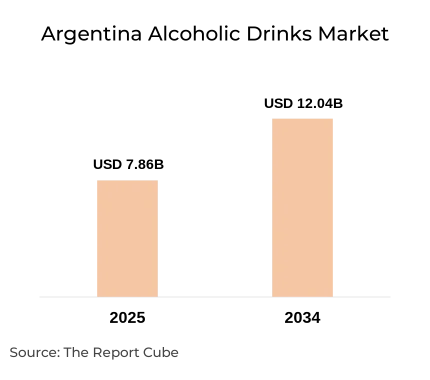
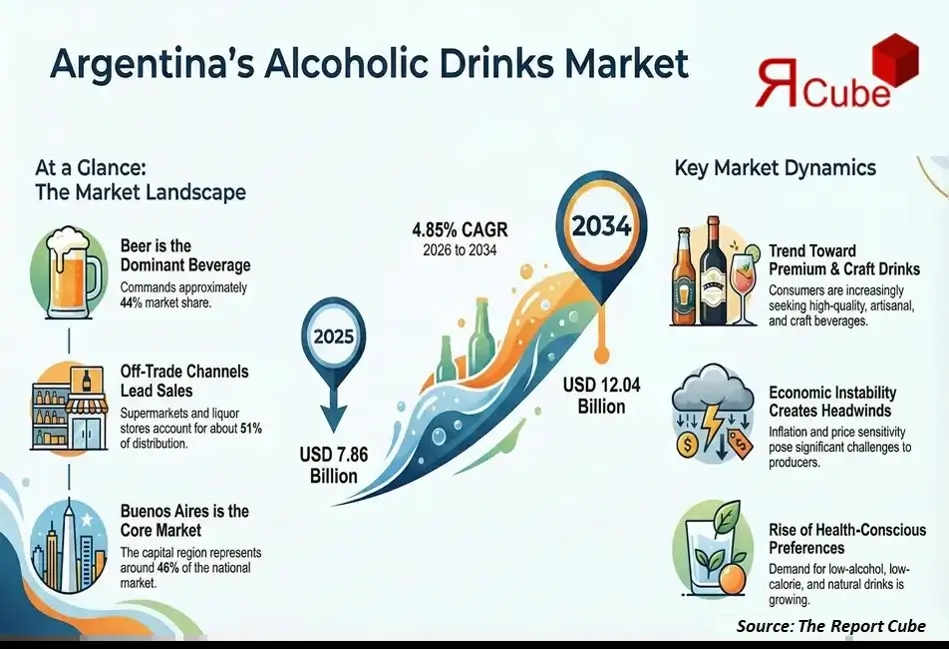
The Argentina Alcoholic Drinks Market is projected to grow at a 4.85% CAGR during 2026-2034. The market stood at USD 7.86 billion in 2025 and is forecast to reach USD 12.04 billion by 2034. Growth is supported by the country’s strong cultural association with beer, wine, and spirits, alongside evolving consumer preferences for premium and craft beverages. Beer consumption continues to dominate due to widespread availability and strong brand presence, while wine remains a central component of Argentine identity, driven by the reputation of Malbec and expanding export-oriented wineries. Spirits and RTD beverages are witnessing increased adoption among younger consumers seeking convenience, flavor variety, and premium cocktail-style drinks. The rise of flavored alcoholic beverages, low-alcohol options, and premiumization trends further shape market evolution.
Recent Developments (2025):
- Cervecería y Maltería Quilmes (AB InBev) launched a new limited-edition craft beer featuring Argentine flavors.
- Diageo Argentina introduced a premium blended whiskey crafted using locally sourced ingredients to appeal to local consumers.
Government Initiatives & Policies:
- Alcohol Advertising Regulation: Argentina's government has enforced stricter regulations on alcohol advertising to protect public health.
- Promotion of Local Wine Production: The government is offering subsidies to encourage local wine production and exportation.
On-trade channels such as bars and restaurants continue recovering post-pandemic, supported by tourism revival and urban nightlife resurgence. Off-trade channels especially supermarkets, specialty liquor stores, and online retail are expanding rapidly due to broader assortment, competitive pricing, and the convenience of home delivery models. Craft beer producers, boutique wineries, and artisanal spirit distillers are gaining traction, driving the diversification of the alcoholic drinks landscape. Economic fluctuations and pricing sensitivity influence consumption patterns, yet premium brands maintain resilience as consumers increasingly seek quality, authenticity, and origin-based differentiation. Overall, Argentina’s rich beverage heritage and dynamic product innovation continue to drive long-term market momentum.
Argentina Alcoholic Drinks Market Dynamics
Driver: Premiumization, Craft Beverage Expansion & Strong Cultural Consumption Patterns
A key driver of the alcoholic drinks market in Argentina is the increasing shift toward premium and high-quality beverages across beer, wine, and spirits segments. Consumers demonstrate rising interest in artisanal products, boutique wineries, craft distillers, and unique flavor profiles. Premium beer and wine experiences supported by tourism, gastronomy, and regional identity fuel steady product diversification. Domestic brands continue investing in innovation, new packaging formats, and flavor extensions. Cultural traditions surrounding wine and social drinking strengthen baseline demand, while urban consumers gravitate toward modern RTD beverages and international spirits, accelerating market expansion.
Challenge: Economic Instability, Price Sensitivity & Supply Chain Constraints
Despite overall market growth, economic volatility and inflationary conditions in Argentina pose significant challenges to alcohol producers and distributors. Fluctuating input costs from grains and grapes to packaging materials create pricing pressures, especially for mainstream brands. Consumer purchasing power constraints can lead to down-trading during periods of high inflation. Supply chain disruptions impact smaller craft producers more severely due to limited scalability and reliance on imported ingredients or specialized equipment. Regulatory variations across provinces also increase operational complexity for national distributors and retailers.
Opportunity: Export Growth, RTD Innovation & Rising Tourism-Driven Demand
Argentina’s global reputation for premium wine especially Malbec presents strong export opportunities and favorable branding for domestic wineries. RTD beverages and flavored alcoholic drinks continue to expand among younger demographics, offering significant whitespace for innovation in cocktails, spritzers, and fruit-based blends. Tourism growth fuels demand for local beers, wines, and spirits across hospitality channels, enhancing brand visibility. Expanding online retail and subscription-based alcohol delivery services present new opportunities for personalized curation and premium offerings.
Trend: Craft Spirits, Sustainable Production & Health-Conscious Drinking Preferences
Craft spirits including gin, vermouth, and regional cordials are becoming increasingly popular as consumers seek unique, small-batch products. Sustainability is also shaping the industry, with producers adopting organic viticulture, eco-friendly packaging, and energy-efficient brewing and distillation methods. Health-conscious consumers are driving demand for low-calorie, low-alcohol, and natural-ingredient formulations. Digital purchasing behaviors, influencer-led brand discovery, and experiential marketing across tasting rooms and events continue to define modern alcoholic beverage trends in Argentina.
Argentina Alcoholic Drinks Market Segment-wise Analysis
By Product Type:
- Beer
- Wine
- Spirits
- Ready-to-Drink (RTD) Beverages
- Others
Beer represents the leading product segment with an estimated about 44% market share. Its dominance stems from widespread availability, strong brand loyalty, affordable pricing, and deep cultural integration within social gatherings. The rise of craft breweries and flavored beer innovations continues to enhance growth within this segment.
By Distribution Channel:
- On-Trade (Bars, Restaurants, Hotels)
- Off-Trade (Supermarkets/Hypermarkets)
- Specialty Liquor Stores
- Online Retail
- Others
Off-Trade Channels hold the largest distribution share at approximately 51%, supported by their broad product variety, promotional pricing, ease of access, and integration with online delivery platforms.
Regional Projection of Argentina Alcoholic Drinks Industry
By Region:
- Buenos Aires & Metropolitan Area
- Central Argentina
- Cuyo
- Patagonia
- Northwest & Northeast Argentina
Buenos Aires & Metropolitan Area leads the market with an estimated around 46% share due to its high population density, strong nightlife culture, tourism presence, and concentration of premium bars, restaurants, and specialty liquor retailers. The region also serves as a major distribution hub for nationwide alcohol supply chains.
What Does Our Argentina Alcoholic Drinks Market Research Study Entail?
- Provides detailed market sizing and forecasting from 2026-2034, showing growth from USD 7.86 billion to USD 12.04 billion at a 4.85% CAGR.
- Delivers segmentation across Product Types and Distribution Channels, highlighting dominant beer consumption and strong off-trade performance.
- Offers regional insights across Buenos Aires, Central Argentina, Cuyo, Patagonia, and northern regions.
- Profiles major industry players including Quilmes (AB InBev), CCU, Grupo Peñaflor, Diageo, Cepas Argentinas, Fratelli Branca, and others.
- Reviews emerging trends across RTD beverages, craft categories, sustainable production, and evolving consumer behaviors.
Table of Contents
- Introduction
- Objective of the Study
- Product/Category Definition
- Market Segmentation
- Study Variable
- Research Methodology
- Secondary Data Points
- Breakdown of Secondary Source
- Primary Data Points
- Breakdown of Primary Interviews
- Secondary Data Points
- Executive Summary
- Market Dynamics
- Drivers
- Challenges
- Opportunity Assessmen
- Recent Trends and Developments
- Policy and Regulatory Landscape
- Argentina Alcoholic Drinks Market Overview (2020-2034)
- Market Size, By Volume (Million Liters) & Value (USD Million)
- Market Share, By Product Type
- Beer
- Wine
- Spirits
- Ready-to-Drink (RTD) Beverages
- Others
- Market Share, By Distribution Channel
- On-Trade (Bars, Restaurants, Hotels)
- Off-Trade (Supermarkets/Hypermarkets)
- Specialty Liquor Stores
- Online Retail
- Others
- Market Share, By Packaging
- Bottles (Glass & PET)
- Cans
- Kegs
- Others
- Market Share, By Region
- Buenos Aires & Metropolitan Area
- Central Argentina
- Cuyo (Including Mendoza)
- Patagonia
- Northwest & Northeast Argentina
- Market Share, By Company
- Revenue Shares
- Competitive Landscape
- Buenos Aires & Metropolitan Area Alcoholic Drinks Market
- Market Size, By Volume & Value (USD Million)
- Market Share, By Product Type
- Market Share, By Distribution Channel
- Market Share, By Key Cities
- Central Argentina Alcoholic Drinks Market
- Market Size, By Volume & Value (USD Million)
- Market Share, By Product Type
- Market Share, By Distribution Channel
- Market Share, By Key Cities
- Cuyo (Including Mendoza) Alcoholic Drinks Market
- Market Size, By Volume & Value (USD Million)
- Market Share, By Product Type
- Market Share, By Distribution Channel
- Market Share, By Key Cities
- Patagonia Alcoholic Drinks Market
- Market Size, By Volume & Value (USD Million)
- Market Share, By Product Type
- Market Share, By Distribution Channel
- Market Share, By Key Cities
- Northwest & Northeast Argentina Alcoholic Drinks Market
- Market Size, By Volume & Value (USD Million)
- Market Share, By Product Type
- Market Share, By Distribution Channel
- Market Share, By Key Cities
- Competitive Outlook & Company Profiles
- Cervecería y Maltería Quilmes (AB InBev)
- Company Overview
- Product Portfolio
- Strategic Alliances/Partnerships
- Recent Developments
- Compañía Cervecerías Unidas (CCU Argentina)
- Company Overview
- Product Portfolio
- Strategic Alliances/Partnerships
- Recent Developments
- Grupo Peñaflor
- Company Overview
- Product Portfolio
- Strategic Alliances/Partnerships
- Recent Developments
- Diageo Argentina
- Company Overview
- Product Portfolio
- Strategic Alliances/Partnerships
- Recent Developments
- Cepas Argentinas (Grupo Cepas)
- Company Overview
- Product Portfolio
- Strategic Alliances/Partnerships
- Recent Developments
- Fratelli Branca Destilerías
- Company Overview
- Product Portfolio
- Strategic Alliances/Partnerships
- Recent Developments
- RPB S.A.
- Company Overview
- Product Portfolio
- Strategic Alliances/Partnerships
- Recent Developments
- Catena Group / Bodegas Esmeralda
- Company Overview
- Product Portfolio
- Strategic Alliances/Partnerships
- Recent Developments
- Andes Origen (Quilmes-AB InBev Brand)
- Company Overview
- Product Portfolio
- Strategic Alliances/Partnerships
- Recent Developments
- Patagonia Cerveza
- Company Overview
- Product Portfolio
- Strategic Alliances/Partnerships
- Recent Developments
- Others
- Cervecería y Maltería Quilmes (AB InBev)
- Contact Us / Disclaimer
Top Key Players & Market Share Outlook
- Cervecería y Maltería Quilmes (AB InBev)
- Compañía Cervecerías Unidas (CCU Argentina)
- Grupo Peñaflor
- Diageo Argentina
- Cepas Argentinas (Grupo Cepas)
- Fratelli Branca Destilerías
- RPB S.A.
- Catena Group / Bodegas Esmeralda
- Andes Origen (Quilmes-AB InBev Brand)
- Patagonia Cerveza
- Others
Frequently Asked Questions






