



Build Your Custom Market Intelligence Report
Customize Your ReportSingapore Anti-Aging Beauty Products Market Insights & Analysis
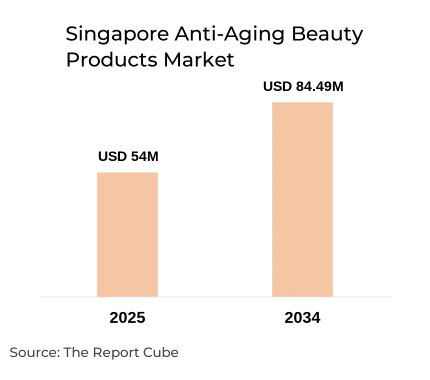
The Singapore Anti-Aging Beauty Products Market is anticipated to register a CAGR of 5.10% during 2026-2034. The market size was valued at USD 54 million in 2025 and is projected to reach USD 84.49 million by 2034. This growth reflects Singapore’s highly mature beauty and personal care ecosystem, where consumers demonstrate strong purchasing power, high brand awareness, and a proactive approach toward skincare and age management.
Singapore’s demographic structure, characterized by a rapidly aging population alongside image-conscious younger consumers, plays a central role in shaping market demand. With nearly one in four residents projected to be aged 65 and above by 2030, demand for clinically proven anti-wrinkle, firming, and brightening solutions continues to rise. At the same time, early adoption of preventive skincare among consumers aged 25-34 has expanded the addressable market for anti-aging products.
Furthermore, Singapore’s advanced retail infrastructure, strong penetration of e-commerce platforms, and high exposure to global beauty trends support sustained product innovation and premiumization. International brands dominate shelf space, while localized formulations designed for tropical climates and sensitive skin conditions further enhance market relevance. These interconnected factors collectively position the Singapore Anti-Aging Beauty Products Market for steady expansion over the forecast period.
Singapore Anti-Aging Beauty Products Market Recent Developments
- 2025: Estée Lauder launched an advanced peptide-based serum line tailored for Asian skin aging patterns.
- 2025: Shiseido expanded its premium anti-aging skincare portfolio through major Singaporean e-commerce platforms.
Government Initiatives & Policies
- Healthier SG Initiative: National program promoting preventive health and wellness, indirectly supporting skincare awareness.
- Consumer Product Safety Regulations: Ensures cosmetic safety, ingredient transparency, and quality compliance.
Singapore Anti-Aging Beauty Products Market Dynamics
Key Driver: Rising Preventive Skincare Adoption Across Age Groups
The increasing emphasis on preventive skincare is a primary driver of the Singapore Anti-Aging Beauty Products Market. Consumers are no longer waiting for visible signs of aging to appear; instead, individuals in their late twenties and early thirties are actively investing in anti-aging serums, eye care, and hydration-focused products. This behavioral shift is supported by strong dermatological awareness, social media influence, and access to scientific skincare information. As a result, brands are expanding entry-level anti-aging ranges, which feeds directly into long-term customer retention and sustained market growth.
Book your FREE 30-minute expert consultation today
Contact UsIndustry Trends: Premiumization and Science-Backed Formulations
A notable trend shaping the Singapore Anti-Aging Beauty Products Market is the strong preference for premium and science-backed formulations. Consumers increasingly seek products containing clinically proven ingredients such as retinoids, peptides, and hyaluronic acid. This trend aligns closely with Singapore’s educated consumer base, which values efficacy, transparency, and dermatological validation. Consequently, brands are emphasizing clinical trials, dermatologist endorsements, and technology-driven skincare solutions, reinforcing trust and supporting higher average selling prices.
Major Challenge: Market Saturation and High Brand Competition
Despite favorable demand fundamentals, intense competition presents a significant challenge for the Singapore Anti-Aging Beauty Products Market. The presence of numerous global and regional brands has led to product saturation, particularly in premium skincare segments. High marketing costs, influencer-driven promotions, and rapid product launches make differentiation increasingly difficult. Smaller brands often struggle to gain visibility, while established players must continuously innovate to defend market share, slightly constraining profit margins.
Opportunity: Growth of Nutricosmetics and Beauty Devices
An emerging opportunity lies in the convergence of beauty, wellness, and technology within the Singapore Anti-Aging Beauty Products Market. Nutricosmetics and at-home beauty devices are gaining acceptance among consumers seeking holistic anti-aging solutions. These categories complement topical skincare and align with Singapore’s wellness-oriented lifestyle. As consumer trust in ingestible beauty supplements and FDA-cleared devices grows, brands that successfully integrate multi-category offerings stand to capture incremental revenue streams.
Singapore Anti-Aging Beauty Products Market Segment-wise Analysis
By Skin Concern:
- Anti-Wrinkle
- Firming & Lifting
- Brightening
- Hydration
- Anti-Spot
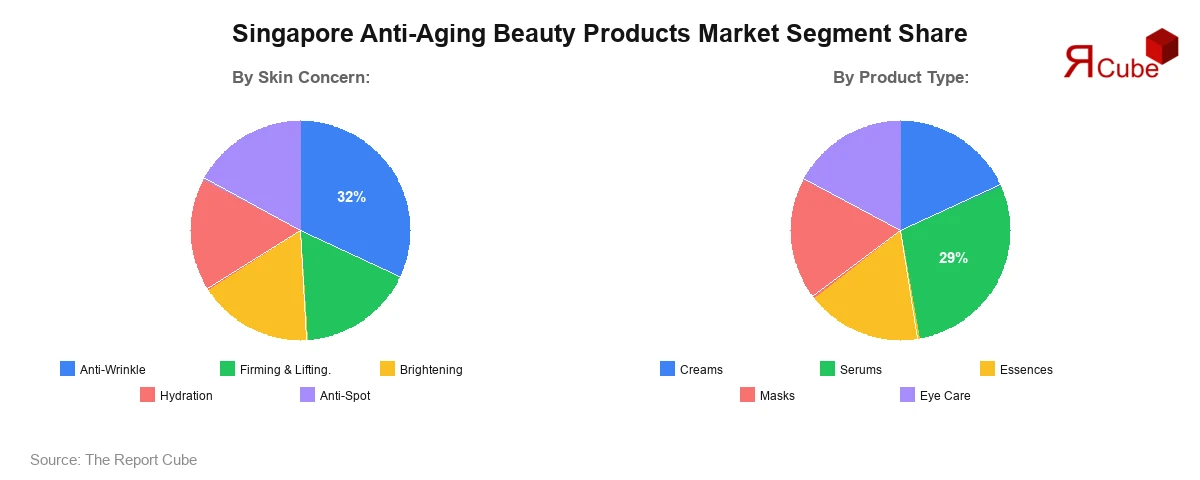
The anti-wrinkle segment leads the Singapore Anti-Aging Beauty Products Market, accounting for an estimated 32% market share in 2025. This dominance is closely linked to rising consumer awareness of early aging signs and strong demand for retinol- and peptide-based products. As consumers progress from preventive to corrective skincare, demand naturally shifts toward wrinkle-targeted solutions, reinforcing the segment’s leadership.
By Product Type:
- Creams
- Serums
- Essences
- Masks
- Eye Care
Serums represent the leading product type, holding approximately 29% share of the Singapore Anti-Aging Beauty Products Market. Their lightweight texture, high concentration of active ingredients, and compatibility with multi-step skincare routines make serums particularly popular among Singaporean consumers. This segment’s growth is further supported by premium positioning and frequent innovation cycles.
Regional Projection of Singapore Anti-Aging Beauty Products Industry
- Central
- East
- North
- North-East
- West
The Central region leads the Singapore Anti-Aging Beauty Products Market, contributing nearly 41% of total revenue. This leadership is driven by higher population density, concentration of premium retail outlets, dermatology clinics, and beauty stores in central districts. The region also benefits from stronger tourist footfall and higher disposable income levels, which support premium and luxury skincare sales. These regional dynamics reinforce the Central region’s dominant role while indirectly stimulating demand in surrounding regions through retail expansion and omnichannel strategies.
Need insights for a specific region within this market?
Request Regional DataWhy Choose This Report?
- Provides a comprehensive overview of the overall market analysis, encompassing key trends, consumer behavior analysis, and risk assessment to support strategic decision-making.
- Provides accurate, up-to-date insights into market size, segmentation, and emerging opportunities, helping to minimize risk & capitalizing on growth.
- Gives deep understanding of target audience preferences, investment habits, and communication channels for enhanced product development & marketing effectiveness.
- Delivers competitive analysis & benchmarking, uncovering the strengths & weaknesses of market competitors to guide strategies.
- Consolidate comprehensive market intelligence, reducing reasoning & streamlining research efforts.
- Facilitates customized market segmentation & risk mitigation strategies, fine-tuned to the business objectives.
- Aids in identifying both market challenges & untapped opportunities within the industry to drive long-term business growth.
- Provides valuable information based on actual customer data & search trends.
Table of Contents
- Introduction
- Objective of the Study
- Product and Category Definition
- Market Segmentation
- Study Variables
- Research Methodology
- Secondary Data Points
- Breakdown of Secondary Sources
- Primary Data Points
- Breakdown of Primary Interviews
- Secondary Data Points
- Executive Summary
- Market Dynamics
- Drivers
- Challenges
- Opportunity Assessment
- Recent Trends and Developments
- Regulatory and Policy Landscape
- Singapore Anti-Aging Beauty Products Market Overview (2021-2034)
- Market Size, By Value (USD Million)
- Market Structure and Consumer Profile
- Market Share, By Skin Concern
- Anti-Wrinkle
- Firming & Lifting
- Brightening
- Hydration
- Anti-Spot
- Market Share, By Product Type
- Creams
- Serums
- Essences
- Masks
- Eye Care
- Market Share, By Ingredient Type
- Retinoids
- Peptides
- Hyaluronic
- Collagen
- Botanicals
- Market Share, By Category
- Skincare
- Nutricosmetics
- Devices
- Market Share, By Gender
- Female
- Male
- Market Share, By Age Group
- Below 25
- 25-34
- 35-54
- 55 and Above
- Market Share, By Price Tier
- Mass
- Masstige
- Premium
- Luxury
- Market Share, By Distribution Channel
- Supermarkets
- Drugstores
- Beauty Stores
- Department Stores
- E-Commerce
- Direct Sales
- Market Share, By Region
- Central
- East
- North
- North-East
- West
- Market Share, By Company
- Revenue Shares & Analysis
- Competitive Landscape
- Central Region Anti-Aging Beauty Products Market
- Market Size, By Value (USD Million)
- Market Share, By Skin Concern
- Market Share, By Product Type
- Market Share, By Category
- Market Share, By Distribution Channel
- Market Share, By Price Tier
- East Region Anti-Aging Beauty Products Market
- Market Size, By Value (USD Million)
- Market Share, By Skin Concern
- Market Share, By Product Type
- Market Share, By Category
- Market Share, By Distribution Channel
- Market Share, By Price Tier
- North Region Anti-Aging Beauty Products Market
- Market Size, By Value (USD Million)
- Market Share, By Skin Concern
- Market Share, By Product Type
- Market Share, By Category
- Market Share, By Distribution Channel
- Market Share, By Price Tier
- North-East Region Anti-Aging Beauty Products Market
- Market Size, By Value (USD Million)
- Market Share, By Skin Concern
- Market Share, By Product Type
- Market Share, By Category
- Market Share, By Distribution Channel
- Market Share, By Price Tier
- West Region Anti-Aging Beauty Products Market
- Market Size, By Value (USD Million)
- Market Share, By Skin Concern
- Market Share, By Product Type
- Market Share, By Category
- Market Share, By Distribution Channel
- Market Share, By Price Tier
- Competitive Outlook and Company Profiles
- L'Oréal Singapore Pte Ltd
- Company Overview
- Product Portfolio
- Strategic Alliances/Partnerships
- Recent Developments
- Procter & Gamble International Operations SA Singapore Branch
- Company Overview
- Product Portfolio
- Strategic Alliances/Partnerships
- Recent Developments
- Estée Lauder Cosmetics Pte Ltd
- Company Overview
- Product Portfolio
- Strategic Alliances/Partnerships
- Recent Developments
- Shiseido Singapore Co Pte Ltd
- Company Overview
- Product Portfolio
- Strategic Alliances/Partnerships
- Recent Developments
- Beiersdorf (Singapore) Pte Ltd
- Company Overview
- Product Portfolio
- Strategic Alliances/Partnerships
- Recent Developments
- Clarins Pte Ltd
- Company Overview
- Product Portfolio
- Strategic Alliances/Partnerships
- Recent Developments
- Amorepacific Singapore Pte Ltd
- Company Overview
- Product Portfolio
- Strategic Alliances/Partnerships
- Recent Developments
- Kosé Singapore Pte Ltd
- Company Overview
- Product Portfolio
- Strategic Alliances/Partnerships
- Recent Developments
- LD Waxson (Singapore) Pte Ltd
- Company Overview
- Product Portfolio
- Strategic Alliances/Partnerships
- Recent Developments
- Unilever Asia Private Limited
- Company Overview
- Product Portfolio
- Strategic Alliances/Partnerships
- Recent Developments
- Others
- L'Oréal Singapore Pte Ltd
- Contact Us and Disclaimer
Top Key Players & Market Share Outlook
- LOreal Singapore Pte Ltd
- Procter & Gamble International Operations SA Singapore Branch
- Estée Lauder Cosmetics Pte Ltd
- Shiseido Singapore Co Pte Ltd
- Beiersdorf (Singapore) Pte Ltd
- Clarins Pte Ltd
- Amorepacific Singapore Pte Ltd
- Kosé Singapore Pte Ltd
- LD Waxson (Singapore) Pte Ltd
- Unilever Asia Private Limited
- Others
Frequently Asked Questions






